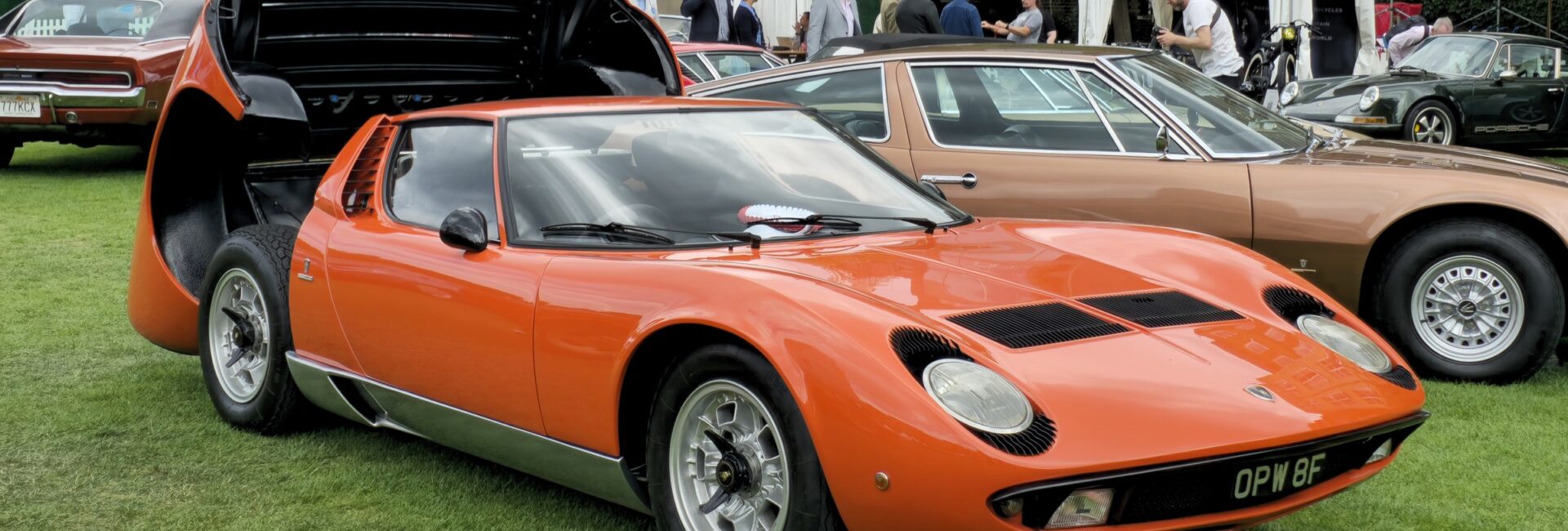
How many Lamborghini Miuras were produced? The figure to remember is 763 units.This is the total communicated in 2026 by Lamborghini, which specifies that these cars were built in Sant’Agata Bolognese between 1966 and 1973 “according to official records.” However, the number 764 appears in a FIA publication, while 765 remains common in books, advertisements and older production tables.
This is not simply a case of three authors having made an addition error. The Miura sits on the boundary between artisanal production and series production: some cars have changed number, configuration or classification, while prototypes, Jota conversions and special examples are not always treated the same way. For a collector, the worldwide total is therefore less important than the documented identity of the chassis under study.
The most recent official figure is 763 Lamborghini Miuras.
In an article published on the occasion of the 60 anniversary of the model, Lamborghini clearly states that763 Miuras were built between 1966 and 1973.This publication dated 2026 is today the most recent official answer to the question.
| Source and method | Announced total | How to interpret it |
|---|---|---|
| Lamborghini, official communication 2026 | 763 | Total to retain for a general answer |
| Lamborghini historical archives cited in 2005 | 763 | 275 P400, 338 P400 S and 150 P400 SV |
| FIA, interview with the head of the historical centre | 764 | The FIA adds that the exact number remains uncertain. |
| Older counts often cited | 765 | Result depending on the classification of series and converted cars |
| Lamborghini historical page currently online | 753 | Addition of 265 P400, 338 S and 150 SV, contradicting the official total 2026. |
The figure 763 is also consistent with a Lamborghini archive release from 2005 reproduced by the specialised site Lamborghini Miura Options. This divides production between275 P400, 338 P400 S and 150 P400 SV.The sum indeed gives 763 cars.
This total must nevertheless be presented with its method: it is a tally of production sheets for series Lamborghini cars. Prototypes and unique examples are excluded. It does not necessarily mean that 763 completely different chassis, never rebuilt or renumbered, can be tracked today without dispute.
Why are there also 764 Lamborghini Miuras?
The number of 764 is not an invention of an anonymous website. The Fédération Internationale de l’Automobile published it in an article dedicated to the Miura. Above all, the text quotes Enrico Maffeo, then head of the Lamborghini historical centre, who stated thatthe exact number remains difficult to establish.
This reservation is essential. In a small production run from the 1960 and 1970 decades, a number recorded in a register does not always correspond straightforwardly to a physical car that has remained unchanged. Several events can complicate a census:
- a car damaged in an accident and rebuilt by the factory;
- a chassis or number reassigned;
- a P400 upgraded to a more recent specification;
- a transitional car featuring characteristics of two series;
- a series Miura later converted into an SVJ or another special configuration;
- a prototype included in a publication but excluded from the series production archives.
Depending on the starting point chosen — invoice, production sheet, chassis number, completed car or current identity — two historians can therefore arrive at similar results without counting exactly the same thing.
Where does the total of 765 units come from?
The total of 765 generally relies on an old breakdown very often copied: 475 P400, 140 P400 S and 150 SV. The sum gives 765. Its apparent precision is misleading, as it does not correspond to the breakdown retained by the Lamborghini archives cited in 2005.
The main point of contention concerns the boundary between P400 and P400 S. Lamborghini itself recalls that the first S models retained several elements of the P400. The version change therefore did not produce a clear industrial break comparable to that of a modern model assembled according to computerised nomenclature.
A car can be classified according to its production date, its invoice, its configuration when leaving the factory or its known later condition. If one source groups certain S models with the P400, while another assigns them to the S series, the subtotals change. And if a rebuilt or renumbered car is counted twice, the total of the lines no longer represents the number of unique cars.
The specialised site Lamborghini Miura Options has compared different lists and thus claims that the number ofunique carscould be lower than the total of the production sheets. This conclusion is not an official Lamborghini figure; it simply shows why an addition published in a book is not enough to resolve every chassis file.
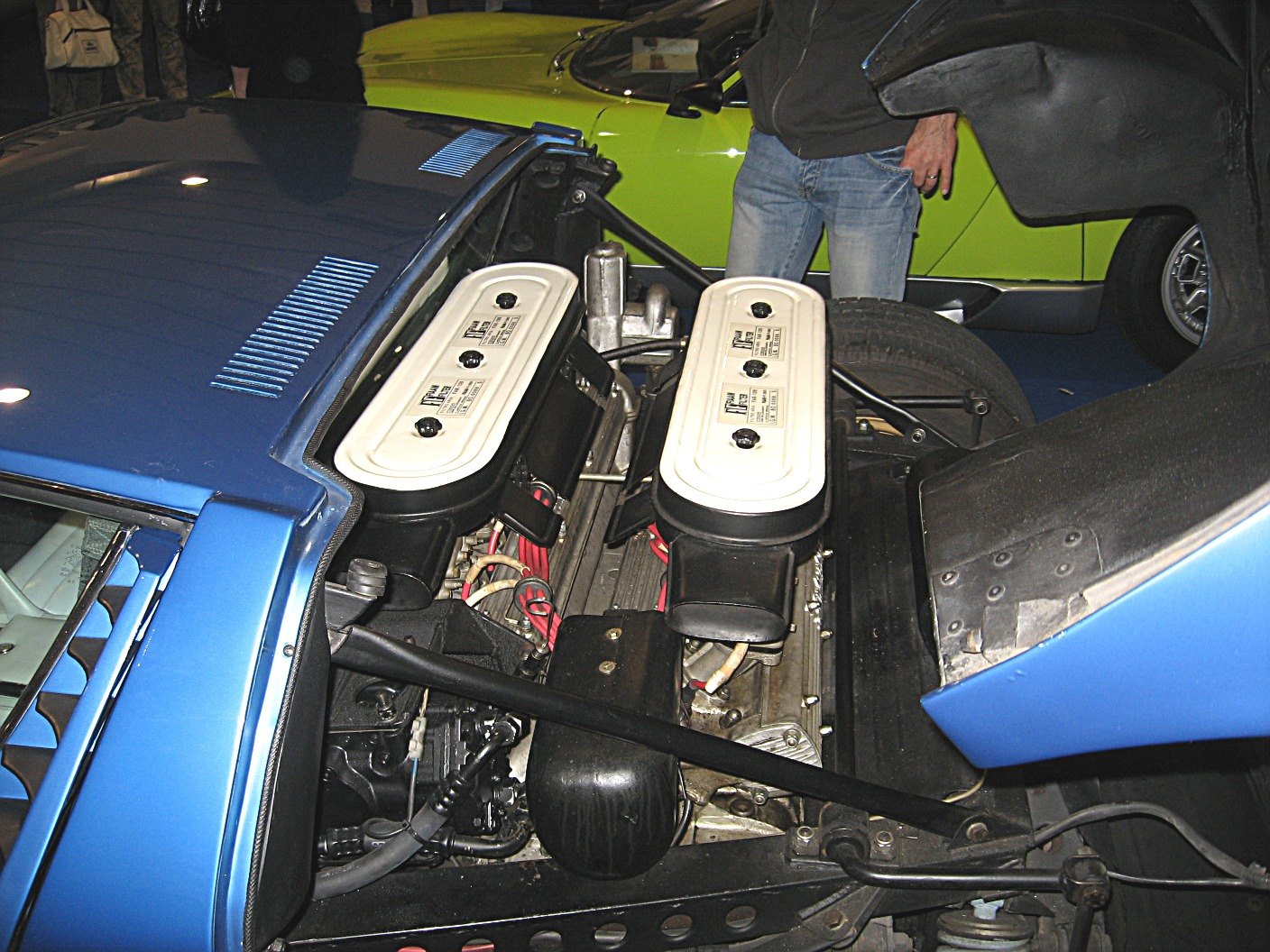
The transverse V12 of the Miura. Photo: Luc106, Wikimedia Commons, public domain.
P400, P400 S and P400 SV: the three main series
Miura P400: the original model
Presented at the Geneva Motor Show in 1966, the P400 features a spectacular architecture: a 12 V3,9 litre engine mounted transversely in a mid-rear position, paired with a five-speed manual gearbox. Lamborghini announces 350 hp for this initial version.
Its identification should not rely solely on visible details. The first cars evolved during production and many were modified during their lifetime. According to the archive survey of 2005, 275 P400 are recorded. However, the Lamborghini historical page accessible today announces 265: this difference of ten cars alone explains part of the current confusion.
Miura P400 S: a less clear-cut transition than it seems
The P400 S appeared in 1968 with a claimed power output of 370 hp, enhanced equipment and several finishing updates. However, the very first examples mixed elements of both P400 and S, a fact acknowledged in Lamborghini’s official communication of 2026.
The cited archives attribute 338 cars to this series. This figure, much higher than the 140 units listed in some older counts, indicates that sources do not use the same classification criteria. To authenticate an S, one must therefore cross-reference chassis number, production date, factory sheet and original configuration rather than rely on a late commercial designation.
Miura P400 SV: 150 examples, the most stable figure
Unveiled in 1971, the SV represents the most accomplished evolution: power increased to 385 hp according to Lamborghini, widened rear tracks, larger tyres, revised chassis and suspension, disappearance of the famous “eyelashes” around the headlights. The total of 150 SV is the figure that varies least among the main sources.
Even here, not all cars are technically identical. Separate lubrication for the engine and gearbox appeared late in production. Some SVs were also converted into SVJs, either at the factory or later. The number 150 therefore describes an original series, not 150 cars necessarily preserved today in a uniform configuration.
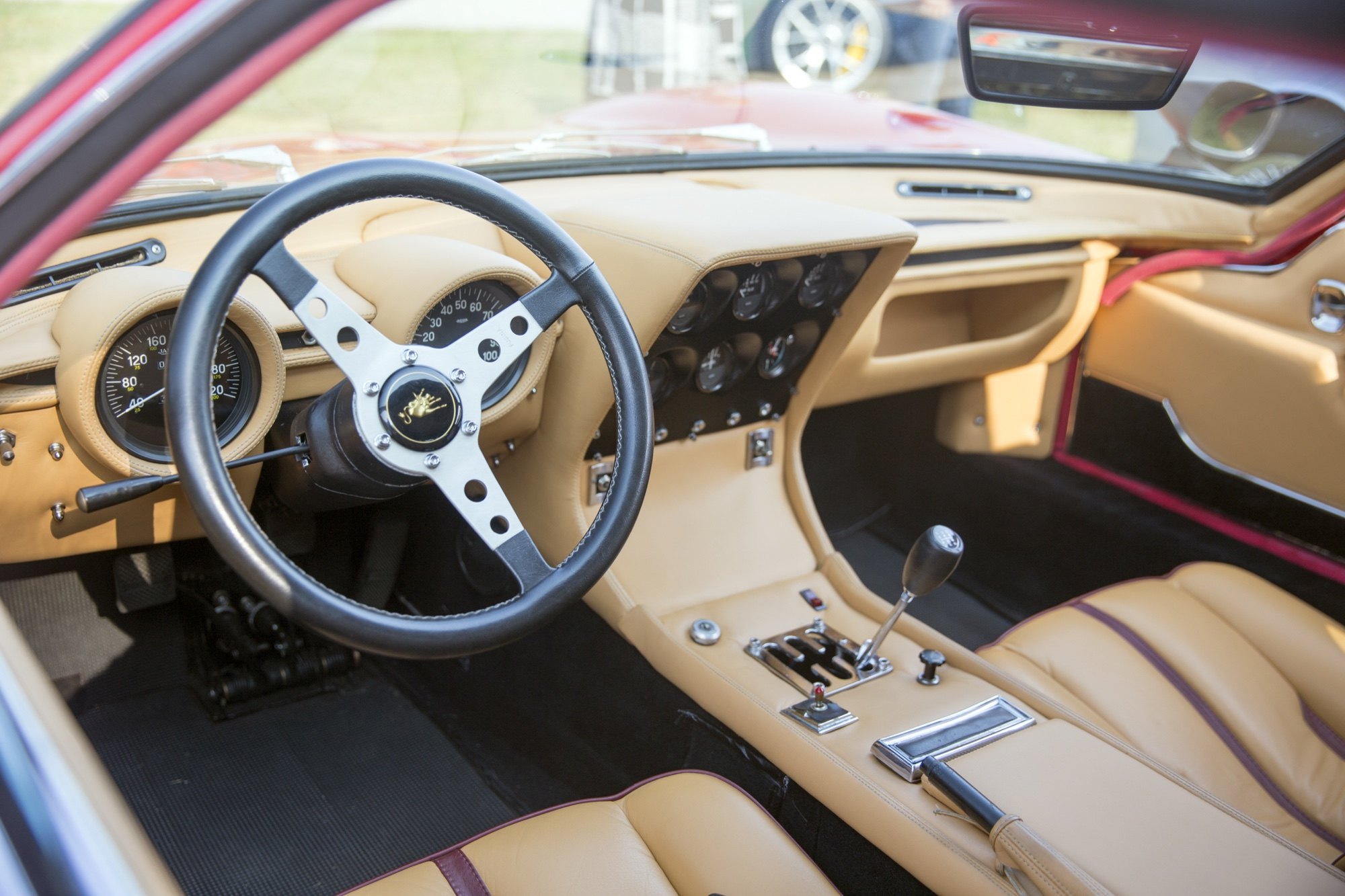
The interior of a Miura P400 S. Photo: Mr.choppers, Wikimedia Commons, licence CC BY-SA 3.0. Image resized.
Should the Jota, the SVJ and the Roadster be counted?
Not automatically. The original Jota was a development prototype built from a Miura by Bob Wallace. It was destroyed, and the SVJs inspired by it are essentially converted Miura SVs: adding them to the SV total would therefore mean counting some identities twice.
Lamborghini also indicates four SVJs derived from the Jota project and one convertible made by Bertone. Depending on the question asked, these cars may appear in a list of “special Miuras”, but they do not necessarily constitute five additional production chassis to be added to the 763.
The correct method is to distinguish three concepts:
- the number of production sheets for series cars;
- the number of unique physical chassis;
- the number of configurations or versions that have existed over time.
Confusing these three columns produces precisely the competing totals still found today.
Another inconsistency exists on the official Lamborghini website
The current historical page of Lamborghini gives 265 P400, 338 P400 S and 150 P400 SV. These values total 753 cars, ten fewer than the 763 announced by the brand in its 2026 publication.
It would be unwise to invent a definitive explanation for this discrepancy. The historical page may use a different scope, contain a typo or reflect an earlier state of the register. In the absence of an official table detailing each chassis number and each exclusion, the most rigorous answer is therefore as follows:
763 is the most recent official general figure; the exact detail of some chassis and the distribution of the early series remain debated.
This wording is more honest than a total presented as mathematically indisputable.
How to authenticate a particular Lamborghini Miura?
To buy, sell or appraise a Miura, knowing that approximately 763 units were built is not enough. The value depends on the car’s own identity. It is essential to check:
- the stamped chassis number and the manufacturer’s plate;
- the engine number and its match with the archives;
- the Bertone body number when accessible;
- the production sheet, original paint colour and upholstery;
- old invoices, restoration photos and ownership changes;
- any conversions from P400 to S, SV or SVJ;
- the consistency between the physical condition, documents and registration certificate.
Lamborghini Polo Storico offers archival research and certification for the brand’s historic models. An independent expert familiar with Miuras should also examine the car: documentary certification does not replace inspection of the structure, previous repairs and mechanical components.
Our feature on the matching numbers of a classic car explains why a matching number alone is never sufficient to prove the overall authenticity of a vehicle.
What the production figure means for a collector
The rarity of the Miura is real, but the worldwide total does not mechanically determine the price of a car. Two examples of the same series can have very different values depending on their authenticity, history, structural condition, quality of restoration and presence of original parts.
The proper unit of comparison is therefore not “a Miura among 763”, but a Miura of the same version, from a comparable period and with a similar dossier. To delve deeper into variants, sales results and essential checks, consult our Lamborghini Miura buying guide 2026.
The best examples can also be negotiated outside public listings. Qualified owners and buyers can request access to the private hypercars and rare vehicles area of Plethore Cars.
Frequently Asked Questions
How many Lamborghini Miuras were produced in total?
Lamborghini officially announces 763 units, built in Sant’Agata Bolognese between 1966 and 1973. This is the most recent overall figure published by the brand in 2026.
Why do some sources state 764 Miuras?
The FIA published the number 764 while citing the head of the Lamborghini historical centre, who stated that the exact total remained uncertain. Reconstructions, renumberings, transitional cars and differences in scope explain these discrepancies.
Why is it sometimes stated that 765 Miuras were built?
The total of 765 generally comes from older counts dividing production into 475 P400, 140 P400 S and 150 SV. The archives cited by Lamborghini in 2005 use a different classification: 275 P400, 338 S and 150 SV, totalling 763.
How many Lamborghini Miura SVs were produced?
The figure of 150 Miura P400 SV is retained by Lamborghini and remains the most stable subtotal. Some of these cars were later converted to SVJ type; they should not be automatically added to the 150.
Are prototypes and special Miuras included in the 763?
The archive record of 2005 indicates that prototypes and unique examples are excluded from the count of production cars. However, a production car subsequently modified remains linked to its original production identity.
How many Lamborghini Miuras still exist?
No perfectly verifiable public total allows one to state how many authentic Miuras survive today. Club registers, factory archives and private censuses do not always use the same criteria, and some cars have been destroyed, rebuilt or remain invisible on the market.
Sources
- Lamborghini — Miura, la prima Supercar della storia: official total of 763 cars, production period and transitional models.
- Lamborghini — history of the Miura: specifications, versions and figures currently displayed by the brand.
- Fédération Internationale de l’Automobile — Beautiful Vision: total of 764 and reservation from the head of the historical centre on the exact number.
- Lamborghini Miura Options — Production Figures: reproduction of the Lamborghini archive record of 2005 and analysis of possible double counts.
- The Lamborghini Miura Book: presentation of the register established from Lamborghini, Bertone and private archives.
Article verified on 7 October 2026. Historical figures may be revised if Lamborghini publishes a detailed register or new archives.