In the world of automobiles, few names resonate with as much prestige and passion asBugatti. Founded in 1909 in Molsheim, in Alsace, by visionary Ettore Bugatti, the brand has embodied excellence, innovation, and artistic design for more than a century. Between artisanal tradition and cutting-edge technologies, Bugatti continues to push the boundaries of the possible, while remaining faithful to its original philosophy:“If it’s comparable, it’s no longer Bugatti. ”This requirement still irrigatesthe most distinctive luxury carsof today.
The beginnings of a genius: Ettore Bugatti
Born in 1881 in Milan, Ettore Bugatti grew up in a family of artists, with his father being a renowned designer and a furniture maker. Very young, Ettore showed an interest in machines and boundless creativity. After studying engineering, he began his career by working for several manufacturers before launching his own project: creating cars that don’t just drive, but that fascinate and inspire.
To learn more about this topic, please consult our article dedicated toThe most expensive old Bugatti.
In 1909, Ettore Bugatti established his manufacturing plant in Molsheim, in Alsace, a region that was then disputed between France and Germany. From the outset, his ambition was clear: to combine innovative engineering with artistic aesthetics to create exceptional vehicles.
The first successes: from Type 10 to Type 35
The first Bugatti model, theType 10, made its debut in 1910. Small and lightweight, this car is a concentration of innovation for its time. It lays the foundation for what will become Bugatti’s signature: performance-oriented vehicles that are uniquely aesthetic and technologically advanced.
But it’s hereType 35, launched in 1924, which propelled Bugatti to the top. With its 8 cylinder engine, its lightweight chassis, and its incredible performance on the track, the Type 35 became an icon of automotive racing. It won more than 2 000 competitions, an unmatched record to date. This model embodies the Bugatti spirit: audacity, elegance, and performance.
The golden age of the years 1920 and 1930
The years 1920 and 1930 were a flourishing period for Bugatti. The brand became a symbol of luxury and exclusivity, attracting prestigious customers such as royalty, artists, and industrialists. It was also the time when Bugatti created legendary models like theType 41 Royale, an ultra-luxurious sedan designed for a wealthy elite.
TheRoyal, with its 12,7 liter engine and its luxurious finishes, is one of the largest and most luxurious cars ever built. Although only six units were produced, it remains today a benchmark in automotive design.
The challenges and the renaissance
World War II marks a turning point for Bugatti. The Molsheim factory is partially destroyed, and Ettore Bugatti dies in 1947. Without its visionary founder, the brand enters a period of decline, no longer producing new models. In the 1960 years, Bugatti is acquired by several companies before falling into obscurity.
But in 1998, Volkswagen AG acquires the brand and decides to bring life back to Bugatti. This renewal is marked by the launch in 2005 of theBugatti Veyron, an hypercar that redefines performance standards. With its W16 quad-turbo engine and 1 001 horsepower, the Veyron becomes the first production car capable of exceeding 400 km/h.
Bugatti today: a fusion between tradition and innovation
Today, Bugatti is a division of the Bugatti Rimac group, under the direction ofMate Rimac, a visionary Croatian entrepreneur. This new chapter builds on more than 110 years of heritage to combine the performance of classic internal combustion engines with the infinite possibilities of electrification.
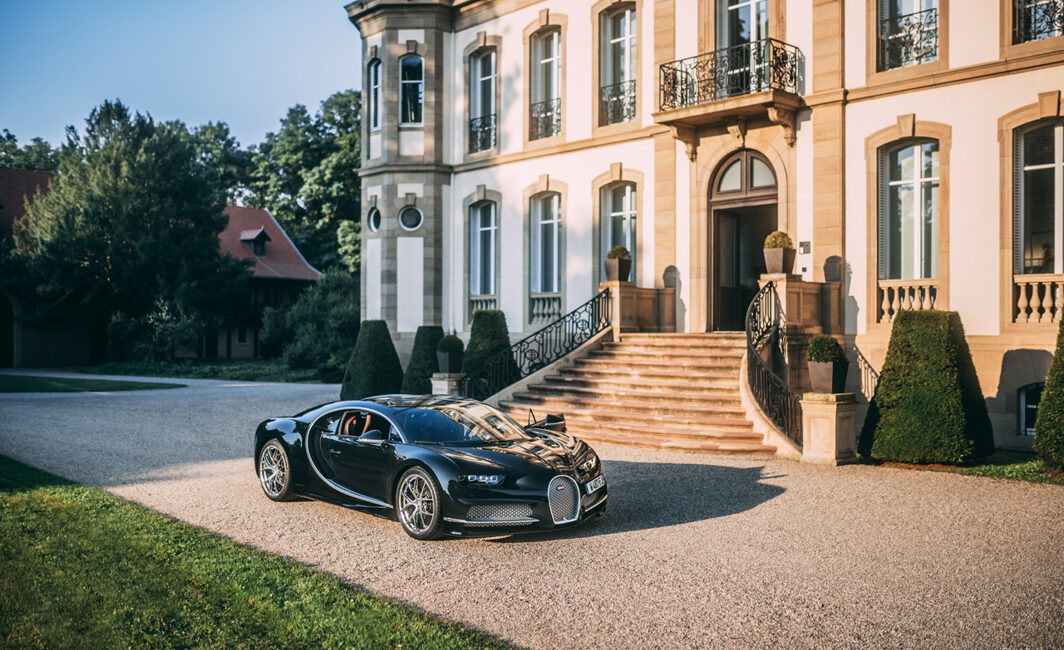
The current models, like theChiron, theDivoor also thebolide, continue to push the boundaries of engineering and design. Every car is a masterpiece, hand-assembled in Molsheim, in the brand’s historic workshop.
The timeless values of Bugatti
What distinguishes Bugatti from other manufacturers is its commitment to three fundamental values:
1. The Dedication: Every detail of a Bugatti is thought out, designed, and executed with almost obsessive precision.
2. Excellence: Bugatti makes no compromises on quality, whether in its materials, technologies, or design.
3. The Courage: True to the spirit of Ettore Bugatti, the brand dares to go where no one else dares to go, whether in terms of performance or innovation.
Conclusion: A brand that inspires the future
Bugatti is not just a simple car brand; it is a symbol of passion, art, and perfection. From Ettore Bugatti’s vision to modern hypercars, every vehicle tells a unique story—the story of a dream come true.
While Bugatti continues to shape the future of the automobile, it remains deeply rooted in its heritage. Car enthusiasts around the world know that a Bugatti is not just a car: it is an art on wheels, designed to be admired, but above all experienced.
Source & image: https://www.bugatti.com