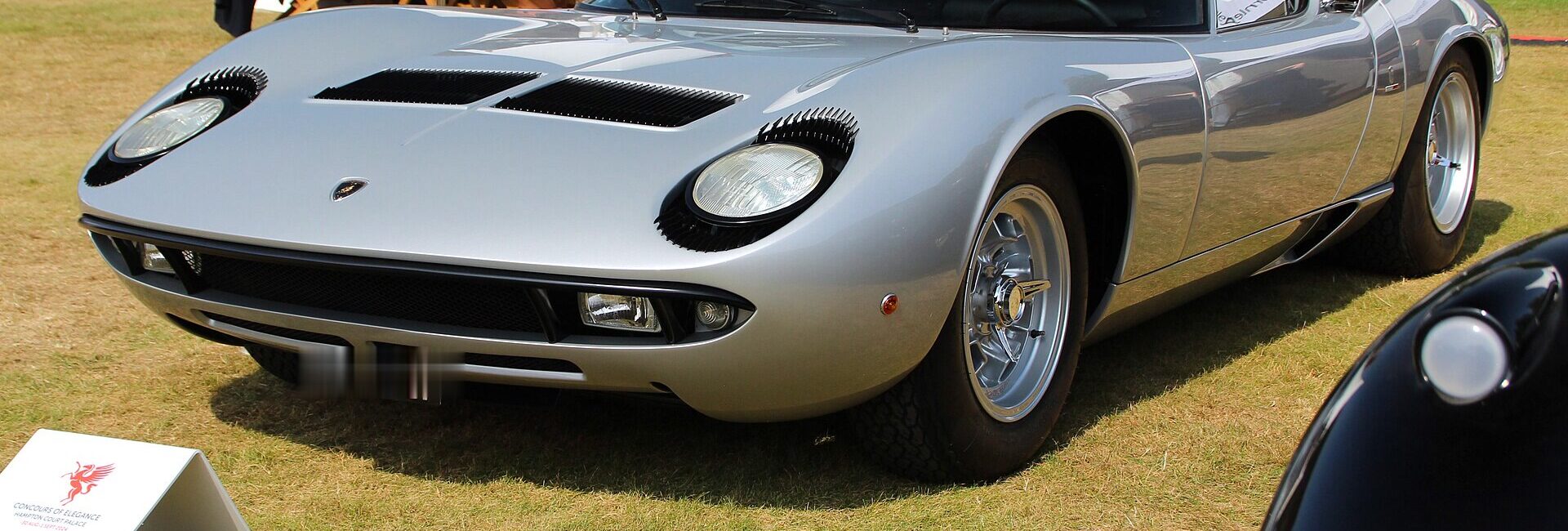
How much does a Lamborghini Miura cost in 2026? Recent public sales place fine examples in a multi-million market, but there is no single price.A P400 S reached 2,59 million dollars at Gooding Christie’s in March 2026. A very original SV set a record the same month at 6,605 million dollars at Broad Arrow. In Paris, another SV certified by Lamborghini Polo Storico sold for 3,7175 million euros at RM Sotheby’s.
These amounts do not constitute an automatic valuation. A Miura is valued car by car: exact version, factory conformity, matching numbers, quality of any restoration, condition of the structure, history and original colour can dramatically affect the price. For a buyer, the challenge is therefore not only to choose between P400, S and SV, but to precisely identify the example and have its needs appraised before committing.
Data verified on 12 September 2026. Auction prices are indicated in their sale currency, including fees when announced as such by the house. They do not predict the future result of another car.
What is the price of a Lamborghini Miura in 2026?
The best benchmark is not a global average mixing versions, but a selection of comparable transactions. Here are four recent and documented public results:
| Date | Version | House | Public price | What the result illustrates |
|---|---|---|---|---|
| January 2026 | Miura SV, chassis 4840 | RM Sotheby’s Paris | 3 717 500 € | Polo Storico certification, original engine, documented restoration and return to factory configuration |
| March 2026 | Miura P400 S 1969 | Gooding Christie’s Amelia Island | 2 590 000 $ | Record announced for the P400 S variant |
| March 2026 | Miura P400 SV 1972 | Broad Arrow Amelia Island | 6 605 000 $ | World record announced for a Miura; very original car, kept for 52 years by the same owner |
| May 2026 | Miura P400 SV 1972 | Mecum Indianapolis | 4 675 000 $ | SV with low mileage displayed, particular configuration and detailed file |
The dispersion is not an anomaly: it reflects the rarity of transactions and the heterogeneity of the cars. The Broad Arrow record concerned an example described as a “time capsule”, with a long single owner and strong preservation. It does not turn all SVs into cars worth over six million dollars. Similarly, a low estimate displayed before a sale is not a guaranteed value.
To follow the offers actually available, consult the classic cars for sale on Plethore Cars. If you already own a Miura or another rare automobile, a free valuation request allows you to place its condition and history in the current market.
P400, P400 S or P400 SV: which Miura to choose?
Lamborghini today presents three main series. Its official figures list 265 P400, 338 P400 S and 150 P400 SV, that is 753 production cars when adding these three variants. Other totals circulate in books and on the market because some counts include prototypes, special cars or conversions differently. To compare an example, start from its chassis number and factory file, not from a generic total found in an advertisement.
Miura P400: the original form
Presented in Geneva in 1966, the P400 installs transversely behind the cockpit a V12 of 3,9 litres associated with a five-speed manual gearbox. Lamborghini announces 350 hp. It is the version closest to the initial aesthetic shock, notably with the famous “eyelashes” around the headlights.
Its appeal lies in its purity and historical importance. But an old P400 should not be considered as a reduced-price SV: its development, braking and details differ, and many cars have received over time modifications inspired by later versions.
Miura P400 S: more power and comfort
The P400 S arrived at the end of the 1960s. Lamborghini indicates 370 hp and highlights the improvement in equipment and comfort. It retains the general appearance of the first Miura while offering a more accomplished evolution.
The S can represent an attractive compromise for a collector seeking the stylistic details of the first cars without aiming for the top price of the SV. Its authenticity must however be carefully verified: a modernised P400 is not automatically a genuine S.
Miura P400 SV: the most sought-after evolution
Unveiled in 1971, the SV officially develops 385 hp. It is notably recognised by its widened rear wings, wider tyres and the disappearance of the headlight “eyelashes”. Lamborghini also mentions a reinforced chassis, revised suspension and, on the cars concerned, separate lubrication between engine and gearbox.
However, not all SVs have exactly the same architecture. The separation of lubricants occurred late in production. Therefore, it is necessary to confirm the actual configuration of the chassis being examined, rather than concluding based solely on the model year shown on the registration document.
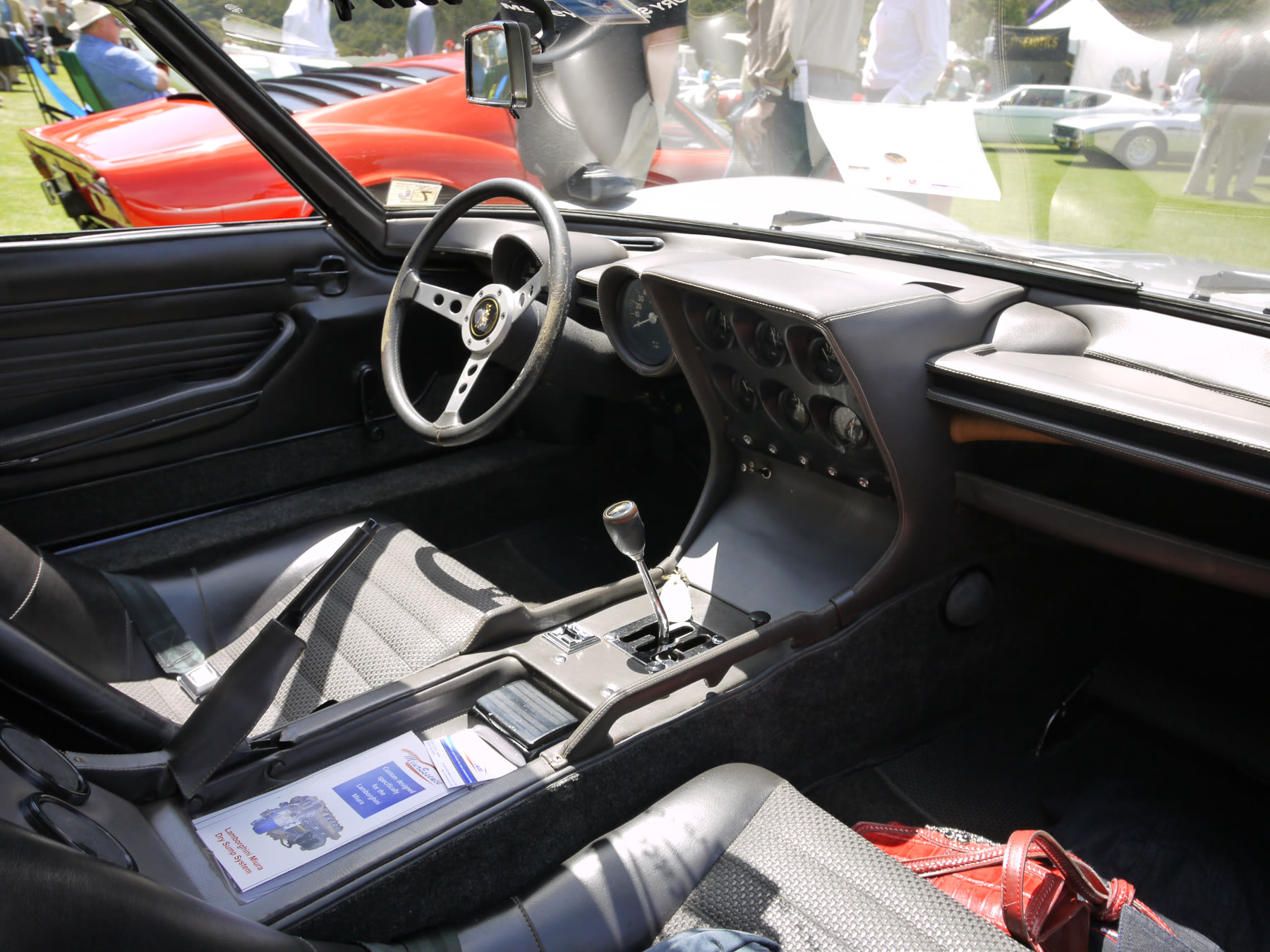
The interior is one of the areas where original parts, colours and materials are highly significant. Photo: Craig Howell,Wikimedia Commons.jpg), licenceCC BY 2.0. Image resized.
Why can two Miuras of the same version be valued so differently?
Identity and matching numbers
Start by comparing the chassis number, engine, gearbox, bodywork elements and known delivery specifications. A “SV” designation in an advertisement or on an old document is not sufficient: P400 and S models have been modified to resemble the ultimate version.
Lamborghini Polo Storico maintains the brand’s historical archives and offers a certificate of authenticity. The manufacturer explains that the examination notably compares numbers, bodywork and finishes against archive data. At this level of value, certification or, failing that, an expert dossier of equivalent standard must be included in the preliminary verification.
Originality or quality of restoration
An exceptionally well-preserved car can command a premium, as demonstrated by the SV Broad Arrow of 2026. A complete restoration can also be highly valuable if it respects the factory configuration and if every step is documented. Conversely, a shiny paintwork does not compensate for a poorly repaired structure or a colour combination unrelated to the original delivery.
Request invoices, photographs before and during work, workshop references, geometry measurements and a list of replaced parts. The RM Sotheby’s Paris result illustrates the value placed on a coherent package: original engine, Polo Storico certification, correct colours and identified restoration.
Provenance and traceability
Successive owners, concours, verifiable cultural history or long-term preservation can strengthen the dossier. Provenance must remain documented: copies of titles, correspondence, invoices, logbooks, photographic archives and period publications are preferable to an oral account that cannot be cross-checked.
To understand the importance of numbers and original parts, consult our guide dedicated tomatching numbers of a classic car.
The 10 essential checks before buying a Miura
An inspection by a specialist who truly knows the Miura is essential. It must be independent of the seller and go far beyond a simple test drive.
- Verify complete identity. Note chassis, engine, gearbox and bodywork numbers. Compare them to the archive dossier and the announced configuration.
- Confirm the version. Establish whether it is an original P400, S or SV, and document all subsequent modifications.
- Examine the steel structure.The aluminium body rests on a structure susceptible to corrosion. The floors, battery compartment, engine frame and suspension mounting points deserve thorough inspection.
- Look for signs of accidents.Measure the geometry, inspect the welds, alignments and the closing of the large front and rear bonnets. A poorly executed old repair can affect the structure and value.
- Identify the lubrication system.On the P400, the S and the early SV models, the engine and gearbox share their oil. Late SVs may have separate circuits. Request oil analyses, invoices and maintenance history.
- Check the V12 when cold.Refuse a car that is already warm on your arrival. Oil pressure, smoke, noises, temperatures, compression and sealing must be assessed by a specialist.
- Inspect the carburettors and fuel system.The four Weber carburettors must be adjusted and synchronised. Ageing hoses or leaks near hot components pose a serious risk.
- Test the gearbox, clutch, brakes and suspension.Check the synchros once the oil is warm, the clutch behaviour, absence of brake seizing and the play in the running gear.
- Audit the interior and accessories.Upholstery, stalk controls, gauges, glazing, wheels, tools and specific trims are costly to find. Check their conformity before considering them as “easily replaceable”.
- Estimate the post-purchase costs.Have a work plan drawn up with priorities, deadlines and parts availability. Add enclosed transport, insurance, possible taxes, storage and recommissioning to the acquisition budget.
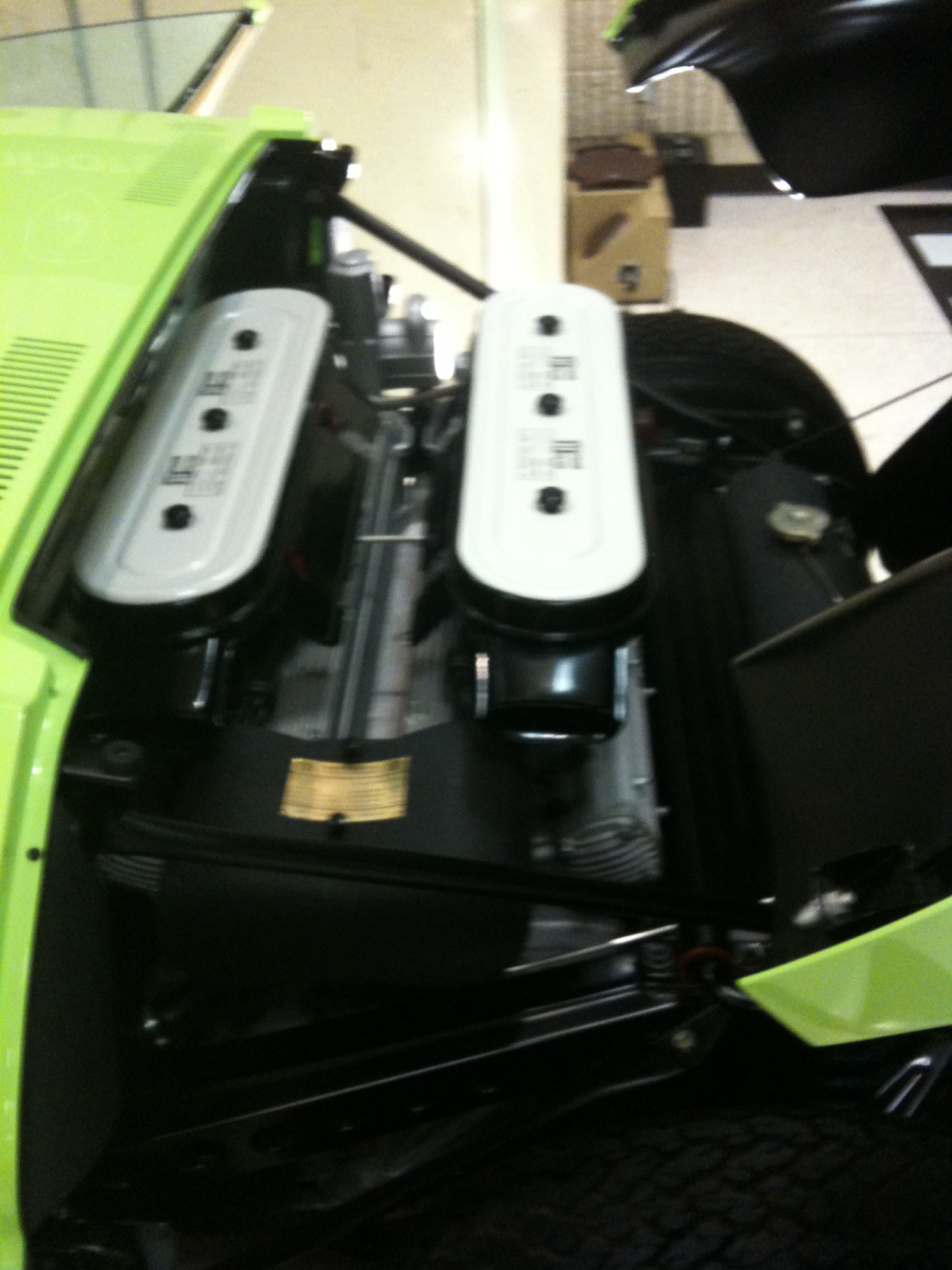
The V12 and gearbox form a compact unit mounted transversely. Photo: Russ Davis,Wikimedia Commons, licenceCC BY-SA 3.0.
Is the shared engine-gearbox lubrication a deal-breaker?
No, but it changes the care required. Lamborghini specifies that earlier versions use shared lubrication and that the SV introduced an evolution towards separate circuits. Specialist guides remind that with a common sump, debris from the gearbox can circulate with the engine oil.
This does not mean a good P400 or S should be ruled out. One must judge the maintenance, frequency of oil changes, oil analyses, gearbox operation and quality of work carried out. An undocumented technical modification can, on the other hand, harm authenticity. The right choice depends on the intended use and the historical value of the example.
How to secure the transaction?
Before any significant deposit, have the offer include the elements on which the price is based: version, matching announced numbers, certification, displayed mileage, delivery colour, accessories, absence or presence of known damages, and list of documents.
Make the purchase conditional on a satisfactory independent inspection and verification of the title of ownership. For an international transaction, determine before signing who bears the cost of transport, insurance, duties, any VAT, and registration procedures. The rules vary depending on origin, destination, tax status, and the vehicle’s age.
Finally, never deduct the net seller value from the price published by an auction house: commissions, taxes, and sales conditions differ. Compare amounts established on a consistent basis and keep the documentation for each reference.
Can the Miura still appreciate in value?
The Miura combines several structural qualities for the collector market: design by Marcello Gandini for Bertone, transverse central V12 architecture, low production numbers, and historical significance. The sixtieth anniversary celebrated by Lamborghini in 2026 also enhances its visibility.
However, no record history guarantees continuous appreciation. The market is illiquid, holding costs are high, and a poor restoration can destroy a substantial part of the value. First, buy the best car compatible with your total budget, including documentation, rather than a prestigious version whose needs are underestimated.
To place the Miura among the models that defined the genre, also see our selection of the 10 most iconic supercars in history.
Frequently asked questions
How much does a Lamborghini Miura P400 cost in 2026?
There is no universally reliable valuation for all P400 models. Results must be compared according to condition, authenticity, restoration, and history. Public Miura transactions in 2026 show a market in the millions, with a strong premium for the best S models and especially the SV.
What is the most expensive Lamborghini Miura sold at auction?
On 12 September 2026, Broad Arrow announced a world record of 6,605 million dollars for a P400 SV from 1972, sold at Amelia Island on 7 March 2026.
How many Lamborghini Miuras were produced?
The current Lamborghini historical page details 265 P400, 338 P400 S, and 150 P400 SV, totalling 753 production cars for these three variants. Totals published elsewhere may differ depending on the treatment of prototypes, special cars, and conversions.
How to recognise a genuine Miura SV?
Widened rear wings and absence of “eyelashes” are clues, not proof. One must verify the chassis number, engine, bodywork, factory specifications, and archives, ideally with Lamborghini Polo Storico or a recognised expert on the model.
Do all Miura SVs have a separate sump?
No. The evolution towards separate lubrication of the engine and gearbox concerns late SVs. The configuration must be established for each chassis.
Is a restored Miura worth less than an original car?
Not necessarily. A remarkably preserved car may command a premium, but a compliant, documented restoration carried out by specialists can also achieve a high value. A rough or non-compliant restoration is penalising.
Should one request a Polo Storico certification?
At this price level, it is a major element of security. The certification compares the car to the manufacturer’s archives. However, it does not replace mechanical inspection or legal analysis of the transaction.
Main sources
- Lamborghini — history and versions of the Miura : official production, power outputs and differences between P400, S and SV.
- Lamborghini — The first Supercar in history : presentation, features and role of Polo Storico.
- Lamborghini Polo Storico — certificate of authenticity : verification method through the manufacturer’s archives.
- Broad Arrow — Amelia 2026 results : record sale of the Miura P400 SV at 6,605 million dollars.
- Gooding Christie’s — Amelia Island 2026 results : sale of the P400 S at 2,59 million dollars.
- RM Sotheby’s — Miura SV, Paris 2026 : price, certification, numbers and history of chassis 4840.
- Mecum — Miura P400 SV, Indianapolis 2026 : result and features of chassis 5066.
- Sports Car Market — Buyer’s Guide to the Lamborghini Miura : risks related to fuel, structure and previous repairs.
Image credits
The three photographs used come from Wikimedia Commons. Featured image: MrWalkr, licence CC BY-SA 4.0. Images within the article: Craig Howell, licence CC BY 2.0, and Russ Davis, licence CC BY-SA 3.0. The featured image has been cropped to exclude faces and its number plate has been blurred; images have been resized or recompressed. Licences and source pages are indicated in the metadata and captions.
Last check: 12 September 2026. Revision recommended every six months or after any major public sale of a Miura.