As a general rule, a private individual must not sell a classic car without having the registration certificate in their possession.The seller must be able to hand over to the buyer the complete registration document, crossed out, dated and signed. If it has been lost or stolen, the holder must normally request a duplicate before the transfer. The vehicle’s age or its historical interest does not automatically exempt from this obligation.
However, there are particular situations: inheritance, sale by the Public Domain or at auction, very old vehicle without title, registration certificate never put in the current owner’s name. These are not all resolved in the same way. An FFVE certificate or an identification sheet can help to reconstruct a file, but neither should be presented as a universal substitute for the registration certificate.
This guide distinguishes the scenarios, the documents to gather and the steps to take before signing a sale.
The rule: the seller must have the registration certificate
The official form “Selling or giving away your vehicle” from Service-Public states that the seller must have the registration certificate in their possession and that only the owner can transfer the vehicle. France Titres also specifies that the complete registration certificate must be handed over to the new owner, after being crossed out and annotated with the date and time of the transfer.
For an ordinary sale between private individuals, the answer is therefore simple:do not sign the transfer until the status of the title is regularised. An old invoice, a sworn statement or keys alone do not replace the registration certificate required to complete the normal procedure.
The term “classic car” has no automatic administrative effect. Likewise, a vehicle over thirty years old is not necessarily registered as a collector’s item. Only the corresponding mention on the registration certificate allows its status to be known.
The six most common situations
| Situation | Can it be sold immediately to a private individual? | Preferred procedure |
|---|---|---|
| Registration certificate lost by the holder | No, in principle | Request a duplicate before the sale |
| Registration certificate stolen | No, in principle | Report the theft then request a duplicate |
| Registration certificate in the name of a previous owner | No | Regularise the chain of ownership and register in the correct name |
| Inherited vehicle | Sometimes, under conditions specific to inheritance | Follow the inheritance procedure; replace the title if it has been lost |
| Classic vehicle without a known title | Not through the ordinary procedure | Reconstruct ownership, history and characteristics before applying for registration |
| Non-running vehicle | Not to a private individual | Transfer it only to a motor trade professional according to applicable rules |
This chart is a starting point. An objection to the transfer, a lien, a vehicle declared destroyed or a serial number inconsistency may require further regularisation.

A transfer should only be signed after verifying the identity of the seller, the title and the vehicle. Photo: Kindel Media, Pexels, Pexels licence.
Case no. 1: the registration document has been lost
If you are the registered keeper or co-keeper, request a duplicate before selling. Service-Public specifies that this procedure can be done online or through an authorised motor trade professional. The duplicate replaces the original and remains valid until a change, for example a change of keeper.
The request is not open to just any holder of the vehicle: it must be made by the keeper, co-keeper or an authorised representative. If the registration is still in the old format, issuing the duplicate results in switching to the SIV format and the assignment of a new number; the plates must then be changed.
Prepare in particular the documents requested by the administration: identity, proof of address, vehicle information and MOT when required. The exact requirements are displayed during the online procedure depending on the situation.
Our guide on the lost registration document of a classic car details the duplicate request and the difficulties specific to older files.
Case no. 2: the registration document has been stolen
In case of theft, the procedure begins with a report to the police or gendarmerie. Service-Public indicates that this report is necessary to then request the duplicate. The official loss or theft declaration form identifies the vehicle and the keeper.
Do not confuse the receipt or declaration with the definitive title to be handed over during the sale. These documents serve to justify the situation and, under conditions, to circulate temporarily; the seller must complete the duplicate procedure before carrying out an ordinary transfer.
If the vehicle is offered for sale while the file is in progress, simply inform prospective buyers that the transaction will be finalised after receipt of the new certificate. Never cross out a photocopy as if it were the original.
Case no. 3: the registration document is not in the seller’s name
This is one of the most common risks with a barn find or an abandoned restoration. Someone bought the car, did not register it in their name, then wishes to resell it. This succession of unregistered transfers usually blocks the future buyer.
The decree of 9 February 2009 concerning registration procedures stipulates that the purchaser of a vehicle already registered must request the issuance of the certificate in their name before any new transfer. The FFVE also reminds that reselling a vehicle without having it re-registered is prohibited and recommends reconstructing the complete chain of ownership between the known holder and the current owner.
The correct procedure is to:
- identify the holder listed on the last title or in the available archives;
- gather all transfer certificates, invoices or deeds linking successive owners;
- verify that the vehicle’s serial number matches the documents;
- request the regularisation of the registration in the name of the current owner;
- only after this regularisation, prepare a new sale.
A backdated “catch-up transfer certificate” or a signature imitating that of a former owner are obviously to be avoided. If a document is missing or if an owner has died, use the procedure that truly corresponds to the situation.
Case no. 4: the car comes from an inheritance
Inheritance constitutes a particular regime. In some cases, heirs may sell or give the vehicle without first having a registration certificate issued in their name, notably depending on the time elapsed since the death and the use of the vehicle. Succession documents and the agreement of the concerned parties remain essential.
However, one rule must be retained: the Service-Public fact sheet dedicated to heirs specifies thatif the registration certificate has been lost, it must first be reissued before the sale, as if the heirs were keeping the vehicle. The inheritance exception therefore does not turn the physical absence of the title into a free sale.
Before any advertisement publication, gather the certificate of notoriety or the appropriate attestation, the heirs’ agreements, the registration certificate, the buyer’s identity and other requested documents. For a complete overview, consult our guide on theregistration certificate of a car inherited after a death.
Case no. 5: the vintage vehicle no longer has any title
A car kept for several decades may have lost its registration certificate, its registration or part of its history. In this case, one should not start by promising the buyer that they “will get the classic car registration.” The seller must first establish their ownership right and the vehicle’s identity.
Useful documents may include:
- an old transfer certificate or a professional invoice;
- a notarised deed or a succession document;
- an auction slip or a Domains deed;
- departmental registration archives;
- maintenance, insurance, restoration or storage invoices;
- old photographs and consistent testimonies;
- the cold-stamped serial number and the manufacturer’s plate.
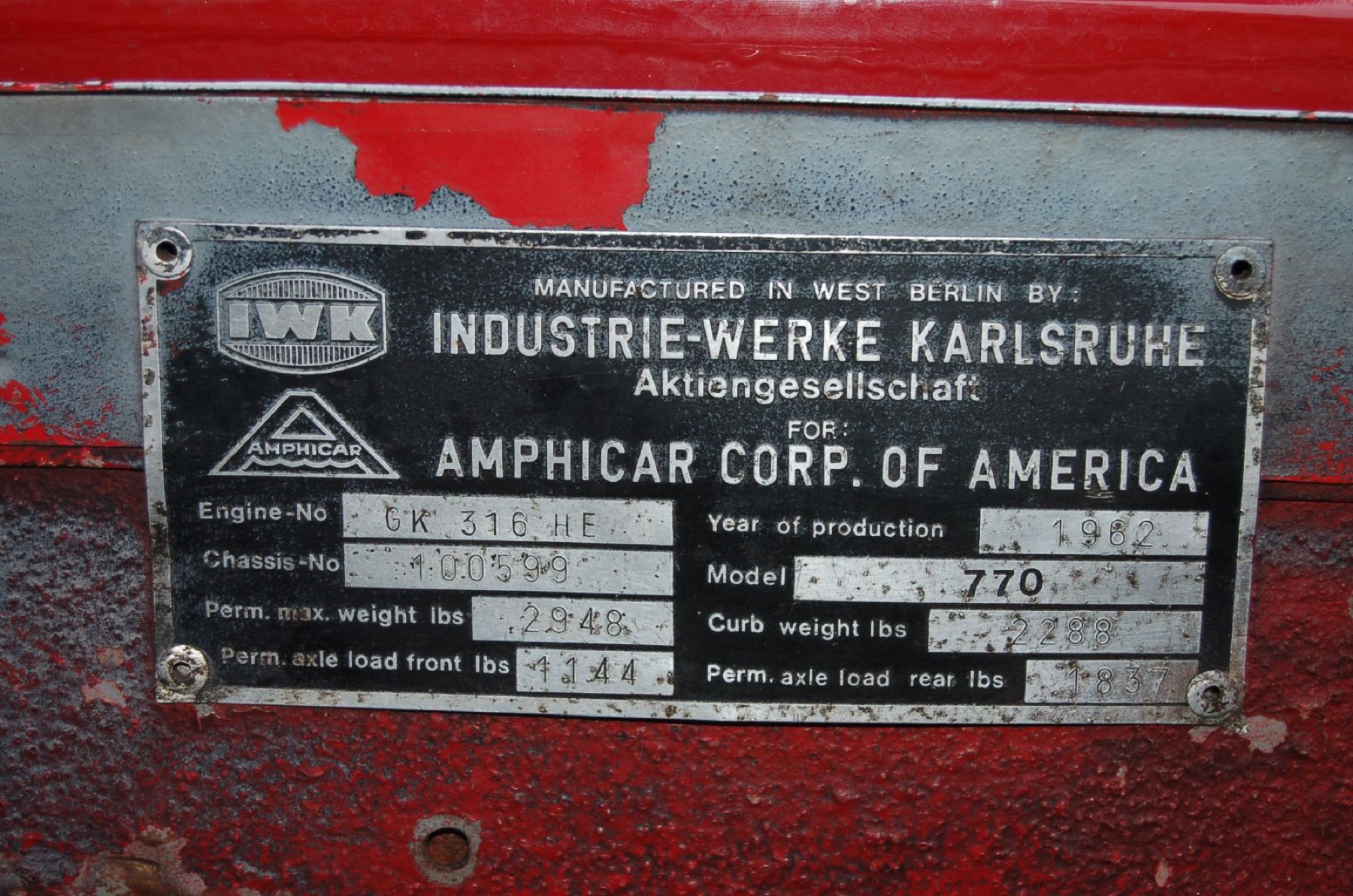
The match between the serial number, the manufacturer’s plate and the documents is crucial for identifying a vintage vehicle. Photo: Joe Ross, Wikimedia Commons, CC BY-SA 2.0.
The FFVE can issue a dating and characteristics certificate when the file meets its conditions. This certificate documents the age and technical characteristics; it should not be confused with the registration certificate issued by the authorities. It also does not exempt one from proving ownership.
The seller is advised to complete the regularisation before putting the vehicle up for sale. This protects the buyer, reduces the risk of blockage and makes the vehicle’s value clearer. If the vehicle’s identity is uncertain, our article on the illegible chassis number of a vintage car explains the checks to be carried out without altering the markings.
Does the FFVE certificate replace the registration certificate?
No. The FFVE certificate confirms the dating and certain characteristics of a vehicle; it serves as a document in a classic vehicle registration application. The registration certificate is then issued by the authorities if the file is accepted.
Presenting the certificate as a “provisional registration certificate” would be misleading. It is not sufficient on its own to carry out the usual transfer procedure for an already registered vehicle. The FFVE also requests proof of ownership and a consistent history when the title is missing.
Another confusion must also be avoided: a car over thirty years old does not automatically obtain a classic vehicle registration certificate. Its historical interest, preservation and conformity to period characteristics are examined as part of the file.
Is a vehicle identification sheet sufficient to sell?
No. France Titres specifies that the vehicle identification sheet lists the technical characteristics but does not constitute a circulation title and does not justify the administrative status..
Its use is limited to certain cases, notably presentation at the technical inspection of a vehicle without a certificate, export of a damaged used vehicle whose certificate has been withdrawn, or certain vehicles sold at auction or by the Public Treasury.
The sheet can therefore help at a specific stage of regularisation; it does not turn a classic sale without a registration certificate into a secure transaction.
Can one sell “for parts” or “as is” without a registration certificate?
The mention “sold as is” does not remove any administrative obligation and does not erase the seller’s responsibility. It does not replace either the registration certificate or the required documents.
Moreover, Service-Public states that a vehicle that is no longer roadworthy cannot be sold to a private individual, even for spare parts. A non-roadworthy vehicle can only be transferred to a motor trade professional. It is therefore necessary to distinguish:
- a roadworthy car with repairs to be made;
- a car temporarily broken down but capable of returning to circulation after repair and inspection;
- a genuinely non-roadworthy vehicle which falls under a professional transfer or a destruction channel.
Our file can one sell a non-roadworthy vintage car?details this distinction and the possible solutions.
The technical inspection remains a separate matter
Regularising the registration document does not exempt one from checking the technical inspection. For a sale to a private individual, proof of a valid inspection is generally required when the vehicle falls within the scope of the obligation. The rules depend on the age, category and status of the vehicle; some cars with classic registration documents benefit from a special regime.
Service-Public also specifies that in the presence of critical faults, repairs and a re-inspection must be carried out before a sale to a private individual. A sale to a motor trade professional follows different procedures. See our article dedicated to the sale of a classic car without a technical inspection before offering an immobilised vehicle.
Documents to gather before the sale
Once the title is regularised, prepare a coherent file:
- the original registration certificate, to be crossed out only at the time of sale;
- the correctly completed and signed transfer certificate;
- the administrative status certificate dated less than fifteen days ago;
- proof of the technical inspection when it is mandatory;
- proofs of inheritance, mandate or co-ownership if the situation requires it;
- invoices, history and authenticity documents useful to the buyer.
The serial number, the identity of the holder and the characteristics must correspond. In case of error, never alter a typing or a plate yourself. Request an administrative correction or an appropriate expert assessment.
Our guide to the transfer certificate for a classic car allows you to check the sections before signing.
Which strategy to choose before putting the car up for sale?
The safest strategy consists of four steps: diagnose the administrative situation, reconstruct the evidence, obtain the appropriate title, then only set the price and publish the advertisement. A rare car without papers is not necessarily without value, but its price must take into account the real risk of regularisation as long as the file remains incomplete.
Avoid passing this risk on to a private buyer by promising an easy procedure. Blockages can come from an opposition, an unregistered previous transfer, an inconsistent serial number, a vehicle declared destroyed or insufficient proof of ownership.
If your title is regularised and you wish to prepare a controlled transfer, discover the Plethore Cars solutions to sell your vehicle . The description of the advertisement must honestly indicate the mechanical condition, documentary history and any ongoing procedures.
FAQ: Selling a classic car without a registration document
Can I sign a certificate of transfer if I only have a photocopy of the registration document?
The standard procedure requires the complete registration document, crossed out, dated and signed. A photocopy does not replace the original. If you are the holder and the document is lost, request a duplicate.
Does an FFVE certificate allow immediate sale of the car?
No. It confirms the dating and characteristics of the vehicle, but it is not a registration certificate. It forms part of the file allowing you to apply for a classic car registration document.
Can I sell if the registration document is still in the name of the person who sold me the car?
No, except in specific cases applicable to professionals. A private individual must normally register the vehicle in their name before reselling it. The chain of transfers must be reconstructed and the situation regularised.
Is a car over thirty years old automatically exempt from having a registration document?
No. Age does not exempt from the registration certificate. It may allow you to request a certificate for classic registration if the conditions are met.
Can heirs sell without putting the registration document in their name?
In certain inheritance situations, yes, with the required supporting documents and depending on the time elapsed or usage since the death. But if the registration document has been lost, Service-Public requires it to be replaced before the sale.
Can you sell a wreck without a registration document to a private individual?
No. A non-running vehicle cannot be sold to a private individual, even for parts. It must be transferred to a motor trade professional or follow the appropriate destruction procedure.
Sources consulted
- Service-Public — Selling or giving away your vehicle, verified by the administration on 23 January 2026.
- Service-Public — Loss, theft or deterioration of the registration document: duplicate request, verified on 19 June 2026.
- Service-Public — Registration document: inheriting a vehicle registered in France, consulted on 31 October 2026.
- Service-Public — Can you sell or buy a non-running vehicle?, verified on 23 January 2026.
- France Titres — Selling or giving away your vehicle, consulted on 31 October 2026.
- France Titres — Requesting a vehicle identification sheet, accessed on 31 October 2026.
- FFVE — Administrative precautions before purchasing or restoring a vehicle, accessed on 31 October 2026.
- Légifrance — Decree of 9 February 2009 concerning registration procedures, version accessed on 31 October 2026.
General information verified on 31 October 2026. In cases of incomplete ownership chain, opposition, or disputed inheritance, request a written response from France Titres or seek advice from a legal professional before the sale.