Selling a classic car to a foreign buyer is possible, but the procedure varies depending on its destination. For a sale within the European Union, French transfer formalities remain central and there is no customs export declaration between member states. If the vehicle is headed to a country outside the European Union, a customs declaration must be added to the file.
In both cases, the seller must secure three matters before handing over the keys: the identity of the buyer, the final payment of the price, and the organisation of transport. It is also necessary to keep proof of the date of handover and, for exports outside the EU, the exit documentation.
Quick answer:prepare the French transfer as for a domestic sale, but do not let the buyer assume that the detachable coupon from the registration certificate allows them to drive the vehicle into their country. It only authorises circulation in France for one month. Transport, any temporary registration, and insurance must therefore be arranged before departure.
Sale within the European Union or export outside the EU: what is the difference?
The buyer’s country of residence is not sufficient to determine the procedure: it is primarily the actual destination of the vehicle and the contractual organisation of the shipment that matter.
| Situation | Main procedures on the French side | Point to organise before handover |
|---|---|---|
| Buyer and destination within the EU | Transfer, crossed-out registration certificate, certificate of administrative status, technical inspection if required, ANTS declaration | Registration and insurance in the destination country; transport or authorised plates |
| Destination outside the EU | French transfer fileandcustoms export declaration | Designate the exporter, choose the customs representative and obtain proof of exit |
| Sale by a professional or an auction house | Contract, mandate, invoicing and specific professional obligations | Precisely identify who sells, who collects payment, who exports and who assumes transport |
This distinction must appear in the contract or invoice. A car sold to a Swiss national but temporarily delivered in France is not organised in the same way as a vehicle shipped directly to Switzerland. Likewise, a buyer established outside the EU may have the car delivered to another member state: never deduce the customs destination from nationality alone.
What documents must be handed over to the foreign buyer?
The French documentary base does not disappear because the buyer resides abroad. The seller must notably have a registration certificate in their name and at their current address. If there are multiple co-holders, each must sign the transfer.
The transfer certificate
The Cerfa form no. 15776 must be completed and signed by both the seller and the buyer, in two copies. The foreign contact details of the purchaser can be indicated in the declaration. Record them exactly as they appear on their passport or company documents.
Also enter the actual date and time of handover. These details establish the transfer of the vehicle and are useful in the event of an offence, accident or dispute occurring during transport.
The crossed-out registration certificate
The registration certificate must be crossed out and bear the mention “sold on”, followed by the date, time and signature of the holder(s). Hand over the entire document to the purchaser.
Attention: according to Service-Public, the detachable coupon allows driving in France for one month, butnot abroad. The buyer must therefore not attempt a cross-border return with this document alone. They must check the regulations of their country and, if necessary, obtain temporary plates or arrange for the vehicle to be transported.
The administrative status certificate
The administrative status certificate, often called the certificate of no encumbrance, must be dated within the last fifteen days. It provides information, notably on the existence of any lien or opposition to the transfer of the registration certificate.
The HistoVec report can complement the transparency of the file. It does not replace an expert appraisal or maintenance history, but helps the buyer verify certain administrative data.
The technical inspection
When the vehicle is subject to a technical inspection, the report given to the buyer must generally be less than six months old, or less than two months old if a re-inspection was required. Exemptions and periodicities may vary depending on the vehicle’s age, category and use: check the exact situation before signing.
Historical and technical documents
For a classic car, include everything that establishes its identity and value: invoices, logbook, previous titles, restoration file, expert report, manufacturer certificates, photographs and list of supplied parts.
A European certificate of conformity can be useful when it exists. However, many vintage cars predate modern community type approval and do not have one. Do not promise one by default: the buyer must check which homologation documents are accepted in their country.
For a rare or claimed original vehicle, review our method toverify the matching numbers of a classic car.
How to declare the sale in France?
The seller must declare the transfer on the National Agency for Secure Documents website within fifteen days. The procedure accepts information for a buyer residing in another country.
Keep the receipt of the transfer registration along with a copy of the signed Cerfa form, the crossed-out registration certificate and the identity document or legal information of the buyer. Provide the transfer code when the procedure requires it.
Also notify your insurer without delay. Agree in writing the time at which custody of the vehicle and responsibility for transport pass to the buyer or carrier. A vague phrase such as “collection at the buyer’s expense” does not always suffice to allocate all risks.
How to secure payment for an international sale?
A visible car, a friendly buyer and proof of transfer on screen do not mean the price has definitely been received. For a significant transaction, payment deserves a written protocol.
Prefer a transfer that is actually credited
Have the funds transferred to an account for which you have provided the IBAN through a secure channel. Check the credit directly in your banking interface and, for a large sum, request confirmation from your advisor using a phone number obtained independently of the buyer’s message.
Do not rely on a screenshot, an email supposedly sent by a bank, or a link allowing you to “release” the funds. No carrier should take the car until the conditions stipulated in the contract are fulfilled.
Define the currency and fees
The contract must specify the currency, the net amount expected, the allocation of bank charges, and the consequence of any exchange rate difference. If the price is agreed in euros, state that the seller’s account must be credited with the full amount in euros before delivery.
For a high-value vehicle or a remote transaction, a professional escrow service may be considered. Verify the identity, accreditation, and contact details of the intermediary without using links provided by an unknown party.
Draw up a detailed written agreement
In addition to the mandatory information, the contract may identify:
- the vehicle by make, model, chassis number and registration number;
- the displayed mileage and whether it is guaranteed or not;
- the included items, notably parts, hard-top, wheels and archives;
- known defects and declared major repairs;
- the price, currency and payment schedule;
- the place, date and time of delivery;
- the person responsible for transport and insurance;
- the declared destination and, outside the EU, the party responsible for export.
The seller remains obliged to honestly inform the buyer about the condition and known defects of the vehicle. A general “as is” sales clause does not turn concealed information into a safe practice.
Transporting the car: road, trailer or container?
The mode of transport must be chosen before payment of the balance. Departure by road may seem economical, but it requires valid registration and insurance for the entire journey. The French detachable coupon does not resolve this issue abroad.
For a valuable, unreliable car or one without a temporary registration solution, transport on a flatbed or in a closed truck limits administrative and mechanical risks. Check the transported goods insurance, exclusions, deductible and maximum value guaranteed per vehicle.
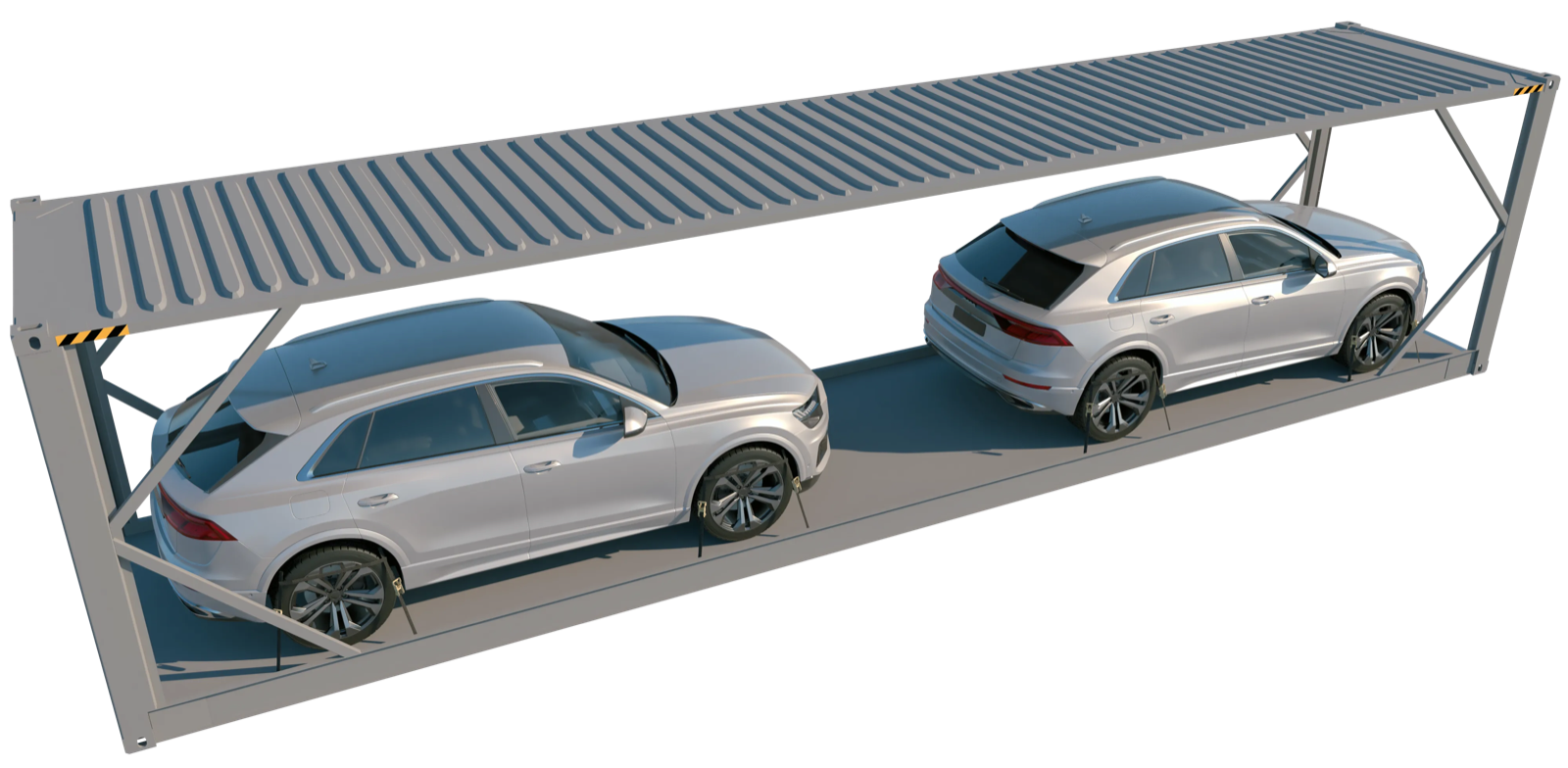
The transport contract must specify the vehicle, its declared value, its condition at loading and the party responsible for insurance. Illustration: Wikideas1, CC licence0 1.0, via Wikimedia Commons.
For sea shipment, a closed container offers protection against handling and weather, but requires professional lashing. The holds, straps and fixing points must be adapted to the car’s weight and ground clearance. A mutually agreed condition report photographed before container closure is essential.
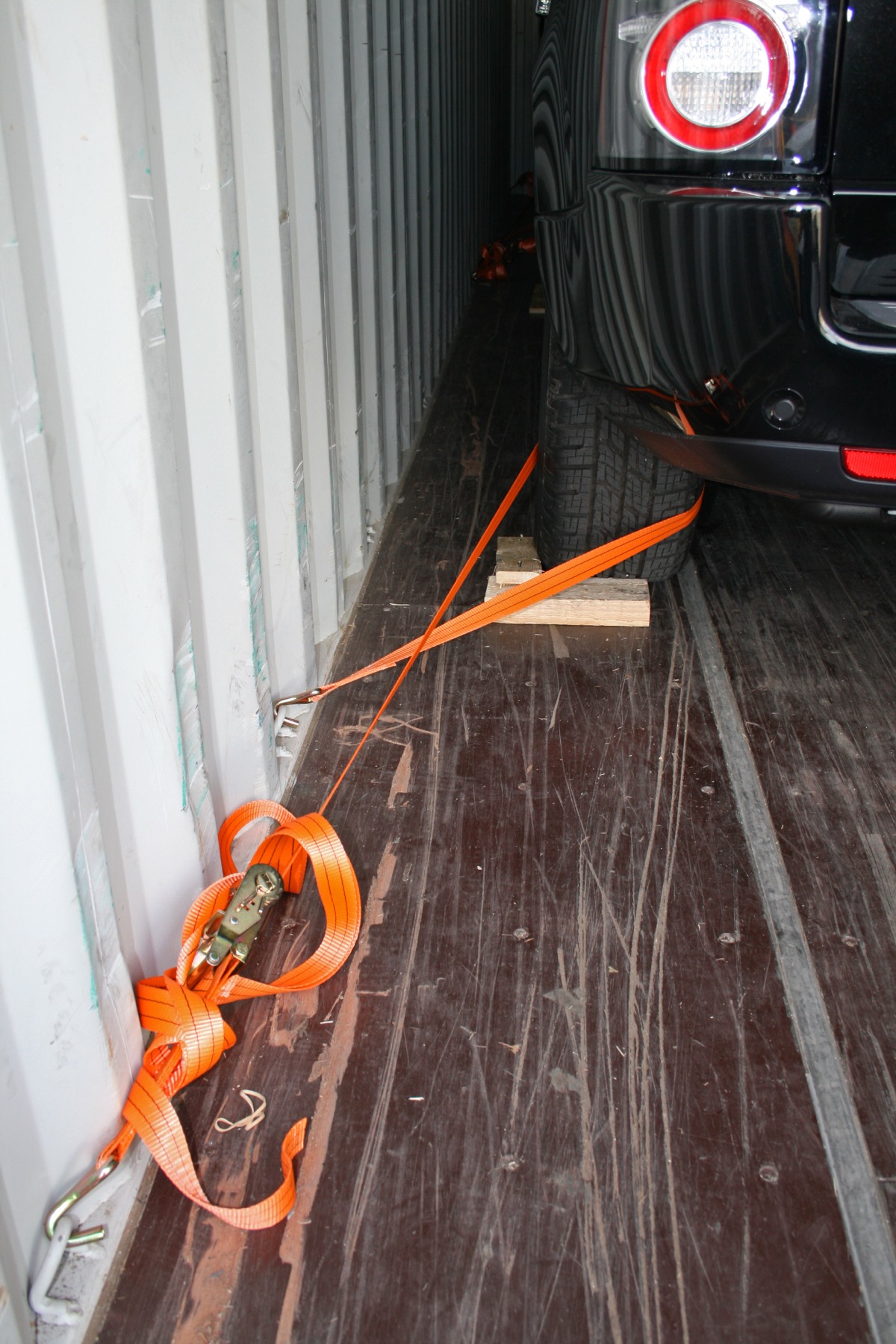
The lashing must prevent any movement without damaging the running gear or bodywork. Photo: Glen, CC BY 2.0, via Wikimedia Commons.
At loading, take dated photographs of each side, the wheels, the accessible underside, the interior, the mileage, the fuel level and the accessories. Have a handover report or a consignment note signed, mentioning any visible reservations.
What formalities are required to export the car outside the European Union?
A sale intended for a third country requires a customs export declaration. According to French Customs, this can be submitted by the seller-exporter or by an authorised intermediary, such as a customs representative; depending on the arrangement, the buyer may also be involved in the operation.
The file notably includes the invoice or sales document as well as a copy of the registration certificate. Other documents may be requested depending on the destination, value, origin of the vehicle, tax regime and chosen transport.
Before handover, have written answers to four questions:
- Who is designated as the exporter in the declaration?
- Who submits the declaration and to which customs office?
- Who receives the document accompanying the export and the proof of exit?
- Who bears the duties, taxes, port charges and formalities on arrival?
The proof of exit should not be considered a mere logistical detail. It can become decisive in justifying the customs or tax treatment of the operation. Ask the forwarding agent for the declaration reference and the exit certificate after crossing the exit customs office.
For certain destinations benefiting from an agreement with the European Union, a preferential origin document may be relevant. Its issuance is neither automatic nor based solely on the brand’s country: the customs origin must be demonstrated according to applicable rules.
VAT and taxation: what points should be checked?
A private individual who occasionally sells a used car generally does not charge VAT. Within the European Union, the buyer then registers the vehicle in their country of residence and pays any registration or circulation taxes that may apply there.
However, European rules distinguish a used vehicle from a “new means of transport”. For VAT purposes, a car is considered new when it is at most six months oldorhas travelled at most 6 000 kilometres. This situation is rare for a classic car, but may concern a very recent and very low-mileage collectible supercar.
French taxation of collectibles calls for further caution. The tax classification of a collectible vehicle does not automatically coincide with the “collectible vehicle” designation on the registration document. A high-value sale or export may be subject to specific rules, with exemptions or options depending on the holding period, price, quality of supporting documents and the seller’s status.
Before accepting a significant deposit, have the treatment validated by a notary, a tax lawyer or an accountant experienced with collectible vehicles. This verification is particularly recommended for an inheritance, ownership by a company, a previously imported car or a significant capital gain.
Checklist before handing over the keys
- Verify the buyer’s identity and, if it is a company, their powers and legal existence.
- Confirm the vehicle’s actual destination: EU or third country.
- Sign the contract and Cerfa form no. 15776 in two copies.
- Obtain an administrative status certificate dated less than fifteen days.
- Provide the technical inspection certificate when the vehicle is subject to it.
- Cross out, date, timestamp and sign the registration document at the actual time of handover.
- Verify that the full price has been definitively credited.
- Decide who insures the vehicle during loading and transport.
- Carry out a photographic condition report and have a handover document signed.
- For an export outside the EU, identify the exporter and the customs declarant.
- Do not hand over the originals or the keys before the written conditions have been fulfilled.
What to do after the vehicle has departed?
Declare the sale within fifteen days if it has not been registered immediately. Send confirmation to the insurer and archive the entire file: contract, Cerfa form, proof of payment, ANTS receipt, copy of the crossed-out registration document, buyer’s identity, transport documents and photographs.
For an export outside the EU, obtain proof of exit from the declarant. If the transport involves a reservation or damage, notify it without delay according to the procedures provided by the transport contract and insurance.
Preparing the car is just as important as the paperwork. A comprehensive inspection of the classic car allows an honest description of its condition and reduces disputes after a remote sale.
Frequently Asked Questions
Can you sell a French car to someone who does not live in France?
Yes. The French transfer formalities remain applicable and the ANTS declaration allows the foreign address of the buyer to be indicated.
Can the buyer leave abroad with the detachable coupon?
No. The detachable coupon allows driving in France for one month, but not abroad. The buyer must have a valid registration and insurance solution or have the vehicle transported.
Is a customs declaration required for a sale in Germany or Belgium?
No, for a vehicle circulating between member states of the European Union: there are no internal customs duties nor export declarations to a third country. The registration and taxation rules of the destination country must still be respected.
Who must carry out the export to Switzerland, the United Kingdom or the United States?
The allocation depends on the contract and the customs arrangement. Explicitly designate the exporter and the representative responsible for submitting the declaration, then plan who will obtain the proof of exit.
Does the seller have to provide a certificate of conformity?
Provide it if it exists in the file. For many classic cars, no modern European certificate of conformity has been issued. The buyer must check with their country which alternative documents are accepted.
Can payment be accepted in foreign currency?
Yes, but the contract must specify the currency, the exchange rate or the expected net amount, the fees, and the moment when the payment is deemed to have been made. The exchange rate risk must not remain implicit.
Key points to remember
The proper approach is to treat the international sale as three coordinated operations: a French transfer, a secured payment, and legally documented transport. Outside the European Union, a fourth operation is added: customs export and proof of exit.
Do not hand over the car based on a promise of a transfer or an improvised itinerary. Validate the documents, insurance, transport liability, and destination before loading. For a significant automobile, a few hours spent on a bilingual contract and tax or customs advice can prevent a very costly cross-border dispute.
Administrative, customs and tax information verified on 3 September 2026. The rules of the destination country and the personal situation of the parties must be checked before the sale.