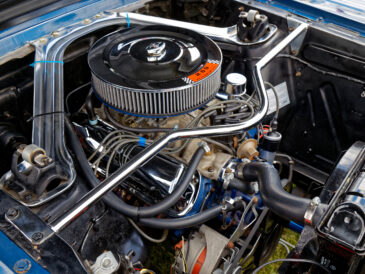
The technical inspection of a classic car depends on two factors: the date of first registration and the mention recorded on the registration certificate. A classic car first registered from 1 January 1960 must undergo an inspection every five years. If it predates 1960, it is exempt. However, a vehicle over thirty years old that remains on a standard registration retains the usual two-year inspection frequency.
When sold to a private individual, an inspection less than six months old remains necessary for vehicles subject to it, even if the previous periodic inspection is still valid for several years. Vehicles legally exempt as classics remain so upon transfer.
Quick answer: the age of the car alone is not sufficient. Check box Z on the registration certificate: only the mention “classic vehicle” grants the five-year inspection interval or, for first registration before 1 January 1960, the exemption.
Classic vehicle inspection: the rules table in 2026
| Vehicle status | Periodic inspection | Upon sale to a private individual |
|---|---|---|
| Car with classic registration, first registered from 1 January 1960 | Every 5 years | Inspection report less than 6 months old, or within 2 months if a re-inspection is required |
| Car with classic registration, first registered before 1 January 1960 | Exempt | No mandatory inspection required for this transfer |
| Car over 30 years old with standard registration | Every 2 years | Inspection report less than 6 months old, or within 2 months if a re-inspection is required |
| Classic vehicle over 3,5 tonnes | Exempt, regardless of registration date | Exemption linked to its classic vehicle status |
| Classic vehicle used as a VTC (private hire vehicle) | Every year | Specific regulations to check before the transfer |
| Sale to a motor trade professional | Depending on the vehicle’s status for road use | The seller is not required to provide a technical inspection less than 6 months old to the professional |
This table concerns the main French situations. An imported, modified vehicle, one used for professional purposes, or lacking proper documentation may require additional checks.
Is a car over 30 years automatically exempt?
No. “Old car” and “classic vehicle” are not synonymous administratively. To benefit from the special regime, the registration certificate must bear the usage mention “classic vehicle.”
The Highway Code defines a classic vehicle as one built or first registered at least thirty years ago, whose type is no longer produced, and which is preserved historically without significant modification to its technical characteristics. Meeting these criteria makes the vehicle eligible; this does not automatically change the registration document.
In 2026, a car first registered in 1996 or earlier can therefore meet the age criterion. However, an application must be made and the classic mention obtained for the specific periodicity to apply.
If your vehicle remains on a standard registration document, its age does not change the inspection frequency: for a passenger car, the inspection remains biennial. Our guide on the classic registration document, its benefits and procedures allows you to compare the two statuses before deciding.
Every five years: how to calculate the next deadline?
For a car on a classic registration document first put into circulation from 1960, a favourable technical inspection is valid for five years. The expiry date appears on the documents issued during the inspection and in the registration data.
The periodicity is not calculated from the presumed manufacturing date or from obtaining a historical certificate. It depends on the inspection actually carried out and the recorded administrative status.
A change of registration does not automatically cancel a still valid inspection. When a car obtains the classic mention after a favourable inspection, Service-Public gives the example of validity extended to five years on the new certificate. However, check the date shown on your own document rather than extrapolating from the example.
The technical inspection sticker is not affixed to the windscreen of a classic vehicle. The absence of a sticker therefore does not mean the vehicle is exempt: the inspection report and registration certificate remain the references.
Which classic cars are exempt from technical inspection?
Cars first put into circulation before 1960
A light vehicle with a classic registration certificate and first put into circulation before 1 January 1960 is exempt from mandatory technical inspection. A first circulation in 1960, even very early in the year, places the vehicle under the five-year inspection regime.
The date to retain is that shown in the administrative file, not an estimate based on the commercial model year. For a rebuilt car or one with incomplete papers, have the first registration date clarified before claiming an exemption.
Classic vehicles over 3,5 tonnes
A classic vehicle with a GVWR exceeding 3,5 tonnes is exempt from the technical inspection regardless of its registration date. This rule notably concerns certain historic coaches, trucks, and road tractors, but it always requires the vehicle to have classic administrative status.
An exemption does not prohibit a voluntary inspection
The FFVE recommends voluntary technical inspections for exempt vehicles. However, this inspection does not become a full certificate of good condition: it allows the examination of the functions required by regulations at a given moment.
For a car that is driven infrequently, regular preventive checks by a specialist remain useful between inspection deadlines. Hoses, tyres, seals, wheel cylinders, and fluids deteriorate even when mileage is low.
Is the inspection truly adapted to vintage cars?
Yes, the inspector takes into account the characteristics and standards applicable at the time of first registration. A vintage car is not required to have equipment that was not mandated at its approval, provided its configuration and identification are consistent.
However, the inspection remains a standardised regulatory procedure. It notably covers:
- vehicle identification;
- braking equipment;
- steering;
- visibility;
- lights and electrical equipment;
- axles, wheels, tyres, and suspension;
- the chassis and its accessories;
- seat belts and other equipment when applicable;
- nuisances, including pollution and noise levels.
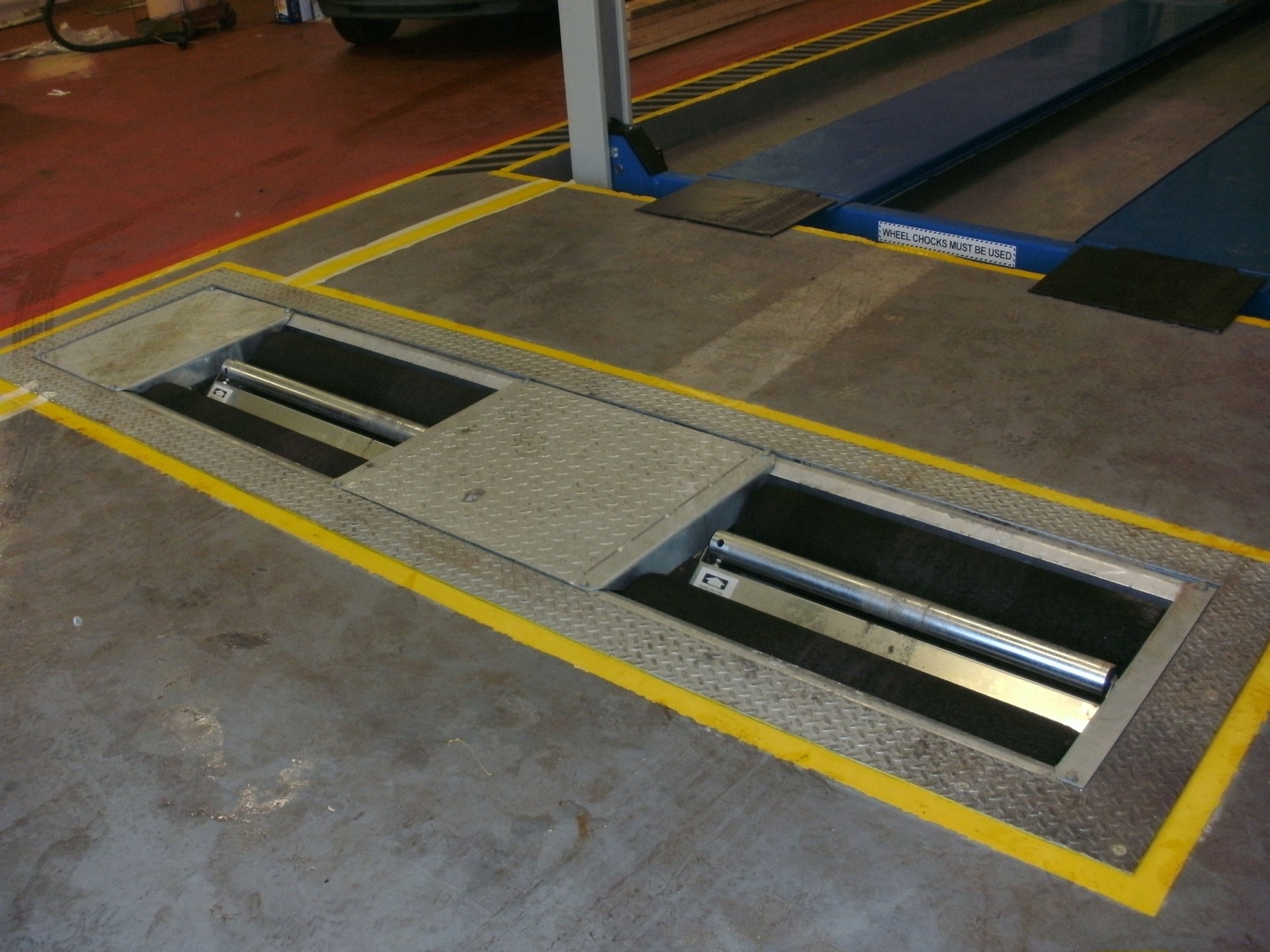
The brake tester notably measures efficiency and imbalance between wheels. Photo: AJH1975, CC BY-SA 3.0 licence, via Wikimedia Commons.
Measurements must remain compatible with the vehicle’s design. Inform the centre when a permanent four-wheel drive, limited-slip differential, very low ground clearance, spoked wheels, or a particular braking system require an adapted method. Preferably choose a centre experienced with historic cars, without assuming that this experience permits relaxation of the rules.
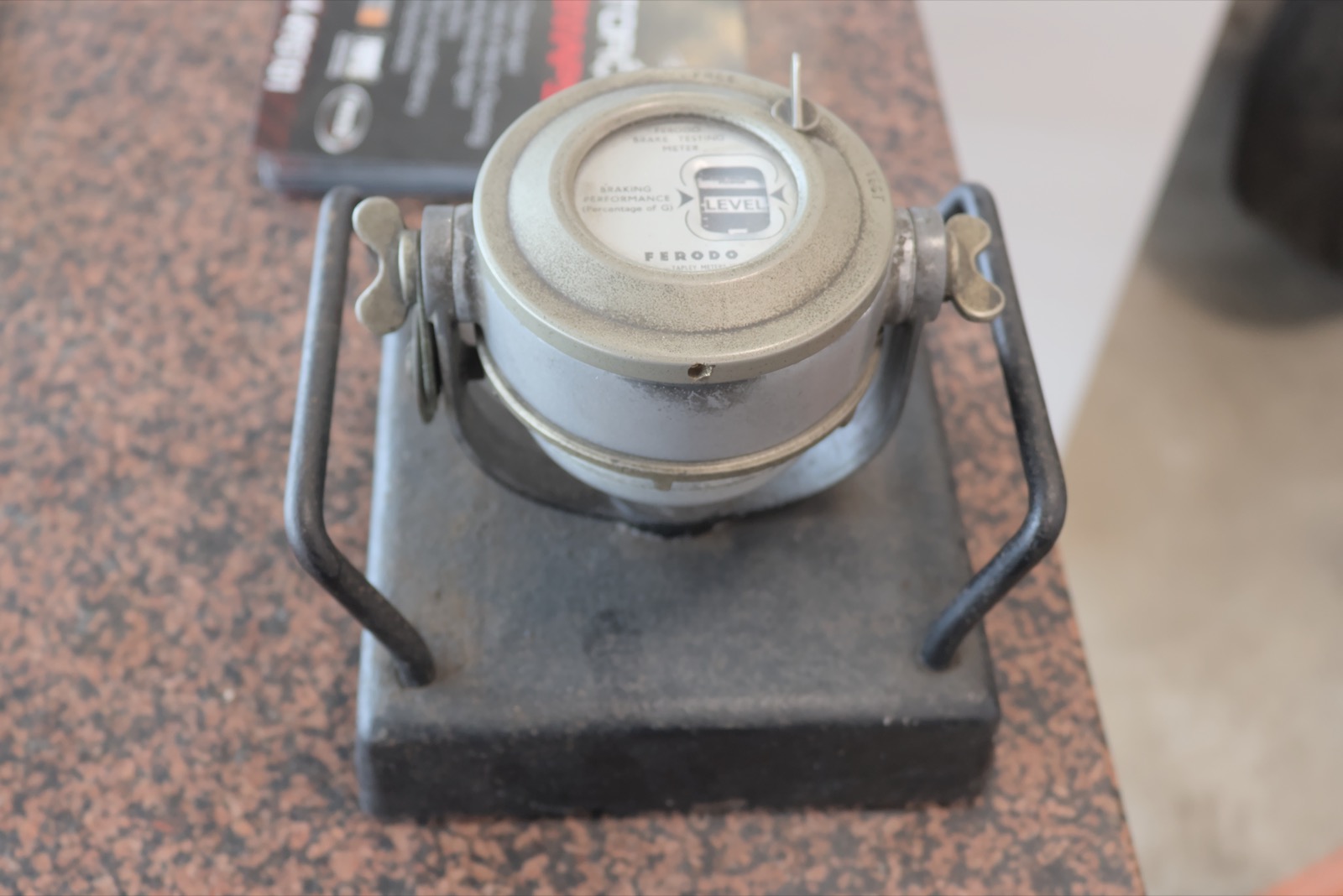
Methods have evolved, but braking remains a central safety aspect of a vintage car. Photo: Aethonatic, CC0 1.0 licence, via Wikimedia Commons.
How to prepare a vintage car before the inspection?
Serious preparation does not mean concealing defects. It mainly avoids an unfavourable result due to a bulb, an expired tyre, or a chassis number that is difficult to read.
Check identity and documents
Present the original registration certificate. First, compare the chassis number on the document with the manufacturer’s plate and the stamped number where it exists. Clean the area without sanding, repainting or retouching any markings.
If the car has several plates or identifiers specific to its brand, document their function. A historical appraisal or a manufacturer’s certificate can help explain a configuration, but does not replace the documents required by the testing centre.
Check the safety components
Before the appointment, examine:
- the condition and age of the tyres, including any cracking on the sidewalls;
- any leaks of brake fluid, fuel, oil and coolant;
- the operation of all lights, indicators and warning devices;
- the play in the steering and suspension;
- the condition of hoses, pipes and fixings;
- the windscreen, wipers and mirrors;
- the seat belts when fitted to the vehicle;
- the secure fixing of the battery, seats and openings.
A prior test by a workshop can detect uneven braking or noisy running. For a car that has been stationary for a long time, do not drive straight to the centre: first carry out a methodical recommissioning.
Our article on storing a classic car without damaging it details the checks to be carried out after a long period of inactivity.
Inform the centre of any particularities
When making the appointment, specify the model, year, type of transmission and any important particularities. Ask if the centre can accommodate the car’s dimensions, weight and ground clearance.
Do not dismantle a mandatory component solely to facilitate passing the test. If a piece of equipment causes an adaptation or identification problem, resolve the issue with a specialist before the inspection.
Favourable, major or critical result: what happens?
The report classifies any faults into three levels.
Minor fault
The result remains favourable and no re-inspection is required. However, the defects must be corrected: “minor” means they have no immediate significant impact on safety or the environment, not that they can be ignored for five years.
Major fault
The result is unfavourable and a re-inspection must be carried out within two months. The inspection remains valid during this period. If you miss the deadline, a new full inspection is required.
Critical defect
A critical defect constitutes a direct and immediate danger. The validity of the inspection is limited to the day it was carried out. The vehicle may no longer be driven from the following day until it is repaired, even though the administrative deadline for re-inspection remains two months.
Since 1 January 2026, the inspection also checks whether the vehicle is subject to a recall campaign deemed serious by the manufacturer. When a vehicle classified as “stop drive” has not been repaired, a critical defect is recorded. This general rule can concern a recent classic car, for example a model from the 1990s that has become eligible due to its age.
Can you sell a classic car without a technical inspection?
Yes, in certain specific situations, but not simply because the buyer agrees to “take it as is.”
A car with a classic vehicle registration certificate issued before 1 January 1960 is exempt, including when sold. The same applies to a heavy classic vehicle benefiting from the exemption. A sale to a motor trade professional can also be made without the private seller providing an inspection report less than six months old.
For a car subject to inspection and sold to a private individual, the seller must provide the inspection report before the sale is concluded. This report must still be less than six months old when the buyer applies for their new registration certificate. If a re-inspection is required due to major defects, sale “as is” is possible during the two-month period; the buyer will carry out the repairs and re-inspection.
With a critical defect, the vehicle may no longer be driven from the day after the inspection. In practice, have it repaired and the re-inspection validated before the sale, or arrange a sale to a professional and transport without road use. A handwritten clause does not override either the documentary obligation or safety regulations.
The technical inspection does not replace the seller’s obligation to inform the buyer of known defects. For an important car, include invoices and an independent report. Our method for inspecting a classic car usefully complements the regulatory inspection report.
Technical inspection and appraisal: what is the difference?
The technical inspection checks a regulatory list of functions and reports observed defects without dismantling. It does not certify the quality of a restoration, the authenticity of an engine, the historical accuracy of a paint colour, the market value, or the absence of hidden defects.
A vehicle appraisal pursues a different objective: to describe the condition, document the identity, examine the consistency of the file, and propose, depending on the assignment, a value. For buying, selling, insuring or transferring a high-value car, both procedures are complementary.
A favourable inspection should therefore not be presented as a general mechanical guarantee. Slightly visible corrosion, intermittent overheating or a worn gearbox may not appear within its scope.
Frequently asked questions
Is the classic vehicle inspection valid for five years even in the event of a sale?
The normal periodicity is five years, but a sale to a private individual requires an inspection report less than six months old for a vehicle still subject to inspection.
Is a 1959 car with a normal registration exempt?
No. The exemption before 1960 requires a registration certificate bearing the mention “classic vehicle.” With a normal registration, the periodicity remains that of the ordinary regime.
Is a sticker required on the windscreen?
No for a classic vehicle. However, the absence of a sticker does not exempt you from keeping the inspection report when the inspection is mandatory.
Can the inspection be carried out at any centre?
It must be carried out at an approved centre. For a particular classic car, ensure that the centre has the appropriate equipment and experience suited to its transmission, dimensions, and ground clearance.
Must a re-inspection be done at the same centre?
No. It can be carried out at the original centre or at another approved centre, provided the necessary documents are presented.
Does the technical inspection prove that the car is matching numbers?
No. It verifies the regulatory identification but does not systematically compare the engine, gearbox, and bodywork against production archives. This matter requires a documentary check of the matching numbers.
Key points to remember in 2026
To know the applicable rule, first read the registration certificate, then the date of first registration. After 1960, a car with a collection status is inspected every five years; before 1960, it is exempt. Without collection status, a classic car is generally subject to inspection every two years.
Plan ahead for a sale: the five-year validity does not replace the inspection report less than six months old required when selling to a private individual. Finally, use the inspection as a regulatory minimum, not as a comprehensive diagnosis. A safe classic car relies on regular checks, even when it is driven infrequently or benefits from an exemption.
Information verified on 4 September 2026 for France. Regulations and technical instructions may change; check your situation before the deadline or sale.