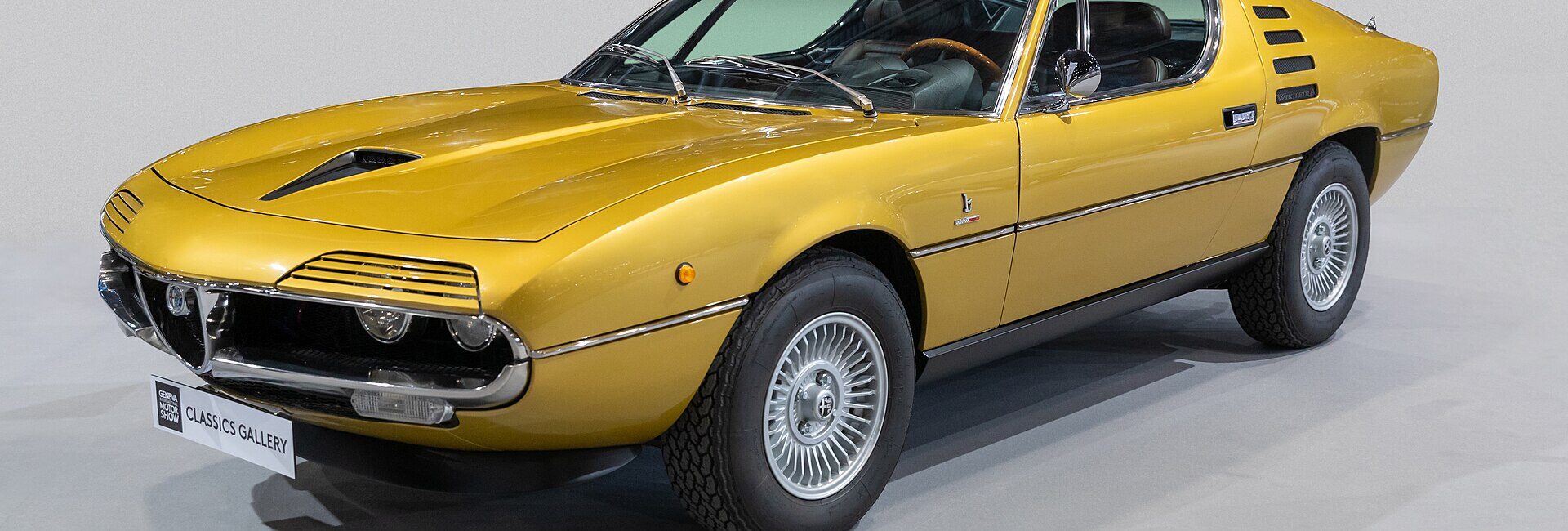
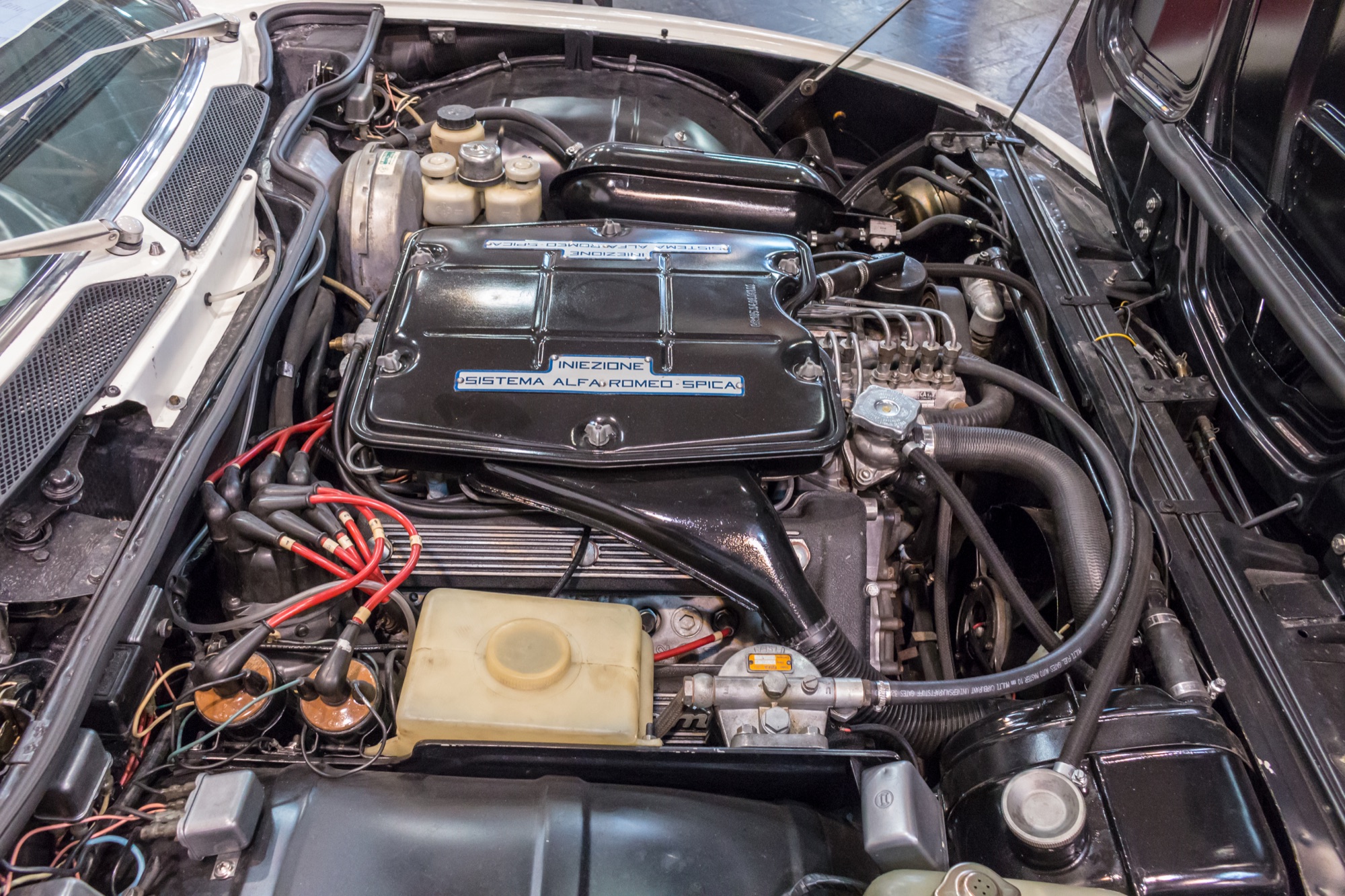
The Alfa Romeo Montreal is one of the most spectacular Italian GTs of the 1970 decade: designed by Marcello Gandini, featuring a V8 with four camshafts, mechanical SPICA injection, and a ZF five-speed gearbox. However, it is not a car to buy based on style alone. In 2026, the best choice remains a complete, documented example that has been regularly maintained by a specialist, even if it is more expensive than a car that has been left standing or recently cosmetically restored.
The short answer: a sound Montreal is not fundamentally fragile, but its refurbishment can become very costly. Before buying, structural corrosion, the water pump, cooling system, SPICA injection, fuel supply, and the completeness of specific parts must be checked. The listed price should therefore never replace a professional inspection.
Why has the Alfa Romeo Montreal become an icon?
The story begins at the Montreal World’s Fair in 1967. Alfa Romeo presented two prototypes intended to embody the ideal car of their era. The brand now reminds us that the design was signed by Marcello Gandini, then at Bertone. The public took note of the location’s name: “Montreal” naturally became the model’s name.
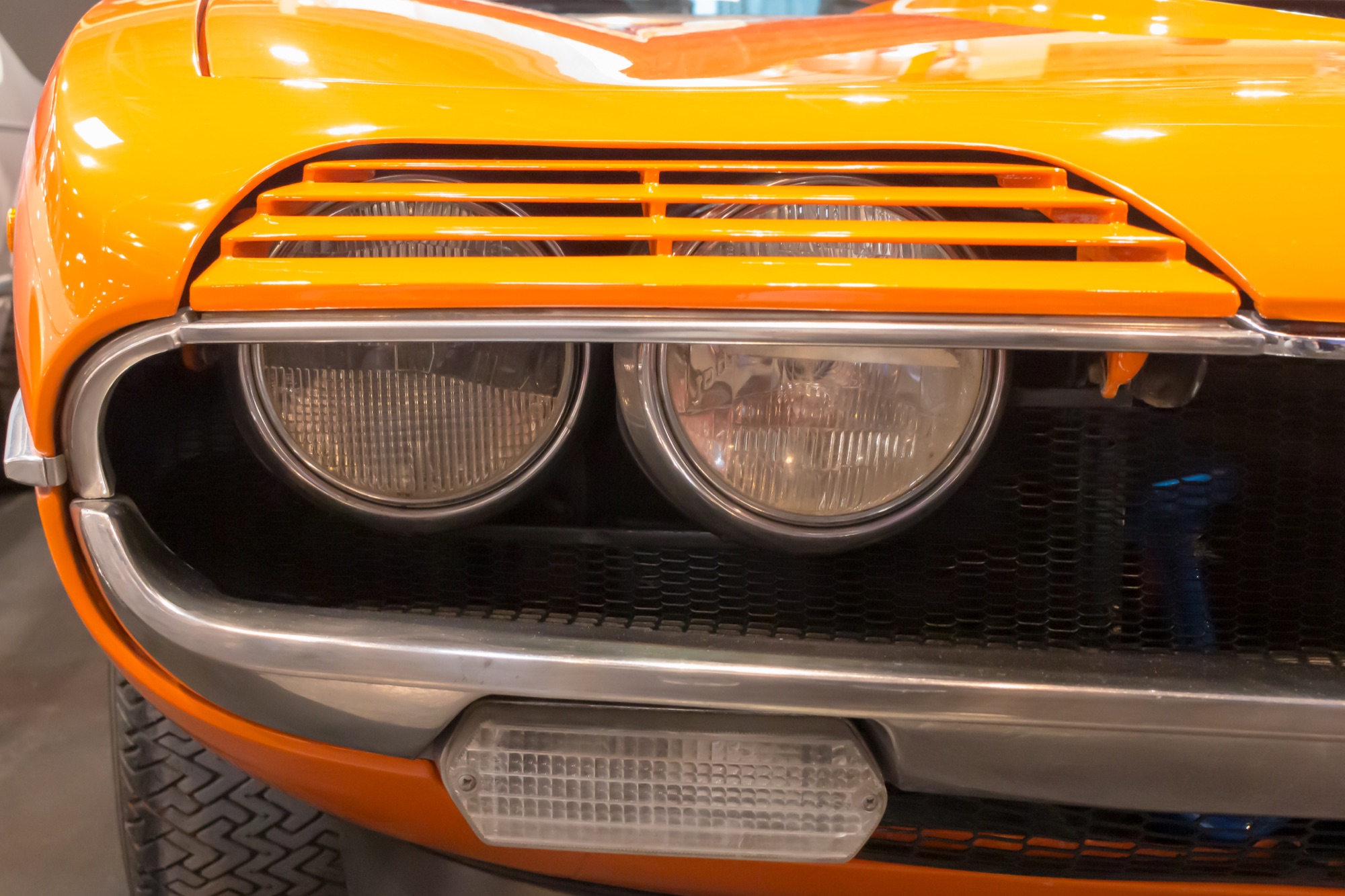
The production version was unveiled in 1970. It retained the very taut proportions of the concept, its air intakes behind the doors, and especially its famous slatted eyelids over the twin headlights. Under the bodywork, the project became much more ambitious: Alfa Romeo installed a V8 engine directly related, in its architecture, to the family of engines developed for the Tipo 33 racing car.
Production remained limited. Specialist references do not all give exactly the same total, but converge around approximately 3 900 units produced until 1977. This rarity, combined with an immediately recognisable aesthetic, explains much of its current appeal.
Technical specifications of the Alfa Romeo Montreal
| Feature | Main data |
|---|---|
| Engine | V8 at 90°, 2 593 cm³ |
| Valve train | Four overhead camshafts, two valves per cylinder |
| Fuel system | Mechanical SPICA injection |
| Lubrication | Dry sump |
| Declared power output | Approximately 200 bhp DIN at 6 500 rpm |
| Transmission | ZF five-speed manual gearbox, first gear down |
| Drive system | Rear-wheel drive, limited-slip differential |
| Declared top speed | Approximately 220 km/h |
| Production | Approximately 3 900 units |
| Production period | 1970–1977 |
These figures set the tone: the Montreal is a true grand touring sports car, not merely a styling exercise. Its ZF gearbox, its smooth and sonorous V8, and its driving position make it a fast car for its era. However, its rigid rear axle reminds us that the technical base remains more traditional than its engine.
What is the price of an Alfa Romeo Montreal in 2026?
There is no single, universal valuation. The country, history, authenticity, quality of restoration, and deferred work can greatly affect the value. Listings also represent asking prices, not necessarily the prices actually paid.
As a reference, the French page of Car & Classic consulted on 26 October 2026 showed 22 Montreals for sale. Its history of 27 sales indicated a latest result of 87 500 €, an average of 71 359 €, and a very wide range, from 21 000 € to 116 464 €. These data aggregate cars of different conditions and markets: they serve to position the market, not to estimate a specific example.
The American Hagerty guide placed, at the same time, a 1970 Montreal in “Good” condition within a range of approximately 77 967 to 107 467 dollars. The evaluation method and the American market differ from the European market; the comparison mainly confirms the sensitivity of prices to condition and history.
In practice, three categories stand out:
- projects or immobilised cars, sometimes attractive on price, but likely to accumulate corrosion, misadjusted injection, and missing parts;
- the running examples, whose value depends on the actual quality of maintenance and any previous repairs;
- the restored or remarkably well-preserved cars, which are more expensive, provided that the work is documented and compliant.
To know the value of a specific car, it is better to request a personalised appraisal and compare it with a physical inspection. You can also consult the classic cars offered for sale on Plethore Cars to compare the available listings.
Is the Alfa Romeo Montreal reliable?
Yes, if it has been properly and regularly maintained. The V8 is not inherently bad, but it is unforgiving of long periods of inactivity, imprecise adjustments, or ignorance of its lubrication circuit. A Montreal that starts and holds idle is not automatically a healthy car.
Specialists emphasise a few critical components.
Water pump and cooling system
The water pump bearing is a known point of concern. Any play, noise or leak should not be overlooked. A failure can cause contamination between oil and coolant, with serious consequences for the engine. When cold, fluid conditions should be checked, then temperature, pressure and any leaks monitored during a sufficiently long test.
Request invoices for replacement or refurbishment of the water pump, not just verbal confirmation. The quality of the coolant, condition of the radiator, hoses and fan are equally important.
SPICA mechanical injection
The SPICA injection contributes to the character of the Montreal. When well adjusted, it works correctly; misunderstood, it often causes poor starting, excessive richness or unstable idle. Adjustment should be made after verifying ignition, compression, timing and absence of air leaks.
Conversion to carburettors is not necessarily synonymous with an unusable car, but it reduces originality and may affect value. Returning to the original configuration can be costly if SPICA components are missing. On a car still equipped with its injection, check that the pump, linkages and thermostat housing are complete and entrusted to a competent specialist.
Dry sump lubrication
The dry sump requires a specific oil level procedure. Reading taken at the wrong time can lead to an incorrect diagnosis or overfilling. The seller should be able to explain the method used, the type of oil and the frequency of oil changes. The filter history and absence of particles or emulsion should be documented.
Fuel hoses and fire risk
Fuel lines age. On a GT with mechanical injection, any smell of petrol, cracked hose, makeshift clamp or seepage requires stopping the inspection until repaired. Preventive replacement of hoses compatible with current fuels is much less costly than a fire.
Where does corrosion hide?
The bodywork is the area that can turn a bargain into an endless restoration. An inspection on a lift, including thickness measurement and hollow body inspection, is essential. The priority areas are:
- the sills and lifting points;
- the floors and crossmembers;
- the suspension mounts and spring cups;
- the lower sections of the wings and the lower parts of the front and rear panels;
- the boot, spare wheel well and fuel tank area;
- the windscreen and rear window surrounds;
- the areas beneath the side grilles and panel joints.
A glossy paint finish can conceal heavy repairs. Look for differences in shade, recent seams, non-standard welds, filler and blocked water drainage. Properly repaired structural corrosion is not a deal-breaker if the work is documented with photographs and invoices. Conversely, undocumented restoration should be approached with caution.
ZF gearbox, transmission, brakes and suspension
The ZF reverse gate gearbox is generally robust but must be tested cold and then warm. The gears should neither crunch nor slip. Pay particular attention to reverse gear, the clutch, bearing noises and the reactions of the limited-slip differential.
On the road, the car should brake straight and remain stable. A vague steering feel may come from old tyres, worn bushes, ball joints or poor alignment. Check the tyre date: deep tread does not guarantee safe rubber. Also inspect the hoses, calipers, discs, shock absorbers and rear axle mountings.
Specific parts make the difference
Common mechanical parts are often easier to find than certain components unique to the Montreal. The headlight eyelids, grilles, mouldings, lights, upholstery elements and interior trims must be inventoried one by one. A missing part can cost more and take longer to source than an ordinary mechanical repair.
Test the operation of the headlight slats, instruments, window lifters, ventilation and all switches. Verify that the wheels correspond to the advertised configuration and that the tyres are of compatible dimensions. To prepare for this check, our guide to websites where you can find classic car parts helps identify the main sources.
Originality: what should be checked?
The value of a Montreal depends greatly on its coherence. You must compare the chassis and engine numbers with the available documents, check the paint colour, upholstery type, equipment and mechanical modifications. The aim is not to demand a car frozen since 1972, but to know precisely what is original, replaced or improved.
Require:
- the registration document and any previous titles available;
- chronologically ordered invoices;
- photos of the restoration;
- technical inspections and mileage records;
- references for the engine, gearbox and injection system;
- the list of replaced parts and original components retained.
To delve deeper into this investigation, consult our method for tracing the history of a classic car.
Road test: the checklist in 12 points
- Observe the start-up completely cold, without any prior preparation.
- Check for smoke, timing noises, oil pressure and temperature rise.
- Look out for any smell or leak of petrol.
- Verify the stability of the idle and the progressive response of the injection.
- Examine the oil and coolant before and after the test.
- Engage all gears cold, then hot.
- Test reverse gear and the clutch’s biting point.
- Brake progressively then firmly on a safe road.
- Listen for suspension, differential and bearing noises.
- Check the operation of the headlight shutters and instrumentation.
- Put the car on a lift to examine the structure and lines.
- Have the compression measured and, if necessary, carry out a cylinder leak-down test.
A pre-purchase inspection carried out by a professional familiar with Alfa Romeo models equipped with SPICA injection remains the best protection. A general inspection may miss issues specific to the Montreal.
What budget should be planned after purchase?
Even a good car deserves a contingency fund. Budget for the initial service, fluids, hoses, tyres, brakes and minor electrical faults. For a poorly documented example, also consider a water pump overhaul, injection system tuning, clutch work or corrosion repairs.
It would be misleading to announce a fixed amount: the price depends on the missing parts, labour, and the level of restoration sought. The most useful rule is to have estimates made before the sale, then add a margin for defects discovered during dismantling.
Verdict: should you buy an Alfa Romeo Montreal in 2026?
Yes, provided you buy the condition and the documentation, not just the colour or the price. The Montreal offers a rare combination: Bertone styling, an exotic engine, still convincing performance, and limited production. But an incomplete or long-immobilised car can quickly absorb the price difference with a fine example.
The best purchase is a Montreal regularly used, whose cooling and injection have been maintained, without hidden structural corrosion and accompanied by a solid history. A modified car can also be interesting if its price reflects its deviations from original and if the work is reversible and documented.
Frequently asked questions about the Alfa Romeo Montreal
How many Alfa Romeo Montreals were produced?
Specialist sources converge on around 3 900 units produced between 1970 and 1977. Small differences appear depending on the counting method; it is safer to speak of just under 4 000 cars.
What engine does the Alfa Romeo Montreal have?
It is fitted with a V8 at 90° of 2 593 cm³, with four overhead camshafts, mechanical SPICA injection, and dry sump lubrication. The announced power is around 200 DIN hp.
What is the main mechanical weakness of the Montreal?
The water pump and its bearing are a major point of vigilance. The SPICA injection also requires competent adjustment. The greatest financial risk remains a heavily corroded or incomplete bodywork.
Is a Montreal converted to carburettors worth less?
Often yes, because the conversion reduces originality and returning to SPICA injection can be costly if original parts are missing. The quality of the installation and the car’s documentation remain decisive.
Can you use an Alfa Romeo Montreal regularly?
Yes. A maintained car, correctly cooled and used regularly, can be more reassuring than an example left stationary. Oil level procedures must be respected, fluids monitored, and fuel lines kept in perfect condition.
Should you have a Montreal appraised before purchase?
Yes. The inspection should ideally be entrusted to a specialist familiar with the Alfa Romeo V8 and SPICA injection. Inspection on a lift and study of invoices are as important as the road test.
Main sources
- Alfa Romeo — Storie Alfa Romeo, for the origin of the 1967 project and the design by Marcello Gandini.
- Alfa Workshop — Montreal Buyer’s Guide, for the mechanical architecture and maintenance points.
- ItalClassic — Alfa Montreal Buyer’s Guide, for corrosion, injection and transmission checks.
- AlfaMontreal.com, specialised technical documentation dedicated to injection, the water pump and maintenance.
- Car & Classic France — Alfa Romeo Montreal, for the snapshot of the European market consulted on 26 October 2026.
- Hagerty Valuation Tools — 1970 Alfa Romeo Montreal, for the American value reference consulted on 26 October 2026.
The values quoted are market indicators at a given date. They do not constitute an individual appraisal nor a guarantee of sale price.