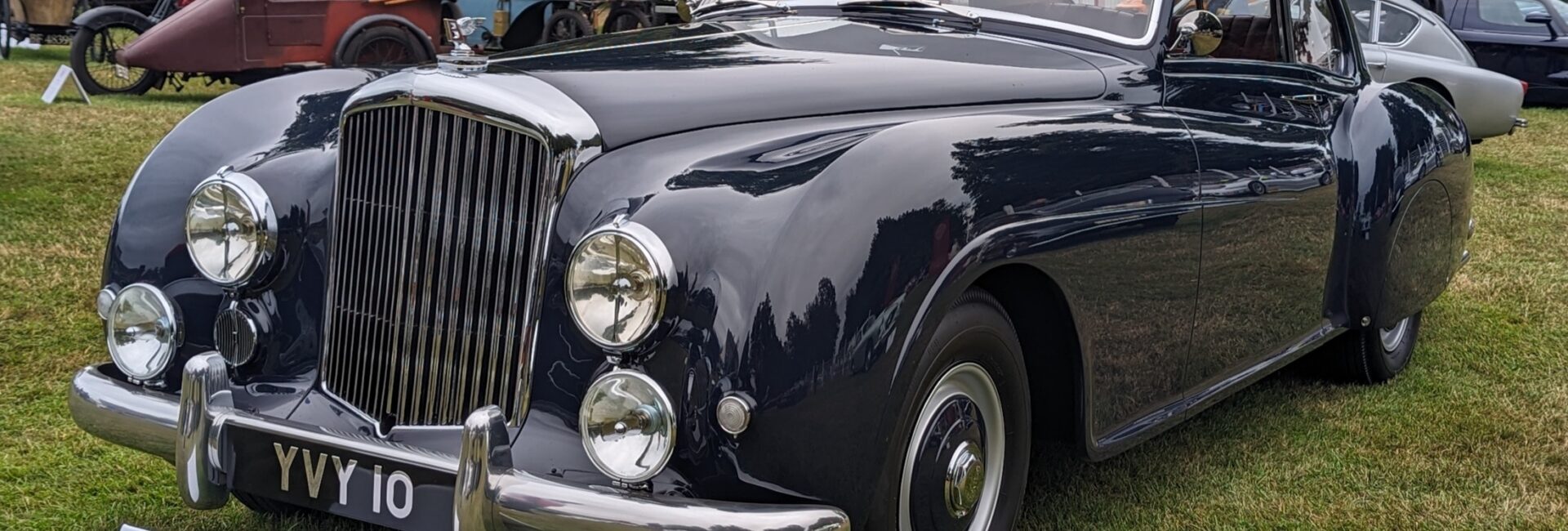
The Bentley R-Type Continental is one of the great milestones of post-war motoring. Produced from 1952 to 1955, it combined four genuine seats, grand touring comfort, and a top speed close to 185 km/h. Bentley records208 examples*, including 193 bodied by H.J. Mulliner. Auction houses sometimes refer to 207 production cars: the difference arises from whether the prototype “Olga” is included in the total or not.
In 2026, an authentic R-Type Continental is not defined solely by its fastback silhouette. Chassis, engine, bodywork, gearbox, original configuration, history, and restoration quality determine its value. Recent public sales show a very dispersed market, ranging from £320 000 to over 1,2 million dollars for cars with very different pedigrees and conditions. Therefore, each chassis must be evaluated individually, rather than applying a single valuation to the model.
Why did the R-Type Continental make history?
In the early 1950s, Bentley wanted to recapture the sporting spirit of its great pre-war touring cars without sacrificing refinement. Engineer Ivan Evernden and stylist John Blatchley worked on an aerodynamic coupé derived from the R-Type saloon. Their aim was not to create a racing car, but a vehicle capable of sustaining high speeds on European roads with four occupants and their luggage.
The approach was bold at the time. The bodywork had to be lighter and more streamlined than a traditional saloon. A scale model was tested in the wind tunnel of Rolls-Royce’s aeronautical division at Hucknall. The inclined grille, steeply raked windscreen, sloping roofline, enclosed rear wings, and small stabilising fins formed an immediately recognisable silhouette.
Bentley recalls that the prototype registered OLG 490, nicknamed “Olga”, ran from August 1951. On the Montlhéry circuit, it achieved an average of 118,75 mph over five laps, with a best lap just under 120 mph. Production began in May 1952 and the first deliveries followed in June.
Lightweight construction entrusted to H.J. Mulliner
The R-Type Continental was to remain under a target weight of approximately 1 750 kg, notably because the available tyres limited the weight-speed combination. H.J. Mulliner therefore made extensive use of aluminium: body panels, window frames, windscreen surrounds, seats, and even bumpers were lightened.
This construction explains both the elegance and complexity of the model. Aluminium can conceal old repairs, deformations, or electrolytic corrosion caused by contact with structures and fixings of another metal. A thorough inspection must not stop at the quality of the paint: it must examine alignments, fixing points, signs of repair, and the conformity of the lightweight components.
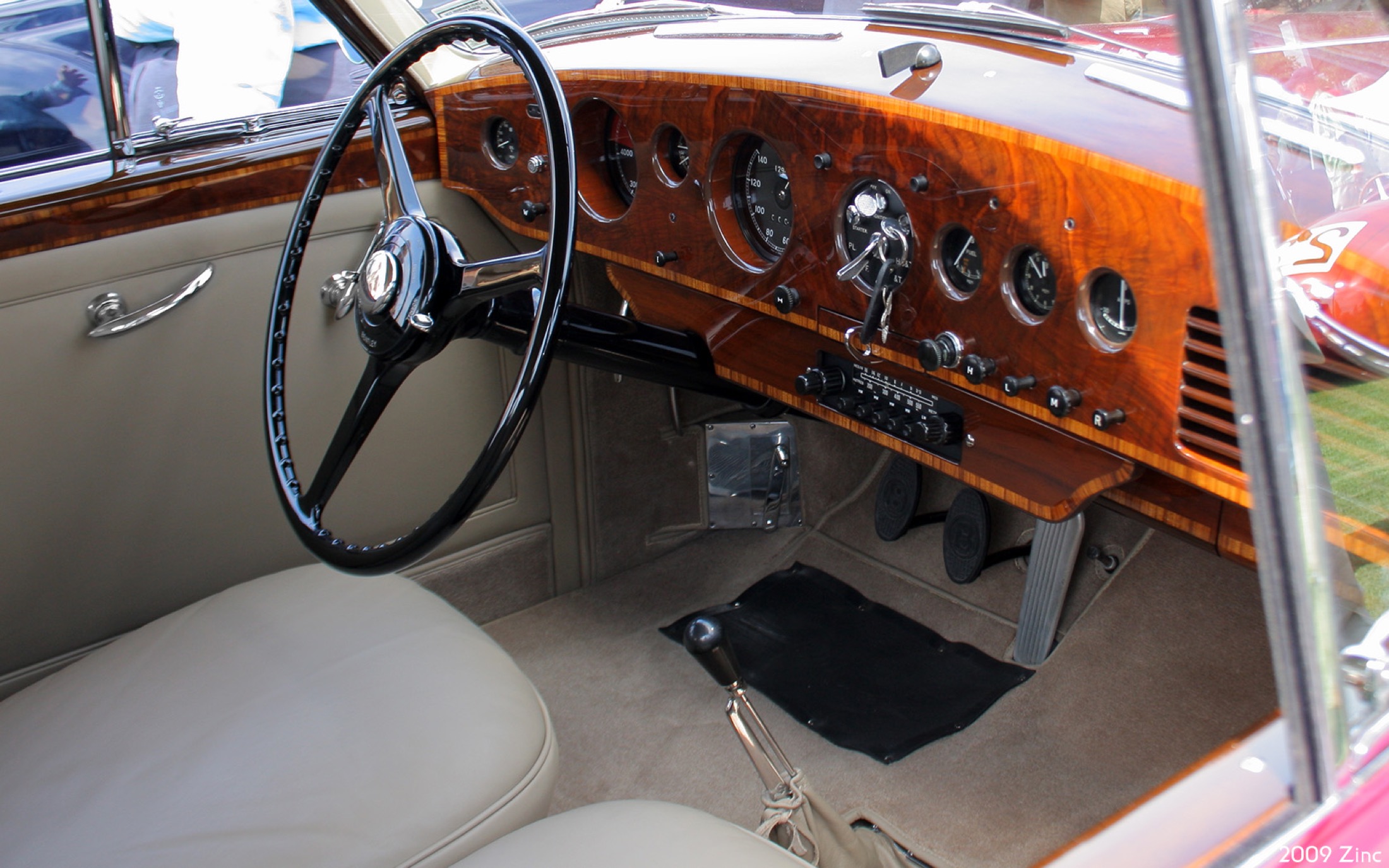
Interior of an R-Type Continental H.J. Mulliner: instrumentation, woodwork, and gear lever are among the elements to document. Photo: Rex Gray, Wikimedia Commons, CC BY 2.0.
4,6 litre engine, then 4,9 litres
The first cars received the inline six-cylinder of 4 566 cm³. Bentley states that its power was increased from 140 to 153 bhp, with a longer final drive ratio to exploit the aerodynamics and contained weight. The factory sheet highlights a practical speed of about 115 mph and the ability to cruise at 100 mph, exceptional performance for a four-seater of 1952.
During production, the bore was increased and the displacement rose to 4 887 cm³, commonly presented as 4,9 litres. This evolution maintained performance despite additional equipment chosen by some customers. An RM Sotheby’s announcement from 2026 recalls that this improvement was offered by the factory from July 1954.
However, one should not deduce a car’s specification from its calendar year alone. Chassis numbers, engine numbers, build sheets, and period invoices are essential. Some cars received a 4,9 litre engine later, sometimes as part of a coherent evolution, sometimes as a replacement of the original block. This distinction influences authenticity and value.
How many Bentley R-Type Continentals were produced?
The manufacturer’s source gives208 examples built*. In its anniversary dossier, Bentley distributes the bodyworks as follows:
| Coachbuilder | Number indicated by Bentley | Main Type |
|---|---|---|
| H.J. Mulliner | 193 | Fastback Sports Saloon |
| Park Ward | 6 | Four convertibles and two coupés |
| Franay | 5 | Special coachworks |
| Graber | 3 | Special coachworks |
| Farina | 1 | Unique example |
| Total* | 208* | All coachworks combined |
Why do some sources write 207? Several sales catalogues refer to 207 “production examples”, meaning series cars, whereas Bentley includes the prototype “Olga” in its total of 208. Both figures can therefore be consistent if their scope is specified. For an article or an appraisal, the safest wording is:208 cars in total according to Bentley, including 207 production examples if the prototype is counted separately*.
The H.J. Mulliner fastback overwhelmingly dominates production, but the minority coachworks are not merely decorative variants. They correspond to specific orders and architectures. Their rarity can increase interest, provided the identity and history of the coachwork are established without ambiguity.
R-Type or R-Type Continental: how not to confuse them?
The standard Bentley R-Type saloon and the Continental share a historical base, but they do not belong to the same value category. The Continental features a chassis and specification dedicated to high speed, a lightweight body, and, for the H.J. Mulliner fastbacks, an immediately recognisable architecture.
The first check concerns the chassis number. Continentals bear a “BC” prefix. RM Sotheby’s highlights this peculiarity on the BC30C chassis sold in 2026. The letters and suffixes also indicate the series and, where applicable, left-hand drive. A coupé resembling a Continental but built on a standard R-Type chassis is not a factory R-Type Continental.
Replicas and conversions can be appealing and well executed, but they must be described for what they are. The value of an original example rests precisely on the documented association of chassis, bodywork, mechanical group, and provenance.
Authenticity points to verify
Before a purchase, sale or valuation, a dossier must be compiled around the car. Even an excellent aesthetic inspection does not replace historical research.
1. The chassis and numbers
Check the chassis stamping, plates, engine number and coachwork references. Compare them with build sheets, registers and available archives. Any discrepancy may have a legitimate explanation, but it must be documented.
2. The Bodywork and Coachbuilder
Identify the design, body number and elements specific to H.J. Mulliner, Park Ward, Franay, Graber or Farina. Check the materials, welds, assemblies and repairs. A rebuilt or replaced body does not carry the same historical significance as a preserved original.
3. The Engine and Transmission
Determine whether the engine is the original unit, a correct period replacement, or a later substitute. Distinguish the 4,6 from the 4,9 litre and verify the gearbox: manual with floor shift or automatic according to specification. Comfort modifications — air conditioning, electric windows, power steering — may improve usability but must be disclosed.
4. The Interior and Light Equipment
The light seats, woodwork, instruments, trims, tools, jack, spare wheel and onboard documents all matter. A prestigious restoration is not automatically consistent with the original delivery configuration. Old photographs and factory records help differentiate a fine interpretation from a faithful restoration.
5. Provenance
A continuous ownership chain, old invoices, participation in concours and work carried out by recognised specialists strengthen confidence. Conversely, a lack of documentation does not necessarily imply a poor vehicle, but it increases the verification effort and uncertainty about value.
To secure this analysis, our guide explains the steps of a pre-purchase inspection of a classic car.
What is the value of a Bentley R-Type Continental in 2026?
There is no single price. Public results reflect the bodywork, left- or right-hand drive, gearbox, mechanical originality, restoration, provenance and sale context. Three documented transactions illustrate the range:
| Sale | Car | Published Result |
|---|---|---|
| RM Sotheby’s London, 2026 | 1954 H.J. Mulliner, chassis BC30C, replaced engine and modernised equipment | £320 000* |
| Gooding Christie’s Pebble Beach, 2026 | 1954 H.J. Mulliner, chassis BC38LC, left-hand drive, P & A Wood restoration, class prize at Pebble Beach | $1 215 000* |
| Bonhams Goodwood, 2024 | 1954 4,9 litre H.J. Mulliner, chassis BC38D, long ownership and mechanical work | £354 200*, fees included |
These figures do not constitute an automatic range. The Gooding result is for a car with a particularly sought-after configuration and pedigree; the RM result concerns a modified example with a non-original engine. The comparison mainly demonstrates that the market values the quality of the documentation as much as the model name.
To estimate a specific car, one must select close comparables: same bodywork, same drive side, same gearbox, consistent displacement, equivalent condition and recent sale date. Prices displayed by dealers should not be confused with prices actually achieved at auction or in private transactions.
If you own a classic Bentley, you canrequest a free valuation from Plethore Cars. Including chassis numbers, archives, invoices and detailed photographs helps avoid an overly generic appraisal.
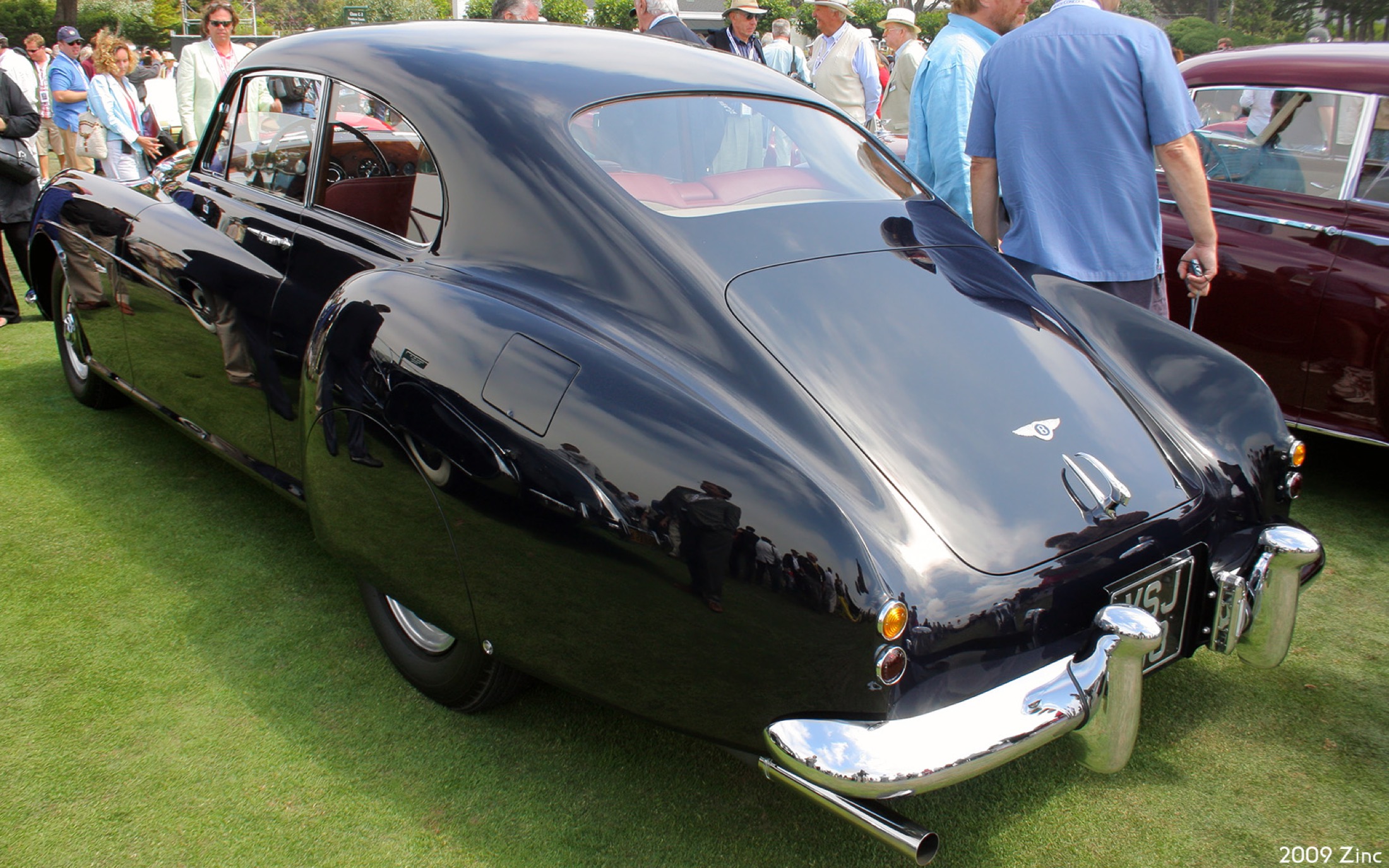
The fastback line, rear wings and wheel spats define the H.J. Mulliner silhouette. Photo: Rex Gray, Wikimedia Commons,CC BY 2.0.
What causes the value to rise or fall?
The strongest premium factors are an indisputable identity, a well-preserved historic bodywork, compliant mechanics, documented restoration and continuous provenance. Left-hand drive, a manual floor-shift gearbox or a rare configuration may attract certain markets, but do not alone guarantee a higher price.
Depreciation can result from a non-compliant engine, irreversible modifications, bodywork rebuilt without documentation, complex corrosion, missing specific parts or an old restoration needing renewal. The cost of a high-level refurbishment can be considerable because aluminium, woodwork, trims and mechanical components require rare skills.
An owner preparing a sale should gather archives before undertaking cosmetic work. A historic invoice or a found build sheet can add more value than a recent paint job without traceability. Plethore Cars also presentssolutions for selling a classic caronce the dossier preparation is complete.
A car made to be driven, but requiring serious checks
The R-Type Continental was designed for long distances. A properly restored car can still take part in rallies and tours, provided its maintenance is up to date. The engine, cooling system, power-assisted drum brakes, steering, bearings, tyres and electrical system deserve inspection appropriate to the vehicle’s performance level and value.
Low usage is not necessarily an advantage. Seals, fuel, brake fluid, hoses and cylinders can suffer from inactivity. Aluminium components must also be monitored at steel interfaces. A prolonged test run, compression measurement, cooling system check and inspection on a lift are preferable to a few minutes of cold starting.
For parts that have become difficult to obtain, consult our guide tospecialist websites for finding classic car parts. Rare parts must be verified by reference and not chosen solely on resemblance.
Why it remains an essential Bentley
The R-Type Continental defined a formula that Bentley still uses: a fast, comfortable, spacious and instantly recognisable grand tourer. The marque emphasises that the three major lines — power line, rear haunch and fastback roof — inspired the modern generations of Continental GT.
Its historical value also lies in its balance. It was neither simply a more powerful saloon nor a stripped-down sports car. It used aerodynamics, lightness and a flexible engine to reduce distances without exhausting its occupants. It is this coherence, more than the speed figure alone, that explains its status.
Collectors interested in the brand’s sporting history can also read our feature on theBentley Speed Six and the difference between original and continuation. For a broader purchasing intention, the selection ofclassic cars for sale on Plethore Cars allows you to compare the currently available offers.
FAQ about the Bentley R-Type Continental
How many Bentley R-Type Continentals were produced?
Bentley announces a total of 208 units between 1952 and 1955, including the prototype. Some auction houses list 207 production cars, counting “Olga” separately.
How many were bodied by H.J. Mulliner?
Bentley states 193 H.J. Mulliner bodies, mainly the famous Fastback Sports Saloon. The other 15 were bodied by Park Ward, Franay, Graber and Farina.
What engine powers the R-Type Continental?
The first cars used an inline six-cylinder of 4 566 cm³, rated at 153 bhp according to Bentley. A 4 887 cm³ version was later introduced during production.
What top speed could it reach?
Bentley gives a practical speed close to 115 mph, approximately 185 km/h. The prototype approached 120 mph on the Montlhéry circuit.
What does the BC prefix on the chassis mean?
It identifies an R-Type Continental chassis. A fastback body mounted on a standard R-Type chassis does not thereby become an original Continental.
How much is a Bentley R-Type Continental worth in 2026?
Prices vary greatly. Reported sales range from £320 000 to $1 215 000 depending on originality, restoration, configuration and provenance. An individual appraisal remains essential.
Main sources
- Bentley Motors — 70 Years of Continental: The Ultimate Grand Tourer
- Bentley Motors — Bentley Story, R-Type Continental
- RM Sotheby’s — 1954 Bentley R-Type Continental BC30C, London 2026
- Gooding Christie’s — 1954 Bentley R-Type Continental BC38LC, Pebble Beach 2026
- Bonhams — 1954 Bentley R-Type Continental BC38D, Goodwood 2024