
Since Brexit, buying a classic car in Great Britain and then registering it in France involves importing from a third country. It is necessary to secure the V5C and proof of sale, declare the vehicle to customs, obtain the 846 A certificate, justify its compliance or dating, undergo the technical inspection when required, and then submit the registration application to France Titres.
The most misunderstood point concerns taxes:a car purchased in the United Kingdom is not automatically exempt from customs duties because it is British, nor automatically admitted at the rate reserved for collectors’ items because it is 30 years old. Preferential origin and customs classification are two different demonstrations, assessed based on supporting documents.
Information verified on 5 October 2026 for the importation into metropolitan France of a used vehicle mainly from Great Britain — England, Scotland or Wales. Northern Ireland is subject to special rules: have the customs treatment of the file confirmed before purchase.
The procedure in 7 steps
- verify the identity, history, chassis number and British registration;
- obtain the complete V5C, the invoice or sales contract and proof of payment;
- determine before shipment the customs regime and the proofs of origin or collector status;
- organise transport and import declaration;
- pay the applicable duties and VAT, then collect the 846 A certificate;
- obtain the appropriate technical documentation: certificate of conformity, identification attestation, individual approval or FFVE attestation;
- include the technical inspection when required and apply for the first French registration on France Titres.
The order matters. A car already delivered in France without V5C, without proof of value or without customs documentation can become lengthy and costly to regularise.
Since Brexit, is the United Kingdom treated as a non-EU country?
For a vehicle shipped from Great Britain to France, yes: customs formalities have been necessary since the end of the transition period, on 1 January 2021. This does not mean that 10% duties are always due. The trade and cooperation agreement between the European Union and the United Kingdom provides for exemption for products that meet the rules of preferential origin.
Provenance does not prove origin. A German Porsche, an Italian Ferrari or a Japanese Datsun sold in London remains in principle of an origin different from the United Kingdom. Conversely, a car manufactured in the United Kingdom can benefit from the preference if its origin conditions are established and if the request is properly documented.
What customs duties and VAT should be expected?
| Customs situation | Customs duties | Import VAT | Essential condition |
|---|---|---|---|
| Ordinary vehicle without tariff preference | Generally 10% for a passenger car | 20 % | Tariff classification and value validated by customs |
| Vehicle of British preferential origin | Zero rate if preference is granted | 20 % | Proof of origin compliant with the EU–United Kingdom agreement |
| Vehicle recognised as a collector’s item, position 9705 | Exemption from duties according to this classification | 5,5 % | Customs criteria for collection met and classification accepted |
| Residence transfer meeting all conditions | Possible exemption | Possible exemption | Residence, duration of ownership, use and previous taxes justified |
This table presents common cases, not an advance customs decision. The tariff code, origin, condition, modifications and documents may alter the treatment. Request confirmation from the customs office or a customs representative before paying for the vehicle when the project’s savings depend on a reduced rate.
How is the taxable base calculated?
Customs indicate that the taxable value includes the vehicle’s value and, where applicable, ancillary costs such as transport, insurance or options. VAT is calculated on the customs value increased by customs duties when due.
For a purely arithmetic illustration, with a vehicle at 20 000 euros and 1 000 euros for transport:
- under the ordinary regime without preference, 10 % duties on 21 000 euros represent 2 100 euros; VAT at 20 % applied to 23 100 euros represents 4 620 euros, totalling 6 720 euros in duties and VAT;
- with accepted British preferential origin, duties may be zero and VAT at 20 % on 21 000 euros represents 4 200 euros;
- if customs accept classification as a collector’s item, VAT at 5,5 % on 21 000 euros represents 1 155 euros, with no customs duties under this classification.
These calculations exclude administrative fees, representation, storage, inland transport, compliance and registration costs. They do not bind the administration on the value retained.

Crossing the Channel does not replace the import declaration: formalities must be prepared before transport. Photo: Kolforn,Wikimedia Commons, licence CC BY-SA 4.0.
When can a classic car be taxed as a collector’s item?
The age of 30 years alone is not sufficient. European case law regarding the 9705 status notably considers vehicles that:
- are at least 30 years old;
- correspond to a model or type whose production has ceased;
- are preserved in their original condition, without substantial modification to the chassis, steering, braking, or engine;
- exhibit the characteristics of a collectible item, including relative rarity, specific transactions, and high value.
The decision lies with customs based on the file and the vehicle. A replica, kit-car, restomod, or heavily modified car should not be budgeted in advance at the collection rate. Customs criteria are not exactly synonymous with the “collector vehicle” designation on a French registration document.
The BOFiP in force since May 2025 confirms that the reduced VAT rate of 5,5% applies to imports of collectibles meeting the fiscal definition. It is therefore necessary first to demonstrate that the car falls into this category.
British origin: why a Jaguar is not automatically exempt
The EU–UK agreement removes duties for products originating from one party, subject to compliance with preferential origin rules. The mere fact that a car has a British brand, right-hand drive, or a V5C alone does not constitute sufficient proof.
Before purchase, ask the seller or your customs declarant what proof will be used: certificate of origin on commercial documents or, when conditions are met, the importer’s knowledge. French customs emphasise the necessity of being able to justify the economic origin of the product. For an older vehicle whose documentary chain is incomplete, this proof may be more difficult to assemble than a brochure or manufacturer’s plate.
Which documents to require from the British seller?
The complete V5C
The British government indicates that in the case of permanent export, the seller must complete and send to the DVLA the part provided for this purpose, then hand over the remainder of the V5C to the buyer. For a vehicle purchased to be registered abroad, the buyer must not leave with only the “new keeper” slip.
Check the consistency between:
- the chassis number stamped on the vehicle;
- the VIN or serial number shown on the V5C;
- make, model, engine capacity, date, and registration;
- identity of the seller or the professional’s authority to sell the vehicle.
The DVLA advises against buying a vehicle without a V5C. A file without a British title can also be much more difficult to have accepted in France.
The invoice or sales contract
The document must identify the seller, buyer, car, chassis number, price, currency, date, and terms of sale. Also keep proof of payment, the advertisement, correspondence, and photographs taken during inspection.
Elements of origin and authenticity
To request preferential treatment or collector classification, gather before departure: manufacturer’s certificate, archives, previous title, restoration file, technical sheets, and detailed photographs. An expert or brand club can help document identity, but only the competent authority decides on fiscal or administrative classification.
How to transport the car to France?
There are two options: bring it back by road or have it transported. In both cases, anticipate the customs declaration and proof of insurance coverage.
For a road return, the British plates must be valid and the vehicle must comply with the requirements applicable to its circulation in the United Kingdom and during the journey. Do not assume that the seller’s insurance continues after the sale. Obtain written confirmation from the insurer covering precisely the driver, the VIN, the countries crossed and the dates.
Transport on a flatbed reduces mechanical risk and insurance difficulties, but does not eliminate any customs formalities. Give the carrier precise instructions on the entry office, the declaration and the documents that must accompany the car.
The 846 A certificate: the document not to lose
After customs clearance, customs issues a declaration, a receipt and the customs clearance certificate 846 A. This document proves, for registration purposes, that the customs status of the vehicle has been regularised.
Since the United Kingdom is outside the European Union for this flow,a tax clearance certificate intended for intra-community acquisitions does not replace the 846 A. This confusion leads to many incomplete files. If the vehicle entered the Union through another Member State, ask the declarant for the necessary free circulation documents for French registration.
Compliance, FFVE or individual approval: which route to choose?
The route depends on the age, original approval, condition and modifications.
Certificate of conformity or identification certificate
For a car whose type has an approval valid in France, the manufacturer or its representative can provide a European certificate of conformity or an identification certificate. However, an older British car may not have a complete European COC, notably depending on its date or national specification.
Individual approval with the DREAL
When the car cannot be identified to an approved type, individual approval may be necessary. The DREAL determines the required documents and inspections. Modifications, lighting, braking, glazing, noise or equipment may be examined depending on the file.
FFVE certificate and classic vehicle registration
For a vehicle at least 30 years old that meets the conditions, the FFVE can issue a dating and characteristics certificate. The Federation specifies that this certificate is not a registration document and does not guarantee the granting of classic use: the final decision belongs to the registration authorities.
For a vehicle imported from outside the EU, the FFVE notice notably requests the 846 A document or the appropriate customs proof, the foreign title, proof of ownership and photographs allowing identification of the car and its serial number.
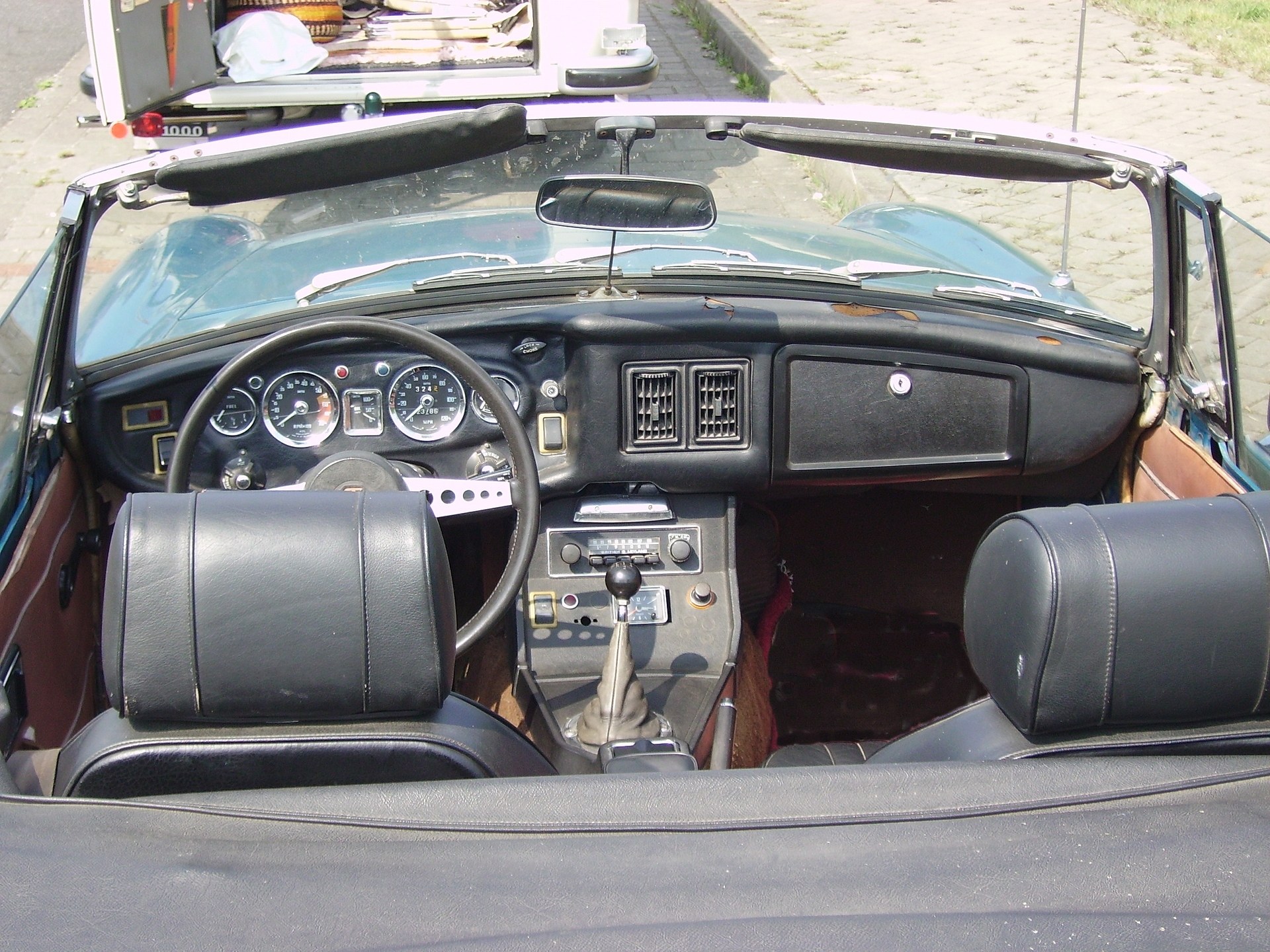
Right-hand drive does not in itself prevent French registration, but the conformity of the entire vehicle must be established. Photo: Pujanak, Wikimedia Commons, public domain.
Which documents to attach to the registration application?
The list depends on the case, but prepare at least:
- V5C or original foreign title;
- invoice or sales contract and proof of ownership;
- 846 A certificate;
- proof of identity and residence;
- registration application form;
- certificate of conformity, identification certificate, RTI or FFVE certificate depending on the chosen procedure;
- valid technical inspection when the vehicle is subject to it;
- insurance certificate and driving licence corresponding to the vehicle category;
- certified translations when required by the administration or the processing body.
The application is made on France Titres as part of the first registration process in France for a used vehicle acquired abroad. Service-Public reminds that the request for the new certificate must be made within one month following the purchase.
What is the real cost of importing?
The budget is not limited to the price displayed in pounds sterling. Add:
- currency exchange and bank fees;
- pre-purchase inspection and possible appraisal;
- transport, ferry or tunnel, fuel and insurance;
- customs agent and administrative fees;
- customs duties and VAT;
- manufacturer’s certificate, DREAL or FFVE certificate;
- technical inspection and conformity corrections;
- registration certificate, number plates and possible penalty depending on the tax situation;
- mechanical servicing after transport.
Compare the cost delivered in France with an example already registered, taking into account right-hand drive and resale liquidity. Theclassic and prestige cars for saleprovide a useful point of comparison, even though a listed price does not guarantee the final transaction price.
The most common mistakes
- buy without a complete V5C;
- confuse the country of origin with preferential origin;
- budget 5,5 % VAT solely because the car is over 30 years old;
- pay before verifying the VIN, the seller, and the possibility of registration;
- allow the carrier to cross the border without clear customs instructions;
- request a tax clearance certificate instead of the 846 A certificate;
- undertake restoration or modifications before identifying and photographing the vehicle;
- believe that the FFVE certificate replaces customs, the technical inspection, or the registration document.
If you are comparing several countries, consult our guides dedicated to importing a classic car from the United States, to importing from Switzerland and the procedures for buying a classic car without registration documents.
Checklist before paying a deposit
- the V5C exists and the numbers match;
- the seller is identified and authorised to transfer the car;
- the condition and modifications have been inspected;
- the value and transport costs are documented;
- the customs regime has been validated with the available supporting documents;
- the proof of preferential origin is acceptable, if claimed;
- the criteria for classic classification have been examined without assuming it is granted;
- the French compliance route has been identified;
- insurance and transport are confirmed in writing;
- The budget includes taxes and a margin for work.
Frequently Asked Questions
Is it necessary to pay 10 % customs duty on an English car?
Not necessarily. The rate can be zero if British preferential origin is proven and accepted, or if the vehicle is classified as a collector’s item. Without preferential origin or special classification, the standard duty rate for a passenger car is generally 10 %.
Does a car over 30 years old automatically benefit from VAT at 5,5 %?
No. Age is an important criterion, but customs also consider the end of production, original condition, modifications, and characteristics specific to collector’s items.
Is a tax clearance certificate required for a car purchased in England?
For an import from Great Britain after Brexit, the expected customs document is normally the 846 A certificate. The tax clearance certificate applies to acquisitions from another European Union member state.
Can a car with right-hand drive be registered in France?
Yes, the position of the steering wheel alone does not constitute a refusal. However, the vehicle must follow the applicable conformity procedure and meet the requirements examined for its registration.
Is the FFVE certificate sufficient to obtain the registration document?
No. It establishes the dating and characteristics for a collector use application, but it does not replace the 846 A certificate, other supporting documents, or the decision by France Titres.
Can the car be driven back by road?
Yes, if the registration, plates, applicable inspection, and insurance remain valid for the entire journey. Have the coverage confirmed in writing; otherwise, opt for professional transport.
Sources
- French Customs — purchasing a vehicle abroad: documents, taxation, customs value, formalities and 846 A certificate.
- French Customs — concept of originating product in the EU–United Kingdom agreement: exemption conditioned on preferential origin rules.
- BOFiP — works of art, collectibles or antiques: VAT at 5,5 % for imports of collector’s items meeting the fiscal definition.
- EUR-Lex — ruling concerning vehicles under heading 9705: criteria of age, origin, rarity and historical interest.
- Service-Public — registering a used vehicle : timeframe, foreign documents, technical inspection and proof of compliance.
- France Titres — used vehicle purchased abroad : vehicle registration online service.
- FFVE — obtaining a dating and characteristics certificate : scope of the certificate and classic car procedure.
- GOV.UK — permanently exporting a vehicle : V5C, permanent export section and seller obligations.