Importing a classic car from Switzerland into France requires a customs clearance, as Switzerland is not part of the European Union. The buyer must secure the Swiss documents, declare the vehicle to customs, obtain the certificate 846 A, then gather the technical documents necessary for French registration. A car over thirty years old does not automatically receive the customs treatment reserved for collectibles.
The decisive point occurs before payment: it is necessary to determine the probable customs classification, the taxable value, and the registration route. An attractive price can lose all appeal if the vehicle is incomplete, heavily modified, or lacks the necessary Swiss document.
Quick answer: Switzerland is a third country relative to the European Union. To register in France a car purchased in Switzerland, the file generally includes the Swiss title, proof of purchase, the customs certificate 846 A, a certificate of conformity or an attestation of dating and characteristics, a technical inspection when required, insurance, and the usual documents for France Titres.
Information verified on 23 September 2026 for an import by a private individual into metropolitan France. The tariff classification and taxes depend on the vehicle, its origin, and the evidence provided: request written confirmation from customs for a valuable automobile.
The eight-step procedure
| Step | Key document or decision | Main risk |
|---|---|---|
| 1. Identify the car | Chassis number, Swiss title, history | Buying a poorly described or non-registrable car |
| 2. Verify the seller | Identity, ownership, invoice or contract | Paying a person who cannot transfer the vehicle |
| 3. Choose the French route | Standard conformity, RTI or collection | Confusing age with administrative acceptability |
| 4. Confirm the taxation | Customs classification and value | Budgeting for a reduced rate not granted |
| 5. Organising Export and Transport | Plates, Insurance, Car Carrier or Transporter | Driving Without Road Tax or Insurance Coverage |
| 6. Customs Clearance | Declaration, Payment, 846 Certificate A | Leaving Without the Necessary Document for Registration |
| 7. Inspection and Documentation | Certificate, Technical Inspection, Repairs | Modifying the Vehicle Before Its Identity Is Finalised |
| 8. Registration | Consistent France Titres File | Discrepancies in Names, Dates or Serial Number |
1. Inspect the Car Before Signing in Switzerland
Start by comparing the chassis number stamped on the vehicle with the Swiss registration certificate, the manufacturer’s plate, invoices and the contract. Photograph the markings without cleaning them aggressively. A single character error can successively block customs clearance, the technical certificate, inspection and registration.
Ask the seller for:
- the original Swiss registration certificate and any accompanying parts;
- an invoice or dated contract indicating the identities, addresses, price, currency, make, model and serial number;
- proof that they are authorised to sell the vehicle;
- maintenance, appraisal and restoration documents;
- information on any modifications;
- the procedures for deregistration or export planned in the relevant canton.
The validity of the foreign title must be verified before paying a deposit. An FFVE certificate does not replace proof of ownership, the customs certificate, or any missing Swiss document. Our dossier onpurchasing a classic car without registrationexplains why an unclear provenance remains a risk even for a vehicle eligible for classic status.
2. Switzerland and the European Union: why the 846 A is necessary

Switzerland participates in numerous European agreements, but it remains outside the EU Customs Union. A vehicle entering France from Switzerland must therefore be presented to customs, except under a documented special regime.
After completing the formalities and paying any sums due, customs notably issues the customs clearance certificate 846 A. The General Directorate of Customs specifies that this document proves the payment of duties and taxes and must be presented for registration.
The 846 A does not certify the technical compliance of the car. Nor does it prove that it will obtain a classic vehicle registration certificate. It solely attests to its customs status. Conversely, a certificate from the manufacturer or the FFVE does not regularise an import that has not been cleared through customs.
Tax clearance certificate or 846 A certificate?
The tax clearance certificate concerns vehicles coming from another EU Member State. For a vehicle coming directly from Switzerland, a third country, the expected proof is normally the 846 A or a mention of exemption.Service-Public explicitly distinguishes these two situations in the list of documents for a classic vehicle file.
3. What customs duties and VAT should be anticipated?
There is no single rate applicable to all classic cars coming from Switzerland. Two scenarios must be distinguished.
Used vehicle classified as an ordinary automobile
A used car that does not meet the customs criteria of a collector’s item generally falls under the regime applicable to vehicles of its tariff classification. Duties depend on the classification and demonstrated customs origin; French VAT at the standard rate generally applies on the import base.
Do not deduce a car’s origin from its place of sale. A Porsche registered in Switzerland is not automatically of preferential European origin, and its age alone does not provide proof of origin. The rules of origin, admissible proofs and applicable agreements must be confirmed by customs or the representative submitting the declaration.
Vehicle classified as a collector’s item under chapter 97
A vehicle that may fall under tariff position 9705 benefits from a different regime. Current tax doctrine provides for VAT of 5,5 % for the importation of collector’s items meeting the applicable definition. Classification under chapter 97 may also lead to exemption from customs duties.
But “more than 30 years” is not sufficient. The European case lawspecifically considers the original condition without substantial changes to the chassis, steering, braking, or engine, an age of at least thirty years, and a model that is no longer in production. The item must also exhibit the characteristics of a collectible object and have historical or ethnographic interest in the customs sense.
A replica, a restomod, a heavily modified car, or a vehicle still used as an ordinary automobile may not fall under this classification. Obtain an opinion before purchase: the customs service decides based on the file and the vehicle, not the advertisement text.
| Scenario considered | What must be confirmed before purchase |
|---|---|
| Ordinary used vehicle | Tariff classification, origin, possible duties and standard VAT |
| Collector vehicle in the customs sense | Eligibility for position 9705 and reduced VAT of 5,5 % |
| Moving from Switzerland | Exemption conditions, holding period and temporary prohibition on transfer |
| Modified vehicle | Risk of refusal under chapter 97 and difficulty of French compliance |
4. On what value are the taxes calculated?
The base is not necessarily the sole amount written on a handwritten contract. The customs value normally starts from the transaction when acceptable and may include certain transport and insurance costs up to the relevant point. For VAT, the tax base also follows specific rules.
Customs may request evidence: bank payment, invoice, appraisal, advertisement, photographs, history and market references. Its dedicated sheet on thecustoms value of used vehiclesprovides comparison methods for sports and collector cars when the transaction value cannot be accepted.
A car sold at a low price because it requires restoration must be documented with dated photographs, a joint condition report and estimates. Declaring an artificially low price exposes one to adjustment; paying in cash without proof then makes the value harder to defend.
5. How to bring the car from Switzerland?
Three common options exist: transport on a flatbed, a professional carrier, or a road trip with valid plates and insurance. The best solution depends on the canton, vehicle deregistration, its ability to circulate and available guarantees.
Before setting off, confirm in writing:
- the validity of the Swiss plates after sale;
- the existence of insurance covering specifically the driver, the vehicle and the journey to France;
- the Swiss export formalities;
- the French customs office where the declaration will be made and its opening hours;
- the documents and accepted payment methods;
- the actual mechanical condition of the car.
Do not use the seller’s plates based on a mere verbal agreement. For an older car that has not been driven recently, a trailer is often safer: tyres, brakes, cooling and fuel supply can prove faulty on the first journey.
6. Standard registration certificate, individual approval or classic car registration?
Customs clearance does not decide the registration route. This decision depends on the age, characteristics, conformity documents and condition of the vehicle.
Standard registration with recognised conformity
When a European certificate of conformity, an identification certificate or an accepted document precisely describes the version, the file can follow a standard route. However, Swiss models are not always identical to the versions approved in the European Union.
Individual approval
In the absence of an acceptable conformity document, individual approval from the Dreal may be necessary. It may require supporting documents and technical adaptations. Do not replace lights, glazing or other elements before identifying the procedure and requirements corresponding to the vehicle.
“Classic vehicle” designation
To request this designation, the vehicle must be at least thirty years old, no longer in production and must not have undergone modifications to its technical characteristics.Service-Public specifically requires a certificate issued by the manufacturer, its representative in France or the FFVE.
TheFFVE certificate dates and describes the car; it is not a registration certificate and does not guarantee the final acceptance by France Titres. Our comparisonFFVE certificate or manufacturer’s certificate helps to choose the source capable of precisely documenting the example.
7. Technical inspection and France Titres file
For a private car purchased abroad, the technical inspection must be organised according to the age, requested status and available documents. In a classic car file, Service-Public indicates that a report less than six months old may be required for a vehicle under 3,5 tonnes first registered from 1 January 1960, as well as in certain first-time application situations.
The digital file may notably include:
- proof of identity and residence;
- registration application form;
- Swiss certificate and proof of ownership;
- customs certificate 846 A or exemption;
- certificate of conformity, identification certificate, RTI or collection certificate depending on the chosen route;
- valid technical inspection when required;
- proof of insurance and corresponding licence;
- translations required for foreign documents;
- mandate if an authorised professional is involved.
Names, numbers and dates must be identical throughout the entire file. A discrepancy between the invoice, the 846 A, the Swiss title and the certificate often triggers a supplementary request.
8. What is the actual cost of importing from Switzerland?
The total budget is not limited to the price and VAT. Add:
- the purchase price and bank charges related to currency exchange;
- Swiss export formalities or plates;
- transport and its insurance;
- fees for any customs representative;
- customs duties according to classification and origin;
- import VAT according to the chosen regime;
- manufacturer’s certificate, FFVE or RTI;
- technical inspection;
- modifications and repairs;
- registration certificate and French insurance.
Allow a reserve for parts and immediate maintenance. A car rarely used in Switzerland may be very well preserved, but low mileage does not protect seals, hoses, tyres, fluids and braking systems.
To compare the imported price with the French market, consult the classic and prestige cars for sale on Plethore Cars. Compare examples of the same version, condition, origin and level of documentation; a listed price is not a transaction price.
The most costly mistakes
- paying before verifying the Swiss title and chassis number;
- believing that Switzerland is treated like a European Union country;
- requesting a tax clearance certificate when the file requires a 846 A;
- automatically budgeting for reduced VAT because the car is thirty years old;
- confusing customs classification 9705 with the French classic car registration certificate;
- neglecting customs origin and its proofs;
- importing a modified car without validating its conformity;
- undertaking restoration before fixing the identity and administrative route;
- crossing the border with the seller’s plates without confirmed coverage;
- under-declaring the price or paying without usable proof.
The method is similar to that of an import from outside the EU, but land transport and Swiss documents create their own constraints. Our guide onimporting a classic car from the United Statesallows comparison of the common steps without blindly applying the maritime section.
Frequently asked questions
Is VAT payable in France for a car purchased in Switzerland?
In principle, an import from Switzerland is subject to French taxation upon entry. The rate and any duties depend on customs classification, origin and supporting documents. An admissible collector’s item may be subject to VAT at 5,5 %, but this treatment is not automatic.
Is a Swiss car over thirty years old automatically classified as a classic?
No. Age is only one of the criteria. Customs notably examines original condition, model production cessation and historical interest according to position 9705. The French classic car registration certificate follows a different procedure.
Is a tax clearance certificate required for a car coming from Switzerland?
The document normally requested for a vehicle imported from a third country is the customs certificate 846 A or an exemption. The tax clearance certificate concerns intra-community acquisitions.
Can you drive the car back from Switzerland by road?
Only with valid plates, a circulation authorisation and insurance for export and the journey. Rules vary depending on the situation and canton. Without written confirmation or if the car’s condition is uncertain, use a transport trailer.
Does the FFVE certificate replace the certificate of conformity?
It can support an application for a registration certificate with the mention “vintage vehicle” when the vehicle is eligible. It does not replace the 846 A and is not itself a registration document.
Which document proves that taxes have been paid?
The customs clearance certificate 846 A issued by customs is the central proof required for the registration of a vehicle coming from Switzerland.
A successful import must be prepared before the sale.
The correct sequence is simple: identify the vehicle, verify the title and the seller, choose the French route, confirm the taxation, organise transport, clear customs, obtain the technical documents, then submit a coherent file. Changing this order easily turns a beautiful car into a stalled project.
For a rare or expensive car, send anonymised copies of the title, the proposed contract, photographs and specifications to the competent professional before payment. A written response from customs, the manufacturer or the FFVE costs less than a dispute after crossing the border.
Main sources
- French Customs — Purchase of a vehicle abroad or in an overseas department or territory: customs clearance and certificate 846 A.
- French Customs — Determination of the customs value of used vehicles: valuation methods.
- BOFiP — VAT regime for collectibles: reduced rate of 5,5 % applicable to eligible imports.
- EUR-Lex — Case C-259/97: criteria for a vintage vehicle in the tariff sense.
- Service-Public — Registration certificate for vintage vehicles: conditions and required documents.
- FFVE — Obtaining a dating and characteristics certificate: role and application for the certificate.
Photo credits
- Featured image: Srdjan Marincic,historic route of the Saint-Gothard Pass_high_in_the_Swiss_Alps.JPG), CC BY-SA 3.0 licence.
- Swiss border sign: Tohaomg, Wikimedia Commons, CC licence 0.
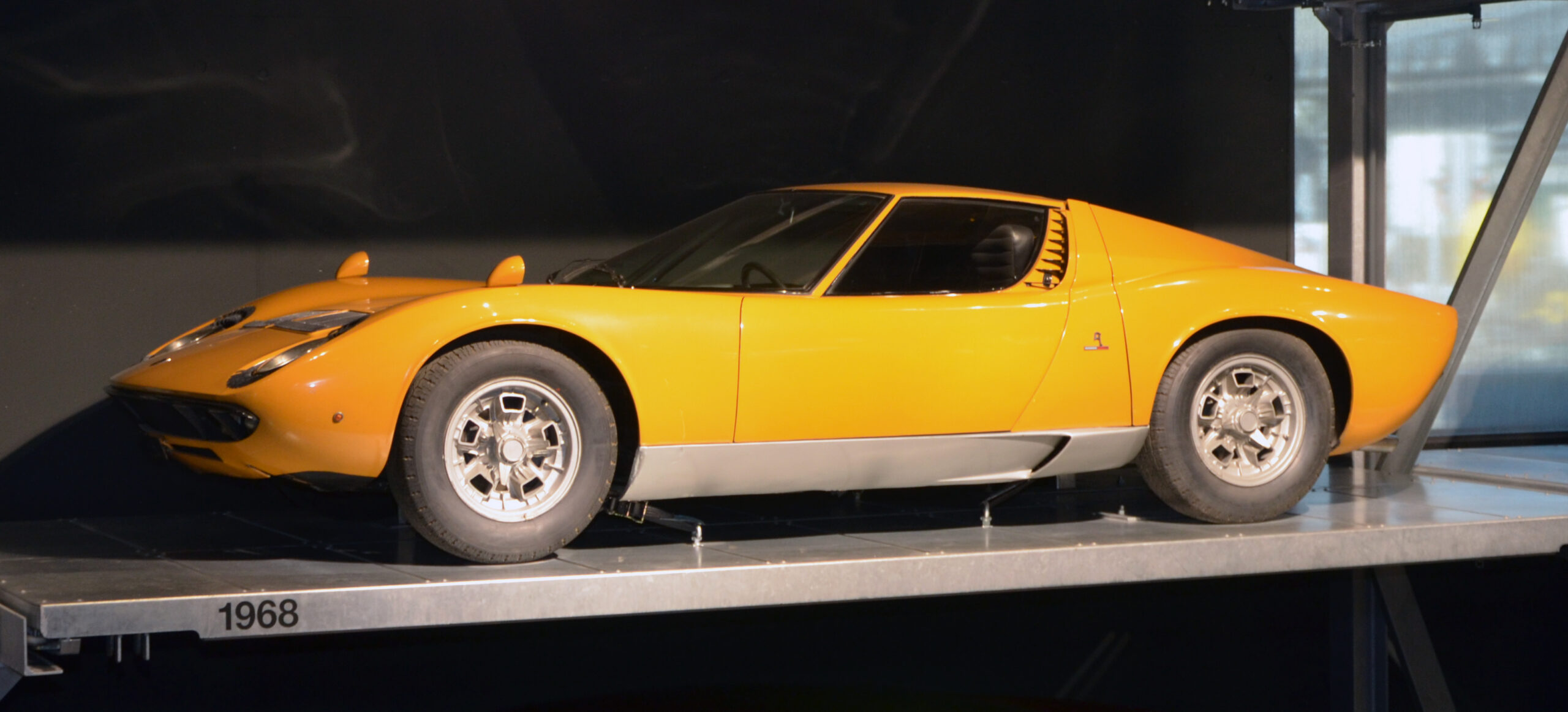
- Lamborghini Miura at the Swiss Museum of Transport: Gzzz, Wikimedia Commons, CC BY-SA licence 3.0.