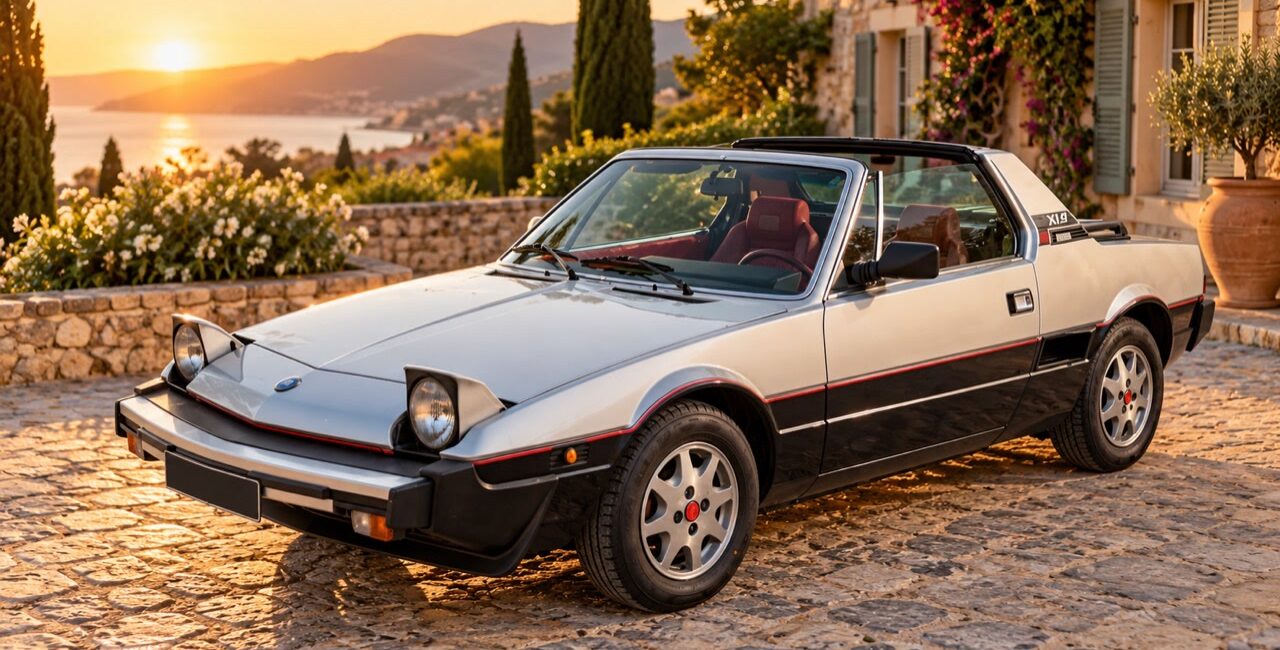
The X1/9 was born at Bertone, was initially sold under the Fiat brand from 1972 to 1982, then continued its career solely under the Bertone name until 1989. The most frequently documented figures report approximately 140 500 Fiat X1/9 and 19 500 Bertone X1/9, that is nearly 160 000 examples. Fiat Heritage, for its part, records a rounded total of about 150 000 cars: it is therefore more accurate to speak of an order of magnitude rather than a definitive number down to the chassis.
With its transverse mid-engine, removable targa roof and sharp line designed by Marcello Gandini, this small sports car made an architecture that was previously exotic accessible to a much wider audience. The example illustrated here has belonged to the same owner for several years and is regularly maintained, according to the information provided with the photograph. However, it features wheels that are not original to its factory fitment: an important detail for understanding, documenting and potentially restoring an X1/9 to its factory configuration.
From the Autobianchi Runabout to the Fiat X1/9
The story begins in 1969 with the Autobianchi A112 Runabout, a concept designed by Marcello Gandini for Bertone. Its very low silhouette, geometric design and engine placed behind the occupants directly foreshadow the future X1/9. Fiat adopted the idea and presented the production model at the end of 1972.
The name does not follow Fiat’s usual commercial nomenclature: “X1/9” is the internal project code. Beneath the spectacular bodywork lies mechanicals derived from mass-production models. The four-cylinder 1 290 cc engine is derived from the Fiat 128, but it is installed transversely in a rear mid-engine position and drives the rear wheels. The car features four disc brakes, independent suspension, two boot compartments and a removable roof panel that stows under the front bonnet.
This formula explains much of its charm. The power remains reasonable, but the weight is contained and concentrated near the centre of the car. The X1/9 therefore prioritises balance, driving precision and maintaining speed through corners rather than brutal acceleration.
Fiat, then Bertone: who actually manufactured the X1/9?
The answer requires nuance. From 1972 to 1982, the bodies were built at Bertone, then transported to Fiat to receive the mechanical components and finishing. The car was then marketed as Fiat X1/9.
In 1982, Fiat wished to discontinue the model. Bertone still believed in its potential and took full responsibility for manufacturing as well as marketing. The Fiat badges gave way to Bertone badges, notably visible on the bonnet and rear pillars. The car officially became the Bertone X1/9, even though its architecture and mechanicals remained closely linked to Fiat.
This transition was therefore not a simple badge change. It marked the moment when the coachbuilder who had designed and produced the body took charge of the entire vehicle. Production continued until 1989, with different trims depending on the country, including the VS, SE and Gran Finale.
How many examples of the Fiat and Bertone X1/9 were produced?
| Period | Brand carried by the car | Commonly cited production figures |
|---|---|---|
| 1972-1982 | Fiat X1/9 | Approximately 140 500 units |
| 1982-1989 | Bertone X1/9 | Approximately 19 500 units |
| Total | Fiat and Bertone | Approximately 160 000 units |
These figures, cited by several publications and experts, do not exactly match the total of approximately 150 000 units communicated by Fiat Heritage in 2022. Other sources suggest even higher totals. The discrepancies may arise from counting methods, model years, cars assembled for certain markets, or rounded historical data.
The reasonable conclusion is as follows: the X1/9 was produced inapproximately 160 000 units over seventeen years, including just under 20 000 under the Bertone brand alone. This latter phase is therefore significantly rarer than the Fiat period, without making every Bertone X1/9 a limited edition.
Main developments: 1300, 1500 and Bertone series
| Version | Indicative period | Engine | Gearbox | Advertised European power output |
|---|---|---|---|---|
| X1/9 1300 | 1972-1978 | 1 290 cm³ | Manual 4 speeds | 75 hp |
| X1/9 1500 | 1978/1979-1989 | 1 498 cm³ | Manual 5 gears | 85 hp |
Dates and power outputs may vary depending on the market and emission standards. North American cars, in particular, received specific equipment and settings, with lower power outputs in certain years.
The switch to 1 500 cm³ mainly brings greater flexibility and a welcome fifth gear for road use. During the Bertone period, the trims were enhanced: two-tone paintwork, more luxurious upholstery, electric windows and alloy wheels appeared depending on the series and countries. The VS is specifically known for its two-tone presentation, alloy wheels and more complete equipment. However, identifying a particular example should always be based on its chassis number, manufacturer’s plate, year and documentation, as configurations evolved and parts were replaced over time.
The photographed example: a well-maintained Bertone, but with non-original wheels
The car provided by its owner features several markers of late X1/9 models: Bertone badges, two-tone presentation, black targa roof, wrap-around bumpers and red interior. It has been kept for several years by the same owner, who takes good care of it. Without a chassis number, first registration date or manufacturer’s plate, however, it would be unwise to assign it a precise year or series.
The wheels visible in the photograph do not correspond to the Bertone wheelsets usually documented for the X1/9. According to the information provided, they come from a Lancia and bear Abarth scorpion centre caps. Their design with rounded openings gives the car a more recent look, but the central logo alone is not enough to identify their manufacturer or original model.
To establish their exact origin, one must remove a wheel and note on its inner face:
- the manufacturer’s brand;
- the width and diameter, for example 5Jx13 or 6Jx14;
- the offset, indicated by “ET”;
- the bolt pattern, normally 4×98 on an X1/9;
- the moulded or stamped reference;
- any manufacturing date.
This check also allows verification that the offset, width, tyres and bolts are compatible. A wheel that fits mechanically can alter geometry, load bearings, rub in the wheel arches or distort the original appearance.
A correctly sized wheel modification is generally reversible, but it must be declared if it changes the vehicle’s technical characteristics. Our guide on modifications, approval and the registration document for a classic car details the administrative points to check.
What do the original wheels of a Bertone X1/9 look like?
There is not a single wheel suitable for all X1/9 models. The fit depends on the year, trim and market. Early Fiats received various steel or alloy wheels of 13 inches. The 1500 and Bertone series also used several designs, including Cromodora wheels and, on some late versions, multi-hole alloys sometimes called “telephone”.
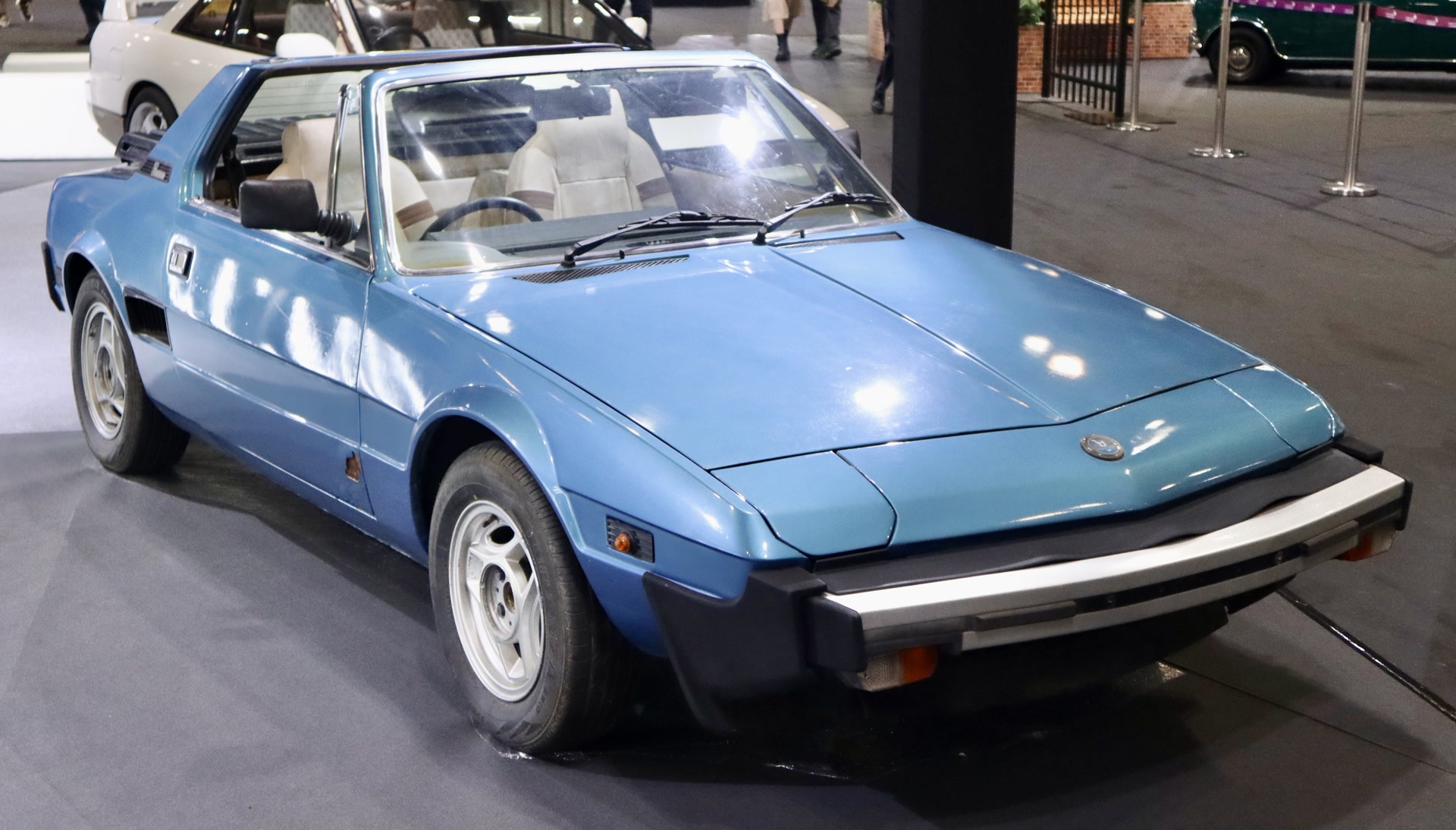
This Bertone X1/9 from 1982, documented at the International MotorXpo in Hong Kong, shows a period configuration with small 13 inch alloy wheels. Photo: User3204, Wikimedia Commons, CC BY-SA 4.0, image resized.
Specialist clubs notably report Speedline wheels with 16 holes on certain Bertone X1/9 IN models, while the Sport versions from the second half of the 1980s may be fitted with specific tyres in 185/60 R13. Brochures and parts catalogues remain essential, as equipment varies depending on the destination, and Bertone sometimes used different stock towards the end of production.
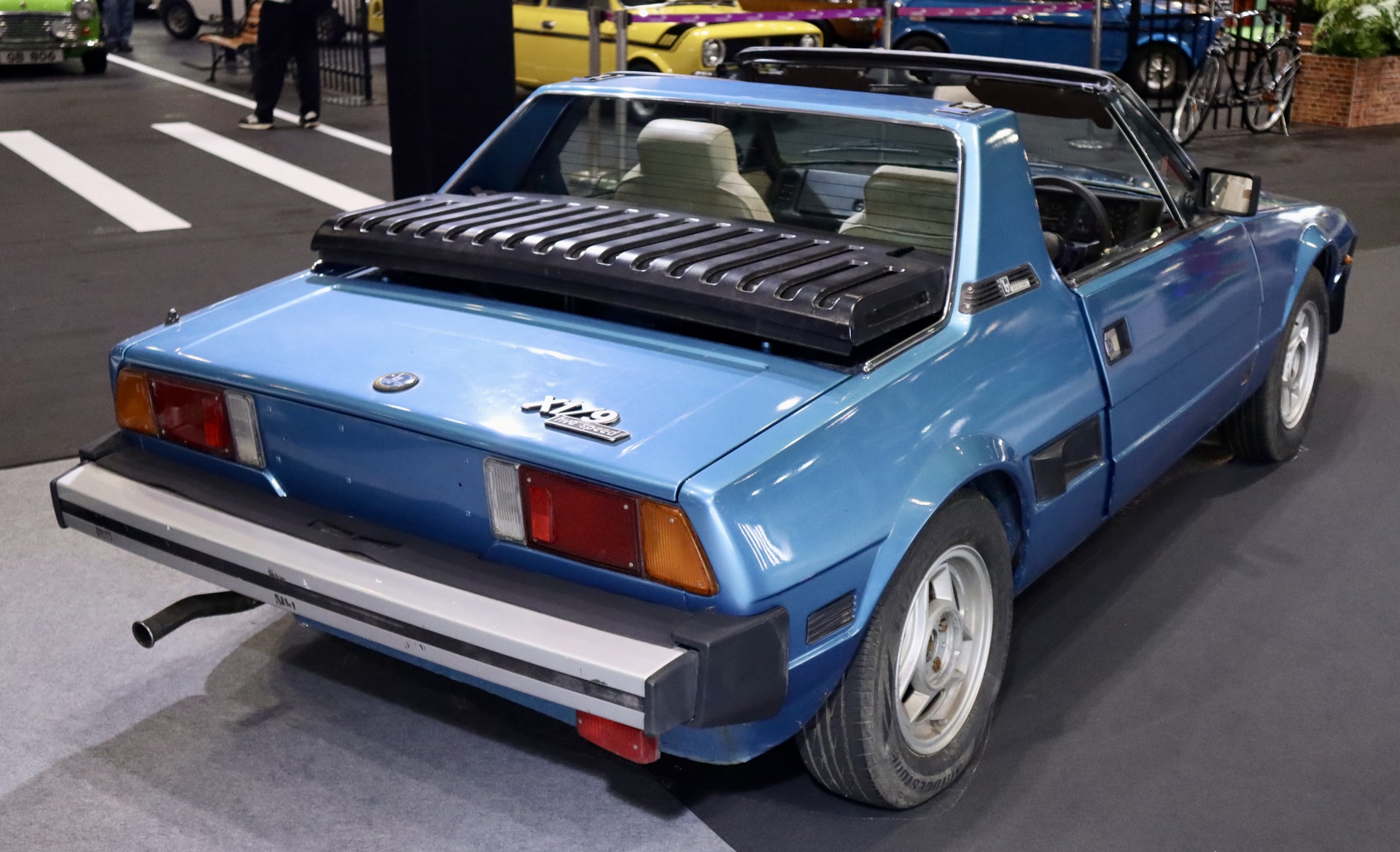
The rear view allows comparison of ride height, bumpers, the targa roof and wheel proportions of a preserved X1/9. Photo: User3204, Wikimedia Commons, CC BY-SA 4.0, image resized.
For a restoration to original specification, the best method is to start with the exact model year, country of delivery and trim level, then look up the corresponding reference in a period brochure or parts catalogue. Purchasing simply “wheels for X1/9” without verifying these details can result in fitting a correct design for a different series.
What to check on an X1/9 today
Corrosion before mechanics
Rust is the main risk. It is necessary to inspect the sills, floors, wheel arches, suspension mounts, engine supports, surrounds of the pop-up headlights and bulkheads near the powertrain. Some areas consist of multiple layers and may conceal significant damage.
The cooling system
The radiator is located at the front while the engine is behind the seats. Therefore, long pipes run through the car. Unsuitable coolant, corroded hoses, a clogged radiator or a faulty fan can cause overheating and internal corrosion. The history of coolant changes is as important as the engine’s appearance.
The timing belt, gearbox and controls
Hagerty recommends replacing the timing belt every 25 000 miles or three years in its British guide; in practice, one should follow the specialist’s recommendations and consider elapsed time, even if the car is driven infrequently. A vague gearbox linkage may result from worn bushings or linkages and can eventually damage the transmission. Common mechanical parts remain more accessible than certain bodywork, interior or gearbox components.
The targa roof and equipment
The roof panel must fit correctly, its seals must not leak and the drains must remain clear. The pop-up headlights, instrumentation, any electric windows and controls should all be tested. A complete and documented car is often worth more than a cheaper example missing specific parts.
A classic car to preserve without erasing its history
The Lancia wheels with Abarth centre caps fitted to the photographed example do not diminish its interest. They are part of its recent history and can be retained for use, provided their dimensions and fitment are safe. To improve authenticity, the owner may simultaneously seek a set of wheels exactly matching the year and trim, without irreversibly modifying the car.
The value of an X1/9 depends more on the structure, absence of serious corrosion, quality of repairs and maintenance records than on a simple set of wheels which can be easily replaced. A documented appraisal allows distinguishing reversible modifications from more significant alterations. Owners wishing to position their car on the market can also have their car appraised free of charge, while enthusiasts searching for a model can consult the classic cars for sale.
To preserve this traceability, it is useful to keep old invoices, references of removed parts, photographs before work, and, if possible, the wheels taken off. This method is detailed in our article dedicated to the historical file of a classic car.
Frequently asked questions about the Fiat and Bertone X1/9
How many Bertone X1/9 were produced?
The most commonly cited figure is around 19 500 cars produced and marketed under the Bertone brand between 1982 and 1989.
What is the total production of the X1/9?
Approximately 160 000 units are generally accepted, including nearly 140 500 Fiat and 19 500 Bertone. Fiat Heritage reports a rounded total of about 150 000 units.
Why do some X1/9 bear a Bertone badge rather than Fiat?
From 1982 onwards, Bertone took over full manufacturing and marketing of the model following Fiat’s decision to discontinue it. The cars then received Bertone badges.
What is the difference between the X1/9 1300 and 1500?
The 1300 uses a four-cylinder engine of 1 290 cm³ and a four-speed gearbox. The 1500 is fitted with an engine of 1 498 cm³ and a five-speed gearbox, offering improved performance and driving pleasure.
Are the Abarth wheels visible on the car original?
No. According to the information provided, these are wheels from a Lancia with Abarth centre caps. Their exact reference should be noted on the back of the wheel to identify the donor model and verify compatibility.
Which wheels are needed to restore a Bertone X1/9?
It depends on the year, trim, and market. The chassis number and period documentation must be cross-checked before purchasing a set of wheels, as several designs of 13-inch wheels were used.
Sources
- Fiat Heritage / Stellantis Media — the 50 years of the Fiat X1/9
- Museo Nazionale dell’Automobile — history of Bertone
- Hagerty UK — Buying Guide: Fiat X1/9 (1972–1989)
- Club X1/9 Italia — technical sheets 1300 and 1500
- Club Fiat Bertone X1/9 France — versions and wheels
- X1-9.it — evolutions of the Bertone X1/9 from 1986
- Wikimedia Commons — Bertone X1/9 from 1982, front view
- Wikimedia Commons — Bertone X1/9 from 1982, rear view
Information verified on 18 October 2026. Specifications may vary depending on year and market.