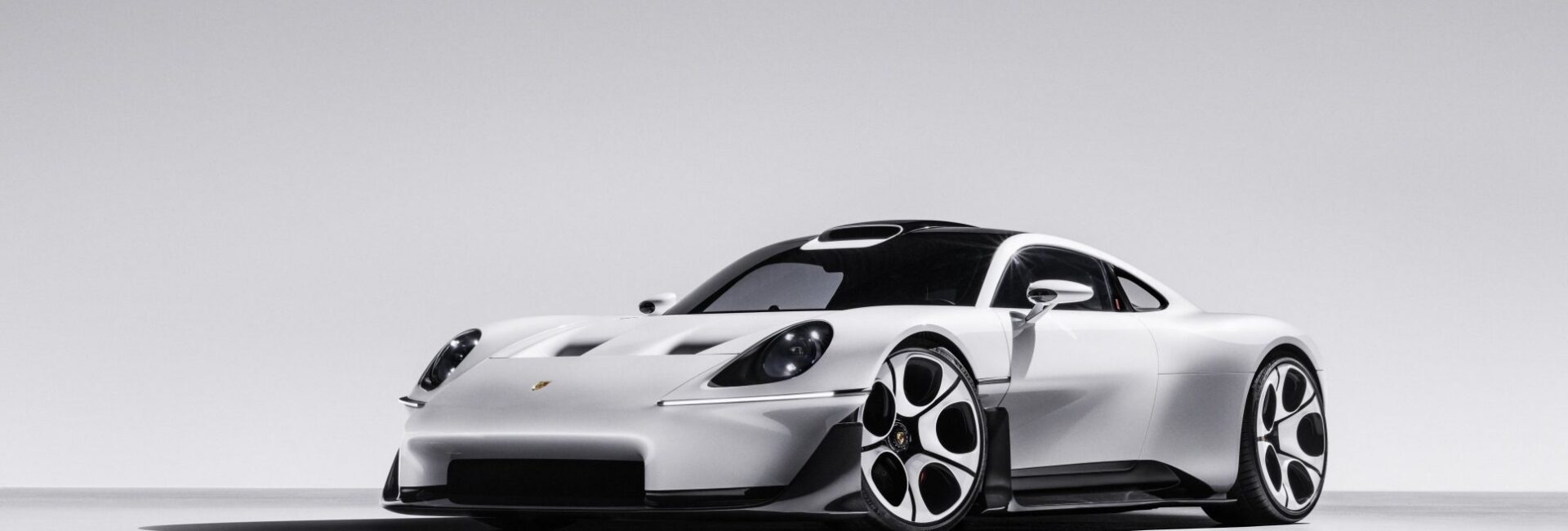
The Porsche Mission S Concept, unveiled on 15 October 2026 in New York, does not simply replace a 911 nor does it announce a new hypercar produced in a few hundred units. It previews a mid-engine supercar platform intended to establish itself permanently above the 911 in the Porsche range.
The concept confirms a very different direction from the electric Mission X: engine placed behind the occupants, physical controls, analogue rev counter, absence of a permanent central screen and deliberate references to the 550 Spyder, 917, 928, 959 and 911 GT1. Porsche has not yet disclosed power, displacement, performance, price or launch date. The Mission S shows a direction; it is not yet the technical specification of a production model.
What is the Porsche Mission S Concept?
Porsche presents the Mission S as a “visionary model” announcing two important developments. The first concerns the style of future Porsches. The second is industrial: the manufacturer is developing a new mid-engine super sports platform, positioned above the 911 family.
This distinction is essential. The Mission S is not described as a limited series set to directly succeed the Carrera GT or the 918 Spyder. Michael Leiters, Chairman of the Executive Board of Porsche AG, speaks instead of a permanent and versatile offering. Porsche therefore wants to create a new regular tier in its range, between the 911 and the brand’s potential exclusive hypercars.
The location of the presentation reinforces the message. Porsche unveiled the concept on a Queens dock in New York, where the first American photographs of the 550 Spyder were taken in 1953. The reference goes beyond mere setting: like the 550, the Mission S is a two-seater mid-engine car designed around lightness and the direct connection between car and driver.
A supercar above the 911, but not a new 918
The 911 will remain the heart of Porsche’s sports offering. The future car inspired by the Mission S is intended to occupy a different territory thanks to its mid-engine layout, lower and wider proportions, and architecture conceived from the outset as that of a supercar.
This strategy distinguishes it from previous Stuttgart flagships. The Carrera GT and the 918 Spyder were limited-run models with a defined production cycle. Porsche announces for the Mission S a platform designed to last and to receive several interpretations. The manufacturer has not yet specified whether it will be a single model with variants, a small family, or an evolving technical base.
The Mission S should also not be confused with the Mission X of 2023. The latter explored a fully electric hypercar, conceived as a radical technological showcase. The Mission S returns to a mid-engine architecture and a much more visible mechanical vocabulary. However, it would be premature to state that the future production car will be exclusively combustion-powered: Porsche has not detailed its powertrain and hybridisation remains possible.
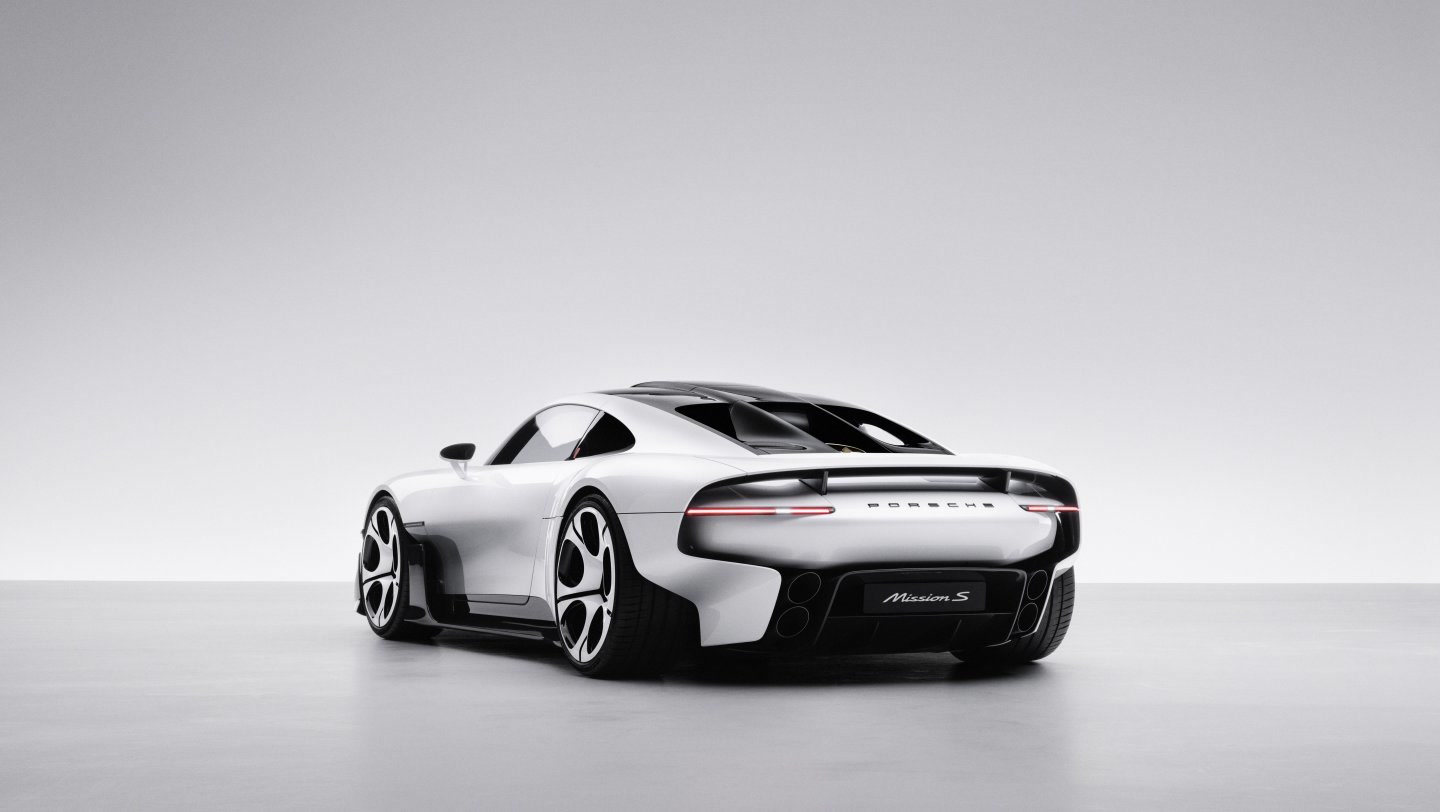
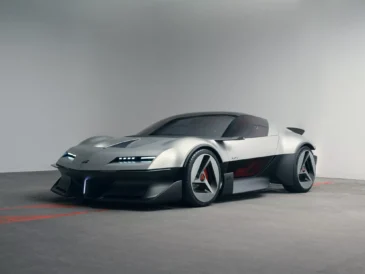
The rear of the Mission S combines a horizontal light signature, an integrated active spoiler and a “car-in-car” architecture inspired by the 911 GT1. Photo: Porsche AG, editorial use via Porsche Newsroom.
A design that reconnects with Porsche’s history
The Mission S does not imitate any previous model, but assembles identifiable references. The torpedo-shaped front wings and round headlights recall the 911. Certain extended cut lines continuing into the light elements evoke the 911 type G produced from 1974 to 1989. The very low nose is inspired by the 911 GT1, while the stretched roofline under the spoiler refers to the Porsche 959.
At the rear, Porsche reprises the “car-in-car” principle of the GT1: the technical volumes appear embedded within a more fluid outer bodywork. An active spoiler integrates completely into the silhouette when not deployed.
The fan visible above the engine compartment is one of the most spectacular details. Porsche presents it as a functional cooling solution and as a tribute to the large fan of the 917. The wheels reinterpret the dial design of the 928, with large openings crafted in a weight-saving logic.
The Firn White Metallic shade, Light Red Metallic accents and Black Chrome elements echo Porsche Motorsport’s historic colours without turning the car into a retro exercise. The whole remains very low, very wide and distinctly more exotic than a 911.
An interior without a large central screen
The interior is perhaps the strongest statement of the Mission S. While most modern cars multiply touch surfaces, Porsche removes the permanent central screen and the passenger screen. A retractable MagSafe-compatible mount allows a smartphone to be used for navigation or additional information.
Facing the driver, five round instruments adopt an iconic Porsche layout. The central rev counter uses an analogue needle placed in front of a digital display. Depending on the selected mode, the dials can move and change their arrangement to bring priority information closer to the field of vision.
Physical controls remain numerous. The aluminium key is placed to the left of the steering wheel, in keeping with the brand’s tradition. “Push-pull” controls provide direct access to main functions, while the large central selector can be pushed or pulled to command the gears of an automated transmission. Porsche therefore does not present the Mission S as a car with a manual gearbox.
A red “On your own” button allows, according to Porsche, the deactivation of driving aids. This function will obviously have to be adapted to safety and homologation requirements if it reaches production.
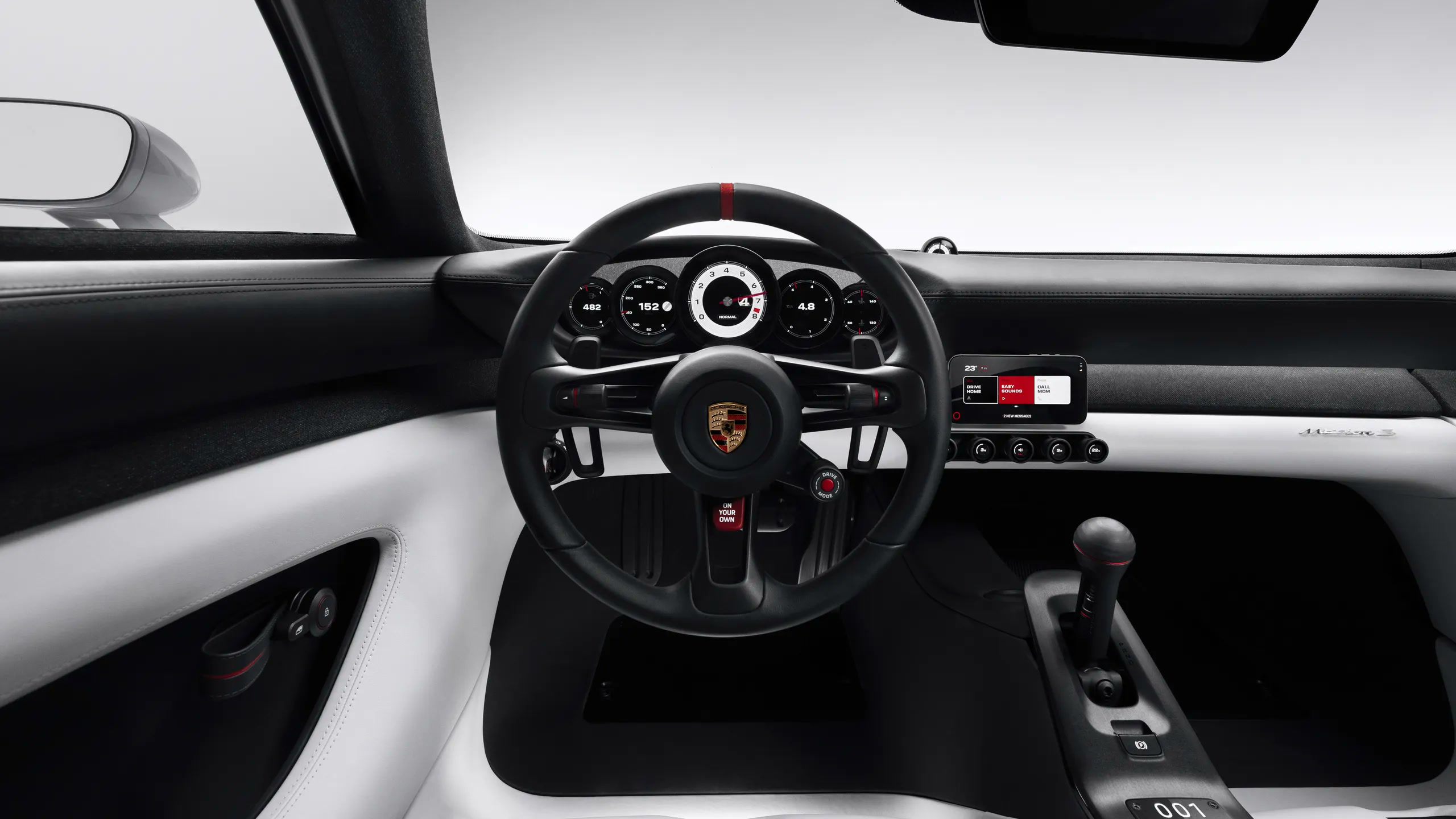
The interior combines five dials, physical controls and a retractable smartphone mount, without a permanent central screen. Photo: Porsche AG, editorial use via Porsche France.
What engine for the Porsche Mission S?
Porsche confirms a mid-engine architecture, but does not reveal the exact nature of the engine. The concept features a rev counter, an engine cooling system and mechanical elements that clearly distance it from a 100% electric supercar. This does not yet allow a choice between a purely thermal engine and a hybrid powertrain.
Hypotheses around a flat-six, a V8 or a hybrid chain therefore remain speculative. None of these choices has been confirmed by Porsche as of 17 October 2026. The manufacturer has also not announced power, torque, the number of possible electric motors, transmission, weight or battery type.
This caution also applies to performance. Any estimate of 0 to 100 km/h, top speed or a lap time on the Nordschleife would be premature. The Mission S currently expresses an architecture, ergonomics and driving philosophy, not a quantified programme.
Porsche Mission S: what is confirmed and what remains unknown
| Element | Situation as of 17 October 2026 |
|---|---|
| Status | Concept or “visionary model” |
| Presentation | 15 October 2026 in Queens, New York |
| Positioning | Future permanent supercar above the 911 |
| Architecture | Two-seater with mid-engine |
| Powertrain | Not detailed; 100 % electric not announced |
| Gearbox | Automated control suggested by the concept, production definition unknown |
| Power and torque | Not disclosed |
| Performance | Not disclosed |
| Price | Not disclosed |
| Release date | Not disclosed |
| Production model name | Not disclosed |
When will the Porsche Mission S be released?
Porsche states that the Mission S’s direction will soon be applied to its future products, but does not announce any launch year. The transition from concept to production may still alter the bodywork, aerodynamics, interior, and especially the powertrain.
It is also necessary to distinguish the concept name from that of the future model. “Mission S” may remain a study designation, as “Mission E” did before the Taycan. Porsche has not confirmed the commercial name of the car that will use this platform.
The price also remains unknown. Its positioning above the 911 suggests a high price, but figures put forward by some media are not based on any announcement from the manufacturer. Until Porsche unveils the production car, any numerical estimate will give a false impression of accuracy.
Why the Mission S already interests collectors
The Mission S marks a possible turning point: Porsche is preparing for the first time a mid-engine supercar intended to remain in the catalogue above the 911. If this promise is fulfilled, the production model could become a milestone comparable, in its strategic role, to the 959 or the Carrera GT — without necessarily sharing their rarity.
Its future appeal will depend on the fidelity between the concept and the delivered car, the chosen powertrain, production volumes, and the extent to which analogue controls are retained. History shows that a spectacular technical sheet is not enough: provenance, configuration, and technical coherence also determine long-term appeal. Our feature on the number of Porsche Carrera GTs produced already illustrates the importance of the industrial context behind rarity.
While awaiting a possible commercial release, enthusiasts can compare this promise to the prestige cars currently offered by Plethore Cars. For the rarest automobiles circulating outside the public market, the private space dedicated to hypercars naturally extends this search.
FAQ on the Porsche Mission S Concept
Is the Porsche Mission S electric?
Porsche does not present it as an electric car. The concept features a mid-engine architecture, a rev counter and a visible mechanical cooling system. However, the brand has not specified whether the future version will be petrol or hybrid.
Will the Mission S replace the Porsche 911?
No. Porsche plans to position it above the 911, on a distinct mid-engine platform. The 911 is intended to remain a core family in the range.
Does the Porsche Mission S replace the Mission X?
Not officially. The Mission X explored a very exclusive electric hypercar. The Mission S announces a mid-engine supercar intended to become a permanent offering.
What will be the power output of the Porsche Mission S?
No power figures have been announced. Porsche has not yet disclosed displacement, torque, or performance figures for the concept or the future production model.
What will be the price of the Porsche Mission S?
The price is unknown. Its positioning above the 911 only indicates that it will occupy a higher segment; any precise estimate remains speculative.
When will the Porsche Mission S be released?
Porsche has announced no commercial release date. The brand confirms the development of a mid-engine supercar platform, but not the schedule for the production model.
Sources
- Porsche Newsroom — Porsche Mission S: the essence of the sports car reinterpreted : presentation, positioning, stylistic references, interior and mid-engine platform.
- Porsche France — Mission S : exterior details, fan, wheels, controls, rev counter and smartphone holder.
- L’Argus — Porsche Mission S Concept 2026French perspective and confirmation of the absence of detailed technical data.
- Car and Driver — Porsche Is Officially Developing a Mid-Engine Supercar Above the 911Contextualising the positioning above the 911.
- T3 — Mission S revealed: This new Porsche supercar isn’t electricThe non-electric nature of the presented concept and operation of the transmission selector.
Information verified on 17 October 2026. Series specifications, schedule and price will need to be updated upon further communication from Porsche.