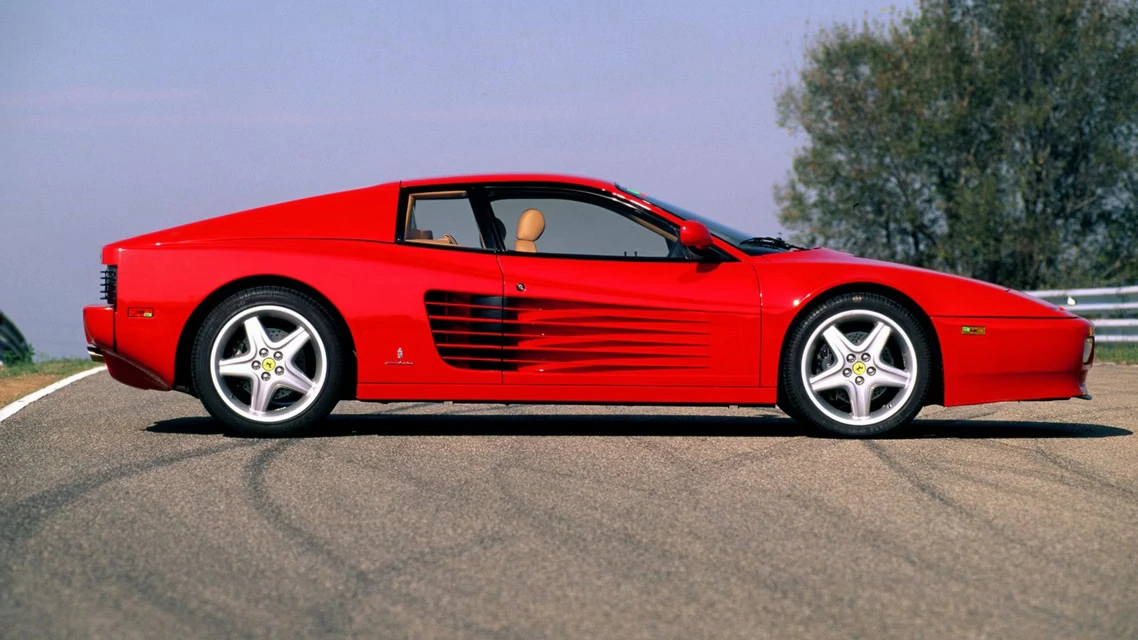
When the Ferrari Testarossa appeared at the Paris Motor Show in October 1984, it redefined the very concept of the supercar. Two metres wide, a 12 cylinder flat engine of 4,9 litres mounted in a mid-rear position, fluted flanks feeding the side radiators. In seconds, it became the object of desire for an entire generation. Forty years later, this icon of the 80s has lost none of its power. Its name, inherited from the 250 Testa Rossa victorious at Le Mans, means “red head” in Italian, a direct reference to the red-painted cylinder heads crowning the flat-12. Here we find everything that makes the legend of Maranello: racing, style, and a sound that nothing else can replicate.
The history of the Ferrari Testarossa: from the 512 BB to the myth
The Testarossa was born from a specific need. After ten years of production, the Ferrari 512 BB was beginning to show its age against the demands of a market requiring more power, more comfort, and above all homologation in the United States. The 512 BB had never crossed the Atlantic: American safety and emissions standards prevented it. The Testarossa would be the first 12 cylinder Ferrari fully homologated for the American market since the early 70s.
The engineers at Maranello took the BB’s tubular steel chassis but redesigned it thoroughly. The wheelbase gained 50 mm to offer more interior space. The engine subframe, now removable and bolted, facilitates maintenance. And the flat-12 of 4 942 cm³ received new cylinder heads with 4 valves per cylinder, raising power to 390 hp at 6 300 rpm and torque to 490 Nm at 4 500 rpm.
Also read our feature on the extreme performance of the prancing horse.
Unveiled worldwide at the Paris Motor Show, the Testarossa sparked immediate enthusiasm. The waiting list reached two years despite a price of 821 000 francs at the time, approximately 230 500 euros adjusted for inflation. Between 1984 and 1992, 7 177 examples left the Maranello workshops, including 438 right-hand drive. This figure may seem high for a Ferrari, but it testifies to a rare commercial success in the supercar world.
Pininfarina design: the lines that defined the 80s
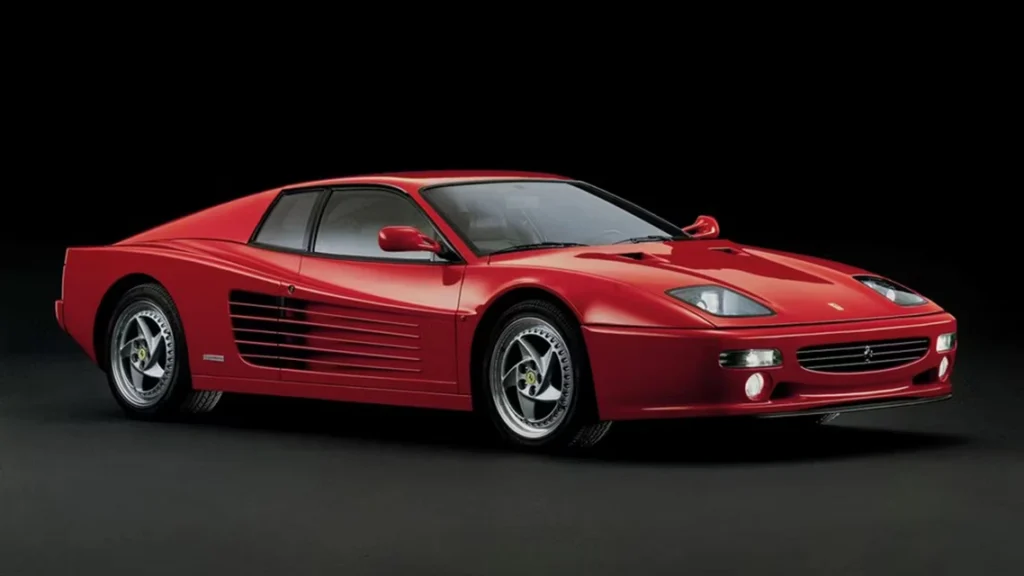
Leonardo Fioravanti at Pininfarina designed a body that breaks with the wedge aesthetics of the 512 BB. The lines are softer, more modern, without ever losing aggressiveness. The stroke of genius is the flanks: horizontal striations running the full length of the profile, feeding fresh air to the two side water radiators of the flat-12. Pininfarina thus solved an engineering problem while creating the most recognisable visual signature of the 80s.
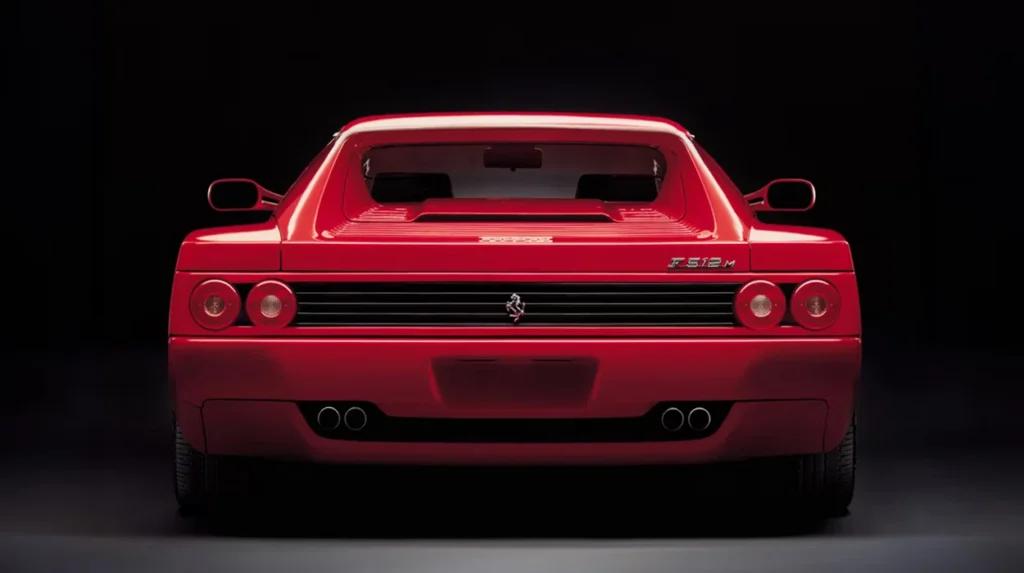
The bodywork combines steel and aluminium in a mixed construction. The drag coefficient reaches an excellent 0,36 for a car two metres wide. At the front, pop-up headlights give the nose a low, almost futuristic profile. The rear, with its very short overhang permitted by the transmission placed beneath the engine, is dominated by a black grille hiding the lights and hot air outlet.
The Testarossa makes you forget its imposing size. Measuring 4 485 mm long, 1 976 mm wide and only 1 130 mm high, it gives the impression of skimming the tarmac. Where the Lamborghini Countach cultivates excess and spectacle, the Testarossa chooses functional elegance. Both approaches are legitimate, but the Ferrari ages better.
Flat-12 engine: full specifications
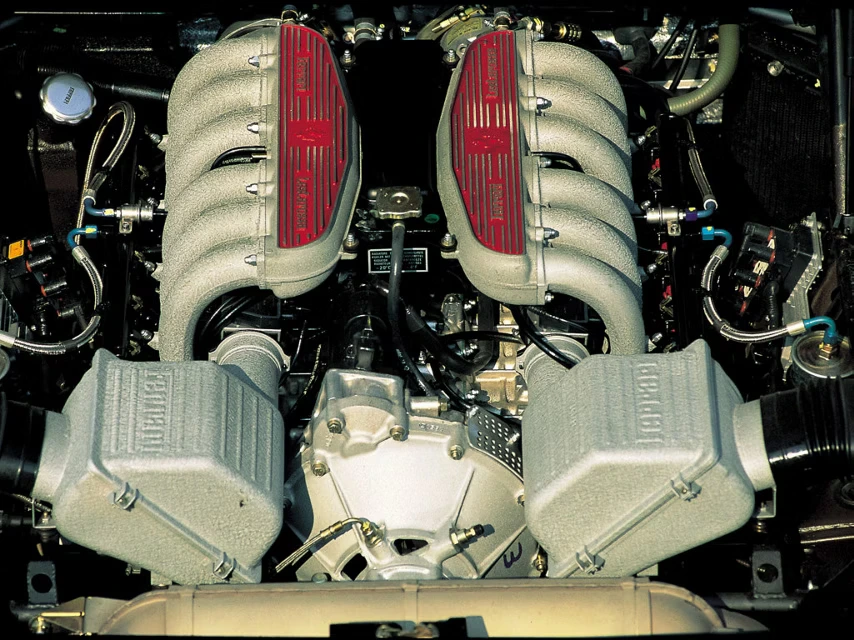
The heart of the Testarossa is a 12 cylinder flat engine of 4 942 cm³, technically a V12 opened at 180° and not a true boxer in the Porsche sense. Introduced in series by the 365 GT4 BB in 1972, this type of engine offers a very low centre of gravity and ideal mass distribution.
Engine data:
| Characteristic | Value |
|---|---|
| Architecture | V12 at 180° (flat-12), longitudinal, mid-rear |
| Displacement | 4 942 cm³ |
| Bore x stroke | 82,0 x 78,0 mm |
| Compression | 9,2:1 |
| Timing | 4 DOHC, 4 valves per cylinder (48 in total) |
| Fuel system | Bosch KE-Jetronic mechanical injection, Marelli Microplex ignition |
| Power output | 390 hp at 6 300 rpm (380 hp in the US catalysed version) |
| Torque | 490 Nm at 4 500 rpm |
| Lubrication | Dry sump (15 to 16 litres of oil) |
| Gearbox | Manual 5 speeds, mounted beneath the engine |
The aluminium cylinder heads are painted red, faithful to the tradition inaugurated in 1957 on the 250 Testa Rossa racing car. The operation of the 48 valves is driven by a Goodyear Supertorque toothed belt which drives four overhead camshafts. Compared to the 512 BB, the engine gains 50 hp while becoming cleaner, lighter by 20 kg according to Ferrari, and finally compliant with US emission standards. This is not just a power increase: it is a complete redesign.
Performance and driving sensations
The figures speak for themselves. The 0 to 100 km/h sprint is completed in 5,2 seconds. The standing start 400 metres is covered in 13,6 seconds. The kilometre is done in 24,1 seconds at over 230 km/h. And the top speed exceeds 290 km/h. For 1984, these performances are spectacular.
But the Testarossa is not just about its times. Behind the wheel, you sit very low. The small three-spoke Momo steering wheel, without power assistance, requires a firm grip at low speeds. Once the road opens up, the steering becomes precise and communicative. The typical Ferrari H-pattern gated gearbox demands decisive and clear shifts. The clutch is heavy. It is a physical car, designed for drivers who appreciate direct contact with the machine.
The flat-12 reveals its character from 5 000 rpm. The sound changes from a deep rumble to a unique metallic howl unlike any other in the world. Linear and smooth at low revs, ferocious at high revs, this engine barely vibrates thanks to the natural balance of its flat architecture. This is what the numbers do not say: the Testarossa delivers raw driving pleasure, without electronic filters, something sorely lacking in modern supercars.
It is also important to highlight a frequently overlooked point: the difference between Euro-spec and US-spec versions is considerable. The European exhaust produces a much rougher and more expressive sound. The reputation of the Testarossa as a “docile GT” often stems mainly from tests conducted on US-spec examples, restricted by their catalytic converters and muffled exhausts. In European specification, the Testarossa is anything but tame.
Testarossa, 512 TR and F512 M: the three versions compared
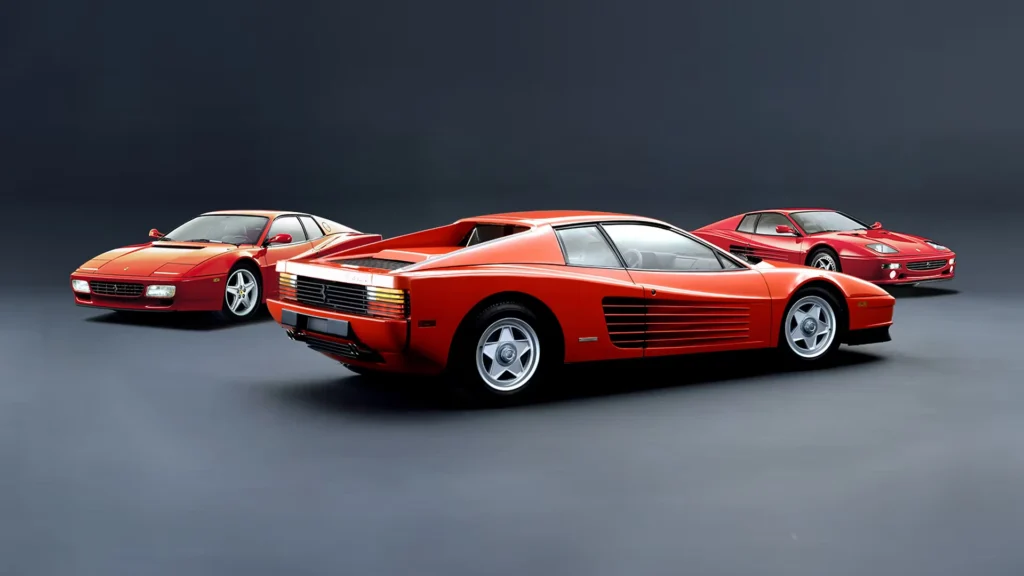
The Testarossa gave rise to two major evolutions. Here is the detailed comparison of the three versions:
| Version | Years | Power | Torque | 0-100 km/h | Top speed | Weight | Production |
|---|---|---|---|---|---|---|---|
| Testarossa | 1984-1991 | 390 hp | 490 Nm | 5,2 s | 290 km/h | 1 506 kg | 7 177 units |
| 512 TR | 1992-1994 | 428 hp | 491 Nm | 4,8 s | 314 km/h | 1 470 kg | 2 261 units |
| F512 M | 1994-1996 | 440 hp | 500 Nm | 4,7 s | 315 km/h | 1 455 kg | 501 units |
The 512 TR features a reinforced chassis with welds replacing the bolts on the engine subframe, recalibrated running gear and 38 additional hp. The F512 M, the ultimate evolution and last road-going Ferrari with a 12 flat-cylinder engine, pushes to 440 hp and exists in only 501 examples. It is today the most sought-after and the most expensive.
An original Testarossa owner familiar with all three versions sums up the situation thus: the 512 TR is more dynamic, but most of the difference comes from modern tyres, not the engine. For those seeking 80 authenticity, the Testarossa remains the choice.
Interior: between Connolly leather and H-pattern grille
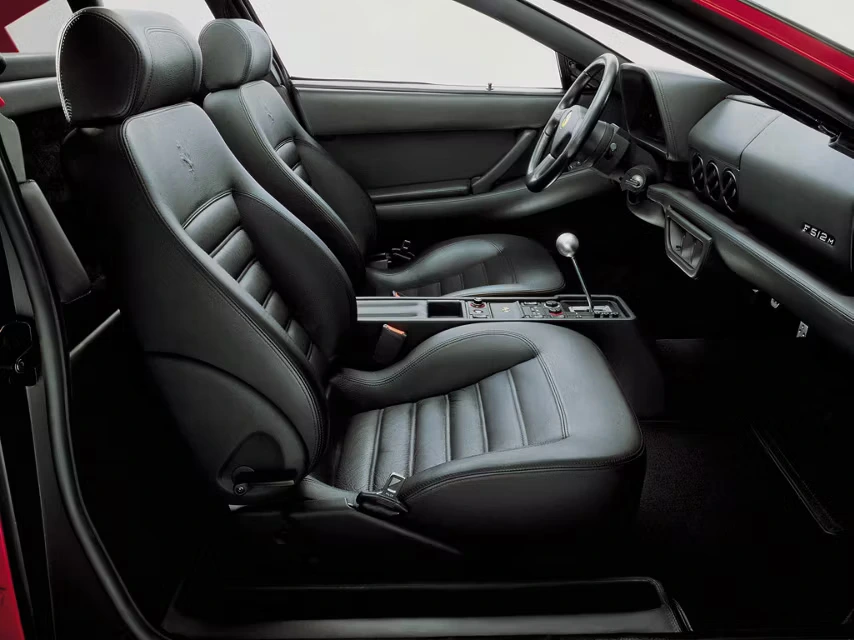
The interior of the Testarossa is a deliberate blend of sportiness and Italian refinement. The Connolly leather seats accommodate two passengers in a surprisingly spacious cabin for a supercar of that era. The driving position, designed for piloting, is excellent.
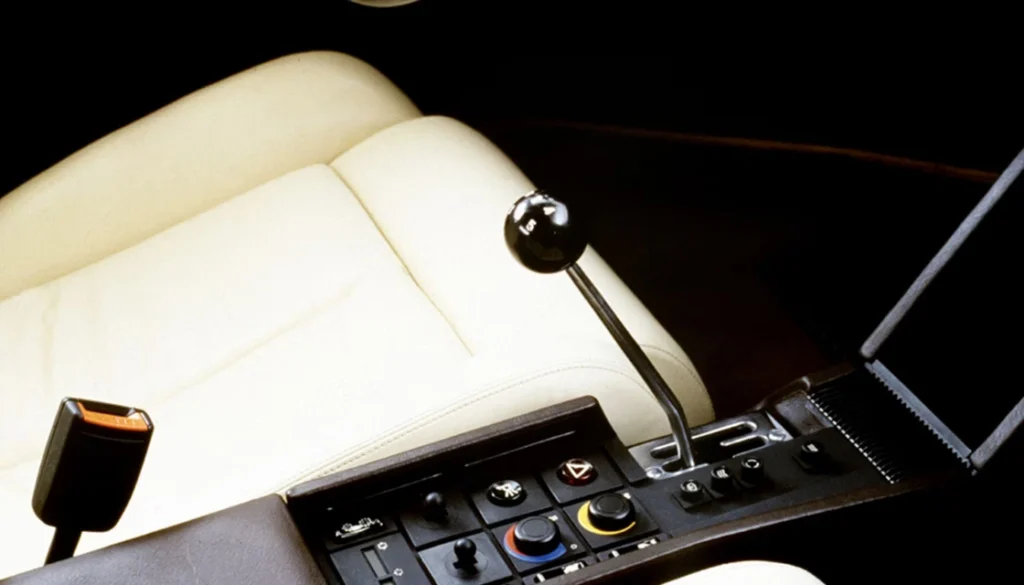
The central tunnel houses the famous chrome H-pattern gear selector grille, a collector’s piece in its own right. The finely crafted three-spoke Momo steering wheel recalls motorsport. Behind the seats, a compartment can hold soft luggage, and under the front bonnet, a storage space houses Ferrari luggage specially designed for the model. Every screwdriver and every key in the tool kit is engraved with ‘Ferrari’. This attention to detail defines Maranello.
Let’s be honest about one point: the interior finish has aged poorly. The plastics of the centre console evoke more a Fiat Uno than a car costing a million francs. The instrument cluster lacks elegance. But the speedometer graduated to 320 km/h reminds you where you are, and the H-pattern grille makes up for many flaws.
The Ferrari Testarossa in popular culture
No car embodies the 80s better than the Testarossa. The Miami Vice series, from 1986, propelled the car into households worldwide. Sonny Crockett behind the wheel of a white Testarossa on Ocean Drive: this image sold more Ferraris than any advertising campaign. The Sega video game Out Run, released the same year, firmly anchored the silhouette in the collective imagination.
But the most delightful anecdote concerns Gianni Agnelli, the head of Fiat and Ferrari owner. He commissioned the only Spider version of the Testarossa, a unique conversion. His initials, AG, correspond to the symbol for silver on the periodic table. Ferrari then forged a solid silver badge for the bonnet of this Spider. It was painted the same colour as the usual aluminium. Without scratching it, it’s impossible to see the difference.
In 2026, Ferrari revived the name with the 849 Testarossa, successor to the SF90 and the most powerful production Ferrari ever made with 1 500 hybrid hp. Forty years on, the name remains at the top.
Buying guide: price, value and practical advice
The Testarossa market has experienced rollercoaster fluctuations. Stabilised at 45 000 euros fifteen years ago, the value exploded to exceed 120 000 euros in 2016, before falling back to 80 000 euros in 2020. Today, expect a minimum of 100 000 euros for a fine example with two mirrors and five bolts, around 50 000 km.
Variants strongly influence the price:
- The ” monodado” (central wheel nut) versions are worth about 10 000 euros more.
- The ” monospecchio”” (single mirror, 1985-start 1986) command an additional premium of 20 000 euros.
- Examples with under 20 000 km exceed 150 000 euros.
A piece of advice that experts repeat without exception: prefer a well-driven and maintained example over a low-mileage one that has been left dormant in a garage. Seals, hoses and rubbers deteriorate faster when stationary than when regularly driven. Rigorous maintenance by a Ferrari specialist is worth more than 10 000 km on the odometer.
Check the service book, the complete history, and have an expert accompany you during the inspection. The slightest repair of aluminium panels can cost a fortune. Also consult our Ferrari Testarossa available on Plethore or our Ferrari 328 GTS for a range comparison.
Maintenance: costs, frequencies and pitfalls to avoid
Maintaining the Testarossa is daunting, often wrongly so. Yes, the timing belt replacement every 30 000 km or three years requires removal of the rear subframe and costs around 10 000 euros. Yes, the clutch is replaced every 25 000 km and also requires engine removal. But by combining both interventions, you save several thousand euros in labour. This is the strategy every savvy owner applies.
Specific points of vigilance:
- The water pumps on pre-1989 models suffer premature failures. Ferrari issued a factory update. Check that the correction has been made.
- The differential endures the torque of the flat-12 and sometimes breaks on mistreated cars. The 2th and 3th gears are also vulnerable.
- The distributor can become flooded with oil and prevent proper idling, a recurring but not catastrophic problem.
- The stiffness when shifting into second gear when cold is normal behaviour: the gearbox oil is not yet at temperature. This is not a sign of failure.
The annual routine maintenance budget is between 2 000 and 4 000 euros excluding major overhaul. The car is reliable provided it is maintained according to best practice.
FAQ on the Ferrari Testarossa
What is the price of a Ferrari Testarossa in 2026?
A fine example in good general condition, with a maintained history and between 40 000 and 60 000 km, trades between 100 000 and 130 000 euros. The monospecchio versions or concours examples exceed 150 000 euros. Restoration projects start around 60 000 euros. Find our classic car listings for current offers.
How many Ferrari Testarossas were produced?
Ferrari produced 7 177 Testarossas between 1984 and 1992, then 2 261 examples of the 512 TR (1992-1994) and only 501 F512 M (1994-1996). In total, the family counts nearly 10 000 units across three generations.
What is the top speed of the Ferrari Testarossa?
The official top speed is 290 km/h for the Testarossa. The 512 TR reaches 314 km/h and the F512 M climbs to 315 km/h.
What is the difference between the Ferrari Testarossa and the 512 TR?
The 512 TR (1992) delivers an additional 38 hp (428 hp vs 390 hp), a chassis reinforced by welding instead of bolts, modernised running gear, and a slightly revised bodywork. The most noticeable difference when driving comes from the modern tyres rather than a mechanical overhaul.
What is the power output of the Ferrari Testarossa?
The Testarossa produces 390 hp at 6 300 rpm in the European version and 380 hp in the American catalysed version. Torque reaches 490 Nm at 4 500 rpm in both cases.
Image source: https://www.ferrari.com/fr-FR/magazine/articles/bloodlines-flat-12-ferraris