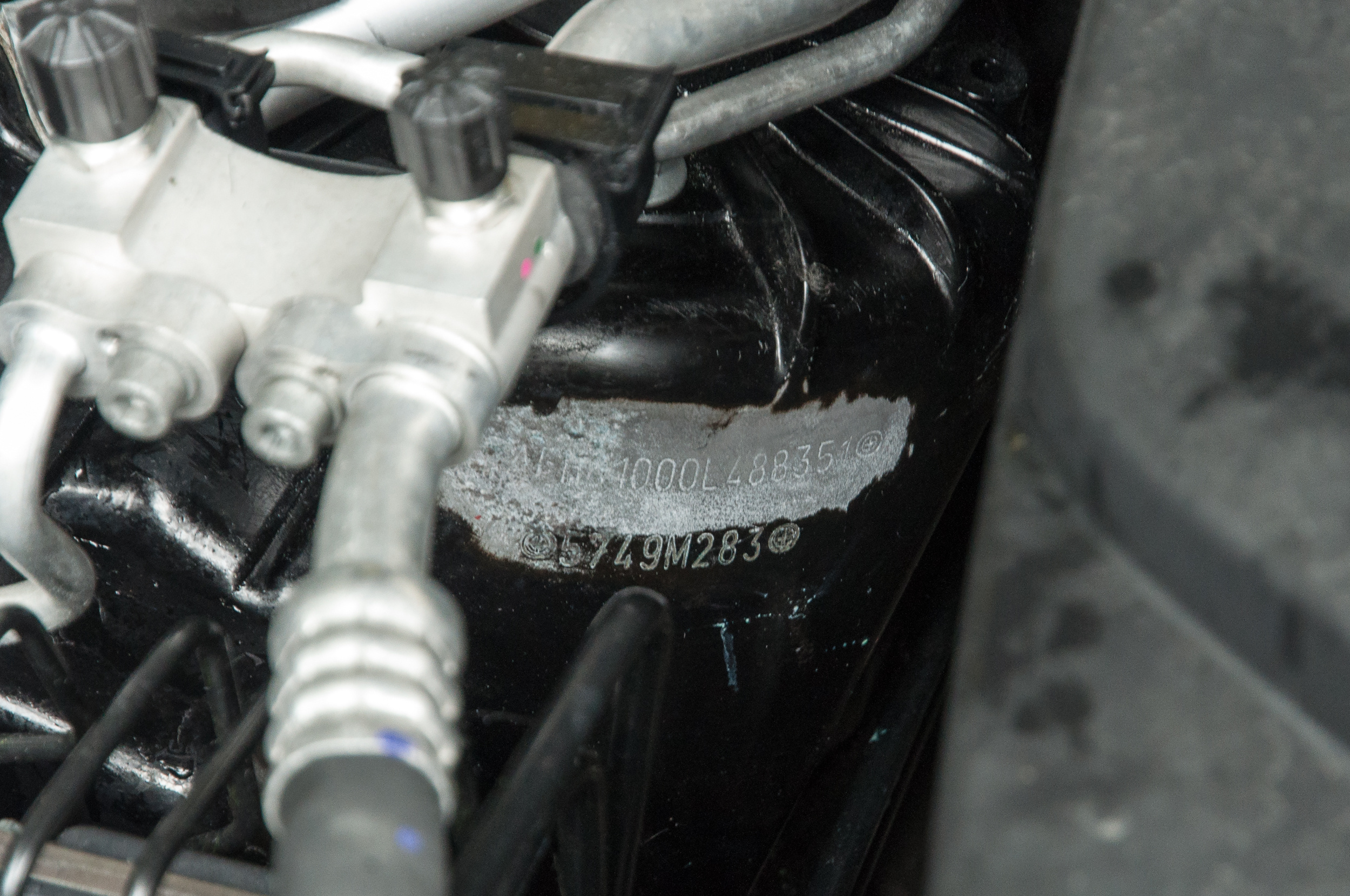
If the chassis number — also called the serial number, VIN or cold-stamp — becomes illegible, do not re-stamp it yourself and do not grind the area. Start by documenting its condition, compare it with field E of the registration certificate and the manufacturer’s plate, then have the origin of the anomaly established by a competent professional. A simple absence may receive special treatment on certain vintage vehicles, but an illegible, obscured, clearly modified stamp or one surrounded by traces of welding or grinding constitutes a major defect during the technical inspection 2026.
The solution depends on the cause: superficial dirt, corrosion, previous chassis repair, replacement of a load-bearing element, error on the registration certificate or doubt about the vehicle’s identity. The technical inspector notes the situation; they do not create a new number nor regularise the administrative file.
Chassis number, manufacturer’s plate and registration certificate: three elements to compare
Before any procedure, distinguish the identification supports.
| Element | Where to find it | What to check |
|---|---|---|
| Field E of the registration certificate | On the registration certificate | The number recorded in the administrative file |
| Cold-stamp | Directly on the chassis, body or a structural element depending on the model | Presence, legibility, coherent appearance and consistency with field E |
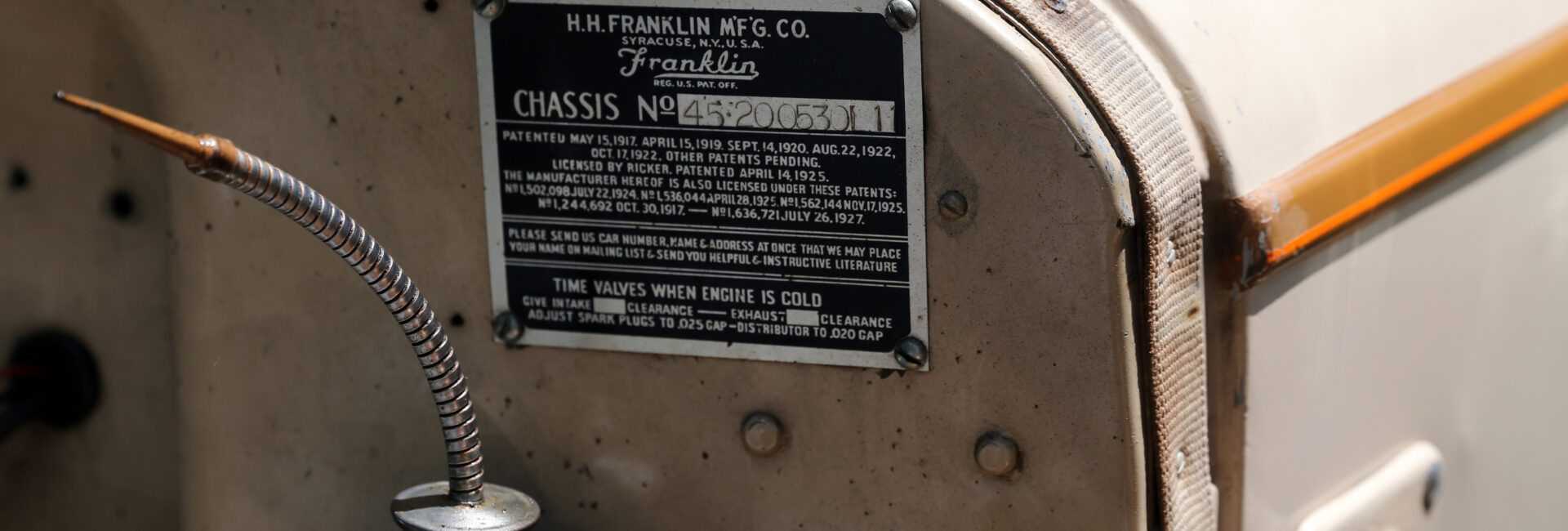
| Manufacturer’s plate | Plate riveted or fixed in a location provided by the manufacturer | Number, apparent authenticity and consistency with the other supports |
| Engine number | On the block or an engine plate depending on the model | Useful historical element, but not necessarily the vehicle’s administrative number |
The French Federation of Vintage Vehicles reminds that the number shown in field E must correspond to the cold-stamp and the manufacturer’s plate when they exist. On a vintage car, the presentation and length of the number may differ from modern VINs. It is therefore necessary to consult documentation specific to the brand, model and year rather than concluding too quickly that there is an anomaly.
The engine number should not automatically be confused with the chassis number. However, some very old cars have historically been identified according to different practices. Only the manufacturer’s archives, a brand register or an expert familiar with the model can correctly interpret these cases.
What does the technical inspection say in 2026?
The UTAC-OTC IT VL F0 technical instruction dated 12 December 2025, applicable since 1 January 2026, distinguishes several situations. This distinction is essential:“absent” and “illegible” are not synonymous in the inspection grid.
| Observation on the passenger vehicle | Level provided by the 2026 instruction |
|---|---|
| Number missing or not found on a vehicle not benefiting from a specific classic case | Major defect |
| Number missing or not found on a vehicle with a classic registration certificate | Minor defect |
| Absence of stamping on a vehicle over 30 years old, excluding classic registration certificate | Unusual identification, minor defect |
| Number slightly different from the documents, according to the tolerances provided | Minor defect |
| Number incomplete, illegible or obscured by corrosion or product | Major defect |
| Number clearly modified, or traces of welding or grinding in its area | Major defect |
| Significant discrepancy with the documents, excluding treatment provided for vehicles over 30 years old | Major defect |
The exception granted to the absence of stamping on certain old vehicles therefore does not turn an altered stamping into a minor defect. If characters exist but can no longer be read, or if the area appears to have been worked on, the inspector must apply the line corresponding to illegibility or the intervention observed.
A major defect results in an unfavourable S outcome. The Ministry responsible for Transport indicates that, for a passenger car or light commercial vehicle, the validity of the inspection is then two months in order to carry out the necessary procedures or repairs and present the vehicle for a re-inspection. This period does not constitute authorisation to re-stamp the number oneself nor a guarantee that the file can be regularised within two months.
To learn about other specificities applicable to classic cars, also consult our guide to thetechnical inspection of a classic car.
The procedure to follow before touching the area
1. Photograph the initial condition
Take both wide shots and close-ups, using raking light, without sanding or harsh products. Also photograph the manufacturer’s plate, the registration document, the stamping location, and any repair marks around the area.
These images alone do not prove the vehicle’s identity, but they preserve the condition in which you discovered the issue. They will be useful to the manufacturer, the expert, the restorer, and, if necessary, the authorities.
2. Verify that you are looking in the correct place
On certain models, the stamping is located beneath a layer of paint, near a seat, in the engine compartment, on a chassis rail, or under the vehicle. Workshop manuals, parts catalogues, brand registers or recognised clubs can confirm the expected location and format.
The technical inspection is visual and carried out without dismantling requiring specialised equipment. Therefore, prepare access to the designated location without marking or removing any structural element. An inaccessible area can itself prevent a normal inspection.
3. Compare all available documents
Gather:
- the registration certificate and its field E;
- any previous registration documents and foreign certificates, if applicable;
- invoices for restoration or chassis replacement;
- the certificate of conformity or available descriptive notice;
- certifications from the manufacturer or their representative;
- sales, maintenance and ownership archives;
- old photographs showing the plate or stamping.
A minor discrepancy may be due to an old transcription error. A significant divergence, a number appearing on a recent plate, or a break in traceability, on the other hand, require investigation before any sale or restoration.
4. Have the car examined by the appropriate expert
Start with the manufacturer’s heritage or homologation department if it exists, their representative in France, or a recognised specialist of the brand. An independent automotive expert can document material clues, repairs and the vehicle’s consistency, without replacing the authority responsible for registration.
If the brand has disappeared or the case involves a significant modification, request written guidance from the DREAL, the DRIEAT in Île-de-France, or the DEAL overseas, as well as from the competent registration service. Regularisation procedures differ for a registration document error, a replaced body shell, an imported vehicle, or stamping destroyed by corrosion. Obtaining written instructions before work avoids an intervention that the administration might later refuse.
Is it permissible to clean a cold corroded stamping?
Conservation cleaning can be useful, but it must stop before any alteration of the material. Gently removing non-adherent dirt is entirely different from sanding, grinding, engraving or redrawing the characters.
For advanced corrosion, entrust the examination to a restorer or expert who will know how to choose a method compatible with the substrate. The objective is to reveal what remains, not to fabricate a reading. Keep photographs before, during and after the intervention, as well as the invoice precisely describing the work carried out.
Do not use a punch, engraver, rotary tool or a new plate to “improve” the number. The UTAC instruction precisely classifies traces of welding or grinding in the stamping area among major failure reasons. An amateur intervention can also raise suspicion of forgery and greatly reduce both the value and negotiability of the vehicle.

Should you request an FFVE certificate?
The FFVE certificate can be part of the documentation for a vehicle over 30 years old, especially when it is not possible to present the registration document at the technical inspection: Service-Public lists this certificate among the official documents accepted in such cases. The FFVE guidelines also require photographs of the manufacturer’s plate and the cold-stamped number when it exists.
However, the certificate should not be understood as authorisation for re-stamping, repair of an altered number, or an automatic guarantee of registration. The FFVE asks the owner to document the identification and traceability. It also warns against reproduced plates or modified stamps, which may create “duplicates.”
In practice, contact the FFVE before submitting a file if the stamping is missing, illegible, or inconsistent. Explain the situation without attempting to reconstruct the number yourself and attach any available historical evidence.
What should you do before buying a concerned car?
A number that is difficult to read is not a mere cosmetic detail. Before signing:
- compare field E, the manufacturer’s plate, and the cold stamping;
- request the latest complete technical inspection report;
- search for invoices related to the bodywork, chassis, and restoration;
- have the area inspected by an expert or a brand specialist;
- make the purchase conditional on written clarification of the vehicle’s identity;
- refuse to allow the seller to “redo” the number before the expert examination.
Our article on thepre-purchase inspection of a classic car details the task to assign to the professional. The guide to matching numbers also helps distinguish administrative identity, historical authenticity, and mechanical component correspondence.
If the vehicle is already yours, have its identity clarified before commissioning an expensive restoration. Once the file is regularised and documented, a free valuation of the car can help assess the impact of its history, condition, and traceability on the market.
The checklist before the technical inspection
- Locate the original position based on a source specific to the model.
- Photograph the area before any intervention.
- Clean only in a non-destructive manner or call in a specialist.
- Compare each character with field E and the manufacturer’s plate.
- Bring the original registration document or an officially accepted document if it is unavailable.
- Gather certificates, invoices, and archives explaining any previous repairs.
- Inform the inspection centre of the particularity, without requesting them to validate the file remotely.
- Never re-stamp the number on your own initiative.
FAQ
Can a classic car pass the inspection without cold stamping?
The UTAC 2026 instruction classifies a missing or untraceable number as a minor defect for a vehicle with a classic registration. This does not cover a present but illegible, obscured, altered, or clearly modified stamping, which is considered a major defect.
Does a car over 30 years old automatically benefit from this tolerance?
No. The age and the “classic” mention on the registration produce distinct treatments in the grid. An absence on a vehicle over 30 years old outside the classic category may be noted as a minor unusual identification, whereas illegibility or signs of intervention remain major.
Is the manufacturer’s plate sufficient if the stamping is illegible?
It is an important element, but the technical inspection examines the cold stamping and the manufacturer’s plate separately. A matching plate does not automatically erase a major defect related to an illegible stamping.
Can I re-stamp the number indicated on my registration document?
Not on your own initiative. First request a written procedure from the manufacturer or their representative and, depending on the case, from the competent administrative service. Amateur re-stamping may be interpreted as modification or falsification.
Does an FFVE certificate replace the registration document at the technical inspection?
For a vehicle over 30 years old, Service-Public lists it among the accepted documents when the registration cannot be presented. However, it does not remove the physical inspection of the vehicle’s identification.
What should I do if the registration number contains an error?
Keep the stamping in its original state and initiate a request to correct the registration certificate with the necessary supporting documents. The vehicle should not be modified to adapt to a documentary error.
Sources and photographic credits
Information verified on 21 September 2026 : UTAC-OTC — technical instruction IT VL F0 of 12 December 2025, Ministry responsible for Transport — technical inspection and defect levels, Service-Public — technical inspection without registration document, FFVE — administrative precautions before purchase or restoration and FFVE — glossary of vintage vehicles.
Photographs: “1930 Franklin 145 Sedan chassis number plate”, Mr.choppers, Wikimedia Commons, CC BY-SA licence 3.0 ; “Manipulated Vehicle Identification Number FIN VIN”, Thilo Parg, Wikimedia Commons, CC BY-SA licence 3.0 ; “Dülmen, Rolls-Royce Phantom II — 2024 — 5846”, Dietmar Rabich, Wikimedia Commons, CC BY-SA licence 4.0.