Importing a classic car from Germany to France is possible without customs duties, as both countries are members of the European Union. The challenge lies elsewhere: securing ownership of the vehicle, obtaining both parts of the German documents when they exist, organising legal transport, obtaining the tax clearance certificate, proving technical compliance, and submitting a complete French registration application.
The safest order is as follows:check the vehicle and its documents before paying, sign a precise contract, collect the original German documents, choose between transport on a trailer or insured temporary plates, request the tax clearance certificate, then submit the registration file within the French deadline. For an eligible classic vehicle, the “vehicle of collection” designation can be a suitable route, but it does not eliminate proof of ownership, fiscal formalities, or compliance requirements.
Short answer: do not pay the balance until the car’s VIN, the seller’s identity, the invoice or contract, and the German documents all match. A beautiful car without an exploitable documentary chain can remain immobilised during the French processing.
The checklist before travelling to Germany
The purchase begins before the trip. Compare truly equivalent examples: same generation, engine, year, bodywork, gearbox, level of originality and condition. Price differences between France and Germany may disappear after transport, refurbishment, compliance and registration.
To establish an initial benchmark, consult theselection of classic and prestige cars for saleon Plethore Cars. However, a listed price remains a commercial offer: it does not prove the final negotiated price nor the condition of the example.
Before booking a ticket or a carrier, ask the seller for:
- clear photographs of the stamped chassis number and the manufacturer’s plate;
- scans of theZulassungsbescheinigung Teil Iand theTeil II, or the former Fahrzeugschein and Fahrzeugbrief if still valid;
- the latest German inspection report, often called Hauptuntersuchung or HU;
- the European Certificate of Conformity if it exists;
- invoices, the service book, restoration file and list of modifications;
- the full identity of the seller and, for a company, its legal information;
- a draft contract or invoice mentioning the price, VIN, mileage and date.
The ADAC reminds that German registration documents consist of two parts. The Teil I accompanies the vehicle’s everyday use; the Teil II is a central document for registration operations, without being an absolute proof of ownership on its own. It is the purchase contract and the consistency of the entire file that establish the transaction.
Teil I, Teil II and contract: documents not to lose
To re-register in France a vehicle previously registered in the European Union, Service-Public requires the original registration certificate or, in some cases, an official proof of ownership. When the certificate consists of two parts, European regulations stipulate that both must be handed over to the authority of the new registration state.
Therefore, request the following originals at the time of delivery:
| Document | Practical use | Check point |
|---|---|---|
| Zulassungsbescheinigung Teil I | Characteristics and registration status | VIN and data consistent with the car |
| Zulassungsbescheinigung Teil II | Essential element of the German file | Original present, identity and history consistent |
| Contract or invoice | Proof of transaction and price | Parties, date, amount, VIN and signatures |
| HU report | Status of the German technical inspection | Date, result and vehicle identification |
| COC or technical certificate | Facilitates proof of conformity | Exact version and data matching the VIN |
| Historical file | Supports authenticity and value | Chronological invoices, without gaps explained by assumptions |
If a German authority retains a document during deregistration, request an official certificate explaining this retention. Do not settle for a photocopy accompanied by a promise of later regularisation.
The contract must describe known defects, restorations, declared mileage and delivered accessories. For a private sale, the ADAC contract template dedicated to classic cars provides a useful basis, but a French buyer should verify that they understand each clause and its consequences. A professional translation may be advisable for an expensive vehicle or a complex file.
Inspect the classic car before payment
An on-site inspection should not be limited to the paintwork and starting the engine. Physically compare the VIN with each document. Check the underbody, mounts, hollow sections, repair marks, leaks, cooling system, brakes, tyres, electrical system and model-specific equipment.
Test drive the vehicle when it is legally registered and insured. If you are unfamiliar with the model, appoint an independent specialist who is neither the seller nor an intermediary paid by them. Our method forinspecting a classic car before purchasehelps organise this check.
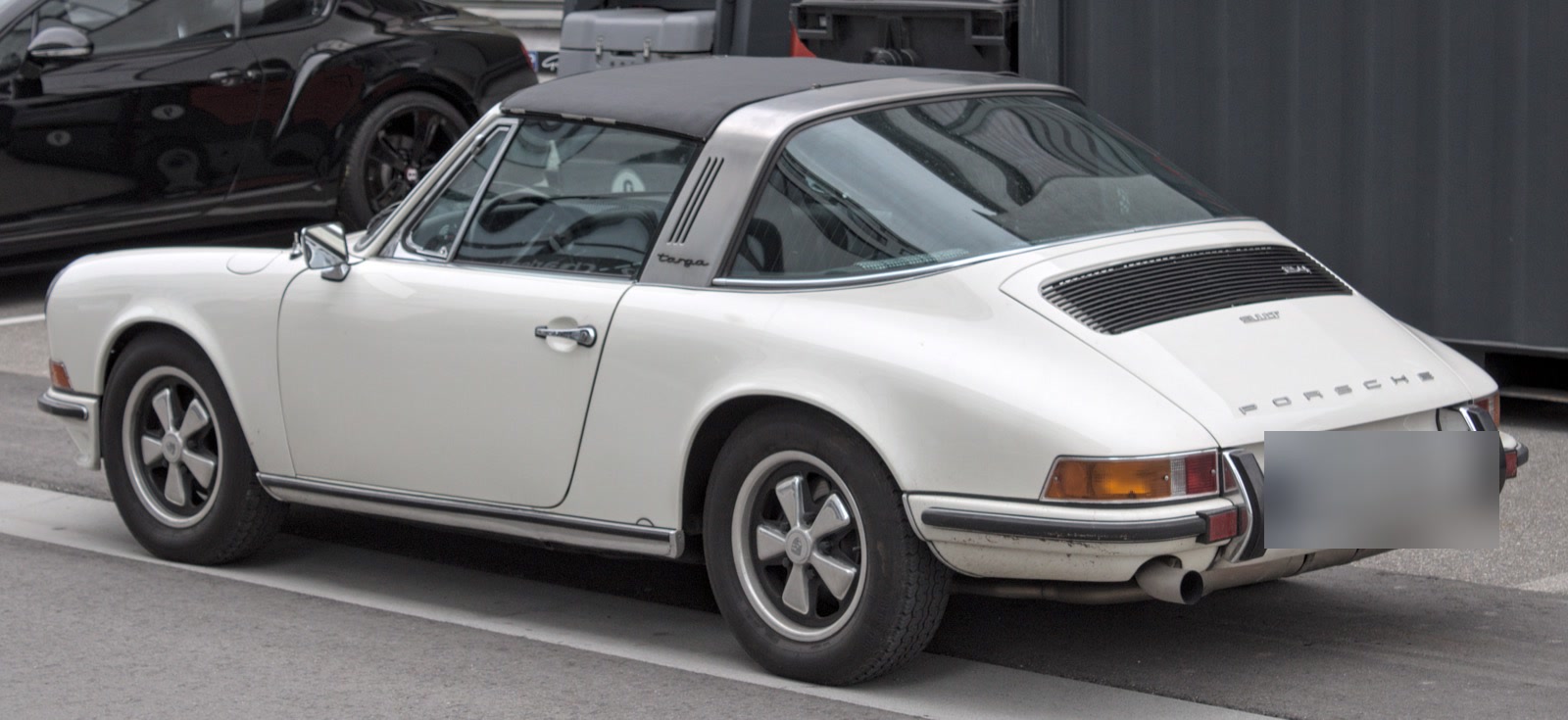
The actual condition and documentary consistency must be checked before payment, ideally by an independent specialist. Photo modified: Alexander Migl, CC BY-SA 4.0, via Wikimedia Commons; plate blurred.
An old restoration is not necessarily a defect, but it must be documented. In particular, verify whether the engine, gearbox or bodywork correspond to the announced version. A significant modification may complicate French compliance even if the car is already registered in Germany.
How to bring the car back to France?
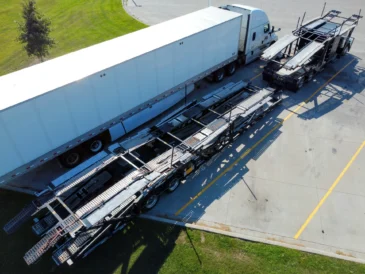
Three practical solutions exist: transport by truck or trailer, driving with a still valid German registration, or using an appropriate temporary plate. The first is often the simplest for a non-running, uninsured car or one whose reliability is not established.
For road entry, never fix plates from another vehicle onto the car. A valid registration, corresponding documents, a valid road inspection when required, and insurance covering all countries crossed are necessary.
Temporary plates are not fully harmonised within the European Union. The official Your Europe portal recommends checking their recognition in each country crossed and the territorial scope of the insurance. A short-term German plate intended for national use should therefore not automatically be considered an export solution. Confirm with the German registration authority and insurer the type of plate, its duration and cross-border use.
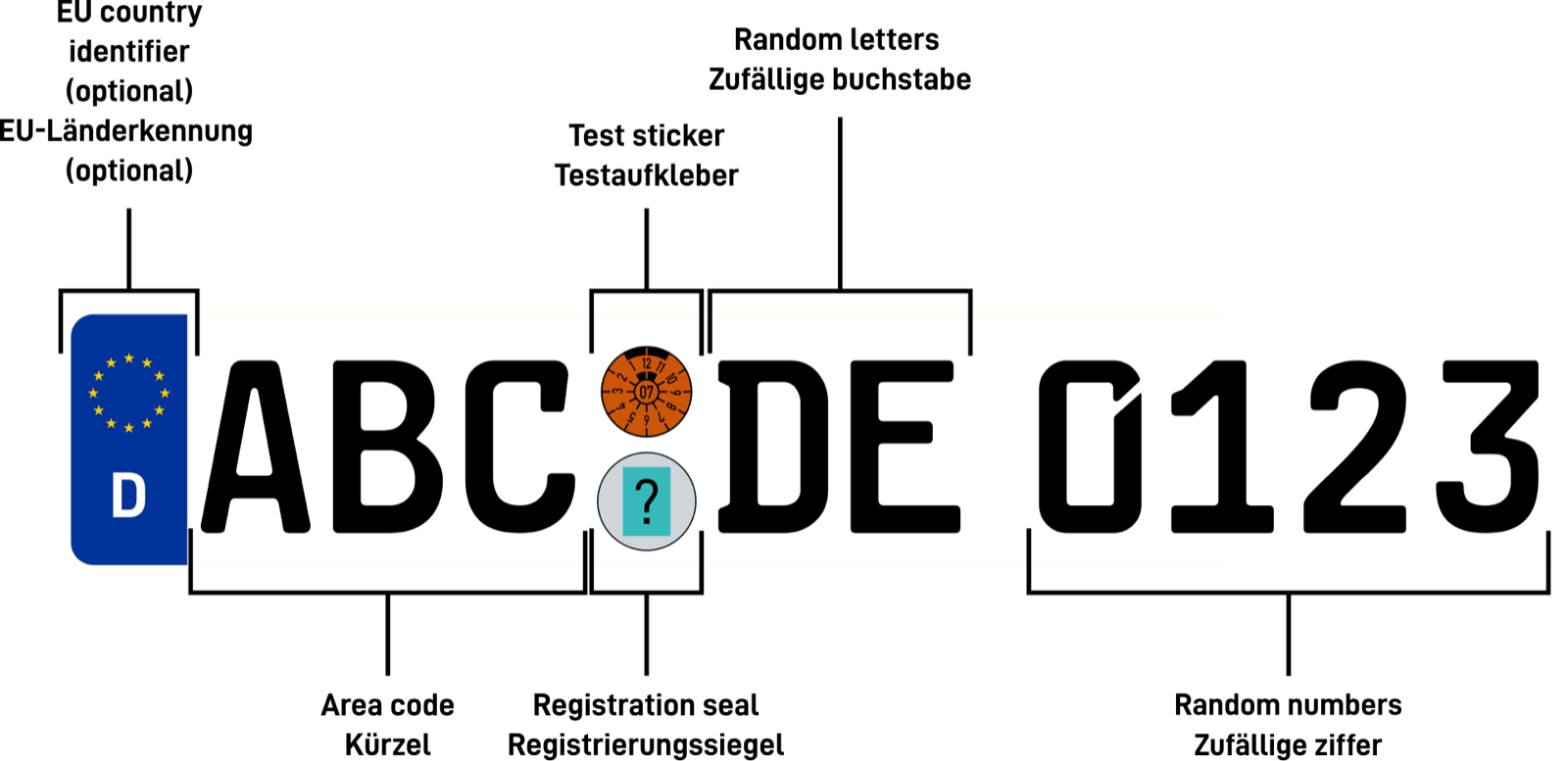
German temporary plates have distinct uses and durations. This diagram uses a fictitious number and does not replace verification of export rules. Illustration: SilverJapan2006, public domain, via Wikimedia Commons.
If you choose a carrier, have the VIN, locations, dates, condition at loading, reservations, declared value and insurance conditions recorded. Take photos at handover and keep the transport documents.
Tax clearance certificate: mandatory even when VAT is not due
The tax clearance certificate attests to the vehicle’s VAT status. Service-Public states that it is necessary to obtain the registration certificate for a vehicle purchased in another European Union state. The procedure depends on the department of residence: generally, the file is sent to the competent service indicated by the tax administration; in the departments 57, 59, 62 and 67, the individual’s request is integrated into the registration online service.
The requested documents notably include the invoice or transfer contract, the foreign registration certificate, an identity document and proof of address. A certified translation may be required when documents are not in French.
For VAT purposes, the fiscal meaning of “new vehicle” does not correspond to common usage. According to the official European Union portal, a car is considered new if it has been delivered at most six months after its first registrationorif it has travelled at most 6 000 km. To be considered used, it must be over six monthsand more than 6 000 km.
A classic car used for decades generally meets both criteria for a second-hand vehicle, but the tax clearance certificate remains necessary. The FFVE specifies that for a vehicle originating from the European Union that is over six months old and has more than 6 000 km, this document is normally issued without additional French VAT. However, the invoicing regime of a German professional may vary; read the invoice carefully and have the VAT clarified before payment.
French registration certificate: the complete file
Service-Public states that a buyer has one month to apply for the new registration certificate. For a car coming from Germany, the French file generally includes:
- the original German registration certificate, with both parts if they were issued;
- the invoice or the certificate of transfer;
- the Cerfa form 13750 for the registration application;
- a proof of address less than six months old;
- the tax clearance certificate;
- proof of a valid technical inspection when the vehicle is subject to it;
- a technical conformity certificate;
- the insurance certificate and the corresponding driving licence, which the applicant certifies to possess.
The application is made on the France Titres — ANTS website — or through an authorised professional. Scan the documents in colour, in full, including their reverse sides and without cropping the edges. Keep the originals until the process is complete.
Is the German technical inspection accepted?
For a vehicle that was registered in the European Union, Service-Public accepts a technical inspection carried out in France or in an EU country. For a private car over four years old subject to inspection, it must be less than six months old at the time of submitting the file; the deadline for any re-inspection must not have been exceeded.
Classic cars have specific rules depending on their date of first registration and the presence of the ‘collection’ designation. Check the exact case in our guide dedicated to the technical inspection of classic cars, rather than assuming an exemption based solely on the vehicle’s age.
COC, identification certificate or individual approval?
The conformity certificate depends on the car and its type approval. Service-Public lists several options:
- the European Certificate of Conformity issued by the manufacturer;
- an identification certificate to the community type issued by the manufacturer, its representative in France, or the Dreal;
- in certain situations, a verification of technical data by the Dreal;
- when other options are not suitable, an individual approval from the Dreal.
Request this document before purchase. For a classic car, a national variant, a modification or the absence of manufacturer documentation can lengthen the procedure. A generic COC found online is not sufficient proof if it does not precisely correspond to the vehicle.
Should you choose the classic vehicle registration certificate?
A vehicle over thirty years old does not automatically receive the classic designation. It must meet the applicable conditions and the application must be documented. When the classic route is appropriate, a certificate from the manufacturer or the FFVE can be used to establish the necessary characteristics before applying for registration with France Titres.
This certificate does not replace the purchase contract, the German papers or the tax clearance certificate. It is also not a valuation appraisal or a mechanical guarantee. Compare the possible routes with our dossier FFVE or manufacturer certificate for a classic vehicle registration certificate.
Before purchasing, submit the available elements to the FFVE or the manufacturer if the vehicle has a particularity: absence of COC, model never officially distributed in France, old modification, special bodywork or inconsistency between the VIN and the documents.
What is the real cost of importation?
The budget is not limited to the German price. Prepare a cost sheet before signing:
| Item | What to budget for |
|---|---|
| Travel and inspection | Trip, independent expert, possible translation |
| Payment | Possible currency exchange, bank fees and securing the transfer |
| Repatriation | Transporter or plates, insurance, fuel and tolls |
| Technical documents | COC, identification certificate, FFVE or Dreal as applicable |
| Technical inspection | Inspection or new visit if the document expires |
| Registration | Taxes and fees calculated according to the vehicle and region |
| Refurbishment | Tyres, fluids, brakes, battery, timing belt and revealed defects |
Do not use an outdated rule found on a forum to calculate the registration certificate or any potential environmental tax. The parameters change and the situation depends notably on the date of first registration, technical characteristics, and the import file. Use the official simulator at the time of the project.
The most common errors that block the file
Most difficulties can be anticipated before purchase. Be particularly cautious if:
- the Teil II is missing without an official certificate;
- the seller indicated on the contract does not correspond to the chain of documents;
- the VIN is illegible, re-stamped or different from one document to another;
- the invoice does not correctly describe the vehicle or the VAT regime;
- the technical inspection expires before the French submission;
- the COC corresponds to another variant;
- modifications are not listed in the German documents;
- the vehicle is transported with temporary plates or insurance whose cross-border validity has not been confirmed;
- the balance is paid before verification of the originals.
An oral promise of an “easy registration certificate” has no administrative value. If a document is missing, ask before payment which organisation can legally issue it, in whose name, and for which vehicle.
FAQ on importing a classic car from Germany
Are customs duties payable between Germany and France?
No, for a car purchased in Germany and already in free circulation within the European Union. The official Your Europe portal confirms the absence of customs duties between member states. However, a vehicle only stored in Germany but originating from a non-EU country may require specific customs documentation.
Is a tax clearance certificate necessary for a classic car?
Yes, for registration in France of a vehicle coming from another European Union country, except in specific cases provided by the administration. The absence of VAT to pay does not automatically exempt obtaining the tax clearance certificate.
Can you return with the German seller’s plates?
Only if the registration, insurance, documents, and the seller’s agreement remain valid for the entire journey. In practice, a properly insured export plate or transport on a trailer offers a clearer framework. Check each country crossed.
Does the German TÜV replace the French technical inspection?
An inspection carried out in a European Union country may be accepted for the French file if it meets the applicable validity conditions. This does not mean that any German document, regardless of its age or result, will be accepted.
Does an FFVE certificate replace the certificate of conformity?
It can contribute to the classic registration route for an eligible vehicle. It does not replace all other documents in the file and should not be confused with a European COC.
Is it possible to register a classic car without the Teil II?
The absence of the second part poses a major risk. An exceptional re-registration may require official confirmation from the German authority. Do not pay assuming that a simple copy or a declaration from the seller will suffice.
The safest method
A successful import is planned backwards from the French paperwork. First identify the compliance route, then verify the German title, taxation, technical inspection and transport. Only then can the purchase price be seriously compared to the French market.
For a rare or expensive car, have the documents reviewed before payment by the appropriate contacts: manufacturer, FFVE, Dreal, tax office, insurer and, if necessary, legal counsel. The aim is not to add formalities, but to avoid a missing document turning a good deal into a car immobilised.
General information verified on 7 September 2026. Procedures and required documents may evolve or vary depending on the department and the vehicle’s situation. Consult official bodies before purchase.
Main sources
- Service-Public — Registering a used vehicle from the European Union
- Service-Public — Obtaining a tax clearance certificate after purchasing a vehicle abroad
- Impots.gouv.fr — Frequently asked questions about the tax clearance certificate
- Your Europe — VAT when buying or selling a car abroad
- Your Europe — Temporary plates, insurance and return to the country of residence
- FFVE — Imported vehicles
- ADAC — German registration documents, Teil I and Teil II
- ADAC — Car sales contract and documents to be handed over