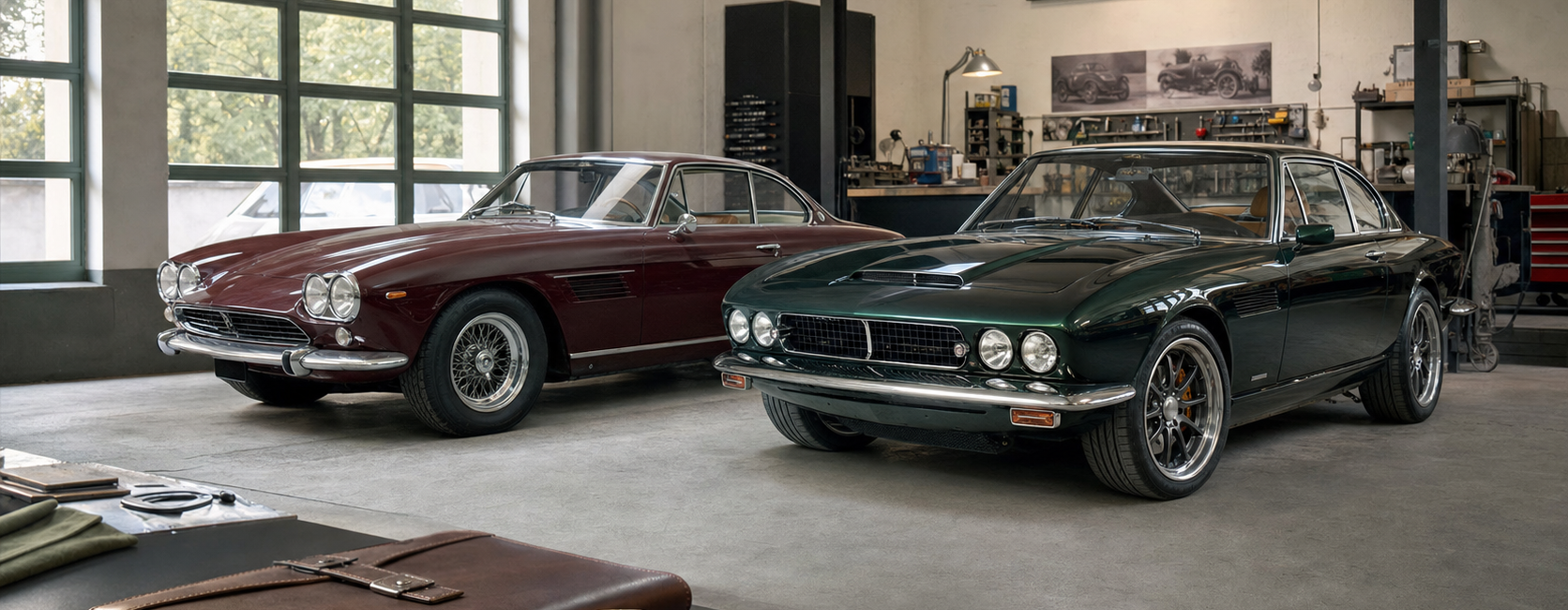
The classic car market is no longer just about choosing between a restored car and one “in its original state.” Restomods, which retain the aesthetic of an older model while modernising its performance, braking or comfort, now hold a visible place in specialised workshops and high-end sales.
The short answer: choose the original if historical value, traceability and liquidity among collectors are paramount. Choose a restomod if you genuinely want to drive the car, accept a modern interpretation and keep the vehicle for a long time. In both cases, the quality of execution and documentation matter more than the label.
Restomod, restoration or preservation: three different philosophies
A preserved car retains as much as possible its original components, materials and finishes. A restoration aims to return the car to a configuration faithful to its factory release, with varying degrees of authenticity. A restomod embraces changes: engine, gearbox, brakes, suspension, air conditioning, lighting or connectivity.
The boundary can be blurred. Modern tyres, a more reliable ignition or an improved radiator do not necessarily turn a classic into a restomod. However, a mechanical transplant, a heavily modified body shell or a completely redesigned interior change its nature and its audience.
The right choice depends primarily on your intended use
| Priority | Original or faithful restoration | Restomod |
|---|---|---|
| Concours and historic collection | Natural choice | Not very suitable |
| Regular outings and long journeys | Possible with careful maintenance | Often easier |
| Period sensations | More authentic | More filtered or higher performing |
| International resale | Established market if well documented | Narrower market, dependent on the restorer |
| Personalisation | To be limited or made reversible | At the heart of the project |
An owner who drives 500 kilometres per year does not have the same needs as someone wishing to cross Europe. Before comparing power outputs, define the frequency of use, the intended routes, the acceptable level of comfort, and your tolerance for downtime. The offerings among classic and prestige Porsche models availabledemonstrate how two cars from the same generation can be aimed at very different uses.
Value: originality remains a currency of trust
With a rare automobile, originality makes the documentation easier to interpret. Consistent numbers, original paint, correct upholstery, continuous history and documented interventions reduce uncertainty. This does not mean that an unrestored car always commands a higher price: a tired, corroded or unsafe car remains a poor purchase.
Restomod creates a different kind of value. This is based on the reputation of the workshop, technical coherence, quality of finishes and the possibility to maintain the installed parts. A project billed at a very high price does not guarantee resale at the same level. The tastes of the client may be too personal, and the future buyer will not necessarily value every hour of work.
To understand what reassures the market, look at the presentation and documentation of cars already sold by the company.
Reversible modifications better protect the purchase
A well-thought-out restomod ideally retains the removed parts and avoids cutting or welding the structure unnecessarily. Seats, wheels, shock absorbers or braking components can be replaced in a reversible manner. A shell modification, permanent widening or an engine that cannot be returned to its original configuration reduce future options.
Request a precise inventory: part references, wiring diagrams, settings, invoices, workshop photos, original elements retained and supplier contacts. A spectacular vehicle but impossible to diagnose in five years can become very costly.
Compliance, insurance and technical inspection: the often overlooked point
A significant modification should never be considered purely aesthetic. Power, braking, dimensions, structure, emissions or seating capacity can affect the vehicle’s compliance, its technical inspection and the insurer’s position in the event of a claim.
Before purchase, provide a complete description to the insurer and request written confirmation of coverage. Verify consistency between the vehicle, its registration document, chassis number and characteristics. For an imported or heavily modified project, have the administrative situation examined by a competent professional before any deposit. The cost of coverage varies greatly depending on the profile: how much does classic car insurance cost.
Which models are best suited to each approach?
An older Porsche 911, a Jaguar E-Type, a Mercedes SL or a classic Land Rover can exist in both worlds. On a rare, numbered version or one fitted with a sought-after engine, preserving originality is generally more prudent. On a model produced in larger numbers, incomplete or already modified, a coherent transformation may make more sense.
The Jaguars available on PlethoreCarsallow, in particular, comparison of philosophies ranging from the classic GT to a more contemporary automobile. The rule remains the same: do not sacrifice an exceptional historic base to replicate a fashionable project.
Checklist before buying a restomod
- Identify the base. Confirm the model, year, chassis and history before transformation.
- Audit the workshop. Examine its previous work, guarantees and ability to support the car.
- Inspect the structure. Look for corrosion, repairs, welds and irreversible modifications.
- Validate the engineering. Brakes, cooling, fuel supply, wiring loom, suspension and tyres must form a coherent whole.
- Check the administrative file. Registration document, insurance, importation and compliance must correspond to reality.
- Assess future maintenance. Availability of parts, software, references and necessary skills.
- Have an independent appraisal carried out. The expert must know the original model and the modifications made.
Verdict: buy a philosophy, but above all an execution
The original remains the clearest choice for a historic vehicle, a concours car or a heritage purchase. The restomod may be preferable for an enthusiast who wants to drive regularly with modern performance and comfort. However, it should not be considered an automatic improvement nor a guaranteed investment.
Prioritise a reversible, documented transformation carried out by a recognised workshop. When reselling, the story alone will not suffice: invoices, photos, appraisal and transparency will determine trust. A specialised platform can help to entrust the sale of a classic car to the right audience.
FAQ
Does a restomod gain more value than an original car?
Not automatically. Its value strongly depends on the workshop, quality of execution, base model and market tastes. A rare and well-documented original car generally has a more established audience.
Which modifications should be avoided?
Poorly documented structural modifications, homemade wiring looms, unobtainable parts and transformations difficult to insure or homologate are the most risky.
Should original parts be kept?
Yes, when possible. They facilitate a return to original configuration, document the project and can reassure a future buyer.
How to have a restomod appraised?
Choose an expert familiar with the classic model and the technical modifications. The inspection should cover the base vehicle, the quality of the work, compliance, testing, and market value.
These tips are general. Always verify the documents, history, condition, insurance, compliance, and current market prices with competent professionals.