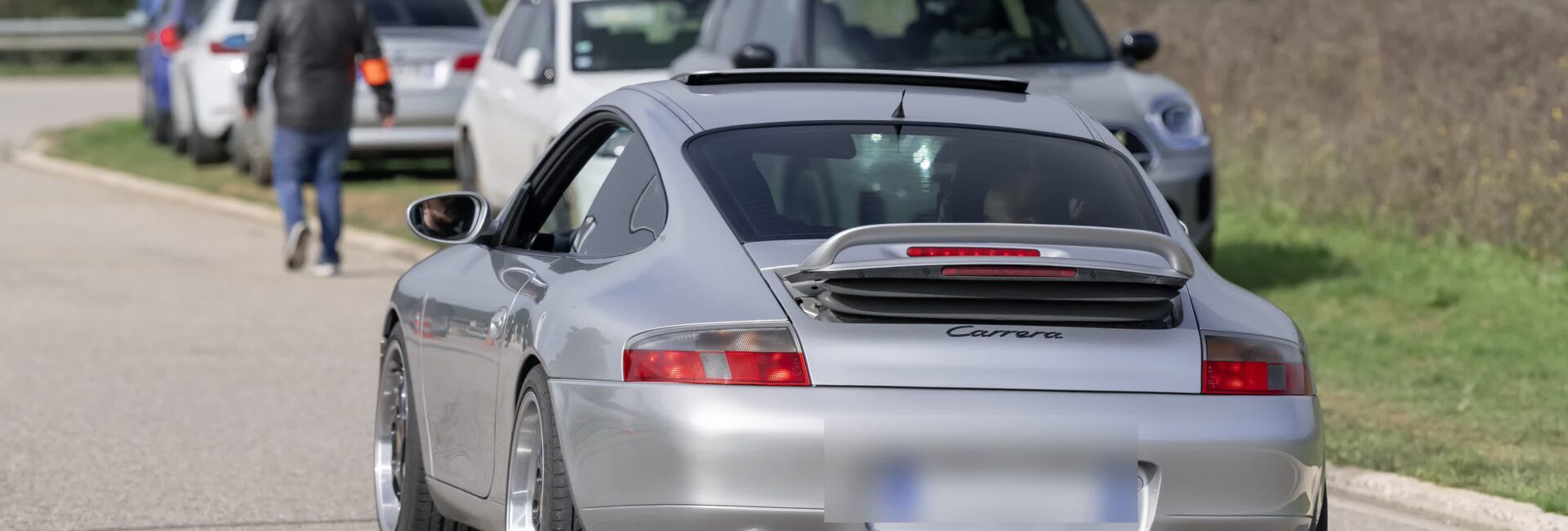
A Porsche 996 can be reliable, but its purchase should not be based solely on the model’s reputation, the mileage, or the mention “IMS done.” For a Carrera, it is necessary to identify the actual engine fitted, check the invoice for the intermediate shaft bearing when it has been replaced, look for debris in the oil filter, and have the cylinders examined by endoscopy. The Turbo, GT2, and GT3 use a different family of engines: they do not have the same IMS bearing issue, although they are not exempt from specialised inspection.
Quick answer: first buy a file and a mechanical condition report, not a model year. An independent pre-purchase inspection by a Porsche specialist must confirm the engine identity, history, absence of worrying symptoms, and the cost of deferred work.
Which Porsche 996 is affected by which risk?
The 996 generation was marketed in many forms. Porsche states that it introduced the water-cooled flat-six on the 911 and that around 175 000 examples were produced between 1997 and 2005. This industrial success does not mean that all versions share the same engine.
| Version | Engine and useful reference | IMS question | Priority before purchase |
|---|---|---|---|
| Carrera and Carrera 4 3,4 l | Flat-six M96, 300 hp, first phase | IMS bearing to identify; possible transition years | Invoices, oil filter, endoscopy, leaks and cooling |
| Carrera, Carrera 4, Carrera 4S and Targa 3,6 l | Flat-six M96, 320 hp from model year 2002 | IMS bearing also to be documented | Endoscopy of the six cylinders, oil history and cooling check |
| Turbo, GT2 and GT3 | Family of engines derived from racing, distinct from the M96 of the Carreras | Not the same sealed bearing at the shaft end as on the Carrera M96 | Version-specific inspection, over-revving, leaks, transmission, brakes and track use |
This table provides guidance, not a diagnosis by model year. An engine may have been replaced during the car’s life and the 2000-2001 years correspond to a transition between several bearing assemblies. The engine number, invoices and examination by a technician therefore take precedence over shortcuts such as “before 2000” or “phase 2.”
The IMS of a Porsche 996: what the file must actually prove
The IMS, standing for *intermediate shaft*, is the intermediate shaft involved in driving the timing system. On the affected M96 engines, a ball bearing supports one end of this shaft. A failure can disrupt the timing alignment and cause significant engine damage.
The subject is often summarised by two percentages taken from a collective American settlement. This reference has historical value, but it concerned a specific scope, warranty period, and particular North American vehicles. It does not allow calculation of the individual probability of failure for a French 996 over twenty years old. Today, the history of each engine is more useful than a general rate.
A usable “IMS” invoice should indicate:
- the date, mileage and registration or chassis number;
- the reference and type of solution installed;
- the workshop that carried out the work;
- the associated operations, for example clutch, rear crankshaft seal or oil change;
- any recommendations for inspection or replacement from the parts manufacturer.
The phrase “reinforced IMS” without an invoice proves neither the reference fitted, nor the date, nor the current condition. Conversely, an original bearing does not mean the engine is already condemned. It justifies a technical evaluation and a quote adapted to this setup, without any promise of zero risk after intervention.
Scored cylinders: why an endoscopy remains useful
Cylinder scoring, often referred to by the English term *bore scoring*, is a different issue from the IMS. It concerns the condition of the cylinder and piston surfaces. Increasing oil consumption, knocking noises, smoke or heavier exhaust emissions may prompt investigation, but none of these signs alone is sufficient to make a diagnosis.
A properly performed endoscopy allows observation of the walls of all six cylinders. Its interpretation should be entrusted to a workshop experienced with M96 engines: a visual mark does not automatically have the same severity as a deep scratch accompanied by other adverse measurements. Depending on the case, the specialist may supplement this with a compression test, a leak-down test, filter examination or oil analysis.
Hartech, a British specialist in rebuilding these engines, emphasises that the causes and mechanisms of wear are multiple. It would therefore be misleading to designate a model year as completely protected or to announce a mileage at which failure would occur. The purpose of the inspection is precisely to replace this general uncertainty with observations on the specific car desired.
The pre-purchase inspection to request from the specialist
A favourable MOT does not replace a pre-purchase inspection. The former complies with a regulatory framework; the latter seeks to assess the condition, history and probable expenses of a specific example.
Request a written report covering at least the following points.
Engine, oil and cooling
- cold start, idle stability and abnormal noises;
- search for oil and coolant leaks;
- inspection of the opened oil filter and its contents;
- endoscopy of the six cylinders on Carrera M96 models;
- inspection of the expansion tank, water pump, front radiators and hoses;
- consistency between engine number, declared version and invoices.
The opening of the filter is explicitly mentioned by a regional technical manager of the Porsche Club of America among the relevant checks for an M96 engine. It does not guarantee the future of the engine, but it can reveal metallic or plastic debris that requires investigation before any signing.
Gearbox, chassis and road test
The test must be long enough to bring the mechanics up to temperature. The specialist will check gear changes, the clutch or the operation of the Tiptronic, bearings, vibrations, braking, suspension play and tyre wear. On a lift, they can examine the underside, lines, mounts, signs of impact and previous repairs.
The front air intakes accumulate leaves and dirt around the radiators. This point, also noted in the buying guide published by Porsche, deserves a visual inspection: a clean radiator seen from the front is not always enough to inform about what has accumulated behind the bumpers.
Electronic diagnostics and over-revving
The electronic readout can complement the history by recording faults and, depending on the version, over-revving ranges. It must be interpreted alongside engine hours and the probable date of events. An isolated figure, without chronology or context, cannot alone condemn or validate a car.
Does a Turbo or a GT3 avoid all reliability problems?
No. Porsche associates the engines of the Turbo, the GT2 and the GT3 of generation 996 with an architecture derived from the 911 GT1, different from the M96 of the Carrera. LN Engineering specifies that their intermediate shaft is supported by oil-fed bearings and that they do not suffer from the same sealed ball bearing defect.
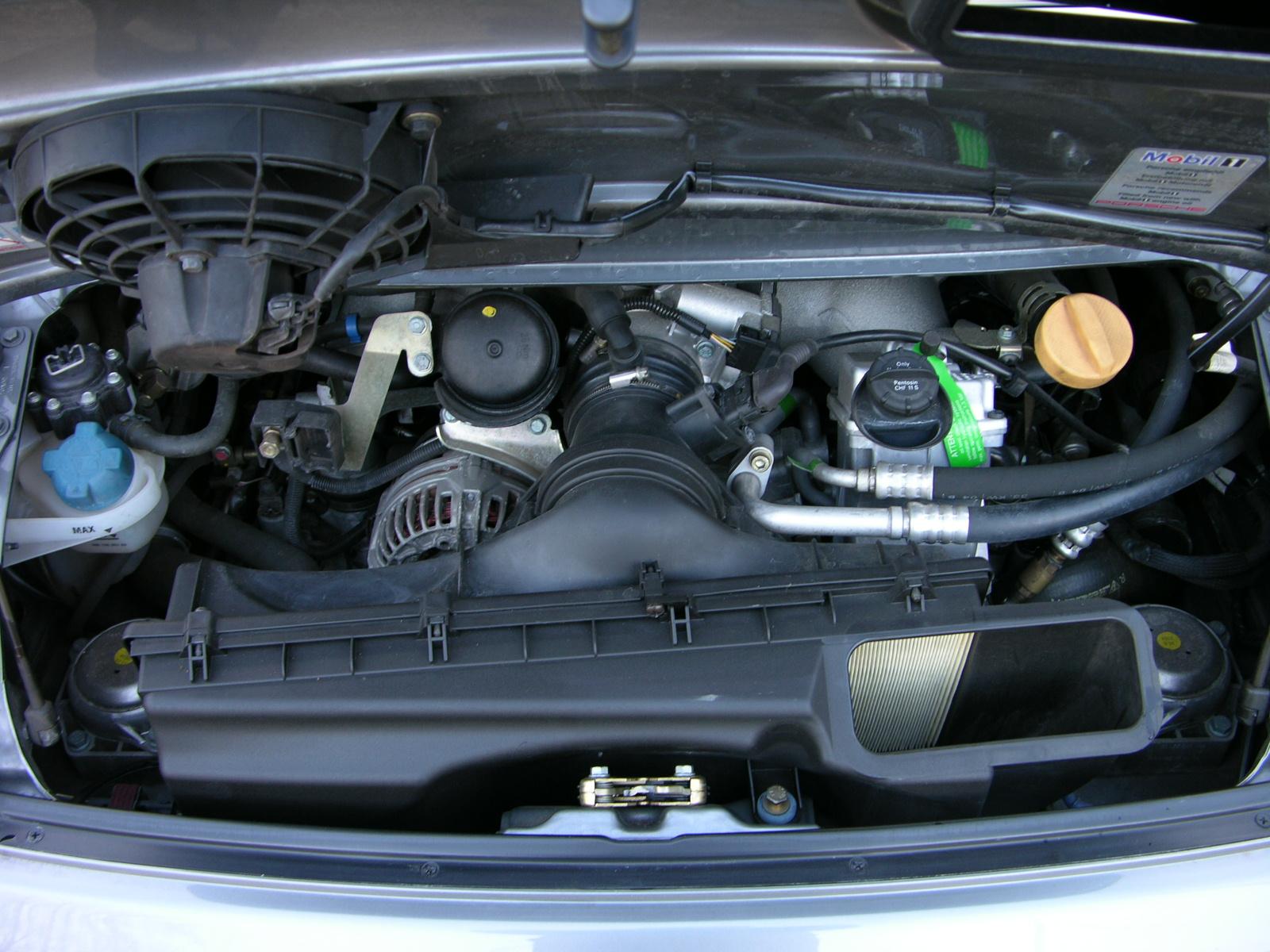
The engine of the 996 GT3 belongs to a family distinct from that of the Carrera M96. Photo: The Car Spy, CC BY 2.0 licence, via Wikimedia Commons.
This difference does not make these versions risk-free purchases. A car used on the track, modified or poorly maintained can present high expenses on the engine, transmission, braking, running gear or tyres. The rarity and value of certain versions also increase the importance of authenticity, quality of repairs and traceability.
3,4 litres or 3,6 litres: which to choose?
The 3,4 litre Carrera develops 300 hp. The facelift of the 2002 model year raises the displacement to 3,6 litres and the power to 320 hp, with a range enriched notably by the Targa and the Carrera 4S. These are real differences in presentation and character, but not an automatic ranking of reliability.
Between two cars, prioritise:
1. the one whose engine and interventions are documented; 2. the one that the independent inspection judges sound; 3. the one whose deferred work is estimated before negotiation; 4. the one whose configuration truly matches your use.
A rear-wheel-drive coupe with manual gearbox, a Carrera 4S, a convertible or a Tiptronic do not correspond to the same project. The best choice is not the version most praised on forums, but the example whose condition, file and maintenance budget are coherent.
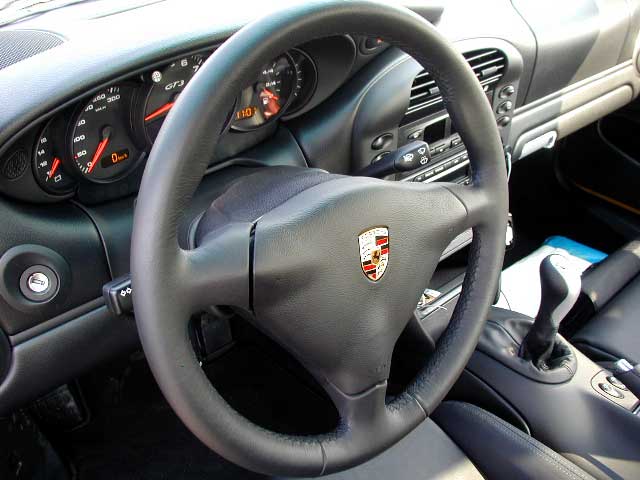
Wear on the steering wheel, controls and seat must remain consistent with the announced mileage and history. Photo: bolton_aston_yellow, CC BY-SA 2.0, via Wikimedia Commons.
Documents to gather before paying a deposit
Request the service book, sorted invoices, previous MOT certificates, any expert reports, the duplicate keys and the list of delivered equipment. Compare mileages and look for periods without proof. A restoration or engine swap is not necessarily negative if detailed by verifiable parts and invoices.
Porsche offers, through certain Porsche Classic centres, a technical certificate based notably on the VIN, vehicle numbers and a visual examination of its condition. This document can enrich the file; it does not replace an independent inspection aimed at the purchase decision.
The notion of matching numbers must also be documented : it neither constitutes a guarantee of mechanical health nor sufficient proof of absence of repairs.
How to decide without underestimating the budget?
Have two lists drawn up: defects to be corrected immediately and foreseeable operations in the medium term. Request separate quotes for the engine, clutch or gearbox, cooling system, brakes, suspension, tyres and bodywork. A cheaper car can cease to be a good deal as soon as several items are deferred.
Before travelling, compare the configurations offered among the classic and prestige cars for sale, then insist on an independent inspection for the chosen example. A detailed advertisement makes selection easier; it never replaces a mechanical check.
After purchase, adapt the servicing to usage and the specialist’s recommendations. Low mileage does not exempt from oil changes and time-related checks. If the car remains stationary for several weeks, our guide to storing a classic car without damaging it helps to limit the effects of inactivity. Also check the deadlines for the technical inspection of a classic car according to its administrative status.
Frequently asked questions
Which Porsche 996 models are affected by the IMS issue?
The Carrera, Carrera 4, Carrera 4S and Targa equipped with the M96 engine use the IMS bearing assembly which must be identified and documented. The Turbo, GT2 and GT3 have a different architecture and do not present the same problem. However, a replaced engine may have a different assembly from that suggested by the car’s year.
Is an IMS replacement invoice sufficient to secure the purchase?
No. It must specify the part, date, mileage and workshop, then be compared with the manufacturer’s recommendations for the solution. It alone does not provide information on the cylinders, cooling, leaks or the rest of the vehicle.
Is it mandatory to perform an endoscopy of the cylinders?
It is not a legal obligation. However, it is a very relevant check on a Carrera M96, as it allows direct observation of the cylinder walls before purchase. Its interpretation requires specific experience with these engines.
Is a low-mileage Porsche 996 necessarily safer?
No. Mileage must be considered alongside age, frequency of use, maintenance and storage conditions. A car that has been driven little may also have ageing seals, old fluids, corrosion or poorly documented periods of inactivity.
Can you buy a Porsche 996 with an original IMS?
Yes, but only after an informed technical and financial evaluation. The specialist must identify the probable assembly, examine the engine’s condition and propose suitable options. The purchase price must allow a realistic margin for the decided work.
The verdict before purchase
The Porsche 996 is neither a mechanical disaster foretold nor a 911 to buy with your eyes closed. General information serves to ask the right questions; only invoices, engine identification and inspection of the example allow a reasonable decision.
Refuse a transaction if the seller prevents an independent inspection, if the declared engine does not match the paperwork or if worrying signs remain undiagnosed. Conversely, a well-maintained, transparent and properly examined 996 can be a usable and endearing 911, without any check promising the total absence of future breakdowns.
Technical information verified on 9 September 2026. IMS solutions and their recommendations may evolve; have the installation and applicable intervals confirmed by the parts manufacturer and a Porsche specialist.