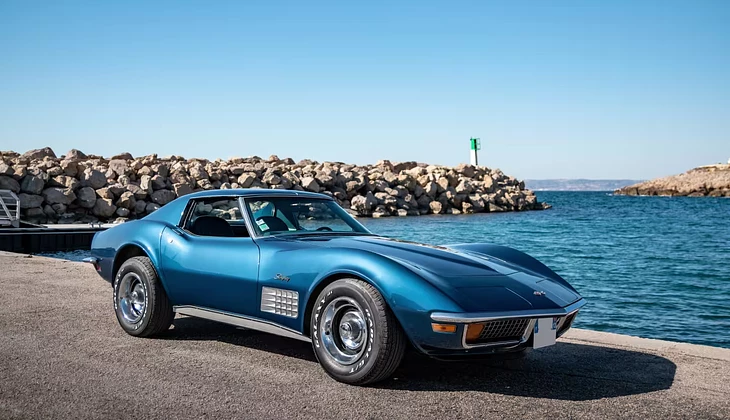
Few cars embody the American dream as viscerally as the Chevrolet Corvette C3. Produced from 1968 to 1982, this third generation holds the record for longevity of the entireCorvette lineage : fifteen years of production, 542 861 units assembled, and an iconic status that remains undiminished. But behind the sculpted lines and the rumble of the V8, what should you really know before falling for a C3? Here is the most comprehensive guide in French.
The genesis of the Corvette C3: from the Mako Shark II to the road
The story of the Corvette C3 begins in the design studios of General Motors, in the mid-1960s. Designer Larry Shinoda then created a concept called the Mako Shark II, a proposal for amid-engine Corvette with aggressive and futuristic lines. The mid-engine project was ultimately abandoned due to cost and reliability concerns, but the curves of the Mako Shark II survived. They were adapted to a classic front-engine, rear-wheel-drive architecture, giving birth to the C3.
The most amusing anecdote about this launch? A few weeks before the official presentation, Mattel unveiled its very first Hot Wheels range. Among the 16 models offered was a Custom Corvette with strangely familiar lines. Designer Harry Bradley had spent four years at GM and knew the Mako Shark II perfectly. General Motors was furious. But the immediate success of the toy amplified the buzz around the real car and ensured that an entire generation of children would dream of Corvette as much as their parents.
Design and bodywork: the lines that defined an era
The Corvette C3 is above all a matter of silhouette. The curvaceous sides shaped like a Coca-Cola bottle, the long sloping bonnet and the truncated rear compose one of the most recognisable designs in automotive history. The coupe adopts a T-top roof with two removable panels, while the convertible version remained in the catalogue until 1975.
The fibreglass body does not rust. This is a considerable advantage over cars of that era. However, the chassis and internal structure, the famous birdcage surrounding the cabin, are made of steel. And steel does rust. We will return to this in the buying guide.
Between 1968 and 1972, the rear window was a removable vertical glass, an elegant style detail but not very practical. In 1978, for the Silver Anniversary of the 25 years of the Corvette, it was replaced by a fastback-style bubble glass. This change radically modernised the silhouette and remains one of the most sought-after model years.
The engines of the Corvette C3: from small block to big block
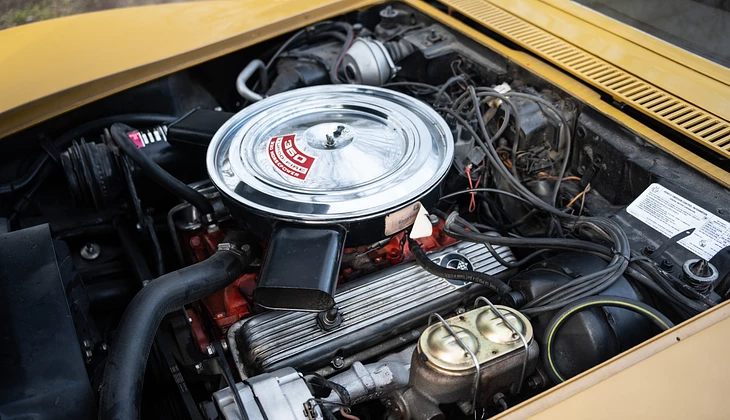
The engine range of the C3 alone tells the story of American automotive in the 1970s. At launch in 1968, six engines were offered. The small block of 327 cubic inches (5,3 litres) developed between 300 and 350 hp, while the monstrous big block of 427 (7,0 litres) peaked at 430 hp in its L88 racing version. These same Chevrolet blocks served as the basis for an atypical neo-classic:the Excalibur.
In 1969, the small block increased to 350 ci (5,7 litres). In 1970, the big block grew again to 454 ci (7,4 litres) with the LS6 delivering 450 hp. This was the peak of raw power.
Then the oil crisis struck. Emission standards tightened. The big block 454 disappeared after 1974. The power of the small block 350 gradually collapsed. In 1979, the V8 of 5,7 litres produced only 195 hp in the base version and 220 hp in the L82. A dizzying drop from the 450 hp of the early decade.
But to reduce the late C3 to its horsepower would be a mistake. The engine torque remains generous and defines the driving experience of these models. You do not drive a C3 of 1979 like a racing car. You savour it like a grand touring GT, with that characteristic rumble of the American V8 and that smooth low-end thrust.
In 1982, the final year, Chevrolet introduced the dual-body Cross-Fire injection and the new four-speed Turbo Hydra-Matic 700R4 transmission with overdrive. Power rose to 200 hp. It was the swan song of the C3, and the announcement of the technology that would equip the C4.
Year-by-year evolution (1968-1982): key dates
1968: launch of the C3 with Coca-Cola bottle-shaped bodywork. Choice between T-top coupe and convertible. Small block 327 and big block 427 engines.
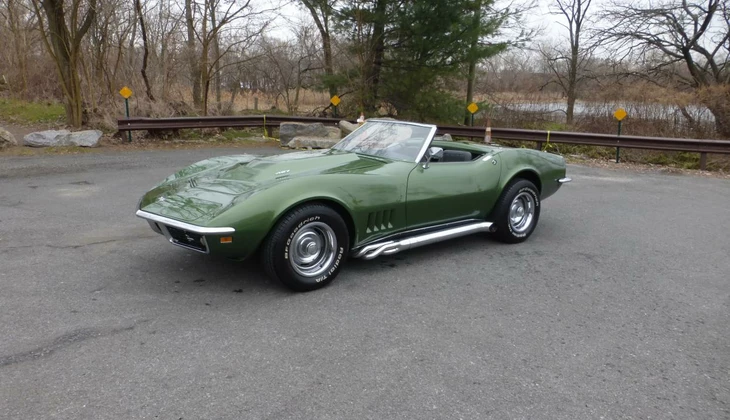
1969: the small block increases to 350 ci. The model name appears, written as one word instead of two. Three special Corvettes are lent to the Apollo 12 astronauts. They are nicknamed the Astrovettes.
1970 : widening of the wheel arches. Big block increased to 454 ci. The LS6 reaches 450 hp. The ZR1 version receives competition suspensions and brakes.
1971 : all engines are detuned to accommodate unleaded fuel with a low octane rating.
1972 : last year for chrome bumpers at the front and rear. End of an aesthetic era.
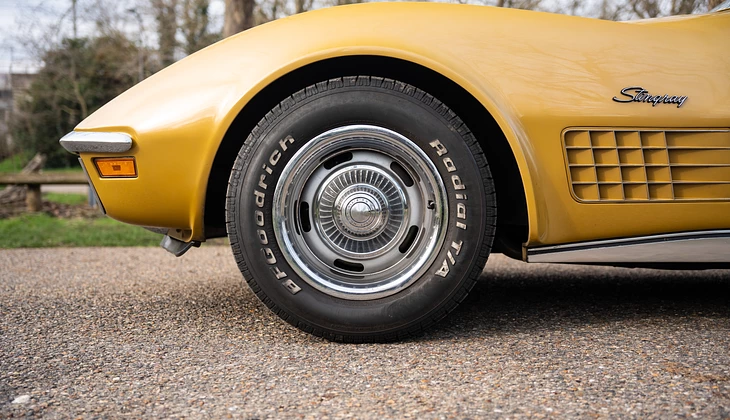
1973 : front bumper in polyurethane. Radial tyres as standard. The L82 replaces the LT1.
1974 : rear bumper also in polyurethane. Discontinuation of the big block 454.
1975 : end of the convertible version for twelve years. Introduction of the catalytic converter and electronic ignition.
1978 : Silver Anniversary. New bubble-type fastback rear window. The Corvette serves as pace car at the 500 miles of Indianapolis, and 6 502 replicas are produced for dealers.
1979 : historic sales record with 53 807 units sold. Introduction of optional glass roof panels.
1981 : only one engine available, the L81 of 190 hp. First rear fiberglass leaf springs. Factory relocation from Saint Louis (Missouri) to Bowling Green (Kentucky).
1982 : Cross-Fire injection and 4-speed automatic gearbox. Limited edition Collectors Edition.
The Corvette C3 in popular culture
The C3 goes beyond the mere status of a sports car. It has become a cultural symbol, inseparable from the American political and social context of the 1970s. Produced under the Nixon, Ford and Carter administrations, it lived through Watergate, the 1973 oil crisis and the subsequent recession. The Corvette represented a form of resilience, a reminder that America still knew how to build objects of desire.
In cinema and television, the C3 is omnipresent. It appears in dozens of films and series of the era. Its silhouette is instantly recognisable, even to those with no knowledge of cars.
And then there is the story with Hot Wheels. The fact that a toy preceded the real car in the collective imagination is unique in automotive history. Millions of children owned a miniature Corvette C3 before they even knew how to drive. This anchoring in childhood memory partly explains the enduring passion this car inspires among collectors today.
Buying guide: how to choose your Corvette C3 today
Buying a C3 is an act of passion. And that is precisely the problem. The majority of Corvette purchases are impulsive buys, according to community specialists. You fall in love with the design, sign too quickly, and discover unpleasant surprises afterwards. Here is how to avoid this scenario.
First rule: no matter the amount paid at purchase, you will need to invest more afterwards. The most recent C3 dates from 1982. Everything ages, everything breaks, everything requires attention. Plan a post-purchase budget of at least 3 000 to 5 000 euros for immediate restorations.
Second rule: always inspect the car in person. For European buyers importing from the United States, demand detailed photos of all critical points. To compare American cars offered by a specialist, consult the Made in US Europe showroom on Plethore Cars.
The essential checkpoints to examine are as follows. The birdcage is the metal structure surrounding the cabin and forming the door pillars, sills and roof arch. It is the most costly corrosion area to repair. Misaligned doors are the classic sign of a compromised birdcage. The radiator support and bumper support structures frequently rust. The chassis rails underneath, rear suspension arms and their mounting points must be inspected on a lift.
The pop-up headlights operate via a pneumatic system with rubber hoses that deteriorate over time. This is a frequently overlooked checkpoint.
On the engine side, the Chevrolet V8 is reputed to be unbreakable. Check for blue smoke at the exhaust (sign of worn piston rings), listen for timing chain rattles and check oil pressure (minimum 20 psi hot at idle). The automatic gearbox is robust if the fluid has been changed regularly. Harsh gear changes indicate a revision is needed.
The question of numbers matching deserves attention. A specimen whose serial numbers of chassis, engine, gearbox and differential match has significantly more value than a recomposed vehicle. The site corvsport.com allows verification of serial and casting numbers for each year. The Corvette Black Book, with its 176 pages of technical data, is the bible for the serious collector.
Market Value of the Corvette C3
The values of the Corvette C3 have significantly increased in recent years, yet it remains one of the most accessible generations. This window of opportunity is gradually closing.
In France, current prices range between 21 500 and 55 000 euros for a well-maintained example with historic vehicle registration. The most sought-after model years are the 1968-1972 with chrome bumpers and big block engine, which can exceed 80 000 euros in concours condition.
Before registration or import, also check the administrative status of the vehicle: our dossier on the classic car law 2026 summarises the points to verify.
At the other end of the spectrum, a restoration project can be found for 3 000 to 8 000 euros. The Chevrolet small block engine is simple and parts are plentiful. A complete turnkey crate engine can be found for 2 500 to 4 000 euros, making engine replacement accessible even on a modest budget.
Factors influencing the value include the model year (early and late years are worth more), engine type (big block is more expensive than small block), numbers matching, body style (convertible is more valued than coupe), and overall condition.
Maintenance and Reliability: Living Daily with a C3
The Corvette C3 is not a museum piece. It is driven, maintained, and rewards those who take care of it. As one owner summarised on Caradisiac: it is the best purchase of his life, with a responsive and powerful engine and unparalleled driving pleasure.
The V8 350 engine is remarkably reliable. The engine assembly is basic and accessible to any competent mechanic. The carburettor fuel system is the most temperamental element, especially with today’s unleaded petrol. Switching to electronic ignition and fine-tuning the fuel system resolves most starting issues.
The radiator is slightly undersized, especially on big block versions. Regularly check the wiring harness, fan shroud, and hoses.
The independent rear suspension with transverse leaf spring is a robust design but requires regular maintenance of universal joints, drive shafts, and suspension arms. The rubber bushings degrade over time. The condition of the four-wheel disc brakes must be monitored, particularly the calipers and brake fluid.
Fuel consumption is naturally significant. Expect 15 to 20 litres per 100 km under normal use. It is the cost of enjoying an American V8.
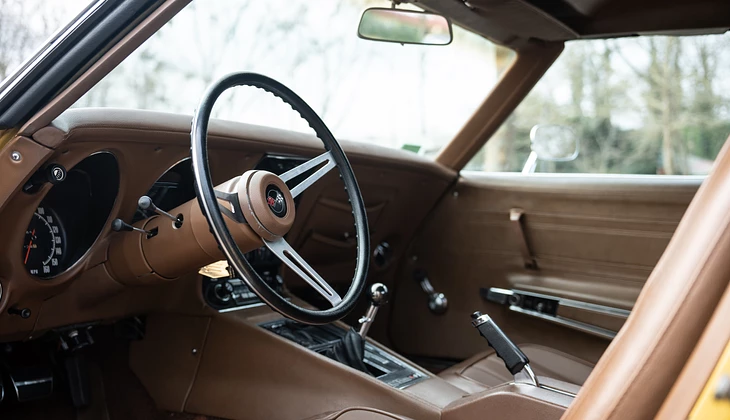
Inside, the quality of materials is not a strong point of the Corvette. The leather and vinyl crack and suffer from sun exposure. Carpets stain. The good news: absolutely everything is available from specialised Corvette suppliers in the United States, and several European dealers stock common parts.
Special Editions and Notable Models
Certain versions of the C3 stand out due to their rarity or exceptional character.
The ZL1 of 1969 is the absolute Holy Grail. This all-aluminium big block 427 was produced in only two official road-going examples. Its announced power of 430 hp was widely underestimated by Chevrolet to avoid alarming insurers. Valuations now reach several million dollars.
The ZR1 package (1970-1972) combined a small block LT1 of 370 hp with racing suspension, reinforced brakes, and specific anti-roll bars. The ZR2 offered the same treatment for the big block. These two packages were reserved for customers who knew exactly what they wanted.
The Silver Anniversary of 1978 celebrates the 25 years of the Corvette with a special two-tone silver paint and a bubble rear window. The same year, 6 502 replicas of the Indianapolis pace car were produced.
The Collectors Edition of 1982 marks the end of C3 production with a special treatment and a unique commemorative plaque. It is a prized version among collectors seeking an original end-of-series example.

FAQ on the Corvette C3
How much does a Corvette C3 cost?
In France, a Corvette C3 in good condition sells for between 21 500 and 55 000 euros with a historic vehicle registration. Big block versions and chrome model years (1968-1972) can exceed 80 000 euros. A restoration project can be found from as little as 3 000 euros.
What is the power output of a Corvette C3?
The power varies considerably depending on the model year. Early versions (1968-1970) reached between 430 and 450 hp with the large big block engines. Later versions (1975-1981) were limited to 165 to 210 hp due to emissions regulations. The final version of 1982 with Cross-Fire injection develops 200 hp.
What is the value of a Corvette C3 1982?
The standard Corvette C3 1982 trades between 25 000 and 40 000 euros in good condition. The rarer and more sought-after Collectors Edition reaches 45 000 to 65 000 euros. Being the last model year of the C3, it holds a special status among collectors.
What is the power output of a Corvette C3 from 1979?
The 1979 model year offers two engines: the L48 with 195 hp as standard and the L82 with 220 hp as an option. In California, stricter regulations reduced the power to 175 hp for the base engine. Despite these modest figures, it was a record sales year with 53 807 units produced.