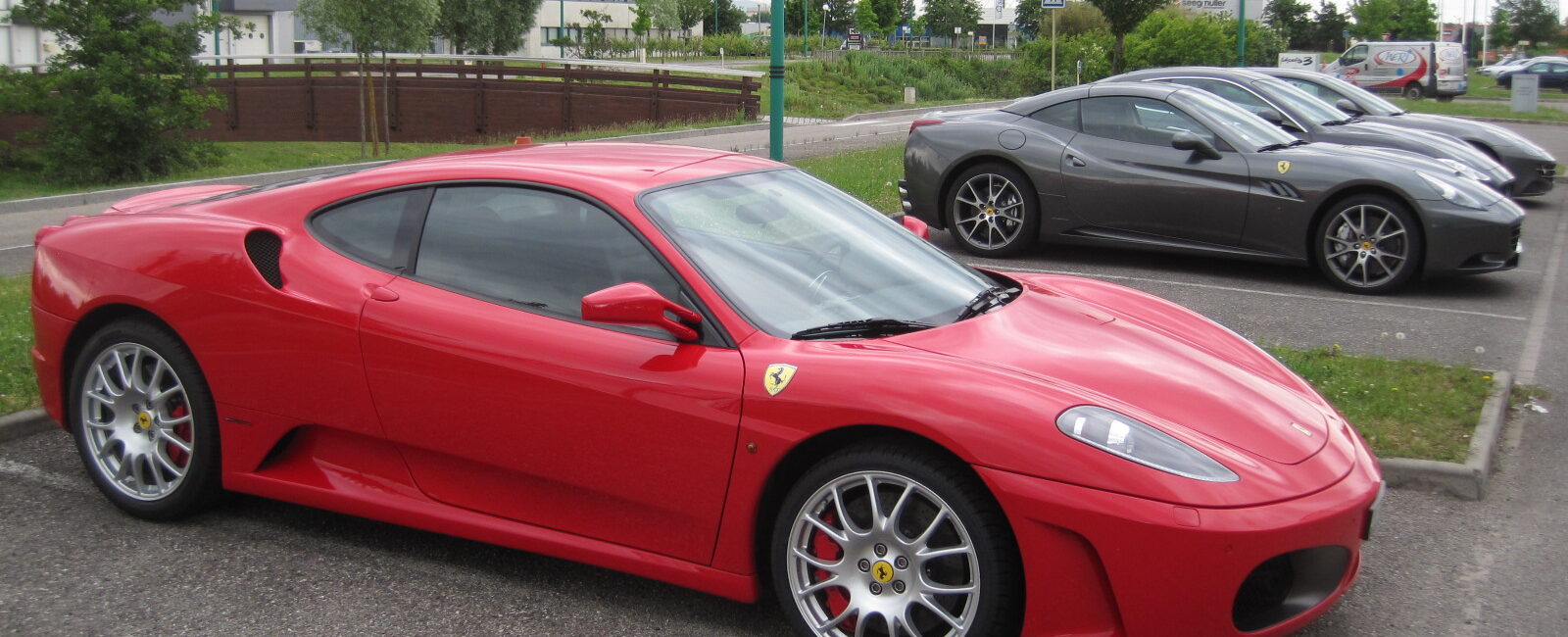
Choose the Ferrari F430 if you are looking for a more mechanical experience, a possible manual gearbox, and generally a lower entry-level budget in the F1 version. Prefer the Ferrari 458 Italia if you want more performance, a much smoother dual-clutch gearbox, and easier usability.The best is therefore not the fastest: it is the one whose technical generation, condition, and history correspond to your project.
The comparison seems natural since the 458 Italia directly replaced the F430. Yet, it contrasts two eras. The F430 refines the Ferrari berlinetta still analogue in its reactions, whereas the 458 inaugurates a much more integrated interface, transmission, and electronics. Before buying, you must compare equivalent examples, not just two model names.
F430 vs 458 Italia: the essential differences
| Criterion | Ferrari F430 | Ferrari 458 Italia |
|---|---|---|
| Presentation | 2004 | 2009 |
| Engine | Naturally aspirated V8, 4 308 cm³ | Naturally aspirated V8, 4 497 cm³ |
| Power announced by Ferrari | 490 hp at 8 500 rpm | 570 hp at 9 000 rpm |
| Announced top speed | Over 315 km/h | Over 325 km/h |
| 0 to 100 km/h | About 4 seconds depending on configuration | Less than 3,4 seconds according to Ferrari |
| Transmission | Manual with 6 gears or F1 automated manual with single clutch | Dual-clutch with 7 gears |
| Character | More physical and mechanical | Faster, more precise and versatile |
| Open version | F430 Spider | 458 Spider |
| Radical version | 430 Scuderia | 458 Speciale |
These data concern the standard berlinettas. A 430 Scuderia should not be directly compared to a base 458 Italia, nor a 458 Speciale to a standard F430 F1. The radical versions have their own level of rarity, price, tuning and restoration cost.
Two naturally aspirated V8 engines, but two philosophies
Ferrari specifies for the F430 a rear longitudinal V8 of 4 307,68 cm³ developing 490 hp at 8 500 rpm. This engine marks a break with the 360 Modena and uses chain-driven timing. The car also introduces the manettino on the steering wheel and pairs its V8 with the E-Diff, an electronic differential derived from the brand’s racing experience.
The 458 Italia increases the displacement to 4 497 cm³, power to 570 hp and maximum revs to 9 000 rpm. Ferrari presents it as a new chapter in its history, with direct injection, E-Diff and coordinated F1-Trac. The gain is not just numerical: the response, traction and execution speed give the impression of a complete generational change.
On the road, the F430 lets you feel the transmission’s operation and weight transfers more. The 458 is more immediate and stable when increasing the pace. This efficiency does not make it cold, but it requires higher speeds to regain some of the involvement that the F430 provides earlier.
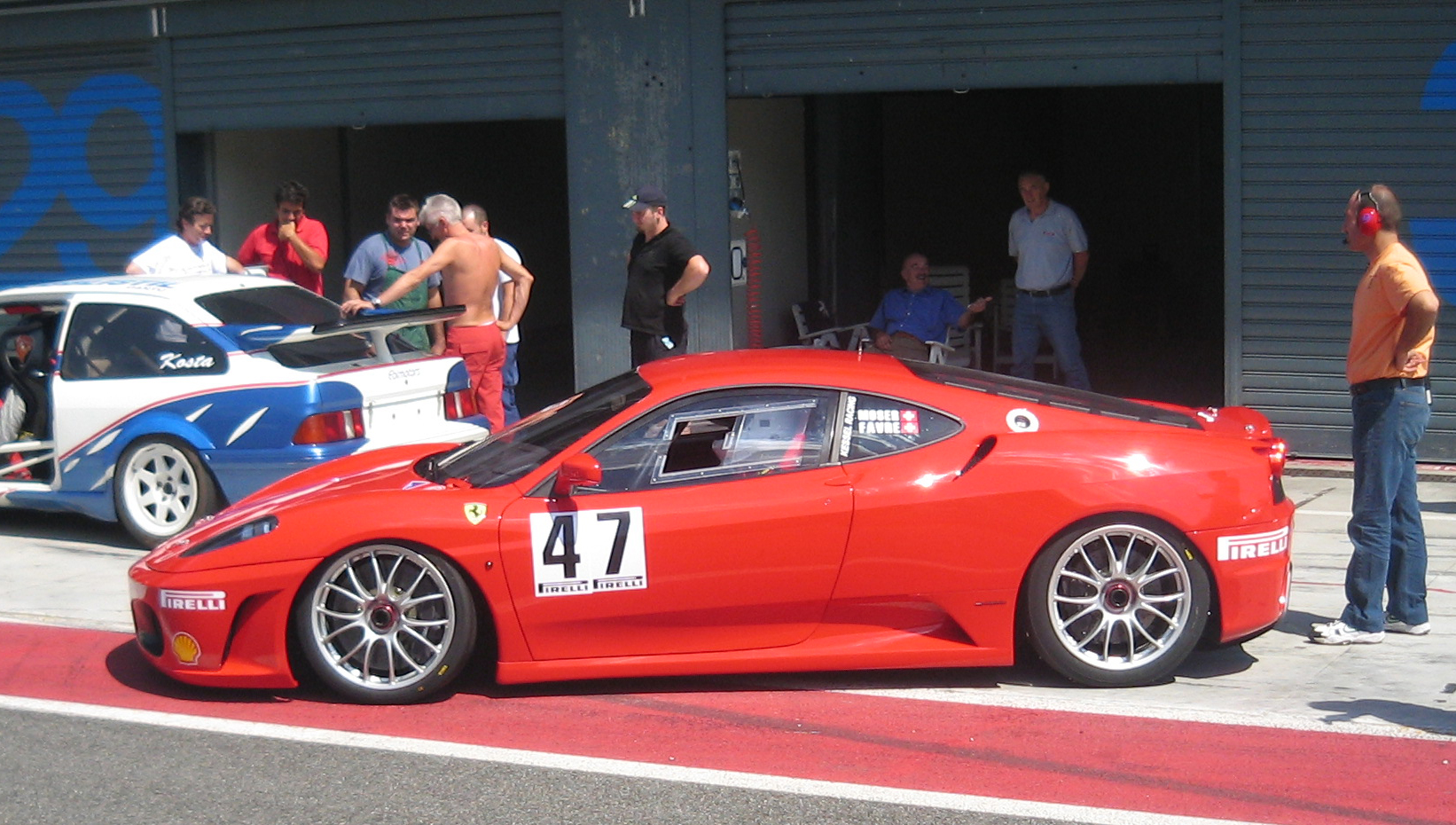
Ferrari F430 at Monza. Photo Lennart Coopmans, CC BY-SA 2.5 licence, via Wikimedia Commons.
F1 gearbox or dual-clutch: the real dividing line
Most F430 models have the robotised F1 gearbox. It is a single-clutch automated manual gearbox: it cuts torque during gear changes and its behaviour depends heavily on the chosen mode, clutch adjustment and driving style. At low speed, poor use can accelerate wear. At high revs, its sharp shifts contribute to the car’s character.
The 458 adopts a seven-speed dual-clutch gearbox. The shifts are faster and much smoother. Manoeuvres, traffic jams and long journeys become easier. For an owner who wants to use their Ferrari regularly, this difference can matter more than the extra 80 hp.
The F430 is also available with a gated manual gearbox. This is its most obvious heritage advantage over the 458, which never received a factory manual gearbox. Original manual F430 models are rare and sought after; a recent conversion should not be valued as a factory-original car. Demand configuration documentation and verify component authenticity.
Which one delivers the best sensations?
The F430 suits the driver who wants to understand what the car is doing: throttle modulation, F1 gearbox shift timing, communicative steering and clearer reactions at road speeds. It retains enough electronics to be usable, without smoothing out as much of the steps between command and response.
The 458 Italia impresses with the coherence of its whole. The engine revs to 9 000 rpm, the gearbox chains the gears and the aids work together. It is more accessible without being mundane. However, its potential is so high that an open road less often offers the chance to approach its limits.
For occasional outings and the pursuit of a very characterful collector’s item, the F430 — especially manual — has a strong argument. For long journeys, regular weekends and smoother driving, the 458 Italia is generally easier to live with.
Reliability of the Ferrari F430: points to check
The V8 of the F430 is often considered reliable when properly maintained, but the entire car can incur significant expenses. A pre-purchase inspection should particularly focus on:
- the exhaust manifolds, which can crack;
- the wear of the clutch in the F1 gearbox and the quality of its adjustment;
- the pump, accumulator and actuators of the F1 system;
- the ball joints, bushes and suspension components;
- the exhaust mounts and the condition of the catalytic converters;
- the operation of the E-Diff and the absence of leaks;
- the buttons and interior trims that have become sticky;
- the thickness and condition of the carbon-ceramic discs when fitted.
The electronic diagnosis must be read by a specialist familiar with the model. The clutch wear percentage only makes sense if the engagement point has been correctly calibrated. An apparently reassuring figure does not replace either a test drive or the service history.
The comprehensive Ferrari F430 buying guide details the versions and specific points of caution for this model.
Reliability of the Ferrari 458 Italia: points to check
The 458 avoids the consumable clutch of the simple F1 gearbox, but its dual-clutch transmission can be very costly in the event of internal faults, sensor or actuator issues. During the test drive, the gears must shift without error messages, abnormal hesitation or persistent jerks, both cold and hot.
You should also check:
- the recall campaigns carried out based on the serial number;
- the condition of the battery and the stability of the electronic systems;
- the front axle lifting mechanism if the option is present;
- the shock absorbers, ball joints and running gear;
- the operation of the air conditioning and all screens;
- the carbon-ceramic brakes and signs of intensive track use;
- the interior controls and trims that may become sticky;
- damage beneath the front splitter and the underbody protections.
The first 458 were subject to a campaign concerning the thermal screens of the rear wheel arches. Other recalls have involved, depending on markets and model years, Takata airbags and the braking system. A general list is not enough: use the Ferrari recall campaign check with the VIN and request proof of completion from the network.
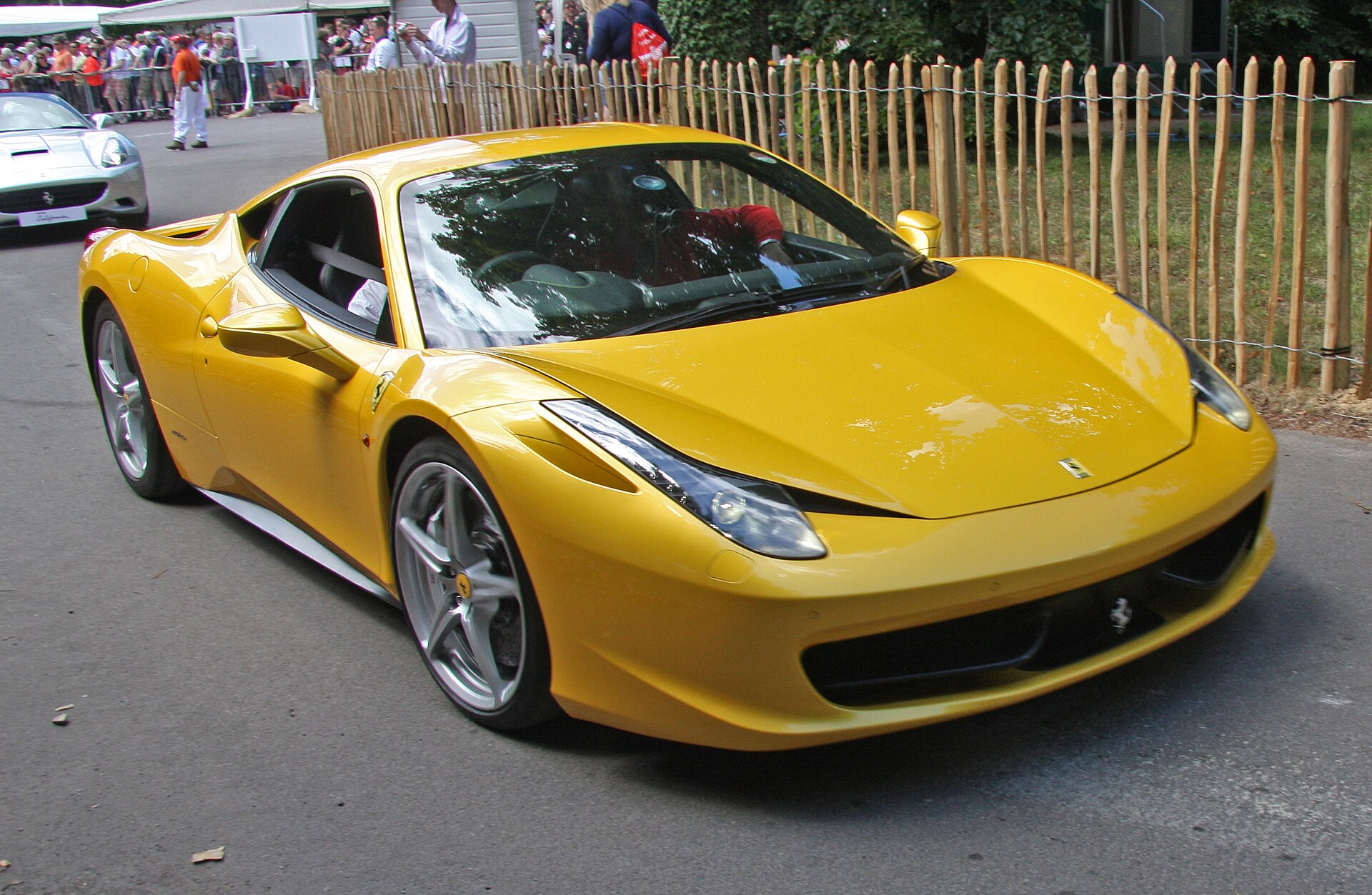
Ferrari 458 Italia at Goodwood. Photo Brian Snelson, CC BY 2.0 licence, via Wikimedia Commons.
Maintenance cost: which is likely to be more expensive?
It would be misleading to give a single annual budget. The cost depends on mileage, the chosen network, the presence of carbon-ceramic brakes, the history and deferred work by the previous owner. A cheap but neglected car can quickly absorb the price difference with a better example.
The F430 may require an F1 clutch, manifolds or a suspension overhaul. The 458 eliminates the F1 clutch as a common consumable, but a dual-clutch gearbox or electronics failure can produce a bill far exceeding a routine service. In both cases, tyres, brakes, shock absorbers and aesthetic elements must be budgeted at supercar rates, not those of a general sports coupe.
Before purchase, demand invoices and not just a stamped service book. Regular annual maintenance does not prove that known defects, recalls or wear components have been addressed.
Price and value: beware of misleading comparisons
A standard F430 F1 is generally priced below a comparable 458 Italia, but several exceptions overturn this logic. An authentic manual F430, a 430 Scuderia or a Scuderia Spider 16M can be worth more than an ordinary 458 Italia. Likewise, a 458 Speciale belongs to a different market than a standard Italia.
Displayed prices are not transaction prices. Compare bodywork, mileage, country of origin, configuration, Ferrari history, brake condition, number of owners and registration taxation. Auction bases provide a second reference, but an American result does not mechanically translate to the French market.
To see the current offer, consult the classic and prestige cars for sale on Plethore Cars. An advertisement serves to identify a market; it never replaces an independent appraisal.
F430 or 458 Italia: which to choose according to your profile?
| Your priority | Most coherent choice | Why |
|---|---|---|
| Mechanical sensations | F430 | More perceptible transmission and reactions |
| Manual gearbox | F430 | The 458 does not come with a manual gearbox from the factory |
| Regular use | 458 Italia | Smoother dual-clutch and more modern ergonomics |
| Performance | 458 Italia | 570 hp, faster gearbox and more integrated chassis |
| Entry budget | F430 F1 | Often more affordable in comparable condition |
| Heritage search | F430 manual or special editions | Rare configuration, to be authenticated |
| Compromise between road use and modernity | 458 Italia | Easier without giving up the naturally aspirated V8 |
Our verdict is therefore nuanced. The F430 F1 is the emotional choice and often the most affordable entry point, provided you accept its transmission and check the clutch. The F430 manual targets a collector willing to pay for rarity and to have the provenance confirmed. The 458 Italia is the most complete choice for frequent and fast driving, with a higher purchase budget and a greater risk of electronic repairs.
Checklist before buying either one
- Obtain the VIN, the original configuration, and the ownership history.
- Request all invoices, diagnostic reports, and completed recalls.
- Start the car cold and drive it until it reaches normal operating temperature.
- Test every gear, the manettino modes, lift function, air conditioning, and displays.
- Measure the wear on the brakes, tyres, and suspension components.
- Check for paintwork, accidents, track use, and damage underneath the chassis.
- Have the control units read and the car inspected by an independent specialist.
- Establish a refurbishment budget before negotiating the price.
Thepre-purchase inspection of a classic car is particularly important for these models. For a car presented as exceptional or certifiable, also consult thecriteria of the Ferrari Classiche programme.
Frequently Asked Questions
Is the Ferrari 458 Italia much faster than the F430?
Yes. Ferrari announces 570 hp and less than 3,4 seconds from 0 to 100 km/h for the 458, compared to 490 hp and about 4 seconds for the F430. The dual-clutch gearbox further accentuates the difference in everyday use.
Does the F430 have a timing belt?
No. Its V8 uses a chain-driven timing system, unlike some earlier V8 Ferraris. This does not exempt it from the scheduled checks and maintenance.
Can you buy a 458 Italia with a manual gearbox?
No. The 458 Italia was sold exclusively with a seven-speed dual-clutch gearbox. The F430 was offered with a gated manual or an F1 automated manual gearbox.
Which Ferrari is easier to use regularly?
The 458 Italia, mainly thanks to its smoother gearbox, more accessible performance, and electronic integration. Its potential repair costs remain high, however.
Is an F430 converted to manual gearbox worth as much as an original manual?
No, in principle. A conversion can be well executed and enjoyable, but its value and authenticity do not match a documented factory configuration.
Should you choose a car with low mileage?
Not necessarily. Low mileage without regular maintenance can conceal a long period of inactivity. Condition, invoices, recalls and quality of use matter more than an isolated odometer reading.
Main sources
- Ferrari — F430, official historical sheet
- Ferrari — 458 Italia, official historical sheet
- Ferrari — the 458 Italia as a new benchmark
- Ferrari — recall checks by VIN
- NHTSA — recall 2010 of the heat shields of the 458 Italia
- Auto Bild Klassik — test and buying guide for the Ferrari F430
- RAC Drive — used Ferrari 458 guide
Information verified on 22 October 2026. Prices, availability and recall campaigns change: always check the VIN, history and condition of the specific vehicle concerned.