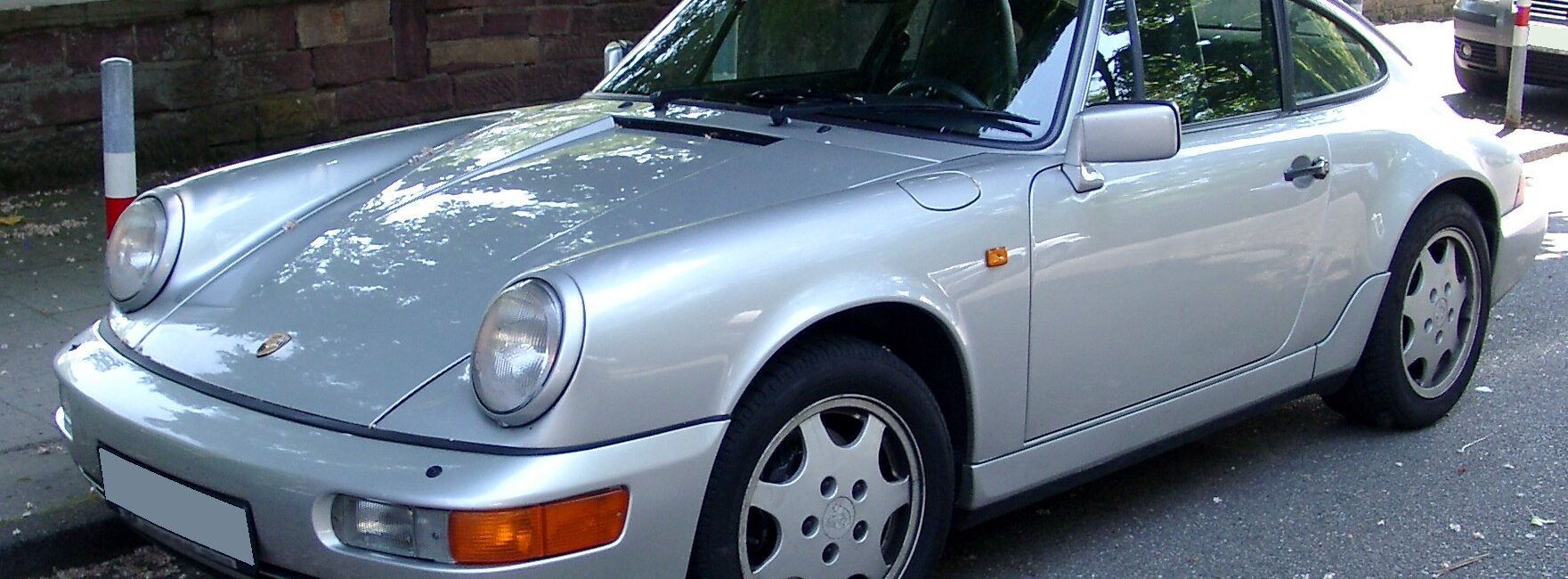
The Porsche 911 type 964 is one of the most sought-after generations of the air-cooled 911. It retains the compact silhouette of the classic models but introduces a profound modernisation: 3,6 litre engine, ABS, power steering, coil springs, all-wheel drive on the Carrera 4, and Tiptronic gearbox on the Carrera 2. This combination explains its appeal, but also the cost of an upgrade when a specimen has been neglected.
Quick answer: to buy a Porsche 964 in 2026, prioritise the quality of the documentation and mechanical condition rather than isolated low mileage. A properly maintained Carrera 2 or Carrera 4 can be reliable, but an inspection by a specialist in air-cooled Porsches should check for oil leaks, cylinder head sealing, dual ignition, flywheel, corrosion, suspension, and the operation of all equipment. On the French market, the listed prices for standard Carreras often range between approximately 65 000 and 120 000 euros depending on the bodywork, gearbox, history, and condition; Turbos, RS models, and limited editions belong to a different market.
Why does the Porsche 964 hold a special place?
Presented at the end of 1988 with the Carrera 4, the 964 succeeds the 911 Carrera 3.2. Porsche states that 85% of its components were new. The line remains familiar, but the bumpers are better integrated, the underbody is more aerodynamic, and the rear spoiler deploys automatically.
The change is mainly technical. The naturally aspirated M64 flat-six of 3,6 litres develops 250 hp on the Carrera 2 and Carrera 4. The suspension abandons torsion bars in favour of coil springs. ABS and power steering make the car more accessible without erasing its rear-engine air-cooled architecture.
Porsche produced 63 762 examples of the type 964 between 1988 and 1994, all versions combined. The range includes the Carrera 2 and Carrera 4 in Coupé, Targa, and Cabriolet, as well as much rarer variants: Turbo 3.3, Turbo 3.6, Carrera RS, RS 3.8, Speedster, and anniversary series.
Carrera 2 or Carrera 4: which to choose?
The answer depends more on the intended use than on an absolute hierarchy.
Porsche 964 Carrera 2
The Carrera 2 sends its 250 hp to the rear wheels. It is available with a five-speed manual or a four-speed Tiptronic gearbox. The manual Coupé concentrates much of the collectors’ demand: it is lighter, more direct, and closer to the traditional 911 experience.
The Tiptronic offers a different pleasure. It suits relaxed use but is generally less sought after and often cheaper than a manual gearbox in comparable condition. This gap should not lead to buying an average car just because its price seems attractive.
Porsche 964 Carrera 4
The Carrera 4 was the first series 911 with all-wheel drive. Its system, inspired by developments made for the Porsche 959, normally distributes 31% of torque to the front and 69% to the rear according to Porsche Classic, with variable management depending on conditions.
It offers more traction on wet roads and reassuring behaviour, but it is heavier and its transmission system adds components to inspect. It was only offered with a manual gearbox. A well-maintained Carrera 4 is not a second choice: it simply responds to a different philosophy.
| Version | Transmission | Character | Buyer profile |
|---|---|---|---|
| Carrera 2 manual | Rear-wheel drive, 5 gears | Direct and sought after | Leisure driving, collection, preference for manual gearbox |
| Carrera 2 Tiptronic | Rear-wheel drive, 4 gears | More flexible, less sporty | Leisure drives, relaxed use, often more affordable budget |
| Manual 4 Carrera | All-wheel drive, 5 gears | Traction and stability | Regular use, varied roads, priority on versatility |
| Turbo and RS | Specific versions | More powerful or radical | Informed collector, appropriate budget and expertise |
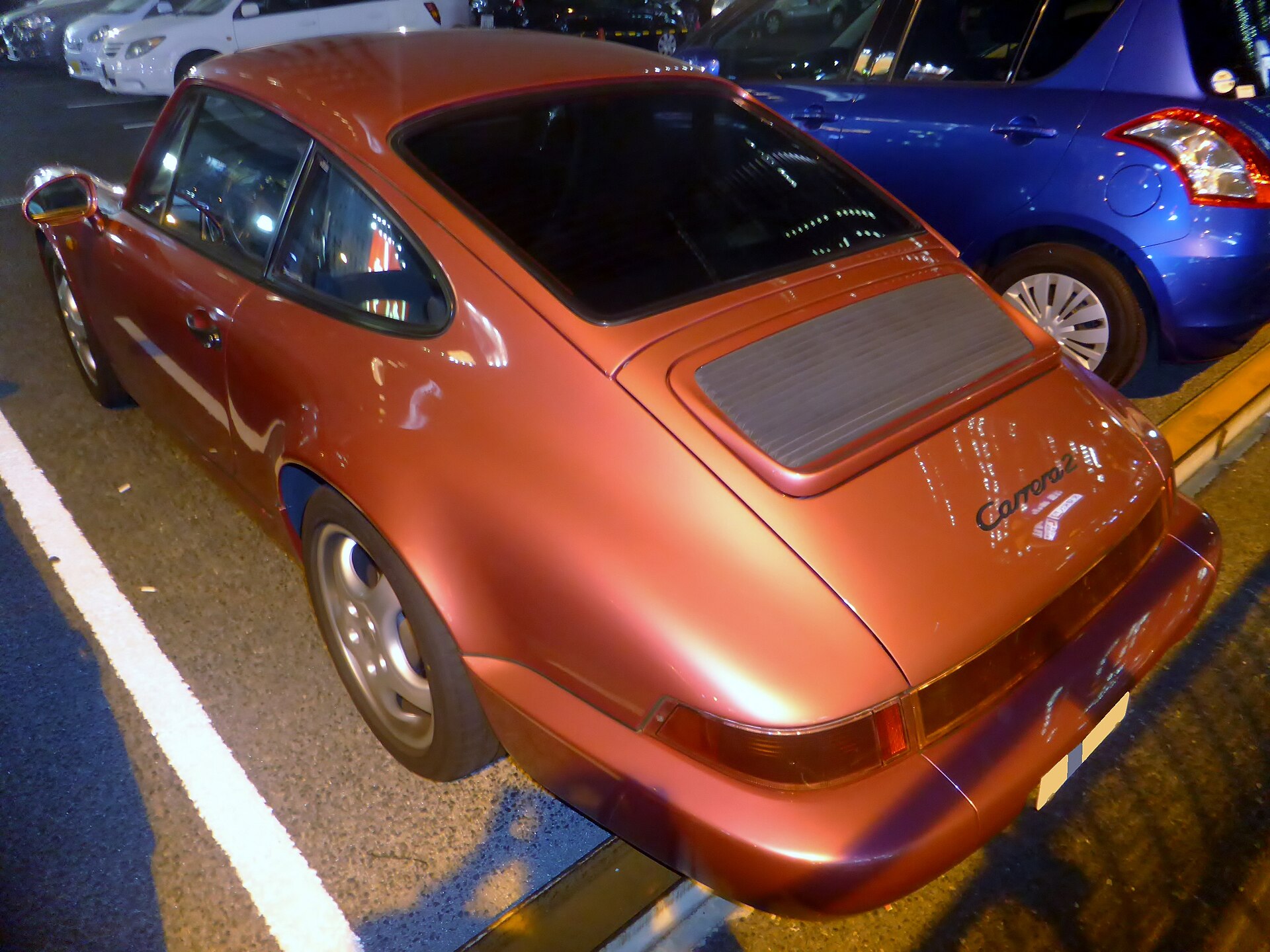
The movable spoiler and rear light strip are part of the visual signatures of the 964 Carrera. Photo: Tokumeigakarinoaoshima, Wikimedia Commons, CC0 1.0.
Coupe, Targa or Cabriolet: which body style to prioritise?
The Coupe is generally the most sought-after configuration, especially with the manual gearbox. It offers the best rigidity and corresponds to the sporty image of the 964. However, this market preference does not automatically make every Coupe more interesting than a fine Targa or Cabriolet.
The Targa retains its fixed roll bar and removable roof panel. It is important to check the condition of the seals, wind noise, leaks and the fit of the panel. For the Cabriolet, examine the hood, its mechanism, waterproofing, rear window and any presence of moisture inside the cabin.
Intrinsic quality should take precedence: a well-documented, sound and regularly maintained 4 Carrera Cabriolet is preferable to an incomplete or freshly disguised 2 Carrera Coupe.
What price for a Porsche 964 in 2026?
There are significant differences. French and European listings consulted in October 2026 show common Carreras offered from around 60 000 euros for some Tiptronic or high-mileage cars up to more than 110 000 euros for well-presented manual Coupes. Targas and Cabriolets may appear in a similar range, but their value strongly depends on the gearbox, body condition and quality of documentation.
These amounts are asking prices, not necessarily transaction prices. CLASSIC.COM publishes separate indices by version: manual 2 Carrera Coupes are valued above Tiptronic ones, while Turbos, RS and Speedsters are tracked as separate markets. Mixing all 964 in a single average therefore produces a misleading figure.
| Common configuration | Order of magnitude of prices listed in France and Europe, October 2026 |
|---|---|
| Carrera 2 Tiptronic | Approximately 60 000 to 85 000 € |
| Carrera 2 Manual Coupé | Approximately 80 000 to 120 000 € |
| Carrera 4 Manual Coupé | Approximately 80 000 to 115 000 € |
| Targa or Cabriolet Carrera 2/4 | Approximately 65 000 to 115 000 € |
| RS, Turbo, Speedster, Jubilé | Specific markets, often well above 150 000 € |
These ranges do not constitute a valuation. A documented restoration, original configuration, sought-after colour and continuous history can create a premium. Conversely, structural corrosion, worn mechanics, rough conversions or incomplete documentation can justify a significant depreciation.
To compare with the current market, consult the classic and prestige cars for sale on Plethore Cars. Even in the absence of a 964 available at the time of consultation, comparable listings help to position the budget within the market.
Is the Porsche 964 reliable?
Yes, provided you purchase a properly maintained car and accept the demands of a sports car over thirty years old. The flat-six engine can cover high mileage, but seals, hoses, pipes, bushes, wiring and accessories age even when the car is driven little.
The poor reputation of some 964 often comes from cars long neglected when their value was lower. Low mileage without recent invoices is not a guarantee of peace of mind. Deferred work accumulates quickly, whereas a regularly used and specialist-serviced example can be a better purchase.
Oil leaks and engine sealing
A slight trace does not automatically mean an engine overhaul, but an active leak must be located. Early engines are known for seepage at the junction between cylinders and cylinder heads. Porsche modified the design during the 1991 model year. The dry sump oil circuit pipes can also corrode or leak.
Ask if the engine has ever been opened, by whom, why and with which parts. A detailed invoice is worth more than a vague phrase such as “engine rebuilt”.
Dual ignition and internal belt
The M64 uses dual ignition. Both distributors are linked by a small internal belt which can age. Specialist guides recommend checking the replacement of this belt and the presence of the ventilation kit designed to limit its degradation. Failure should not be taken lightly.
Dual-mass flywheel
The first manual Carreras were fitted with a Freudenberg dual-mass flywheel prone to causing vibrations and irregular running at low revs. An improved LUK model appeared later. On an older car, the actual fitted part should be checked via invoices rather than inferred solely from the year.
Suspension, Braking and Steering
The front suspension bushes, shock absorbers, ball joints and brake hoses may be worn. A vague front end, noises on rough roads or uneven tyre wear require inspection. On a Carrera 4, the check should also include the all-wheel drive system, its gaiters, leaks and the absence of vibrations.
Heating, Air Conditioning and Electrical Equipment
The heating and ventilation system is more complex than on previous generations. Test all blower speeds, the regulation, air conditioning, flap motors, the electric spoiler, sunroof, seats, windows, ABS and every dashboard warning light.
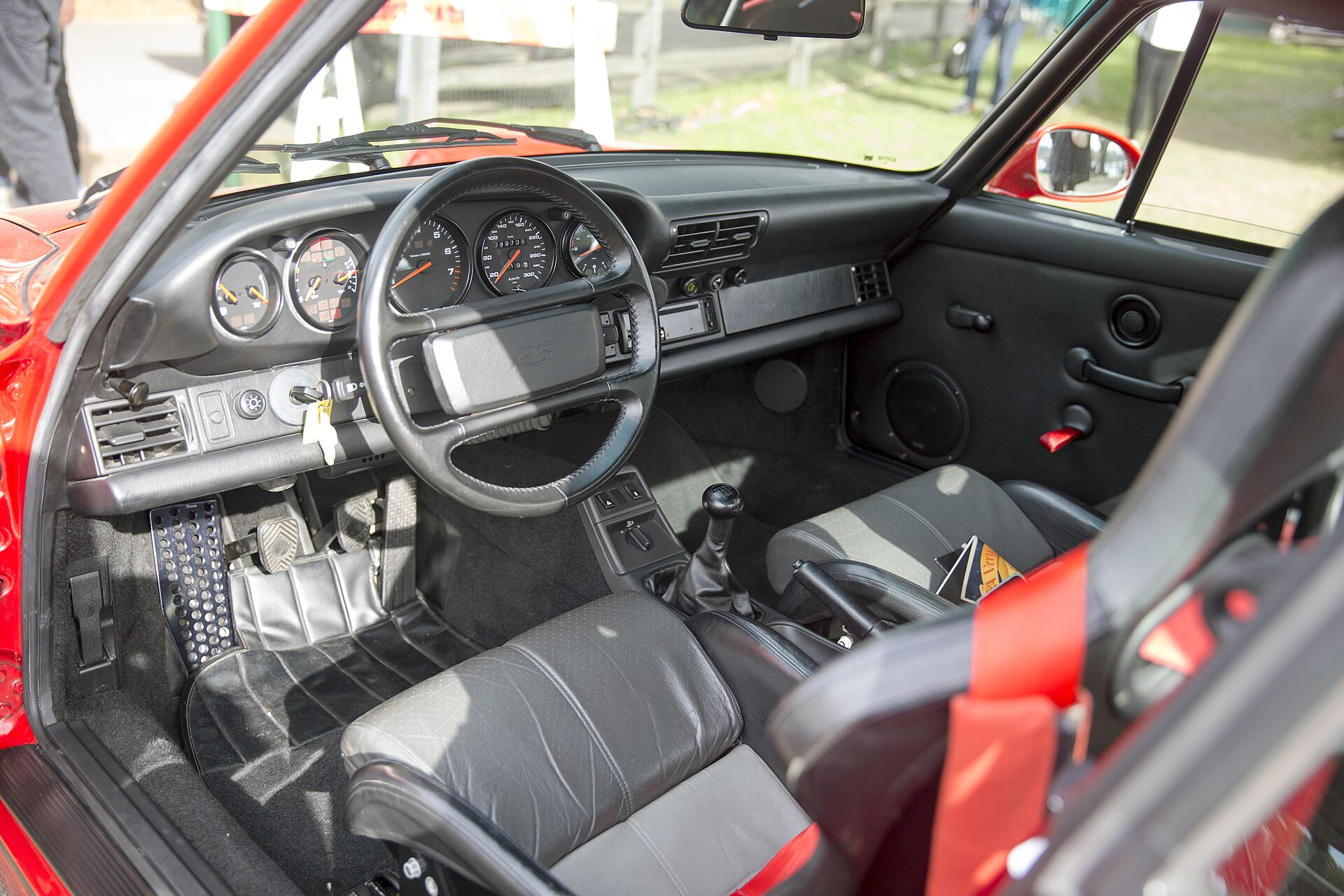
The interior must be checked as thoroughly as the mechanics: instrumentation, heating, seats, trim and controls. Photo: Mr.choppers, Wikimedia Commons, CC BY-SA 3.0.
Where Can Corrosion Hide?
The galvanised bodywork does not make the 964 invulnerable. Look for traces around the windscreen and rear window apertures, under seals, at the bottom of the wings, around the headlights, in the wheel arches, at the battery tray and lifting points.
A glossy paint finish can conceal an old repair. Measure thicknesses, examine alignments, look for colour differences and inspect underneath on a lift. A properly documented body repair is not necessarily a deal-breaker; a distorted structure or concealed corrosion certainly is.
Which Documents and Checks Should Be Requested Before Purchase?
The file should allow you to link the car’s identity, its configuration, mileage and the work carried out. Gather:
- chassis number and option labels;
- service book and manuals;
- invoices arranged chronologically;
- successive technical inspections;
- proof of work on the engine, clutch and flywheel;
- proof of maintenance of the dual ignition system;
- ownership history and import documents, if applicable;
- photos of any restorations or body repairs;
- duplicate keys and original accessories.
Our guide to tracing the history of a classic car before purchasehelps to cross-check information. If the car is distant, also apply the precautions detailed in the article dedicated to buying a classic car remotely.
What should a pre-purchase inspection include?
A proper pre-purchase inspection is not limited to a twenty-minute test drive. Entrust it to an independent specialist familiar with the 964 and request a written report with photographs.
- A completely cold start with observation of smoke, noises and warning lights.
- Checking for leaks on the rear axle, inspection of oil lines and the transmission.
- Compression measurement or a leak-down test if the engine’s condition warrants it.
- Verification of the dual ignition system, references and maintenance invoices.
- Road test until normal operating temperature, with gear changes both cold and hot.
- Inspection of the flywheel, clutch, synchronisers and bearings.
- Examination of the structure, paint thickness measurement and search for corrosion.
- Comprehensive testing of heating, air conditioning, ABS and electrical equipment.
- Comparison of chassis number, labels, options and documentation.
- Separate cost estimates for urgent, short-term and cosmetic work.
Also consult the method ofexpert appraisal before purchasing a classic carto prepare for the appointment and interpret the report.
Which Porsche 964 should be prioritised for purchase?
For a first 964, a standard, complete and well-maintained Carrera 2 or Carrera 4 is generally more sensible than a modified car or a project. The manual Coupé remains the most sought-after, but this popularity comes at a price. A Tiptronic, Cabriolet or Carrera 4 may offer a better balance between cost and enjoyment if the configuration truly suits the intended use.
Do not choose a year solely to avoid a theoretical defect. After three decades, the work actually carried out matters more than the original specification sheet. The best 964 is not necessarily the one with the lowest mileage: it is the one whose condition, identity, repairs and price form a coherent whole.
FAQ
What is the best Porsche 964 to buy?
The manual Coupé Carrera 2 is the most sought-after choice, but a well-maintained Carrera 4 or Tiptronic may better suit your needs and budget. Condition and documentation should take precedence over the version.
How much does a Porsche 964 in 2026 cost?
Standard Carreras are often listed between approximately 65 000 and 120 000 euros depending on gearbox, bodywork, mileage, condition and history. Turbos, RS, Speedsters and special editions follow distinct and much higher markets.
Is the Porsche 964 expensive to maintain?
Routine maintenance remains predictable with a specialist, but an engine overhaul, significant corrosion or several years of deferred maintenance can be very costly. A pre-purchase inspection is essential.
Carrera 2 or Carrera 4: which is more sought after?
The manual Carrera 2 generally attracts more collectors, while the Carrera 4 offers superior traction and great versatility. A beautiful C4 is better than a mediocre C2.
What are the main issues with the Porsche 964?
Known issues include oil leaks, the sealing of early engines, the dual distributor belt, certain dual-mass flywheels, the silent blocks, localized corrosion and heating or air conditioning equipment.
Should you avoid a Porsche 964 Tiptronic?
No. It offers a different driving experience and often a more accessible price. However, you should check its operation when cold and hot, its maintenance history, and accept that its resale demand is generally lower than that of a manual gearbox.
Sources and date of verification
Information and prices verified on11 October 2026 :
- Porsche Newsroom — Seven generations of the Porsche 911 : technical innovations and 3,6 litre 250 hp engine.
- Porsche Classic — 911 type 964 : timeline, body styles and all-wheel drive.
- Porsche Newsroom — Third generation engines : Carrera, Turbo and RS engines.
- Porsche Newsroom — The type 964: a new start with this 911 : total production and generation evolution.
- Hagerty UK — Buying Guide: Porsche 964 : known faults and inspection.
- Revolution Porsche Specialists — Porsche 964 Buyers’ Guide : leaks, flywheel, distributor, suspension and corrosion.
- CLASSIC.COM — Porsche 911 type 964 market : segmentation and market indices by version.
- La Centrale — Porsche 911 type 964 listings and LesAnciennes — Porsche 964 listings : asking prices observed in France.
Prices are volatile and should be reviewed within six months. They do not replace an expert appraisal of the individual vehicle nor an analysis of comparable transactions.