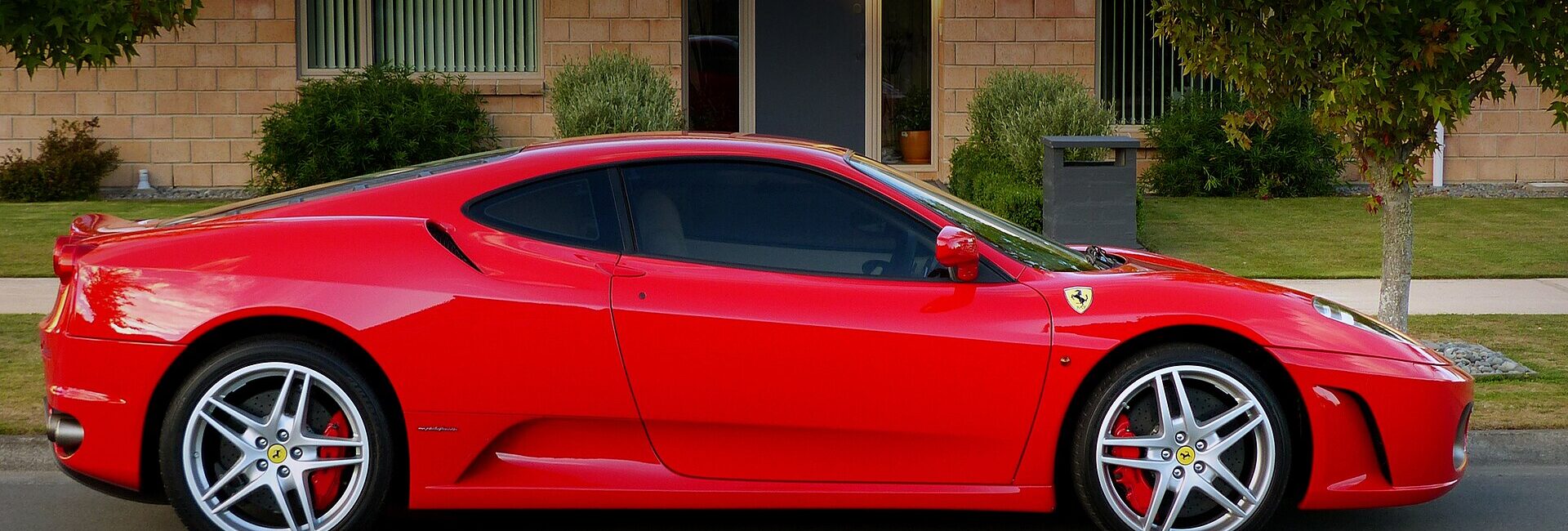
To purchase a Ferrari F430 without unpleasant surprises, do not choose solely based on colour or low mileage. Prioritise a car that has been regularly used, accompanied by a continuous history, then have the exhaust manifolds, clutch and F1 gearbox control, suspension, brakes, engine mounts and electrical equipment checked both cold and hot. In September 2026, French listings typically show F430 and F430 Spider models with F1 gearboxes priced between approximately 90 000 and 155 000 €, whereas a genuine original manual gearbox can exceed 250 000 €. These amounts are asking prices, not guaranteed transactions.
The F430 is easier to live with than its reputation as an Italian supercar suggests, but it remains a 490 hp automobile for which an overhaul can be costly. The best purchase is therefore not necessarily the lowest mileage example: it is the one whose condition, usage and invoices tell the same story.
Ferrari F430: the essential technical specifications
Presented in 2004, the F430 succeeded the 360 Modena while retaining its rear mid-engine layout and aluminium structure. Ferrari stated at the time that the car was new by 70 % compared to the 360. The manufacturer attributes the following characteristics to it:
| Characteristic | Ferrari F430 |
|---|---|
| Engine | Naturally aspirated V8 with 90° bank angle, longitudinal rear mid-mounted position |
| Displacement | 4 307,68 cm³ |
| Maximum power | 490 hp at 8 500 rpm |
| Drive | Rear-wheel drive |
| Gearboxes | Manual with 6 speeds or F1 single-clutch automated |
| Claimed top speed | Over 315 km/h |
| Body styles | Berlinetta and Spider |
| Period | 2004-2009 for the F430 touring family |
The official historical page of Ferrari confirms the V8 of 4,3 litres, the 490 hp at 8 500 rpm and a top speed exceeding 315 km/h. Ferrari also recalls that the F430 was the first car from the marque equipped with the manettino on the steering wheel. This coordinates several electronic settings, including the E-Diff, the electronically controlled rear differential.
The F430 represents an important transition: it retains a traditional manual gearbox in the catalogue, but its robotised F1 transmission is sufficiently advanced to have convinced the vast majority of buyers. Ferrari announces a shift time of 150 milliseconds for this dual-clutch evolution — not to be confused with the dual-clutch gearbox of the 458 Italia which succeeded it.
Which version to choose: Berlinetta, Spider, Scuderia or manual gearbox?
F430 Berlinetta F1: the most rational choice
The Berlinetta equipped with the F1 gearbox concentrates the F430 experience at the most accessible price. Its closed bodywork is simpler than the Spider, its selection of examples is broader, and its robotised gearbox corresponds to the majority original configuration. It is the right entry point if the priority is to drive regularly rather than to seek absolute rarity.
F430 Spider: the V8 in the open air
The Spider adds an electric soft top and the unfiltered sound pleasure of the V8. In return, the mechanism, struts, sensors, window adjustment and sealing must be inspected. Perform several complete soft top cycles with the engine running, then check the storage boot, seals and carpets after reasonable watering.
F430 with manual gearbox: rarity and strong market premium
The metal gate and traditional lever now transform the value of an F430. This rarity has also encouraged conversions of F1 cars to manual gearboxes. A conversion can be pleasant to drive, but it must never be presented or valued as a factory original. Request the original configuration from the chassis number, the conversion invoices and the list of parts used.
A genuine original manual benefits from a major premium. In Monaco, a manual F430 Spider of 2006 was sold for 201 250 € at Bonhams on 24 April 2026, according to the result archived by Classic.com. This one-off result does not set the value of all manuals: mileage, bodywork, provenance and condition strongly affect the price.
430 Scuderia and Scuderia Spider 16M: a different market
The 430 Scuderia is a lighter, more powerful and more radical version. Its specific mechanics, brakes, bodywork and interior require distinct expertise. French listings observed in September 2026 frequently exceed 400 000 € for a Scuderia, while the 16M, produced in 499 units according to Ferrari and specialised catalogues, goes even higher. Do not directly compare these versions with a standard F430.
What is the price of a Ferrari F430 in 2026?
The sample of French listings consulted on 22 September 2026 on L’Argus Occasion shows a very dispersed market. F430 and Spider with F1 gearbox are listed approximately from 86 000 € for high-mileage cars to 155 000 € for better examples, while original manuals appear around 250 000 to 275 000 €.
| Version | Price range observed in France | Recommended reading |
|---|---|---|
| F430 Berlinetta F1 | Approximately 95 000 to 150 000 € | Clutch maintenance and wear matter more than isolated low mileage |
| F430 Spider F1 | Approximately 86 000 to 145 000 € | Add a thorough check of the hood and waterproofing |
| F430 original manual gearbox | Approximately 250 000 to 275 000 € | Authenticity of the configuration is essential |
| 430 Scuderia | Often over 400 000 € | Specific market, configuration and traceability are decisive |
These ranges are indicative and dated. They mix different years, mileages, histories and levels of preparation. Above all, a listing price is not a sold price. The results from Collecting Cars illustrate this variation: a F430 Spider F1 from 2007 was listed as sold for 140 000 € in France on 21 August 2026, while a Spider F1 from 2005 sold for 92 500 € in the Netherlands on 9 September 2026.
The main premium factors are the original manual gearbox, a recognised Ferrari or specialist history, consistent mileage, well-preserved paint and interior, carbon seats, a sought-after configuration and a complete dossier. Conversely, a manual conversion, a repainted body without invoice, a clutch nearing end of life or undocumented exhaust should be factored into negotiations.
Reliability: issues to check before purchase
1. Cracked exhaust manifolds
The manifolds are the most frequently cited point of concern by specialists. A ticking noise when cold, an exhaust smell, abnormal heat or loss of performance can guide the diagnosis, but listening alone is not enough. The Magneto buying guide recommends an inspection by a specialist, as cracks can be difficult to identify.
Ask if the manifolds have been replaced, with which reference and on what date. An invoice is more useful than a mere assertion. The inspection should also cover the mounts, heat shields, catalytic converters and the welds of the exhaust system.
2. Clutch, pump and F1 gearbox
The F1 gearbox is an automated manual transmission, not a torque converter automatic nor a dual-clutch. Its refinement depends on the adjustment, the condition of the clutch, the hydraulic pump, the accumulator, the sensors and how the car has been used.
A clutch can wear quickly if the car has undergone many slow manoeuvres, hill starts or starts on slopes. Demand a wear reading via diagnostic, but ask the specialist to interpret the value alongside the slip point and actual operation. During the test drive, reverse gear must engage without abnormal delay, gears should shift smoothly when cold and when warm, and no transmission warning lights should appear.
3. Ball joints and suspension
Ball joints are considered recurring wear parts by several specialised guides, including Magneto and PistonHeads. On rough roads, listen for clunks and check the play in each joint on a lift. Also inspect the bushes, shock absorbers, springs, drop links, bearings and alignment.
Uneven tyre wear or a misaligned steering wheel can indicate poor setup, an impact or worn components. The wheels should be inspected on the inside, where cracks or deformations are less easily seen.
4. Engine mounts and leaks
Collapsed engine mounts transmit vibrations and alter the position of the powertrain. They should be examined alongside hoses, seepages, boots and the underside of the chassis. A cleaned trace just before the inspection is not proof of a fault, but it justifies a check after a sufficiently long test drive.
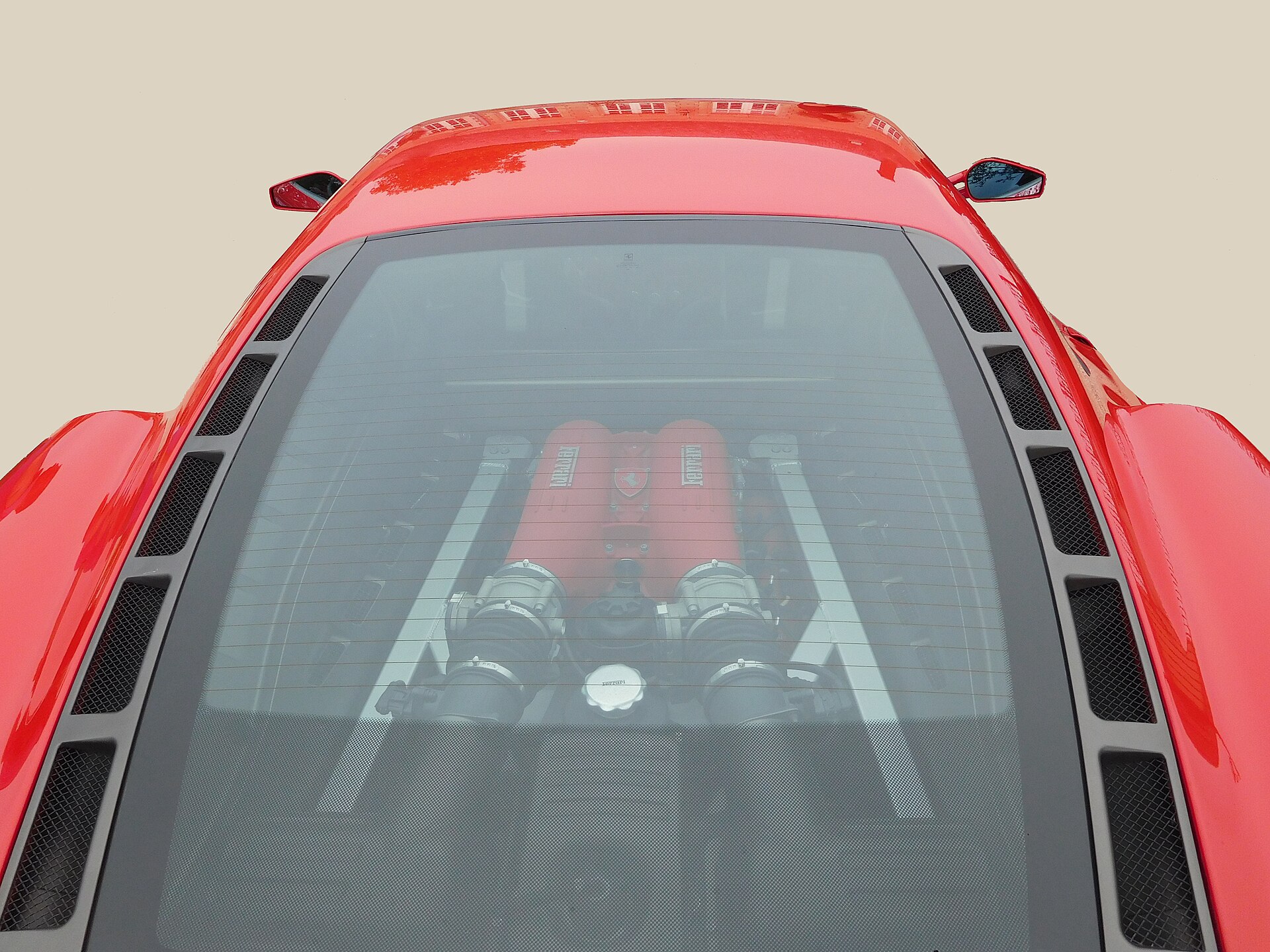
The V8 of the F430 uses a chain-driven timing system, which avoids the periodic replacement of timing belts associated with previous Ferrari V8 engines. This does not make maintenance cheap: fluids, spark plugs, seals, accessories, coils, cooling system and peripherals still age over time.
5. Steel or carbon-ceramic brakes
Steel discs were fitted as standard and carbon-ceramic offered depending on the year and configuration. Measure wear and look for cracks, impacts and surface defects. For carbon-ceramic brakes, request an appropriate inspection and the percentage or measurement used by the specialist rather than a simple visual judgement. The replacement cost justifies a precise check.
6. Sticky buttons, leather and electrical equipment
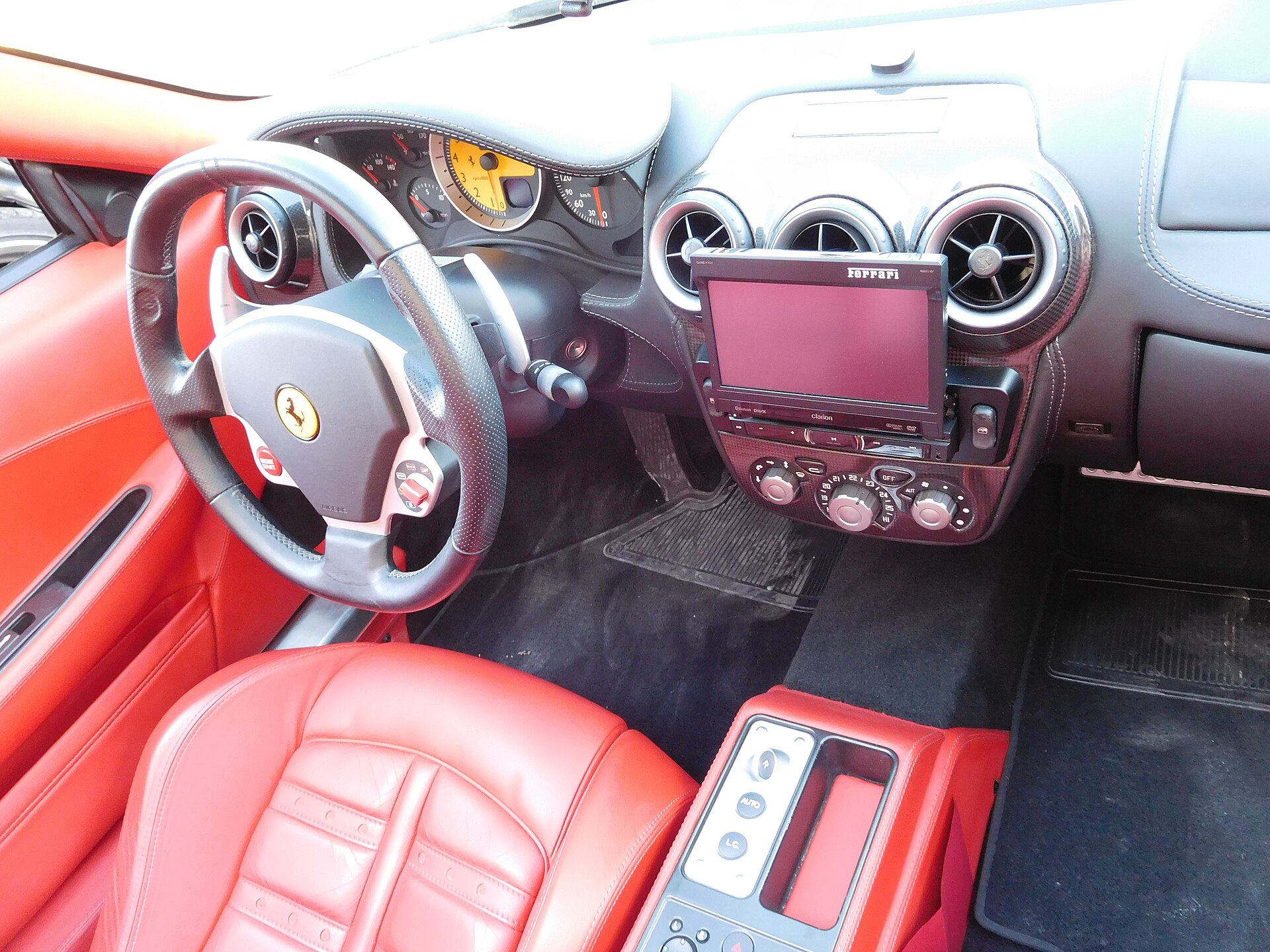
Soft-touch coatings can become sticky with age. This aesthetic defect affects buttons, paddles, controls and trims. Also check the screen, air conditioning, windows, mirrors, locks, pressure sensors and all warning lights at startup.
Very worn upholstery with very low mileage deserves an explanation. Conversely, a refurbished interior can be superb without being strictly original: ask for invoices and keep replaced parts when available.
How much does maintenance of a Ferrari F430 cost?
There is no universal annual budget. A car already brought up to standard, which is driven regularly, may mainly require servicing and consumables; a cheap example left unused for a long time may accumulate tyres, battery, fluids, F1 pump, clutch, suspension and exhaust costs.
Request written estimates before purchase for any defects found. Prices depend on the chosen network, region, parts availability and whether the car is standard or modified. Keep a reserve separate from the purchase price: buying at the maximum of your budget without maintenance margin is a poor strategy for this model.
The service book should show interventions spaced according to the applicable plan, but invoices are essential. A car with low mileage still needs fresh fluids, non-aged tyres, a healthy battery and regular warm-up.
The essential pre-purchase inspection
Entrust the car to a workshop or expert who truly knows the F430. A thorough inspection should include:
- starting completely cold, without the engine being preheated before your arrival;
- reading the control units, stored faults and parameters of the F1 gearbox;
- estimation of clutch wear as interpreted by the specialist;
- inspection of the manifolds, catalytic converters and heat shields;
- inspection on a lift of the chassis, leaks, ball joints, shock absorbers and wheels;
- measurement and condition of the brakes, including carbon-ceramic if applicable;
- measurement of paint thickness and search for structural repairs;
- road test cold and hot, including slow manoeuvres and restarting;
- verification of the chassis number, keys, service books, tools and invoices;
- complete inspection of the hood on a Spider.
Our guide to the pre-purchase inspection of a classic car details the mission to be commissioned. Also consult the method to trace the history of a classic car and cross-check adverts, invoices, inspections and mileages.
Documents to request
Check the registration document, chassis number, invoices, service book, previous MOT certificates, duplicate keys, tool kit and tyre inflator. Ask the owner for the HistoVec report for a car registered in France.
For a manual gearbox, have the original configuration confirmed. For an imported car, trace the country of delivery, successive ownerships and its French registration. A Ferrari Classiche certification can strengthen an eligible dossier, but it does not replace the test drive or current mechanical inspection.
Accessories must also be documented: exhaust, springs, wheels, carbon parts, gearbox conversion or remapping. A quality part does not remove the obligation for transparency about modifications.
Is the Ferrari F430 a good classic purchase?
The F430 combines a naturally aspirated V8 of 490 hp, still hydraulic steering, the first Ferrari manettino and the historic choice between manual gate and F1 gearbox. It is modern enough for regular use, while embodying a now bygone technical generation.
This does not guarantee any increase in value. The market increasingly distinguishes original manuals, Scuderia models, sought-after configurations and impeccable dossiers. A standard F1 will primarily remain a car to buy for driving. The right example is one that its future owner can maintain without postponing work.
To compare available opportunities, consult the classic and prestige cars for sale on Plethore Cars. If you are interested in a F430, negotiate only after inspection and based on a documented estimate.
Checklist before buying
- Identify the exact version and the gearbox originally fitted.
- Check the chassis number and the continuity of invoices.
- Demand a cold start.
- Inspect the manifolds and the entire exhaust system.
- Read and interpret the clutch and F1 gearbox data.
- Check ball joints, shock absorbers, wheels and alignment on a lift.
- Measure the condition of the brakes and the age of the tyres.
- Test all equipment and the Spider’s convertible roof.
- Look for repainting, impacts and structural repairs.
- Estimate each upgrade before making an offer.
FAQ
What is the price of a Ferrari F430 in 2026?
French listings checked on 22 September 2026 generally place the F430 and Spider F1 between approximately 90 000 and 155 000 €. Genuine original manual gearboxes are often priced above 250 000 €, and the 430 Scuderia above 400 000 €. These are asking prices, varying according to condition and history.
Is the Ferrari F430 reliable?
Its V8 is robust when properly maintained, but the entire car requires specialised servicing. The main points of concern are the manifolds, the F1 gearbox and its clutch, ball joints, engine mounts, brakes and interior equipment.
Should I choose the F1 gearbox or the manual?
The F1 is cheaper to buy and represents the majority of production. The original manual offers a more traditional experience and is valued for its rarity, but commands a significant premium. A conversion should not be confused with a factory manual.
Does the F430 have a timing belt?
No, its V8 uses timing chains. This eliminates the periodic replacement of belts known on some earlier Ferraris, without removing other maintenance operations or age-related checks.
What mileage should be avoided?
There is no automatic threshold. A higher-mileage but well-maintained car may be preferable to a low-mileage example whose fluids, tyres, seals and actuators have aged. History and inspection take precedence over the odometer alone.
Is an expert appraisal really necessary?
Yes. The cost of an inspection is low compared to a clutch, exhaust manifolds, carbon-ceramic brakes or suspension components needing refurbishment. It also allows you to distinguish an original manual from a conversion and to assess any bodywork repairs.
Sources and photographic credits
Information verified on 22 September 2026 with Ferrari — F430, history and specifications, Ferrari Magazine — Technological Masterclass, Magneto — Ferrari F430 buying guide, PistonHeads — F430 buying guide, L’Argus Occasion — F430 listings, Collecting Cars — F430 results and Classic.com — F430 Spider manual sold by Bonhams.
Photographs: “2006 Ferrari F430 F1”, Bernard Spragg. NZ, Wikimedia Commons, CC0 licence; “Ferrari F430 Berlinetta, F136 E engine”, Cjp24, Wikimedia Commons, CC BY-SA 4.0 licence; “Ferrari F430 Spider 03”, Cjp24, Wikimedia Commons, CC BY-SA 4.0 licence.