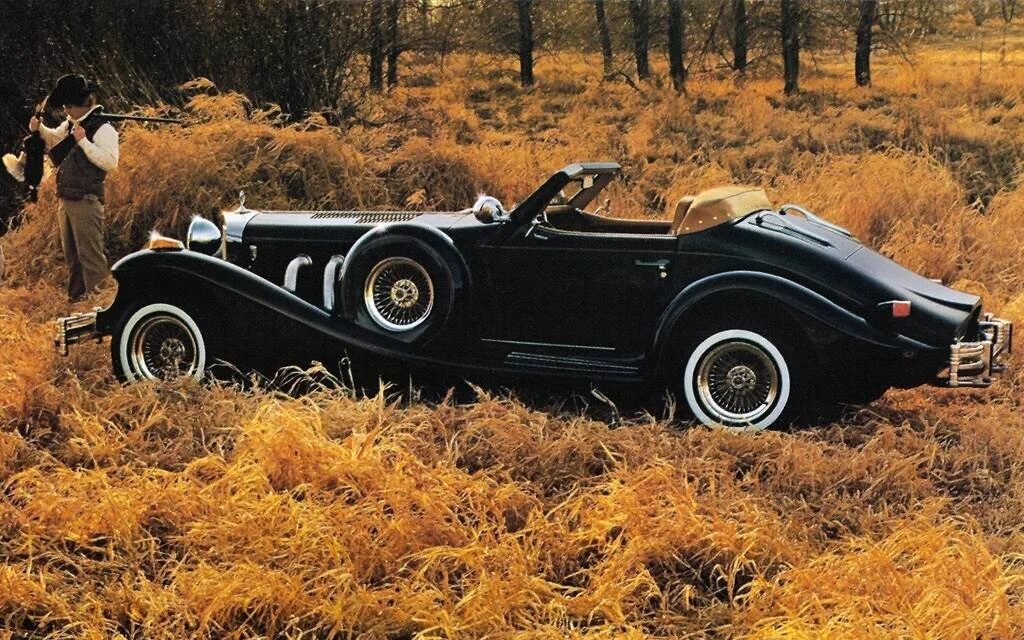
Few cars bear a name as evocative as Excalibur. This American brand, born from the boldness of a single man in the 1960s, produced around 3 500 units of neo-classic roadsters and phaetons in small series before disappearing. Combining references to the Mercedes SSK and modern Chevrolet mechanics, the Excalibur embodies a fascinating automotive paradox. Here is the complete history of this legendary car, from its genesis at Studebaker to its current status on the collector market.
Brooks Stevens, the visionary designer behind Excalibur
Clifford Brooks Stevens was born in 1911 in Milwaukee, Wisconsin. This industrial designer, who became a benchmark of American design, did not limit himself to designing cars. He created for more than 40 companies, from Willys-Overland to Miller Beer, including Briggs and Stratton and Evinrude. He was the one who designed the first all-steel station wagon for Willys-Overland in 1946. He also designed the Jeep Wagoneer, whose silhouette endured for 30 years without major changes.
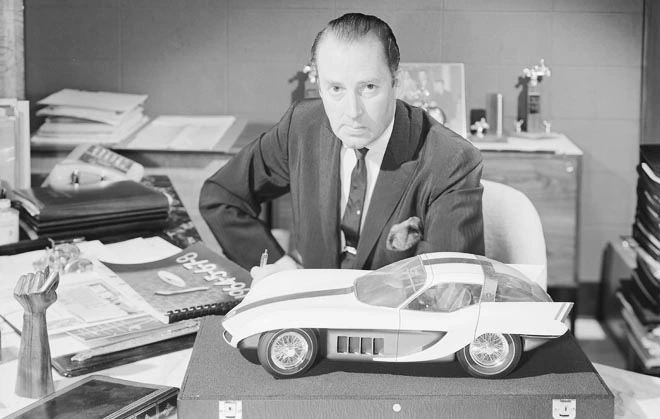
But his deep passion remained collectible automobiles. Stevens owned a personal museum in Milwaukee housing a Packard Twin Six, an Indianapolis racing Duesenberg and a Alfa Romeo 8C 2900B from 1939 which he restored himself. This 8C had won the Mille Miglia 1938 and is now at the Simone Foundation in Philadelphia.
Even before the neo-classics, Stevens created the Excalibur J in the early 1950s. It was a sports car on a modified Henry J chassis, capable of competing with the Jaguar XK120 on the track. This often forgotten competitive past explains the sporty DNA that permeates the first production Excaliburs.
From the Mercebaker to the Excalibur: birth of a legend
In 1963, Stevens worked as a design consultant at Studebaker. President Sherwood Egbert asked him to prepare something spectacular for the New York auto show, following the failure of modified Studebaker Larks at the Chicago show.
Stevens requested a Daytona chassis and designed a car inspired by the famous Mercedes, with the ambition to create what he called “a new car with an old appearance.” He actually owned a 1928 Phaeton in his own garage.
His son William built the prototype in just six weeks, with the help of Ray Besasie. The engine was moved back by 74 cm to improve weight distribution. The result was more compact and lighter than the original Mercedes. It was nicknamed the “Mercebaker,” a contraction of Mercedes and Studebaker.
Studebaker refused to exhibit the car at the show, fearing for its already fragile finances. It was Jerry Allen, the show organiser and Chevrolet dealer, who found an exhibition space. The car generated twelve firm orders on the very first day.
A detail that changed everything: Allen requested a Chevrolet engine instead of Studebaker, as his showroom was located in a General Motors building. This practical request defined the mechanical DNA of the entire lineage. Every Excalibur produced thereafter would receive a Chevrolet engine.
In July 1963, Brooks founded the company with his sons Steve and David. Small-scale artisanal production began in Milwaukee.
The five Excalibur series: evolution of an icon from 1965 to 1989
Series I (1965-1969): the sporty genesis
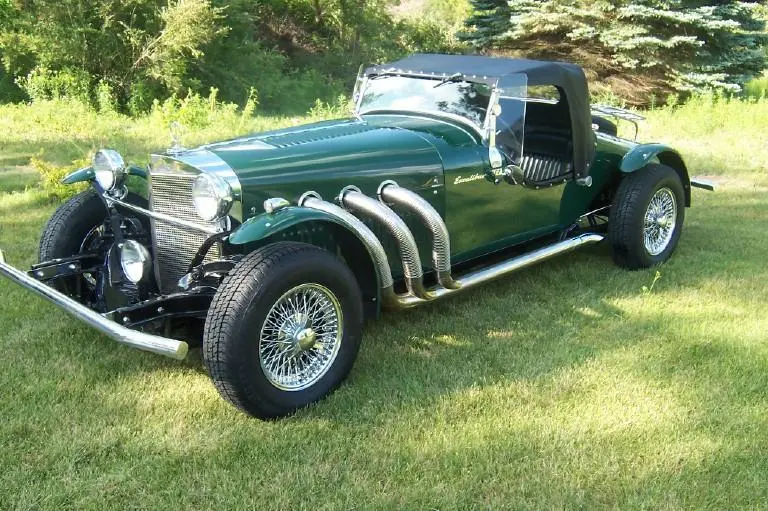
The first series was based on a Studebaker Lark chassis equipped with a Chevrolet V8 engine producing 327 horsepower. In total, 359 units were built, offered in open and phaeton versions. The weight remained contained at only 950 kg, which gave these first Excaliburs a surprising agility.
Series II (1970-1975): increased power
Stevens developed an entirely new chassis with a longer wheelbase. The engine grew to 454 cubic inches, or 7,5 litres of displacement. The price doubled compared to Series I. A four-seat version appeared for the first time with the Phaeton.
Series III (1975-1979): the commercial peak
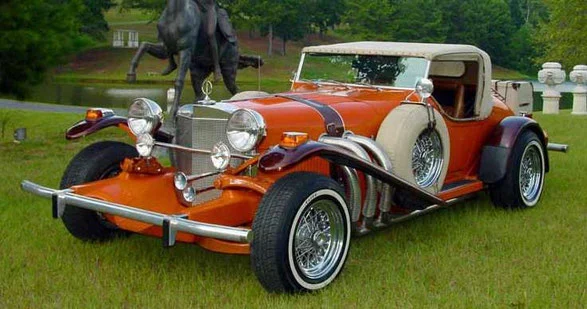
This is the most produced series. Numbers rose from 90 cars in 1975 to 367 in 1979. The wings became more enveloping, the style more ostentatious. Series III featured drum brakes on all four wheels, a three-speed automatic gearbox and pneumatic suspension with air ride. The side exhausts (side pipes) remained functional.
But it is also the stylistic turning point. As a British automotive journalist summarises, the Series III is the moment when the Excalibur “jumps the shark.” The elegant neo-classic gives way to unabashed bling, in tune with the American brougham era of the Lincoln Continental Mark III and Cadillac Eldorado.
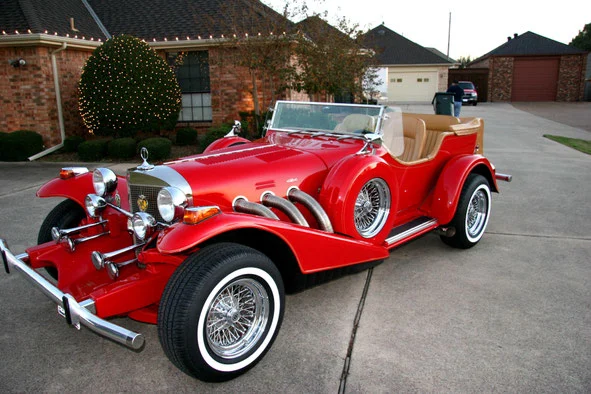
Series IV (1980-1984): the Mercedes turn
A radical change in aesthetics. The Series IV abandons the SSK references to draw inspiration from the Mercedes 500 K and 540 K of the 1930s. Electric windows and a powered convertible top make their appearance. The sale price reaches 50 000 dollars, approximately 200 000 dollars in today’s value.
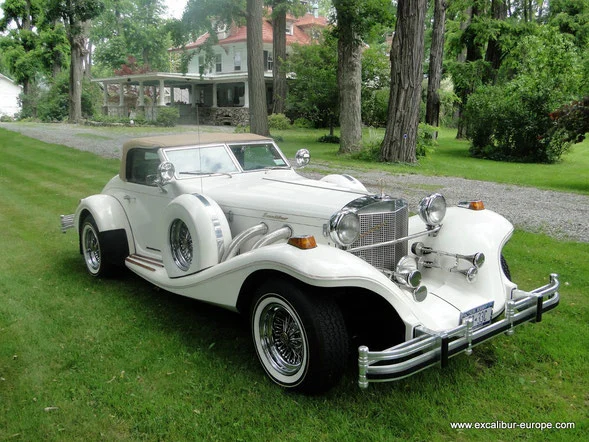
Series V (1984-1989): the twilight
The final series aims to be more sophisticated with a hard-top and a specific interior. But beneath the surface, it is an eclectic assembly of parts from various manufacturers: door handles and gear lever from Chevrolet Camaro and Corvette, window lifter motor from Chrysler, indicators from Volkswagen Beetle, rear lights from a scooter. The side pipes become purely decorative.
Sales plummet. The combination of stricter regulations, ever-increasing prices, and a shift in public taste leads to bankruptcy in 1989. Several revival attempts follow, with the last car leaving the workshops in 1997.
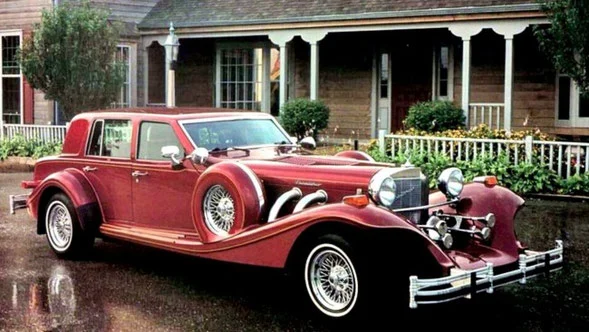
The Excalibur 35X: the European interlude signed Michelotti
Between 1966 and 1968, the story takes an unexpected detour. Guy Storr, European distributor, markets the Excalibur 35X. This version is inspired not by the Mercedes SSK but by the Bugatti Type 35. The Italian coachbuilder Michelotti designs its lines and 27 units are produced, equipped with Opel Commodore mechanics.
A pre-series example appears in the film Slogan by Pierre Grimblat (filmed in 1968, released in 1969), featuring Serge Gainsbourg and Jane Birkin. This French cinematic connection remains one of the best-kept secrets in Excalibur’s history.
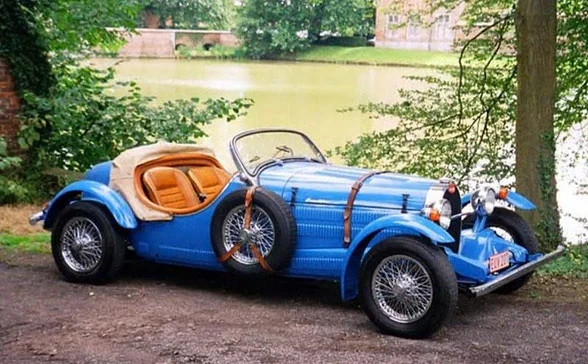
Technical specifications of Excalibur cars by series
Technical specifications vary considerably from one series to another. The table below summarises the essential data for collectors.
| Characteristic | Series I | Series II | Series III | Series IV | Series V |
|---|---|---|---|---|---|
| Years | 1965-1969 | 1970-1975 | 1975-1979 | 1980-1984 | 1984-1989 |
| Engine | V8 Chevrolet 327ci | Chevrolet 454ci (7,5L) | Chevrolet 454ci (7,5L) | Chevrolet 350ci (5,7L) | Chevrolet 305ci (5,0L) |
| Chassis | Studebaker Lark | Excalibur (bespoke) | Excalibur (bespoke) | Excalibur (bespoke) | Excalibur (bespoke) |
| Weight | ~950 kg | ~1 400 kg | ~1 500 kg | ~1 600 kg | ~1 600 kg |
| Production | 359 units | ~600 units | ~1 200 units | ~350 units | ~250 units |
| Body styles | Roadster, Phaeton | Roadster, Phaeton 4 seats | Roadster, Phaeton 4 seats | Roadster, Phaeton, Coupe | Roadster, Phaeton, Coupe |
| Inspiration | Mercedes SSK | Mercedes SSK (evolved) | Neo-baroque style | Mercedes 500/540 K | Mercedes 500/540 K |
It should be noted that the side pipes are functional up to and including Series III, then become decorative on subsequent series.
The driving experience varies radically from one generation to another. Behind the wheel of a Series I, the 950 kg and non-assisted steering offer a raw feel: every irregularity in the tarmac is transmitted to the arms, the V8 327 responds with disconcerting frankness, and the roar of the open-air side pipes fills the cabin. On the earliest examples equipped with the four-speed manual gearbox, the sensation is more akin to a sports car than a ceremonial carriage.
Later series offer a different programme. The Series III, with its 1 500 kg and three-speed automatic gearbox, drives like a chrome-plated ocean liner: soft power steering, pneumatic suspension that swallows imperfections, linear acceleration from the 454 cubic inches. You no longer drive, you parade — and that is precisely what its buyers were looking for.
Prices and value of Excalibur on the collector market
The price of Excalibur has followed a unique trajectory. At its launch in 1965, the Series I cost around 6 000 dollars. In 1985, a new Series V reached 50 000 dollars. Today, the collector market offers a wide range depending on the series and condition.
Recent listings on specialised French platforms show prices between 35 900 euros for a Phaeton SS Series III from 1975 and 89 950 euros for an SSK model from 1966. Series III remain the most common and accessible, with prices ranging between 35 000 and 65 000 €.
However, be cautious: the purchase price does not tell the whole story. The Series III, despite its ostentatious nature, remains the easiest to maintain thanks to its standardised Chevrolet mechanics and larger production (around 1 200 examples).
The Series I, rarer with its 359 examples, commands a significant premium. Series IV and V, produced in smaller numbers, trade between 50 000 and 70 000 € depending on condition and documentation.
A point often underestimated: the liquidity of these cars on the secondary market remains low. The circle of enthusiasts for American neo-classics remains narrow, and resale times often stretch over several months, or even more than a year for the least sought-after series. Unlike a Porsche 911 or a comparable period Mercedes SL, an Excalibur does not find a buyer within a few weeks. It is better to consider this purchase as a heritage pleasure rather than an easily realisable investment.
Buying an Excalibur: advice for collectors
The main challenge of owning an Excalibur lies in the paradox of spare parts. In the 1970 and 1980 decades, one of the selling points was precisely the ease of maintenance compared to genuine vintage cars: modern mechanics, GM parts available everywhere. Today, the situation has reversed.
Each Excalibur mixes components from several manufacturers. The engine and transmission come from Chevrolet. The indicators are often Volkswagen parts. The window lift motor can be a Chrysler component. The rear lights sometimes come from a scooter. Identifying the exact origin of a faulty part already represents half the restoration work.
To minimise surprises, check these points before any purchase: the condition of the fibreglass bodywork (repairs are costly and visible), complete maintenance documentation, and the operation of all electrical equipment. Excaliburs stored for long periods without running often develop seal and hose problems.
One last point deserves attention: Alice Preston, who worked with the brand from its beginnings as chief mechanic of the racing team, still holds the intellectual property, registered trademarks, and original Excalibur moulds. A buyer is being sought, which leaves hope for a revival.
Heritage and Influence of the Excalibur on Neo-Classic Automobiles
The Excalibur did not merely make its mark on automotive history through its retro styling. It invented an entire segment and remains the absolute benchmark for neo-classic cars. As automotive historian Richard Langworth points out, among all the replicars produced in the United States, the Excalibur was “the best-selling, best-designed, and most carefully built.”
When compared to its main neo-classic rivals, this observation is reinforced. The Clenet, designed by French designer Alain Clenet in California as early as 1975, offered more refined lines and was even voted “most iconic car of the decade” in the United States in 1979. However, its limited production and recurring financial difficulties relegated it to a curiosity for enthusiasts. The Zimmer Golden Spirit, introduced in 1978, targeted a similar clientele with a more ostentatious aesthetic, closer to a retro limousine than a sporty roadster. Neither of these reached the 3 500 units produced by Excalibur, nor its longevity of over thirty years. France produced its own neo-classic in the same niche:the Clénet Roadster.
Celebrities adopted it: Steve McQueen, Adam West (the Batman of the 1960s), and actress Phyllis Diller are among the most famous owners. A Series III example was even purchased new by a member of the Abu Dhabi royal family, who later exchanged it for flying lessons.
Today, perceptions of the Excalibur oscillate between nostalgia and irony. Some find it kitsch, associating it with the worlds of Scrooge McDuck or Cruella de Vil. Others see it as an authentic testament to the exuberance of American culture in the 1970s. In France, these cars are mainly used for weddings and special events, which gives them an undeniable theatrical charm.
What remains indisputable is the superior design quality compared to all other replicars of the era. On the road, an Excalibur from the 1970s drives better than many replicas built three decades later. The power steering is light, the engine acceleration is brisk, and the bespoke chassis offers surprisingly competent road behaviour.
FAQ: Everything You Need to Know About Excalibur Cars
What is the price of an Excalibur car?
On the current collector market, an Excalibur trades between 35 000 and 90 000 euros depending on the series, condition, and documentation. Series III are the most accessible (35 000 to 65 000 euros), while the rare Series I and SSK models often exceed 80 000 euros.
What is the brand of Excalibur cars?
Excalibur is an American automotive brand founded in 1963 by industrial designer Brooks Stevens and his sons Steve and David, in Milwaukee, Wisconsin. The company specialised in the handcrafted construction of neo-classic cars inspired by prestigious automobiles of the 1920-1930s.
What is the price of an Excalibur Series 3?
The Series III, produced from 1975 to 1979, is the most common on the market. Prices range from 35 900 euros for a model in fair condition to around 65 000 euros for an example in excellent condition with complete documentation. It offers the best value for a beginner collector, thanks to its standardised Chevrolet 454 engine. The Chevrolet engine powering it also equips another American icon of the period:the Corvette C3.
Does Excalibur still manufacture cars?
No. Main production ceased in 1989 with the company’s bankruptcy. A few cars were still assembled until 1997 during attempts to revive the brand. Today, Alice Preston holds the intellectual property and original moulds and is seeking a buyer to relaunch the marque. The rights, trademarks, and tooling are offered for sale.
Image sources: https://www.excalibur-35x.net/les-excalibur-35x/la-marque-excalibur/