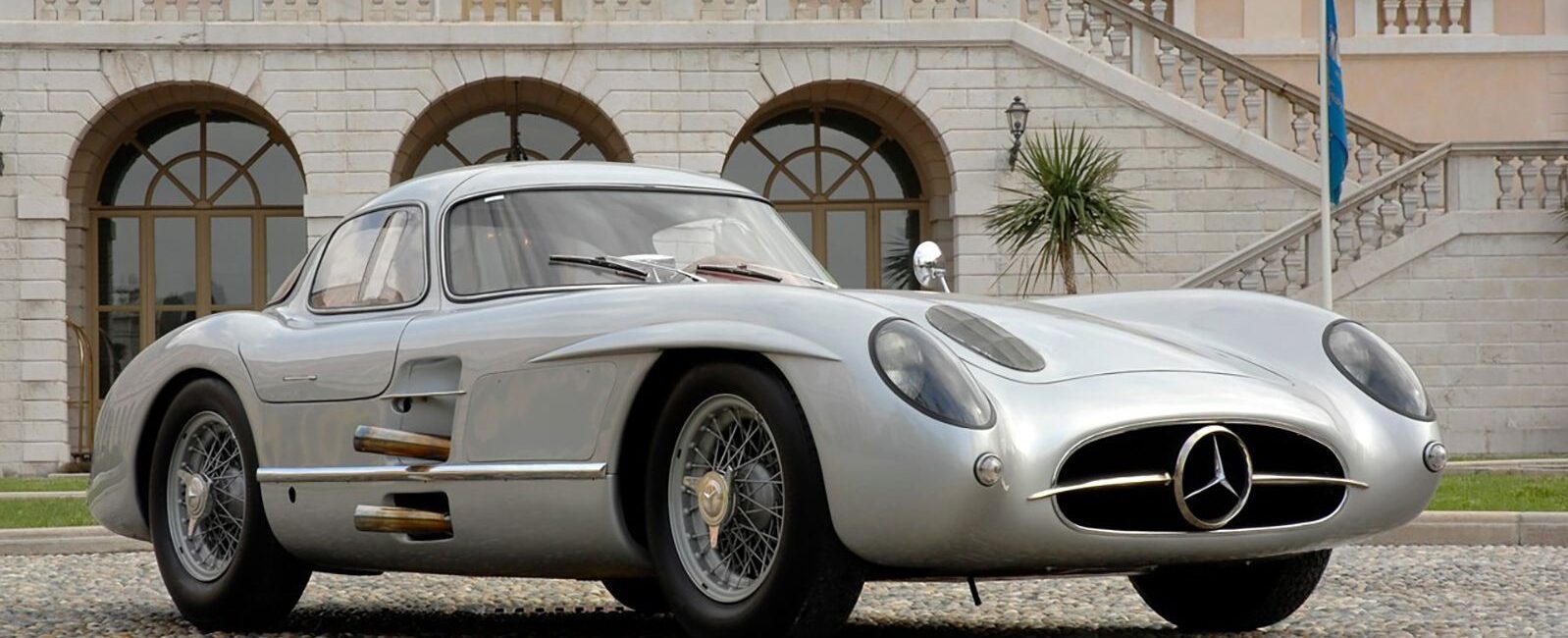
In May 2022, the world of classic car collecting was shaken by a staggering figure: 135 million euros. This was the price at which a Mercedes-Benz 300 SLR Coupé Uhlenhaut went up for auction during an auction organized by RM Sotheby’s at the Mercedes-Benz Museum in Stuttgart, according to the official statement from Mercedes-Benz France. An absolute record, shattering the previous holder by aFerrari 250 GTOSold for approximately 70 million euros in 2018. But beyond the figure, what does this car truly represent? Why does it inspire such fascination among collectors and car enthusiasts? This article traces the exceptional history of the Uhlenhaut Coupe, from its genesis on the circuits of the 1950 decades to its status as an invaluable icon. You will discover its technical specifications inherited from Formula 1, the dramatic context that interrupted its career, and what makes this model an absolutely unique piece in the history of automobiles.
A race car born from the Formula 1
The origins: the Mercedes-Benz W196
Contrary to what its name might suggest, the Mercedes-Benz 300 SLR is not derived from the famous 300 SL “Butterfly.” As Wikipedia states, it actually constitutes the sport version—two-seater and streamlined—of the Mercedes-Benz W196, the single-seater that dominates the Formula 1 world championship in 1954 and 1955. The acronym SLR stands for “Sport Leicht Rennen,” which translates to “Light Sport Racing” in French.
The inline eight-cylinder engine of the W196 of Formula 1 has been taken over and its displacement was increased from 2 500 cm³ to 3 000 cm³ to meet the requirements of endurance racing. This block produced a power of 302 horsepower (222 kW). Among its technical features are direct gasoline injection and modromic valve control, a technology that allows for precise mechanical control of the opening and closing of valves at very high speeds.
To learn more about this topic, please consult our article dedicated tothe most expensive car of all time.
An illuminating but dazzling highlight reel
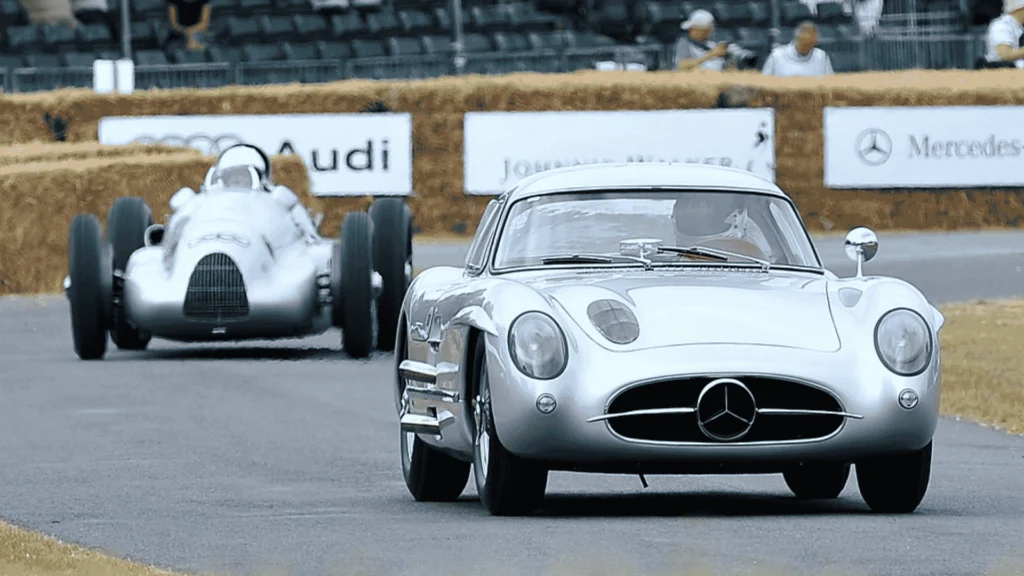
The 300 SLR had a meteoric sporting career in 1955. Under the hands of legends like Stirling Moss and Juan Manuel Fangio, it allowed Mercedes-Benz to win the 1955 World Sportscar Championship with two points ahead of Ferrari.
The most iconic moment remains Stirling Moss’s victory at the Mille Miglia 1955: he completed the approximately 1 600 km of the course at a record average speed of 157,65 km/h, accompanied by journalist Denis Jenkinson who used handwritten notes—the precursors to modern rally pace notes. Fangio finished second in a sister car. The 300 SLR then achieved a triple at the RAC Tourist Trophy in Dundrod and a double at the Targa Florio in Sicily.
The drama of the Mans and the end of an era
The dominance of the 300 SLR was brutally tarnished by the disaster of the 24 Le Mans 1955. During the race, Pierre Levegh, driving a 300 SLR, violently hit a curb after colliding with Lance Macklin’s Austin-Healey. His car disintegrated and debris were thrown into the crowd. The Elektron magnesium alloy body burned. The toll was terrible: 83 spectators and Levegh lost their lives, which remains the deadliest accident in the history of motorsport to this day.
Mercedes-Benz decided to withdraw its cars from the race while they were leading. At the end of the season 1955, the manufacturer is withdrawing from international circuit competitions for more than thirty years.
From circuit to road: the birth of the Uhlenhaut Coupe
Rudolf Uhlenhaut, the visionary engineer
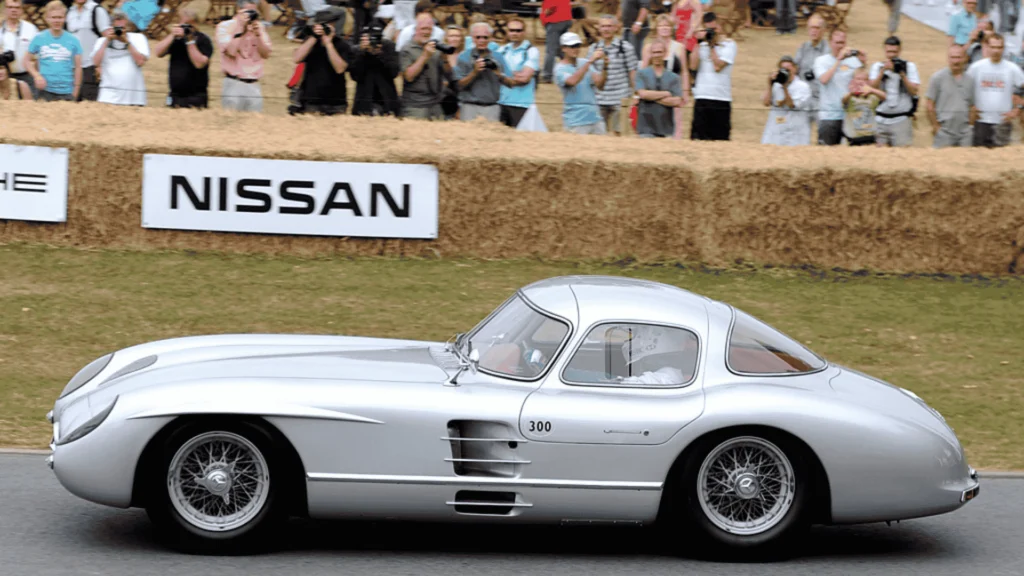
Rudolf Uhlenhaut, director of the Daimler-Benz competition department and architect of the 300 SLR, had ordered before the Le Mans tragedy that two of the nine W196 S chassis produced be put aside to be converted into a road-sport hybrid. The project was initially intended to enter these coupes in the Carrera Panamericana, which was itself cancelled for safety reasons related to the Le Mans tragedy.
Mercedes’s withdrawal from the competition sealed the fate of the project. Uhlenhaut then acquired one of the remaining two prototypes as a production car, simply adding a large suitcase-sized exhaust muffler to dampen the near-free-flowing exhaust noise. The coupe earned its name: the “Uhlenhaut Coupé.”
Exceptional technical characteristics
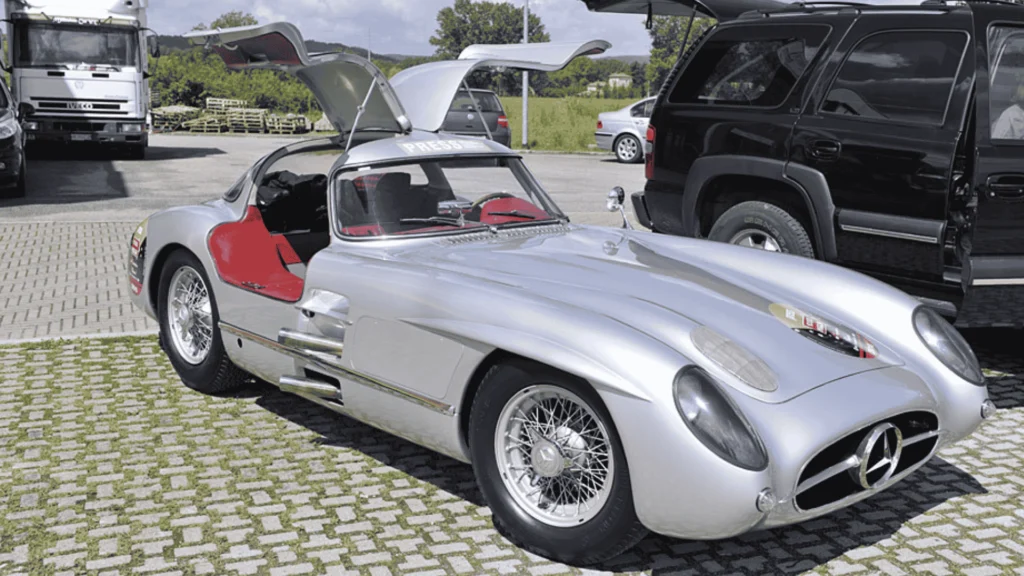
The Uhlenhaut Coupe retains the mechanical fundamentals of the 300 SLR race car while adding a refined coupe bodywork, with distinctive butterfly doors necessary to clear the high-mounted longitudinal members of the tubular chassis (spaceframe).
Here are its main technical characteristics, all sourced:
The car displayed a weight of 1 117 kg in its coupe version according to Wikipedia EN, thanks to its magnesium Elektron alloy body whose relative density is only 1,8 — that is less than a quarter of that of iron (7,8). The tubular steel frame (spaceframe) ensured remarkable rigidity for such a lightweight car.
Its inline eight-cylinder engine of 3,0 liters with direct injection developed302 ch (222 kW), with a bore and stroke of 78 mm. As for the maximum speed, it approached 290 km/h, which made the Uhlenhaut Coupé by far the fastest production car of its time.
Among the notable innovations is the aerodynamic brake system called the Intrados system: a wing of the car’s width that lifted during braking to compensate for the reduced effectiveness of drum brakes compared to Jaguar Type D disc brakes. This system worked remarkably well, not only improving braking but also traction in tight turns.
A legendary anecdote
A famous story circulates about Rudolf Uhlenhaut driving his coupe: late for a meeting, he allegedly drove the 220 km separating Munich from Stuttgart on the highway in less than an hour—a trip that would now take two and a half hours. True or embellished by time, this anecdote perfectly illustrates the extraordinary capabilities of this machine.
Journalists from the Automobile Revue magazine, who had driven more than 3 200 km in the coupe, described a car capable of overtaking traffic in a fraction of a second and for which 190 km/h on a free highway was hardly more than cruising speed.
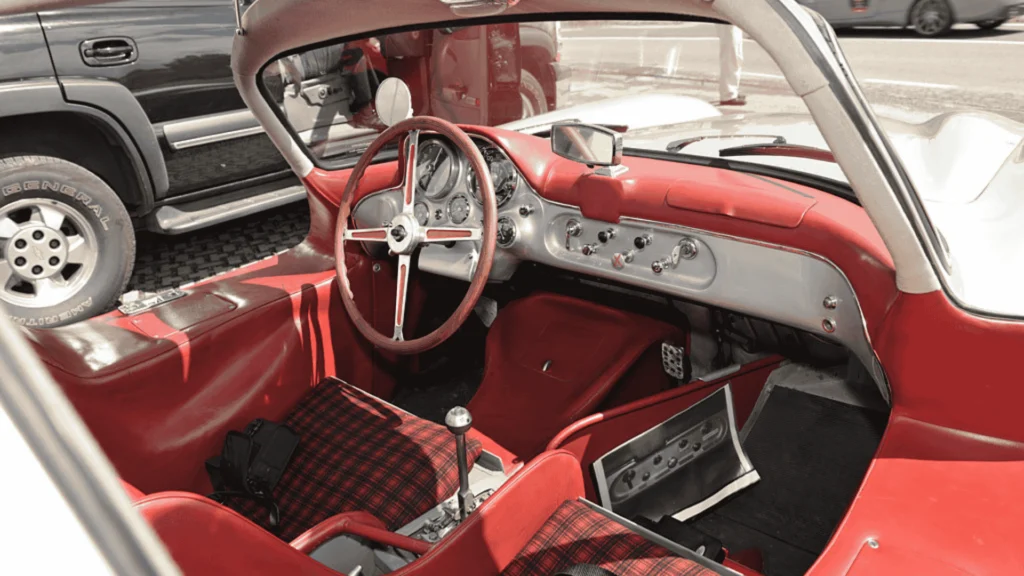
Record sale of 2022: 135 million euros.
A historical event at the Mercedes-Benz Museum
On 5 May 2022, one of the two Uhlenhaut Coupes was sold at an ultra-selective auction held at the Mercedes-Benz Museum in Stuttgart, in cooperation with RM Sotheby’s, according to the official statement from Mercedes-Benz France. The guests included among the most prestigious Mercedes-Benz customers and international car and art collectors.
The sale price — 135 million euros — has set an absolute record for a car according to RM Sotheby’s, far surpassing the 70 million euros spent in 2018 for a Ferrari 250 GTO. In US dollars, this amounted to approximately 142 million dollars.
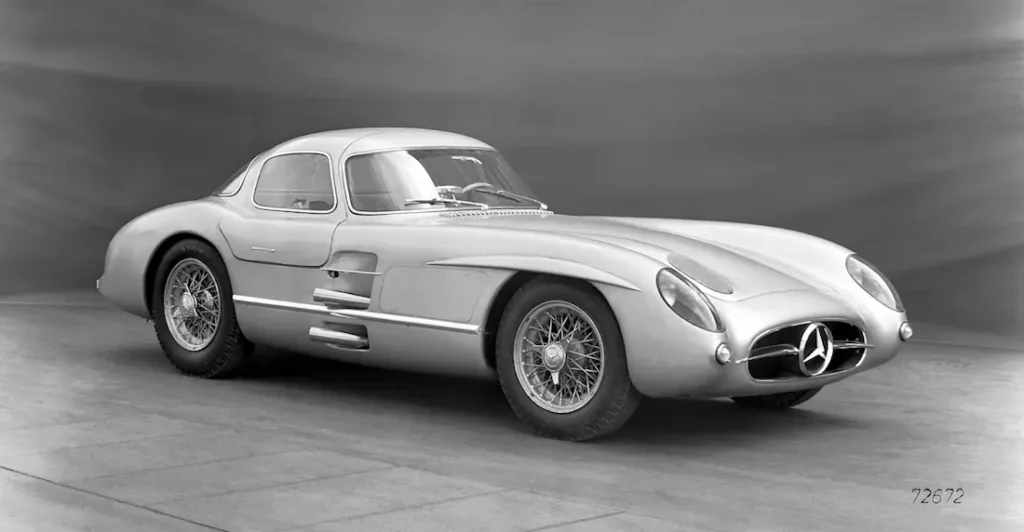
Why such a price?
Several factors explain this exceptional valuation. First, the absolute rarity: only two Uhlenhaut Coupés exist in the world, according to all the sources consulted. Second, the historical significance: this car embodies a pivotal moment in automotive history, at the intersection of competition and the road, technical innovation, and human drama.
RM Sotheby’s emphasizes that the Uhlenhaut Coupe represents a “milestone in the history of Mercedes-Benz chronology” and a “masterpiece of automotive engineering and technology from the 1950 era.” The unique design, racing technology, iconic butterfly doors, and direct connection to the Formula 1 of the 50 years form an irreplaceable ensemble.
A sale for the benefit of a cause
As stated by Ola Källenius, CEO of Mercedes-Benz Group AG, quoted in the official statement from Mercedes-Benz France, the sales revenue was used to create the “Mercedes-Benz Fund,” a global scholarship and research program in the fields of environmental science and decarbonization for young people. The second Uhlenhaut Coupe remains the property of the company and continues to be displayed at the Mercedes-Benz Museum in Stuttgart.
What the Uhlenhaut Coupe represents for collectors
An inaccessible Grail
For car collectors, the Uhlenhaut Coupe embodies the ultimate object, the one that can never be owned. With only two existing copies—one at the museum and the other with a private collector who has agreed to lend it for occasional public exhibitions according to Mercedes-Benz France—it is a car whose value is as symbolic as it is financial.
The impact on the market for classic cars
The sale of 2022 has redefined price ceilings in the world of classic automobiles. It confirms that certain cars, beyond their mechanical function, are works of art in their own right whose value can rival the greatest masterpieces of the masters. For enthusiasts and investors, the Uhlenhaut Coupe reminds us that extreme rarity, combined with an exceptional history and impeccable provenance, constitutes the most precious combination of all.
Errors to avoid in evaluation
It would be incorrect to directly compare the Uhlenhaut Coupé to other 300 SLs or even other Mercedes competition cars from the 1950 era. The 300 SLR Coupé is not a 300 SL “improved”: it is a Formule 1 bodycar for the road, a unique prototype without an equivalent. Informed collectors know this: confusing these two lines is like comparing a fighter plane to a commercial airliner on the pretext that they have the same logo on the wing.
To remember — Expert advice
The Mercedes-Benz 300 SLR Coupé Uhlenhaut is not simply the most expensive car ever sold. It is a concentration of automotive history: the Formula 1 technology of the 50 years, the genius of a visionary engineer, an overwhelming sporting pedigree interrupted by a tragedy, and absolute rarity with only two units built. For any car collector, understanding the history of the Uhlenhaut Coupé is to grasp why some cars transcend their simple mechanical function to become invaluable cultural objects. If you ever encounter this silver coupe with butterfly doors in a museum or at a special event, take the time to observe it: you are standing face to face with a piece of history that will never be seen again on the market.
conclusion
The Mercedes-Benz 300 SLR Coupé Uhlenhaut crystallizes everything that makes classic cars magical: technical prowess, rarity, human history, and pure emotion. From Moss’s victory at the Mille Miglia to the drama of the Mans race, from the Munich-Stuttgart highway to the auction room of 2022, this car tells a half-century of automotive history in one object. Its sale to 135 for millions of euros is not just a financial record: it is the universal recognition that a machine can embody human genius in its most refined form. And you, which classic car do you consider the absolute icon of the automobile?
FAQ
How many copies of the Mercedes-Benz 300 SLR Coupé Uhlenhaut exist?Only two copies have been built, according to all official sources. One is kept at the Mercedes-Benz Museum in Stuttgart, the other was sold to a private collector in May 2022 for 135 million euros according to RM Sotheby’s.
What is the maximum speed of the Uhlenhaut Coupe?The maximum speed approached 290 km/h, making it by far the fastest road car in the world during the 1950s.
Why is the Uhlenhaut Coupe so expensive?Its exceptional value is explained by a unique combination: absolute rarity (two copies), technology directly derived from the Formula 1, a historical connection with the 1955 World Sportscar Championship and the Le Mans drama, an iconic design featuring its butterfly doors, and direct provenance from Mercedes-Benz.
Who bought the Uhlenhaut Coupe in 2022?The buyer’s identity has not been officially revealed. According to the Mercedes-Benz France statement, it is a private collector who has agreed that the car will remain accessible for public exhibitions during special occasions.
Are you passionate about classic cars and want to know more about the most iconic models? Explore our websitePlethore.fr to discover other fascinating stories and expert tips on the world of classic cars.
Image source:https://www.supercars.net/blog/1955-mercedes-benz-300-slr-uhlenhaut-coupe-gallery/