The tax clearance certificate is required to register in France a classic car purchased in another European Union country. It certifies that the vehicle complies with VAT regulations. The age of the car or its future status as a “collector vehicle” does not automatically exempt it from this formality.
The procedure depends on the buyer’s department of residence. As of 4 November 2026, individuals residing in the departments 06, 44, 57, 59, 62, 67, 69 and 75 request the tax clearance certificate at the same time as the registration on France Titres (ANTS). In other departments, the application is sent by email to the competent tax office, along with the form 1993-PART-D and supporting documents.
What is the purpose of the tax clearance certificate?
The tax clearance certificate, also called the fiscal certificate, is issued by the Directorate General of Public Finances. It does not prove the technical compliance of the car, nor its authenticity, nor its good condition. It only confirms its VAT status and allows the French registration process to proceed.
It concerns a new or used car acquired in a European Union member state other than France. Therefore, it is necessary to distinguish the vehicle’s geographical origin from its brand nationality: a Porsche purchased in Belgium falls under the EU procedure, whereas a Jaguar bought directly in the United Kingdom falls under customs formalities outside the EU since Brexit.
For a vehicle cleared through customs in France from a country outside the European Union, the central document is in principle the customs clearance certificate 846 A, not a tax clearance certificate. A special case exists when the vehicle coming from a third country was first cleared through customs in another member state before its introduction into France: the customs clearance and VAT payment documents must then be kept and presented.

In which cases does a classic car require a tax clearance certificate?
The following table summarises the most common situations.
| Situation | Main fiscal document |
|---|---|
| Classic car purchased in Germany, Belgium, Italy, Spain or another EU state | Tax clearance certificate |
| Car purchased directly in Switzerland, the United Kingdom or the United States and cleared through customs in France | Customs clearance certificate 846 A |
| Vehicle coming from a third country but already cleared through customs in another EU state | Tax clearance certificate and customs clearance documents within the EU depending on the file |
| Trailer, semi-trailer, agricultural or forestry vehicle | No tax clearance certificate according to Service-Public.fr |
| Car already registered in France | No tax clearance certificate for an intra-community purchase |
The “collection” designation does not change the fiscal nature of the acquisition. A car over 30 years old purchased in the Netherlands remains a vehicle originating from the EU. The tax clearance certificate is issued before or with the registration; the request for the “collector vehicle” designation is a separate matter.
Where to request the tax clearance certificate in 2026?
In the departments 06, 44, 57, 59, 62, 67, 69 and 75
The request must be made exclusively on the France Titres website (ANTS). For a private individual, the tax clearance certificate and registration are combined in the same online procedure. Any VAT due can be paid by credit card or direct debit.
Before starting, check the personal information on your ANTS account, particularly your civil status and address. A consistent tax file submitted from an incomplete account may be blocked or generate a request for correction.
In other departments
You must complete the form1993-PART-D, current edition, then send the request and supporting documents by email to the tax office indicated for your domicile. The official Impots.gouv.fr page allows you to find the competent service based on your address. If VAT is due, payment is made by bank transfer.
Do not use an address found on an old forum or an undated guide: services and procedures have evolved. The rule depends on the buyer’s address shown on the invoice or transfer certificate, including when an agent submits the file.
Which documents must be provided?
For a private individual, prepare at minimum:
- the 1993-PART-D form in the general case, or the information requested by the ANTS online procedure;
- the purchase invoice if the seller is a professional, or the transfer certificate if the seller is a private individual;
- the final foreign registration certificate if the car has already been registered;
- an identity document in the buyer’s name;
- proof of residence in France;
- a power of attorney if the procedure is carried out by another person;
- a certified translation if the administration requires it for a document not written in French.
The invoice or transfer deed must clearly identify the seller, the buyer and the car. In particular, check the chassis number or VIN, delivery date, price, make, model and, for a professional seller, their contact details and VAT number if applicable.
On a classic car, the foreign registration document and the chassis may feature historical formats. A short stamping, an old serial number or a difference in typography does not authorise you to “correct” the document yourself. You must document the vehicle’s consistency and, if necessary, seek assistance from the manufacturer, their representative, the Dreal or an authorised organisation.
Our article on the certificate of conformity for a classic car explains when a COC, an identification certificate or an individual approval may become necessary. For a purchase in Germany, also consult the guide dedicated to documents and the tax clearance certificate for a classic car imported from Germany.
How much does the tax clearance certificate cost?
The tax clearance application itself is free of charge. This does not mean that VAT is never due. The tax authority examines the actual situation of the vehicle, the invoice, the seller and the applicable regime.
For a properly purchased used classic car within the EU, the tax clearance certificate is often issued without additional French VAT, but this situation should not be taken as an absolute rule. An incomplete invoice, a vehicle fiscally considered as new, poorly documented foreign VAT, a relocation or an import that has passed through another Member State can alter the analysis.
The tax clearance certificate does not cover other expenses: transport, temporary plates, technical inspection, conformity, translation, registration document, possible individual approval or intervention by an authorised professional.
What timeframe should be expected?
The official sources consulted do not announce a guaranteed national issuance timeframe. Best practice is to submit a complete file as soon as the vehicle is delivered. The DGFiP reminds that the registration application must be made within one month following delivery.
A file may take longer if the VIN differs between documents, if the invoice does not sufficiently describe the vehicle, if the foreign registration document is incomplete, if a translation is requested or if the VAT situation requires verification. Therefore, do not plan an event, resale or long journey assuming the tax clearance certificate will be issued within a few days.
The errors that most often block the file
Submitting the application to the wrong department
The buyer’s home department determines the procedure to follow. The old lists limited to four departments are outdated: the Service-Public.fr page updated on 1 October 2026 mentions eight for the France Titres online procedure.
Confusing tax clearance, conformity and classic car registration
The tax clearance settles the fiscal issue. The certificate of conformity or individual approval deals with technical conformity. The certificate required for a “classic vehicle” registration mention follows yet another logic. One document does not replace the others.
Accepting an invoice that is too vague
An invoice without a VIN, delivery date or full identity of the parties may delay processing. Before paying for the car, have the document corrected by the seller. An improvised certificate after the transaction is less convincing than a complete act established from the outset.
Modifying or concealing documents
Submit clear, complete scans, in colour when useful, without cropping edges or masking information. If numbers differ, explain the situation with evidence instead of retouching a document.
Recommended procedure after purchasing a classic car within the EU
- Secure the invoice or transfer certificate, the foreign registration document, and proof of payment.
- Photograph the VIN and verify its consistency with all documents.
- Arrange transport or valid temporary plates and appropriate insurance.
- Submit the tax clearance certificate application according to your home department.
- Simultaneously gather the technical documents: MOT test, COC, identification certificate or classic vehicle file as applicable.
- Complete the French registration application.
- Keep the tax clearance certificate, translations, invoice, and transport proofs in the vehicle’s historical file.
If you are still at the selection stage, the choice ofclassic and prestige cars for saleallows you to compare vehicles already offered on the French market. For precise importation, do not pay the balance before identifying the actual available fiscal and technical documents.
Frequently asked questions
Is a car over 30 years old exempt from the tax clearance certificate?
No. Its age or historical interest does not automatically exempt it from the tax clearance certificate when purchased in another European Union country.
Does the tax clearance certificate replace the certificate of conformity?
No. The tax clearance certificate concerns VAT; the COC, identification certificate or individual approval concerns the technical compliance necessary for registration.
Can the tax clearance certificate be requested before receiving the car?
The DGFiP states that the tax clearance certificate must be requested after delivery. Prepare the documents in advance, but use the final transaction and vehicle information.
Is a tax clearance certificate required for a classic car purchased in the United Kingdom?
For a direct purchase in the United Kingdom after Brexit, the car comes from a non-EU country: customs formalities and the 846 A certificate are normally central to the file. A special case may exist if the vehicle was previously cleared in another Member State.
How long is the tax clearance certificate valid?
The official pages consulted do not present the tax clearance certificate as a document to be renewed periodically. It is linked to the acquisition and the vehicle concerned; it must be kept with the registration file.
Can the application be entrusted to a professional?
Yes, with a power of attorney. The submission route remains determined by the buyer’s domicile or registered office.
Sources
- Service-Public.fr — Purchasing a vehicle abroad: how to obtain a tax clearance certificate? : procedure, eight departments concerned, documents and payment methods; page verified on 1 October 2026.
- Impots.gouv.fr — You are a private individual and wish to obtain a tax clearance certificate : distribution between ANTS/email, supporting documents and search for the competent service.
- Impots.gouv.fr — form 1993-PART-D, vintage 2026 : official form for private individuals in the general case.
- France Titres — assistance on the tax clearance certificate : role of the tax certificate and access to the online procedure.
- Service-Public.fr — obligations for registering a vehicle purchased abroad : distinction between EU, customs and technical compliance.
Image credits
- Featured image, Opel Olympia Rekord P1 Caravan from 1960 :Berthold Werner, Wikimedia Commons, CC BY-SA 3.0 licence; plate obscured for privacy, derivative image distributed under the same licence.
- European flag in Karlsruhe:Entbert, Wikimedia Commons, CC BY 4.0 licence.
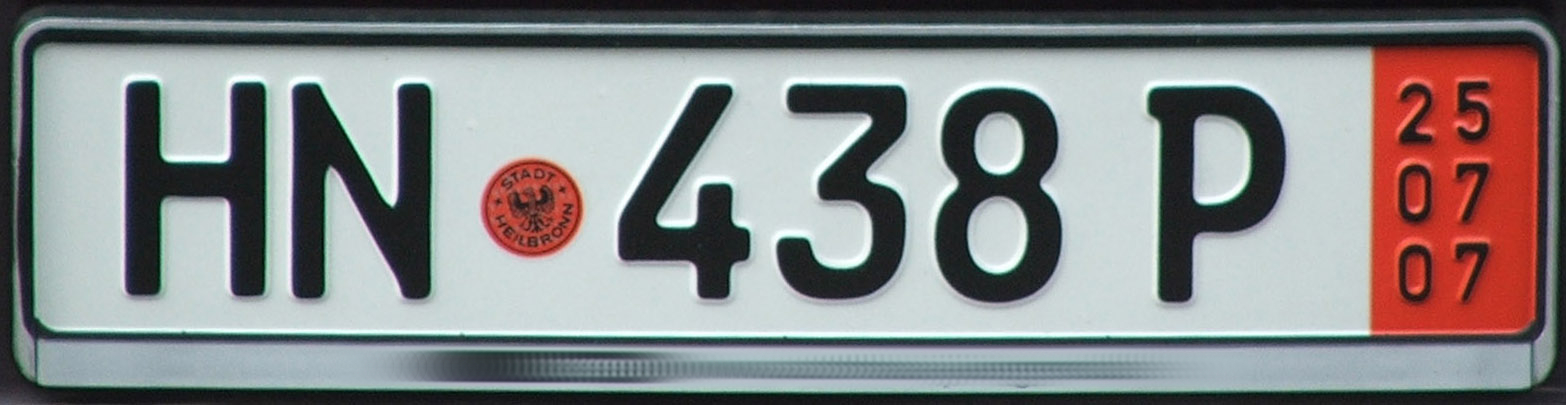
- Temporary German export plate:Krokodyl, Wikimedia Commons, CC BY 2.5 licence.
Procedure verified on 4 November 2026. As administrative procedures may evolve, please check the official page corresponding to your department before submission.