Yes, a classic car whose engine has been replaced can be sold. But before publishing the advertisement, it is necessary to precisely identify the installed engine block, determine whether it is an equivalent replacement or a significant modification, gather the invoices, and present the situation unambiguously to the buyer. A non-original engine does not automatically prohibit the sale; however, an unregularised different engine can complicate registration, insurance, and the vehicle’s value.
Information verified on 23 November 2026 for a car registered in France. The classification of a modification depends on the vehicle, its initial approval, and the characteristics of the installed engine. In case of doubt, request a written response from the manufacturer or the competent approval authority.
The answer in 30 seconds
- Rebuilt engine: the car retains its original block; keep the invoices and number records.
- Identical engine replacement: the FFVE states that a truly identical replacement is not, in itself, a significant modification. However, equivalence and provenance must be proven.
- Different or more powerful engine: the modification may require an individual approval (RTI) and an update of the registration certificate.
- To sell: indicate the replacement in the advertisement and in a document given to the buyer, with references, invoices, and available administrative decisions.
Can you sell a classic car with a replaced engine?
The sale remains possible if the seller is the rightful holder of the registration certificate, if the vehicle can legally be sold, and if the usual sales documents are gathered. Service-Public notably reminds that the registration certificate, the transfer certificate, a certificate of administrative status less than fifteen days old, and, when applicable, a technical inspection less than six months old must be provided.
The engine change raises a separate question: does the car still correspond to its approved type and declared administrative characteristics? The sale does not regularise a modification. A favourable technical inspection does not constitute homologation of the installation either. That is why the seller must clarify the situation before setting the price or implying that the car is “compliant.”
Three situations not to be confused
| Situation | Careful interpretation | File to present |
|---|---|---|
| Reconditioning of the original engine | Restoration or repair, without replacement of the identity block | Invoices, photos, number record before and after work |
| Strictly equivalent replacement block | May be considered a repair if no technical characteristic changes | Engine reference, origin, invoice, proof of equivalence |
| Engine of a different type, power, displacement or fuel type | Potentially significant modification | Manufacturer approval, DREAL/DRIEAT/DEAL file, RTI report and updated registration document if required |
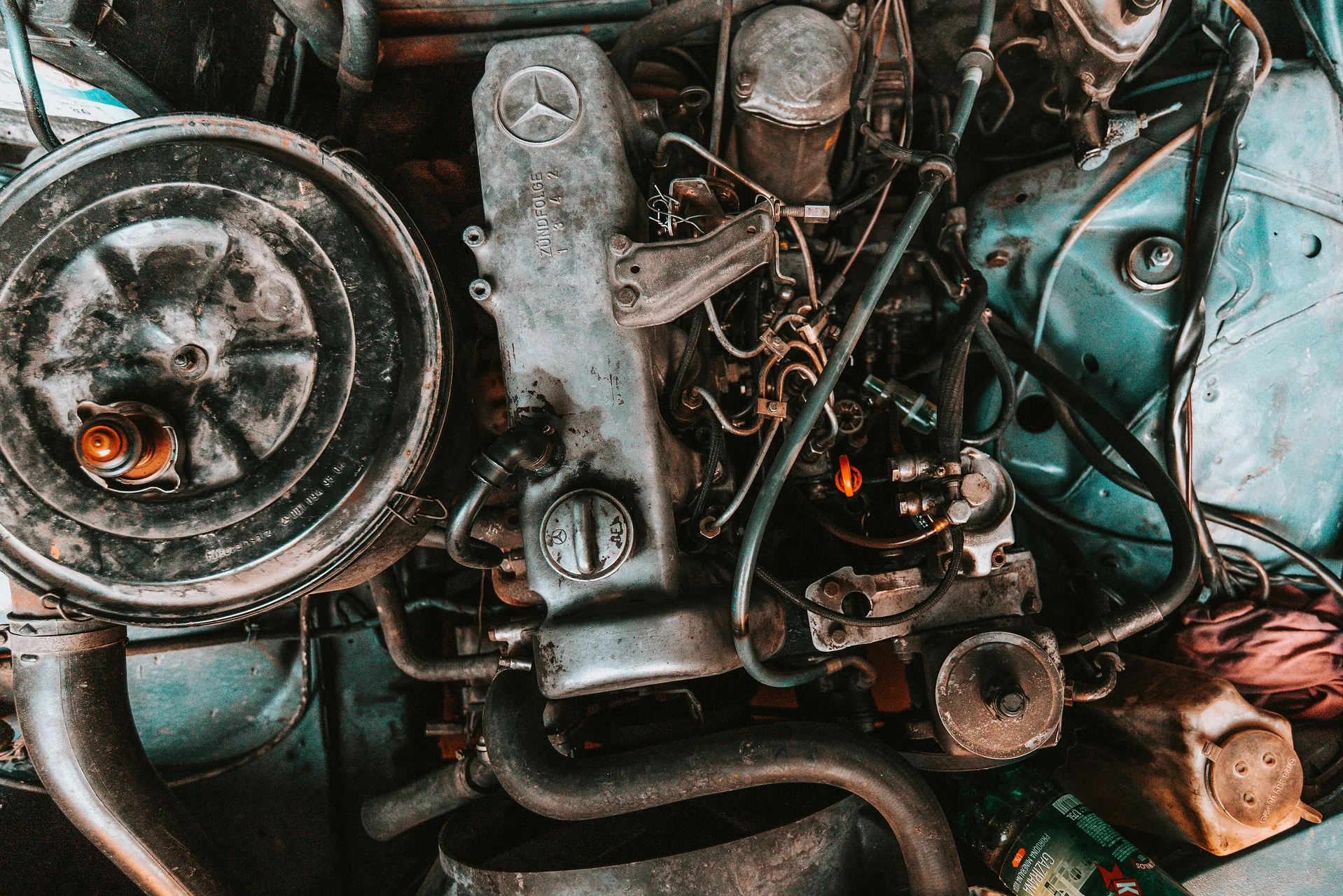
The word “identical” does not simply mean “it fits in the engine bay”. The engine code or type, displacement, power, fuel supply, fuel type, weight, emissions, noise, mounts, transmission and peripherals may all be relevant. To explore this distinction further, please consult our guide dedicated to the engine replacement of a classic car.
Which documents to gather before putting the car up for sale?
A classic car buyer does not just purchase a vehicle; they also buy a technical history which they will need to explain to their insurer, their expert and the next owner. A clear file reduces uncertainty and prevents the replaced engine from being discovered during the inspection.
- Identify the engine currently fitted. Note its type, code and individual number if it exists. Photograph the markings without editing.
- Find the purchase invoice for the engine block. Ideally, it should mention the seller, date, reference and origin. A mere verbal statement counts for little with a discerning buyer.
- Add the workshop invoice. It should describe the removal, the installed engine, any adaptations and the checks carried out.
- Compare with the original specification. Descriptive notice, manufacturer sheet, archive certificate or workshop documentation allow verification of the consistency of the installation.
- Keep official correspondence. Manufacturer’s response, reception service opinion, RTI report and updated registration certificate must accompany the car.
- Document the old engine. If it still exists, indicate whether it is included in the sale, stored elsewhere or beyond recovery.
Arrange these elements chronologically and digitise them. Our method for compiling a historical file for a classic carhelps to transform scattered invoices into a verifiable narrative.
When should an Individual Vehicle Approval (IVA) be considered?
The Ministry of Ecological Transition reminds us that modifications to engine performance can significantly alter the vehicle’s behaviour. When the modification affects the technical characteristics of the type approved, the vehicle may need to be presented to the DREAL, the DRIEAT in Île-de-France, or the DEAL overseas for an Individual Vehicle Approval.
Warning signs include an increase in power, a different engine capacity, a change of fuel type, added forced induction, an engine from another family, or adaptations to the chassis, braking, transmission, and suspension. The official file for a modification not conforming to an approved type may require the manufacturer’s approval, a work certificate, and regulatory documentation. Therefore, the IVA should not be presented as an automatic formality.
Conversely, the FFVE specifies that replacing the engine with an identical one is not considered a significant modification. However, this assumes a true technical identity, not just a resemblance. If the car holds a classic vehicle registration certificate, also verify consistency with the documented historical characteristics.
How to inform the buyer without unnecessarily devaluing the car?
The best advertisement text is factual. For example, write: “engine replaced on 2018 with a block of the same type, reference X, purchase invoice and installation invoice available.” If the engine is different and the modification regularised, mention the IVA report and the updated registration certificate. If any point remains uncertain, state it and initiate checks before signing.
The Civil Code requires informing the other party of any information crucial to their consent when they are legitimately unaware of it. It also provides a guarantee against hidden defects that render the item unfit for use or significantly reduce its usability. Without turning the advertisement into legal consultation, the practical rule is simple: anything affecting conformity, insurability, authenticity, or value must be described and proven.
Provide the buyer with a signed annex summarising:
- the reference and, if available, the number of the current engine;
- the date and reason for the replacement;
- the identity of the workshop or person who carried out the work;
- any peripheral modifications made;
- the documents provided with the car;
- whether or not the old engine is present;
- any reservations or checks still outstanding.
A vague statement such as “sold as seen” does not replace a precise description. Nor does it remove the rules applicable to pre-contractual information and hidden defects.

Does a non-matching numbers engine reduce the value?
There is no universal depreciation. On a rare sports car, a concours automobile, or a model whose factory archives allow verification of the engine delivered new, the absence of the original block can weigh heavily. On a popular mass-produced car, an equivalent, sound, and documented engine may be preferable to a very worn original block or an opaque restoration.
Value depends on rarity, version, overall condition, quality of work, provenance, and demand at the time of sale. The racing history can even make certain replacements coherent: competition cars often changed engines throughout their careers. Our feature on the matching numbers explains why a matching number alone does not summarise authenticity or quality.
To set the price, compare examples of the same version and the same level of documentation. Do not mix a completely original car, a restoration with a correct replacement engine block, and a deeply modified restomod. A free Plethore Cars valuation allows you to obtain an initial opinion taking into account the actual configuration.
Which sales strategy should you choose?
For an accessible classic car whose equivalent engine is perfectly documented, a detailed advertisement may suffice. Photograph the vehicle, the engine compartment, the relevant numbers, and the invoices while masking personal data. Consult our guide to photograph a classic car for sale.
For a rare model, a complex modification, or a high value, an independent appraisal and assisted sale reduce the risk of poor pricing. The Plethore Cars sales mandate helps prepare the presentation, qualify buyers, and secure the transaction steps. The mandate does not replace a missing homologation, but it prevents marketing the car with an imprecise file.
Checklist before publishing the advertisement
- Is the current engine identified by its type and number?
- Is its origin justified by an invoice?
- Is the replacement truly equivalent to the original?
- Has a characteristic of the registration document or the type approval changed?
- Has the manufacturer or the approval service responded in writing?
- Have the RTI and registration document been updated if necessary?
- Does the insurer know the actual configuration?
- Does the advertisement clearly mention the replaced engine?
- Will the buyer receive a copy of all supporting documents?
- Does the price compare technically comparable cars?
Frequently asked questions
Can you sell a classic car with a non-original engine?
Yes, provided you describe the actual configuration and verify its compliance. An equivalent and documented block does not have the same status as a different engine that is not regularised.
Should you write “engine replaced” in the advertisement?
Yes. This is information that could influence the purchase, appraisal and price. Specify the date, reference, reason for the replacement and any available invoices.
Does a valid technical inspection prove that the engine is approved?
No. The technical inspection assesses the vehicle according to its own criteria; it does not replace any administrative approval that may be required for a significant modification.
Must the original engine be delivered with the car?
This is not always possible, but its presence can preserve traceability and offer the possibility of future restoration. Clearly state whether it is included in the sale.
How to calculate the depreciation of a replaced engine?
There is no reliable percentage applicable to all models. You need to compare transactions of similar versions and weigh factors such as rarity, type of engine fitted, quality of work and documentation.
Can the car be sold before regularising a modification?
The sale does not regularise the vehicle. An unclarified modification can block or jeopardise the buyer’s registration and insurance. It is prudent to resolve the situation before marketing the vehicle.
Main sources
- Service-Public — Selling or giving away your vehicle
- Ministry of Ecological Transition — Vehicle approval
- Ministry — File for modification not compliant with an approved type
- FFVE — What is a significant modification?
- Légifrance — Article 1112-1 of the Civil Code
- Légifrance — Article 1641 of the Civil Code