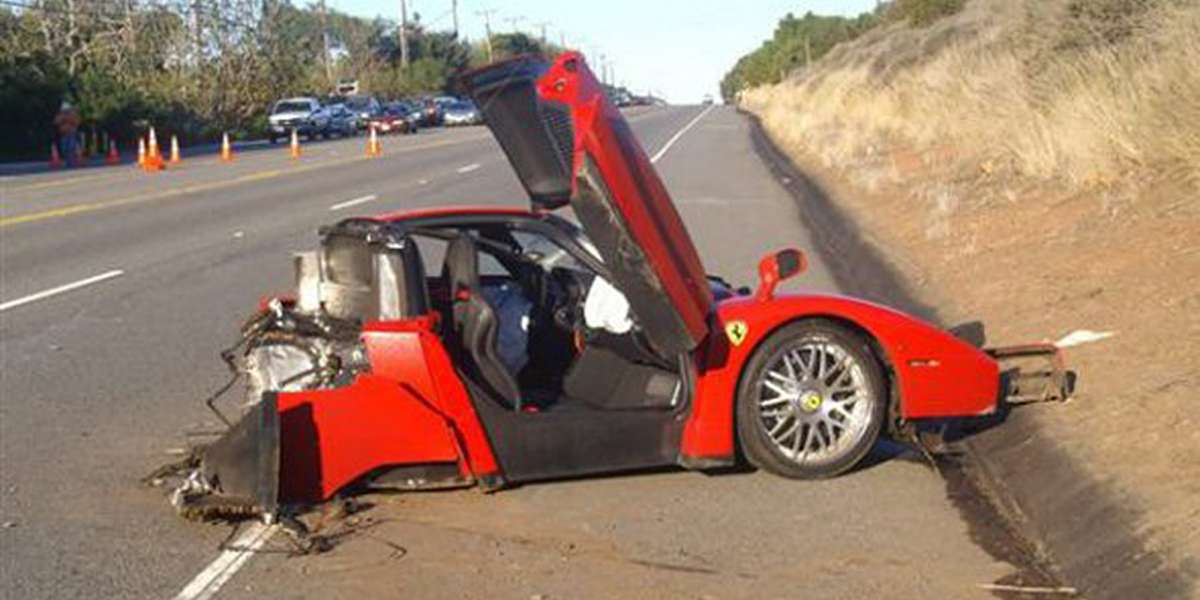
At the dawn of 21 February 2006, on the Pacific Coast Highway that runs along the cliffs of Malibu, California, a vermilion red supercar literally splits in two at nearly 260 km/h. The image of the two halves of Maranello’s masterpiece scattered across the asphalt — “the car was split in half,” American television would headline — immediately went viral worldwide. Behind this legendary crash lies one of the most romantic sagas in modern automotive history: a Swedish criminal, a business scandal worth 400 million dollars, a phantom driver named “Dietrich,” and an investigation that would lead to the downfall of a true international figure. A look back at the Ferrari Enzo accident in Malibu — its causes, its driver, the full story, and the improbable fate of a supercar resurrected from the dead.
The Ferrari Enzo: an extraordinary masterpiece
Launched in 2002, the Enzo is no ordinary supercar. Named in honour of the brand’s founder, it was designed as the “halo car” of an entire generation — a technological showcase born from Ken Okuyama’s studios at Pininfarina and refined on the track by Michael Schumacher himself. Its naturally aspirated V12 engine of 6 litres produces 660 horsepower, its paddle-shift sequential gearbox is directly inherited from Formula 1, and its carbon fibre structure borrows the sleek lines and advanced cockpit of a single-seater racing car.
Luca di Montezemolo, then president of Ferrari, had warned from the start: “We will produce 349, one fewer than we can sell.” In the end, 399 units left the Maranello factory between 2002 and 2004, with a four-hundredth unit gifted to Pope John Paul II — later auctioned for 1,18 million dollars. A calculated rarity which, combined with the machine’s absolute performance, immediately placed this car among the most coveted icons of the 21st century — in the lineage of Maranello’s great sports cars such as theFerrari Testarossa. Today, the value of an Enzo approaches three to four million euros. It is precisely this aura of perfection that made the Malibu crash so staggering.
Also read, our feature onranking of Italian cars by top speed.
Chassis 135564: the red Enzo that should never have driven in California
Behind every Ferrari Enzo lies a chassis number — and the one that ended its run against a Californian power pole is 135564. Finished in Rosso Corsa with Nero seats, the car left Maranello in January 2004 bound for Maranello Concessionaires, the British distributor, where it was registered MD53 VSK on 12 February. It was delivered to a Swedish businessman (full name Bo Stefan Eriksson) based in England. Its twin, chassis 137331, dressed in black, went to his associate and compatriot Carl Freer. Both supercars were financed by the Royal Bank of Scotland and intended to serve as a showcase for Gizmondo, the handheld video game company run by the duo.
A few months after delivery, however, Eriksson stopped paying his instalments. The bank did not report the vehicle as stolen: it still believed the Enzo was safely parked on British soil. In the summer of 2005, taking advantage of this silence, Eriksson illegally exported five luxury cars to the United States: the two Enzos, a Mercedes-Benz SLR McLaren, and two other Mercedes models. Total value of the convoy: 10,8 million dollars. It is in this context of financial irregularities that the red Enzo would drive for the last time.
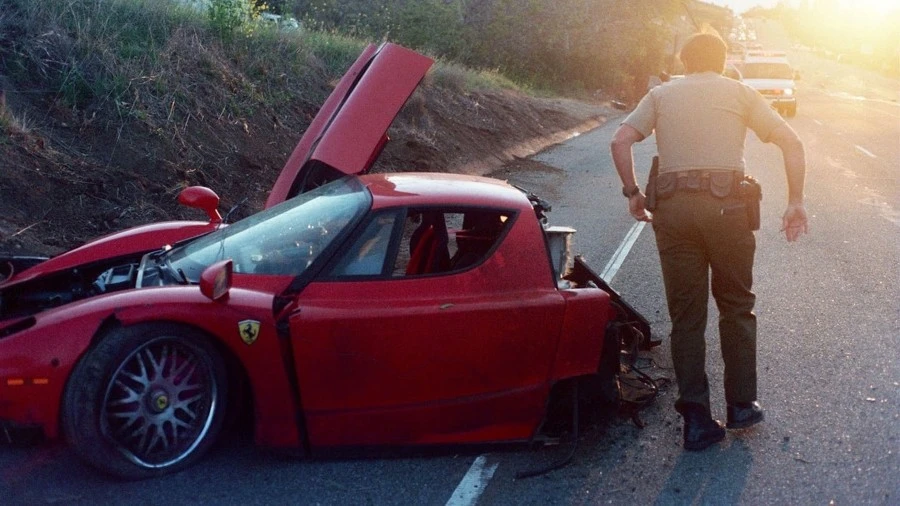
21 February 2006: what happened that morning on the Pacific Coast Highway
Shortly after sunrise that morning, the Enzo set off on the Pacific Coast Highway, that legendary stretch of asphalt winding between the ocean and the Malibu hills. Beside it, according to initial police hypotheses, a Mercedes-Benz SLR McLaren: investigators would quickly suggest the idea of a wild dawn race. Witnesses reported the roar of a V12 engine pushed to the limit. The speedometer, filmed by an onboard camera, showed up to 199 mph — nearly 320 km/h — at the height of the race. An absolutely dizzying speed for a public road.
At approximately 162 mph (260 km/h), the car loses control and leaves the roadway: it crashes into an embankment and then an electric pole with such force that the carbon monocoque fractures behind the bulkhead, right at the engine compartment. The front of the supercar, with its cockpit and occupants, slides for several dozen metres, while the rear — including the engine and transmission — remains caught on the scenery. What happened is therefore clear: the supercar is cut in two, as if sliced with a knife. Debris litters the road for several hundred metres. Spectacular, the scene almost resembles an art installation.
Miraculously, the two occupants emerge almost unscathed. Eriksson suffers only a split lip. His passenger, an American of Irish descent named Trevor Karney, bears only bruises. What remains is to understand what really happened that morning.
The story of the phantom driver “Dietrich”
This is where the Malibu crash shifts from a mere incident to a noir thriller. When the first California patrols arrive at the scene, Eriksson tells officers he was only a passenger, he insists. The driver, he explains, was called “Dietrich”. A German met shortly beforehand, a man whose surname he does not even know, who supposedly fled into the canyons after the impact. Karney, meanwhile, claims to have been the passenger in the SLR McLaren — another Mercedes that also vanished.
The investigators do not believe this for a second. No “Dietrich” is ever found. Nor is the SLR McLaren. The minimal extent of Eriksson’s injuries does not fit well with the passenger’s position in a car cut in two. And above all, the cockpit analysis speaks for itself: Eriksson’s blood was found on the driver’s side airbag. Irrefutable DNA evidence. To top it all off, an onboard video — whose existence was confirmed by investigators — shows the speedometer climbing to 199 mph before freezing at the moment of impact. The tape was seized by investigators as evidence; while images of the speedometer leaked to the press, the full recording has never been made public — which still fuels the wildest theories today about the final seconds before the crash.
On site, Eriksson attempts one last bluff. He brandishes a business card presenting him as Deputy Police Commissioner of the San Gabriel Valley Transit Authority. In reality, this “Transit Authority” is merely a modest bus company for seniors. Eriksson had obtained this honorary title in exchange for installing a video surveillance system — a Californian setup allowing him to possess a police badge and, above all, simplified access to weaponry. Meanwhile, Karney takes advantage of a phone loan from a passer-by to surreptitiously slip a Glock magazine into the good Samaritan’s car.
Who is Stefan Eriksson, the driver?
To understand what a Swede is doing behind the wheel of a Ferrari Enzo in Malibu, one must go back to the suburbs of Uppsala, Sweden’s fourth largest city. Born in 1961, Bo Stefan Eriksson began in a bodywork workshop before shifting, from the late 1970s, into a long criminal career. First convictions for theft in 1981. Three and a half years in prison in 1988 for cocaine and weapons offences. In the 1990s, he became the leader of a group quickly dubbed by the Swedish press the “Uppsala mafia” — specialising in racketeering, drug trafficking, counterfeiting and muscle debt collection, with a front company called “Cannon debt collectors”. Eriksson was sentenced to ten years in prison in 1993 for fraud and counterfeiting, but served only five.
Upon his release, he met Carl Freer, and together they launched in 2001 a project for a portable gaming console called Gizmondo, intended to compete with Nintendo and Sony. Over four years, the business raised nearly 400 million dollars, multiplied flashy partnerships (including an association with the Formula 1 Jordan Grand Prix team) and made a notable appearance at the 24 Hours of Le Mans 2005, driving a Ferrari 360 GTC in Gizmondo colours. Eriksson’s salary then reached 1,1 million pounds, plus bonuses and vehicle allowances. But the venture turned into a scandal: between April and October 2005, over 250 million dollars vanished from Gizmondo’s accounts, siphoned off to satellite companies owned by the executives themselves. The company filed for bankruptcy with 300 million dollars in debt. Eriksson, forced to resign, crossed the Atlantic to start a new life in California. The Maranello supercar was, in this headlong flight, just one accessory among others.
His influence in the Scandinavian underworld and his taste for ostentation transformed Eriksson into a sort of fictional character — to the extent that a play, “Fat Steve”, was created in Uppsala in 2015 to recount his story.
The investigation, trial and conviction
In the days that followed, the sheriff’s office received a first call from Edinburgh: the red Enzo actually belonged to Capital Bank. Then a second, from Lombard Bank: Eriksson had also imported a second Enzo, black, parked in front of his Bel Air villa. On 29 March 2006, Eriksson’s fiancée, Nicole Persson, was apprehended driving the Mercedes SLR McLaren: suspicious British plates, no valid licence, unregistered vehicle. After all, she had no legal right to drive on Californian soil. The net tightened. On 8 April, Los Angeles sheriffs raided the Bel Air property just as Eriksson was about to board for London. They discovered a Magnum .357 revolver and took the Swedish underworld boss into custody.
Charges poured in: embezzlement, car theft, driving under the influence, possession of cocaine, weapons law violations. The judge set bail at three million dollars — about three times what is usually requested for a homicide. Eriksson was defended by Jim Parkman, the lawyer who had already secured the acquittal of the former CEO of Healthsouth. On 3 November 2006, after two weeks of hearings, the jury declared itself deadlocked ten to two in favour of conviction: mistrial. Californian justice announced it would retry the case. Eriksson then chose to accept a plea bargain. He pleaded guilty to two counts of embezzlement and illegal possession of a weapon, received three years in prison and deportation from the United States at the end of his sentence. He was released on 21 January 2008, before being immediately sent back to Sweden where a new sentence of eighteen months awaited him for extortion and aggravated assault. Later still, in 2014, he would be prosecuted again for drug possession and driving under the influence.
The supercar cut in two: restoration and resale for 1,75 M$
The fate of chassis 135564 could have ended there, on the side of a Californian highway. It did not. What remained of the car was sent to Ferrari Classiche, Maranello’s division specialising in the restoration of the brand’s historic models. The Italian engineers made a bold decision: to keep the original monocoque — despite the fracture — and reuse the original V12, which remained intact in the rear part of the vehicle left on site during the separation, dressing the whole in an entirely new bodywork. Several features were added on this occasion: satellite navigation system, reversing camera, Bose sound system, electric windows and a carbon rear spoiler engraved with the “Enzo Ferrari” signature. The colour also changed: the Rosso Corsa gave way to Nero Daytona, with a Rosso leather interior.
In February 2016, ten years after the crash, chassis 135564 resurfaced under the hammer at RM Sotheby’s during the Paris auction. The odometer showed only 2 500 kilometres since restoration. The resurrected Enzo sold for 1,75 million dollars — a record price for a car that everyone, ten years earlier, had written off. In the brand’s history, it probably remains the most told, most photographed, and certainly the most ill-fated example.
Why this crash became legendary
More than twenty years after the events, the Malibu accident continues to fuel forums, documentaries and press articles. Its lasting fame is due to a rare conjunction of spectacular elements: the destruction of a two-million-dollar supercar filmed right up to the moment of impact, the romantic figure of a Swedish criminal with a past worthy of a Henning Mankell novel, the persistent mystery of the phantom driver “Dietrich”, the missing onboard cassette, and the resounding collapse of a publicly traded company (Gizmondo) whose scandal reverberated all the way to the City of London. This saga alone crystallises all the possible excesses surrounding an automotive icon.
For Ferrari enthusiasts, this crash also recalls the fragility of legends. The Enzo symbolises the pinnacle of Maranello’s expertise at the turn of the 2000s, extending a lineage of mythical sports cars initiated by models such as the Ferrari 328 GTS; seeing it reduced to two halves on a Californian road makes tangible the idea that even the most exceptional machines are not immune to the excesses of their owners. In many respects, the Malibu saga has fixed this supercar in the collective imagination as an almost cursed car — while paradoxically giving it a second life and a steadily rising value.
Frequently Asked Questions about the Ferrari Enzo accident in Malibu
Who was driving the Ferrari Enzo during the Malibu accident?
Bo Stefan Eriksson, a Swedish businessman with documented criminal activities and former co-director of the company Gizmondo, was at the wheel at the time of the crash. He initially tried to blame a mysterious German driver named “Dietrich”, a version contradicted by the presence of his own blood on the driver’s side airbag — irrefutable DNA evidence that convinced the investigators.
How fast was the Ferrari Enzo travelling just before impact?
The onboard camera recorded a maximum speed of 199 mph (approximately 320 km/h) at the peak of the run. The car then decelerated and left the roadway at about 162 mph (260 km/h), hitting an embankment and then an electric pole on the Pacific Coast Highway. These two figures therefore correspond to two distinct moments in the sequence: the top speed, then the loss of control.
How many Ferrari Enzos were produced in total?
Ferrari produced 400 examples of the Enzo between 2002 and 2004. The initial commercial production was for 399 units, to which is added a one-off example gifted to Pope John Paul II, later resold at auction for 1,18 million dollars. Luca di Montezemolo had announced from the outset a limited production of “one less than what we can sell”.
Has the Ferrari Enzo involved in the Malibu accident been restored?
Yes. Chassis 135564 was fully restored by Ferrari Classiche, Maranello’s official restoration division. The cracked monocoque and the original V12 — recovered intact from the rear part of the vehicle — were preserved, the bodywork entirely redone, and the colour changed from the original Rosso Corsa to Nero Daytona. Ten years after the crash, in February 2016, the resurrected car was sold by RM Sotheby’s in Paris for 1,75 million dollars.
What is the value of a Ferrari Enzo today?
On the current auction and private sale market, a Ferrari Enzo in good condition trades between 3 and 4 million euros. The rarity of the model (400 examples), its direct lineage from Formula 1, and its status as the ultimate “halo car” at the turn of the 2000s make it one of the most sought-after — and most highly valued — Ferraris of the 21st century.
What happened to Stefan Eriksson after the Malibu accident?
Arrested in April 2006 during a raid at his Bel Air villa, Eriksson was charged with embezzlement, illegal importation of luxury vehicles, possession of weapons and cocaine. After a first trial ended in a mistrial (10 jurors against 2 in favour of conviction), he accepted a plea bargain, pleaded guilty to two counts and was sentenced to three years in prison. Deported to Sweden upon his release in January 2008, he served an additional eighteen-month sentence for extortion before being prosecuted again in 2014 for drug possession.
What was the company Gizmondo, involved in the scandal?
Gizmondo was a British handheld video game company founded in 2001 by Bo Stefan Eriksson and Carl Freer, intended to compete with Nintendo and Sony. The company raised nearly 400 million dollars, secured numerous media and sports partnerships — including a presence at the 24 Hours of Le Mans 2005 — before filing for bankruptcy at the end of 2005 with 300 million in debts. Meanwhile, over 250 million dollars had been siphoned off to satellite companies controlled by its own executives.
Why is the Malibu accident considered the most famous crash in automotive history?
The notoriety of this crash stems from an exceptional convergence of factors: the filmed destruction of a two-million-dollar supercar cut in half at 260 km/h, the extraordinary identity of the driver (head of the “Uppsala mafia” turned tech businessman), the persistent mystery of the “ghost driver Dietrich,” the missing onboard cassette, and the collapse of a London-listed company. No other car accident has combined the elements of a news story, a noir novel, and an international financial saga to such an extent.
Join the Plethore community
The saga of the Malibu Ferrari Enzo — Swedish criminal, ghost driver, resurrected supercar — perfectly illustrates what Plethore explores every week: the true story behind exceptional machines. Classic cars, industrial sagas, exclusive test reports: features that start from the facts to take the reader where mainstream media never goes.
Receive the next Plethore features →
In brief: what to remember about the Ferrari Enzo accident in Malibu
The Ferrari Enzo accident in Malibu, which occurred on 21 February 2006 on the Pacific Coast Highway, remains to this day one of the most famous crashes in automotive history. Behind the wheel was a Swedish criminal, Bo Stefan Eriksson, former head of the company Gizmondo, who unsuccessfully tried to convince authorities of the existence of a German driver named Dietrich. The supercar, chassis 135564, was cut in half at nearly 260 km/h before being fully restored at Ferrari Classiche and resold ten years later for 1,75 million dollars. Beyond the mechanical feat and the news story, this saga intertwines organised crime, financial fraud, international police investigation, and automotive passion — a cocktail that explains why, two decades later, the Malibu crash continues to fascinate.