An old tyre may have deep tread yet no longer provide the expected safety. Conversely, a tyre over five years old is not automatically prohibited. For a classic car, the right decision is based on four checks:the approved size, load and speed ratings, the tyre’s construction and its actual condition. The manufacturing date completes this assessment, but it alone does not constitute a legal expiry date in France.
This guide explains how to read a tyre sidewall, choose a fitting consistent with the car, understand the technical inspection and decide when to replace tyres that see little use.
Key points to remember
- France does not set a universal maximum age for a tyre in service. An old date therefore does not, by itself, result in a re-inspection.
- Michelin recommends a professional inspection annually from five years of use and, as a precaution, replacement at ten years after manufacture, even if the tyre appears usable.
- The size, load index, speed rating and construction must comply with the requirements applicable to the vehicle.
- Tyres on the same axle must be of the same type. UTAC regulations also require identical construction across the entire vehicle.
- A bulge, exposed carcass, deformation or deep cut means the tyre must no longer be used, regardless of the age indicated on the sidewall.
- The inspection exemption reserved for certain vehicles first registered before 1960 does not give free rein to fit any size.
How to read the size of an old tyre?
Let us take a common modern marking:185/70 R15 89V.
- 185 corresponds to the nominal tyre width in millimetres;
- 70 indicates that the sidewall height is 70 % of this width;
- R denotes a radial carcass;
- 15 corresponds to the rim diameter in inches;
- 89 is the load index;
- V is the speed rating.
Older cars may have different nomenclature: sizes in inches, series not indicated or markings specific to a generation of tyres. One should not convert an old reference “by eye”. A similar width can alter the overall diameter, gearing, speedometer accuracy, ground clearance and wheel arch clearance.
To find an approved fitment, the UTAC technical instruction dedicated to the chassis specifically cites manufacturer documentation, the vehicle label, the certificate of conformity, a statement from the manufacturer, their representative or the tyre manufacturer, as well as equivalence tables published by manufacturers and the TNPF. For a rare car, a written attestation is preferable to a simple comparison found on a forum.
Original dimension or modern equivalent: which to choose?
Retaining the original dimension is often the simplest choice to preserve the car’s handling, stance and aesthetics. This does not mean that a modern equivalent is always impossible. However, it must remain compatible with the rim, axle load, vehicle speed, clearance in the wheel arches and documented requirements.
Before placing any order, proceed in this order:
- note the four dimensions currently fitted, without assuming they are correct;
- consult the manual, manufacturer’s plate and period documents;
- check the recognised dimensions in the manufacturer’s or a tyre maker’s databases;
- verify rim width, indices, construction and overall diameter;
- request written confirmation from a specialist if an equivalent is necessary.
A wider fitment is not necessarily better. It can make steering heavier without assistance, increase stress on bearings, degrade steering feel and cause rubbing when turning or compressing. On a classic car, mechanical coherence takes precedence over appearance.
DOT or TIN code: how to determine a tyre’s age?
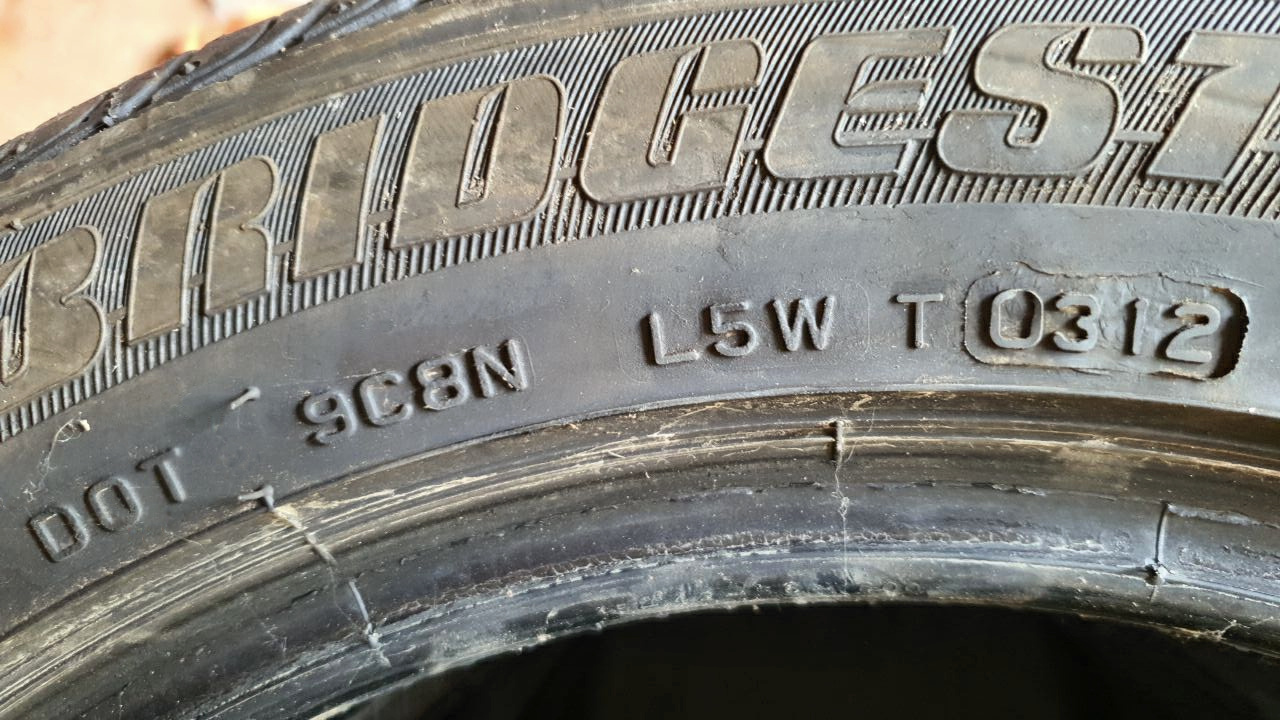
The date code consists of four digits. The first two indicate the week, the last two the year of manufacture. In the photographed example,0312 corresponds to the third week of 2012. The full block is sometimes called the TIN, while “DOT” is commonly used to refer to the American marking.Bridgestone specifies that the letters DOT do not necessarily appear on tyres intended exclusively for the European market.
The full code may only be visible on one side of the tyre. If you only see part of the marking, safely examine the inner sidewall or have the car lifted by a professional. Check every wheel: two tyres bought at the same time may come from different batches. Don’t forget the spare wheel, often much older than the four tyres in use.
Does a tyre have a legal expiry date?
No: there is no general rule in France requiring automatic replacement of a tyre at five, six or ten years. TheTNPF reminds that a universal usage duration cannot be set, as ageing depends on storage, maintenance, temperature, load and usage conditions.
This absence of a legal date must be distinguished from safety recommendations.Michelin advisesto have the tyres checked at least once a year by a professional after five years of use. The manufacturer also recommends, as a precaution, replacing any tyre that is ten years old from its manufacture date, including the spare wheel, even if its appearance and tread depth seem acceptable.
This distinction is important for a classic car that covers 1 500 km per year: the tyre wears little, but its rubber and carcass still age. A car left stationary in a damp garage, in full sunlight, or with insufficient pressure can degrade its tyres faster than a vehicle used regularly and stored properly.
What the technical inspection actually checks
The UTAC instruction applicable since 1 September 2025 details the defects observed during the inspection. The manufacturing date does not appear as an independent reason for failure. However, the conformity and condition of the tyre are checked.
| Observed defect | Level specified by the UTAC instruction |
|---|---|
| Dimension, load capacity or speed rating non-compliant and affecting safety | Major |
| Tyres of different dimensions or types on the same axle | Major |
| Different structures on the vehicle | Major |
| Tread worn down to the wear indicator | Major |
| Deep cut, significant damage, deformation or very irregular wear | Major |
| Visible or damaged cords, sidewall bulge | Critical |
| Depth less than 1,6 mm on one measurement | Critical |
| Difference of more than 5 mm between the minimum depths of tyres on the same axle | Critical |
| Tyre touching a rigid part of the vehicle | Major |
A critical failure indicates an immediate danger. Obviously, one should not wait until the MOT appointment to immobilise a car that shows a bulge, visible cords, or tread separation.
UTAC stipulates that the inspection of dimensions and indices is not carried out in the same way for vehicles put into circulation before 1 January 1960. This inspection provision is not an automatic approval of an improvised fitment. The tyre must always be suited to the rim, the weight, the speed, and the operation of the vehicle.
To place these rules within the full range of checks, also consult our feature on the MOT for a classic car.
Diagonal, radial and belted: can they be mixed?
Diagonal carcass tyres generally bear the letter D, cross-belted tyres the letter B and radial tyres the letter R. Switching from an older technology to a modern radial fitment can alter steering precision, the smoothness at the limit of grip, and the forces transmitted to the chassis.
The UTAC instruction requires a uniform structure for all the tyres on the vehicle. Fitting diagonals at the front and radials at the rear is therefore not a recommended solution. On the same axle, tyres must also be of the same type, which includes brand, usage category, structure, and indices.
If a model existed with several fitments depending on the year or market, do not automatically transpose the configuration from another version. Rely on the serial number, documentation corresponding to the model year, and the advice of a specialist in historic tyres.
Inner tube, tubeless tyre and vintage rim
The presence of a valve is not sufficient to determine whether a wheel has an inner tube. Some vintage rims are not designed to ensure the seal of a tubeless fitment, while some modern tyres bear the “tubeless” marking.
Do not add an inner tube inside a tubeless tyre to compensate for a porous or rusty rim without validation from the tyre manufacturer and the specialist performing the fitment. Internal friction, pinching, or a shape incompatibility can cause overheating. Have the condition of the hooks, rim bed, valve, and, on a spoked wheel, the intended sealing solution checked. Specific metric systems, such as certain TRX fitments, require matching rim and tyre: a similar diameter in inches is not interchangeable.
How to inspect tyres that have seen little use?
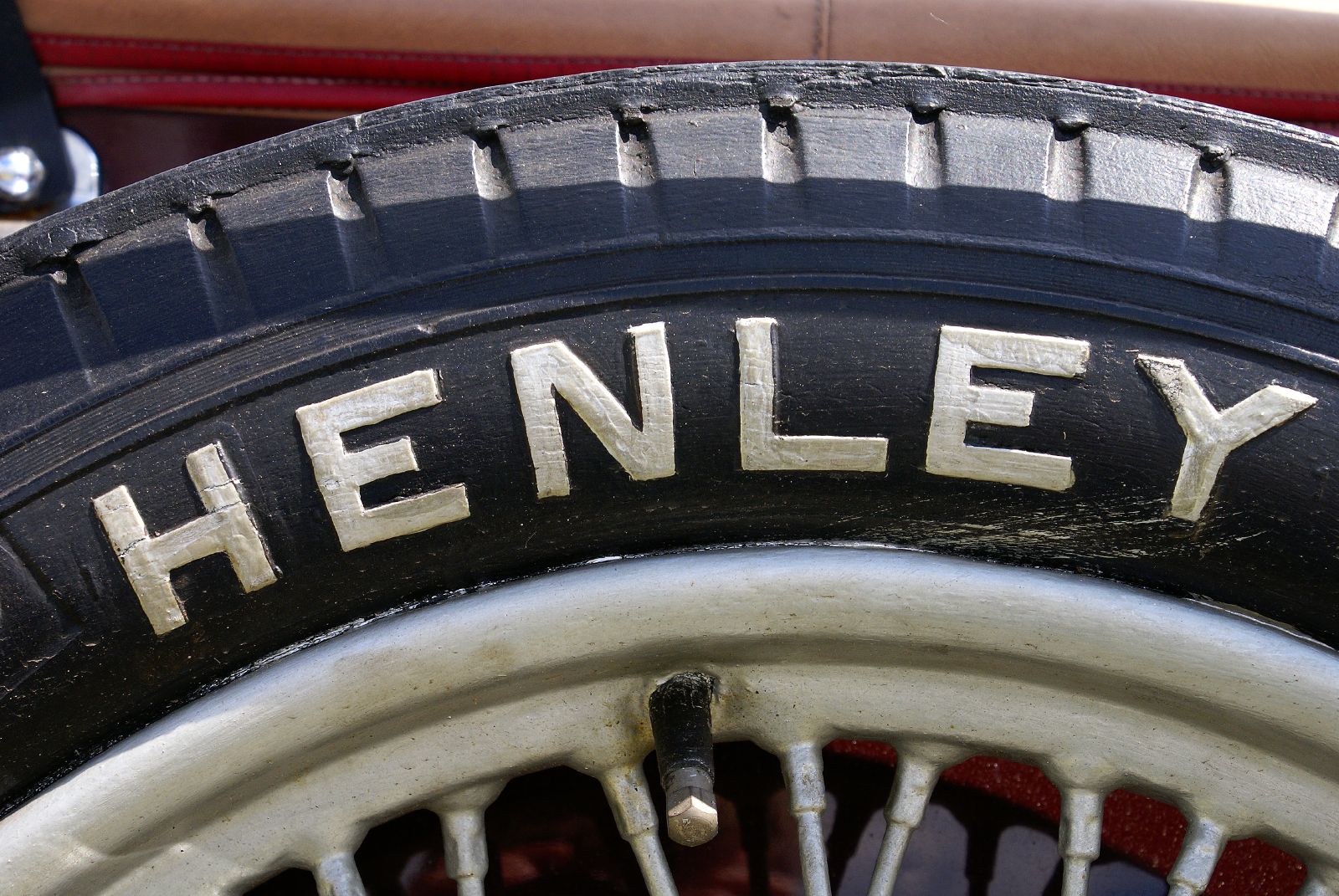
A useful inspection is not limited to the visible tread. Place the car on a flat surface, turn the wheels, and illuminate both sidewalls. Look for:
- cracks in the tread grooves and near the bead;
- a bulge, ripple or deformation;
- a cut, an embedded object or a dubious repair;
- wear on only one shoulder, a possible sign of incorrect alignment;
- a flat spot causing vibration after a long period of inactivity;
- marks from rubbing against the wing, suspension or steering;
- a cracked valve and regular pressure loss.
Measure the depth at several points across the entire width. The legal minimum of 1,6 mm is not a practical target for a classic car: grip in the rain and resistance to aquaplaning deteriorate before reaching this limit. Check the pressure when cold, according to the vehicle’s recommendation and not the maximum pressure indicated on the sidewall.
After a long period of inactivity, our guide to starting up a classic car also allows you to check the brakes, fluids and fuel system before the first journey.
Should you replace two or four tyres?
When only one tyre is damaged, replacing just that one can create a difference in model, age or wear on the axle. In practice, replacing in pairs is often the minimal coherent solution. The two new tyres must have the required characteristics and be compatible with the other axle.
On a seldom-used collection, all four tyres often have the same age and storage history. If one shows marked ageing, the other three should be examined with the same rigour. A specialist can also check balancing, rim runout, alignment and suspension play: fitting new tyres without correcting a worn ball joint or incorrect alignment only addresses the symptom.
Keep invoices, references, photos of markings and pressure readings. This file facilitates monitoring and reassures during resale. If you are looking for a car, examine the tyres in the listings available on the Plethore Cars classic car selection as safety consumables: four old tyres can represent an immediate expense, even if the seller claims they are “like new”.
Storing a classic car without damaging its tyres
Good storage slows ageing and limits deformation:
- check the pressure at least once a month and adjust it when cold;
- protect the tyres from direct sunlight, constant humidity and heat sources;
- keep solvents, fuels, oils and ozone-producing devices away;
- avoid leaving the car for months with insufficient pressure;
- move it periodically or use a validated storage solution to distribute the load;
- clean with water and mild soap, without aggressive shining products;
- have the tyres inspected before a short journey after a long period of inactivity.
Excessively high pressure is not a universal storage method. Follow the manufacturer’s and maker’s instructions, and never exceed the limits of the wheel or tyre.
Checklist before buying tyres for a classic car
Before confirming the order, note:
- the recognised size for the model and its year;
- the exact width and diameter of the rim;
- the minimum load index;
- the minimum speed rating;
- the permitted structure, identical on all four wheels;
- the possible need for an inner tube, rim strip or specific valve;
- the actual manufacturing date delivered;
- the fitter’s ability to work on classic wheels, spoked or metric;
- the balancing and geometry check to be planned;
- the future availability of an identical tyre in case of damage.
For a rare and costly fitment, ask the seller to confirm in writing the exact reference, the approximate batch date and the return conditions. Check all four tyres upon delivery before fitting.
Frequently asked questions
Is it possible to drive with tyres over ten years old?
The age of ten years is not an automatic legal prohibition in France. However, Michelin recommends replacing them as a precaution ten years after manufacture, even if they still appear usable. On a classic car, a professional inspection is essential well before this threshold if cracking, vibrations or deformations appear.
Does an overly old tyre cause a failed MOT?
Not for age alone. The technical inspection will fail a vehicle for a non-compliant size affecting safety, insufficient tread, a bulge, visible carcass, a deep cut, a different structure or dangerous rubbing.
Where can the manufacturing date be found?
Look for a group of four digits on the sidewall: week then year. “2522” means, for example, the 25th week of 2022. The full code may only be found on the inner sidewall.
Can radial tyres be fitted instead of cross-ply?
Sometimes, but only if the size, rim, indices and vehicle requirements allow it. The structure must be identical on all four wheels. Request documented validation for a classic model.
Can vehicles from before 1960 use any size?
No. The technical inspection guidelines include a specific provision for checking the dimensions and ratings of vehicles put into circulation before 1 January 1960. This does not make a dimension chosen without study safe or suitable.
Should the spare wheel be replaced?
The spare wheel is not checked in the same way as the wheels fitted during the technical inspection, but it must remain fit for use. Michelin includes the spare wheel in its precautionary replacement recommendation at ten years.
Main sources
- UTAC-OTC — Technical instruction VL F5G, chassis and suspension, version applicable since 1 September 2025.
- TNPF — Duration of tyre use.
- TNPF — Technical inspection requirements.
- Michelin — How long does a tyre last?.
- Bridgestone — Reading the information on a tyre sidewall.
Photo credits
- Featured image: Kate / kateanne, Wikimedia Commons.jpg), CC0 licence.
- Manufacturing code: Richard Huber, Wikimedia Commons, CC BY-SA 4.0 licence.
- Classic car wheel: Martin Pettitt, Wikimedia Commons.jpg), CC BY 2.0 licence.