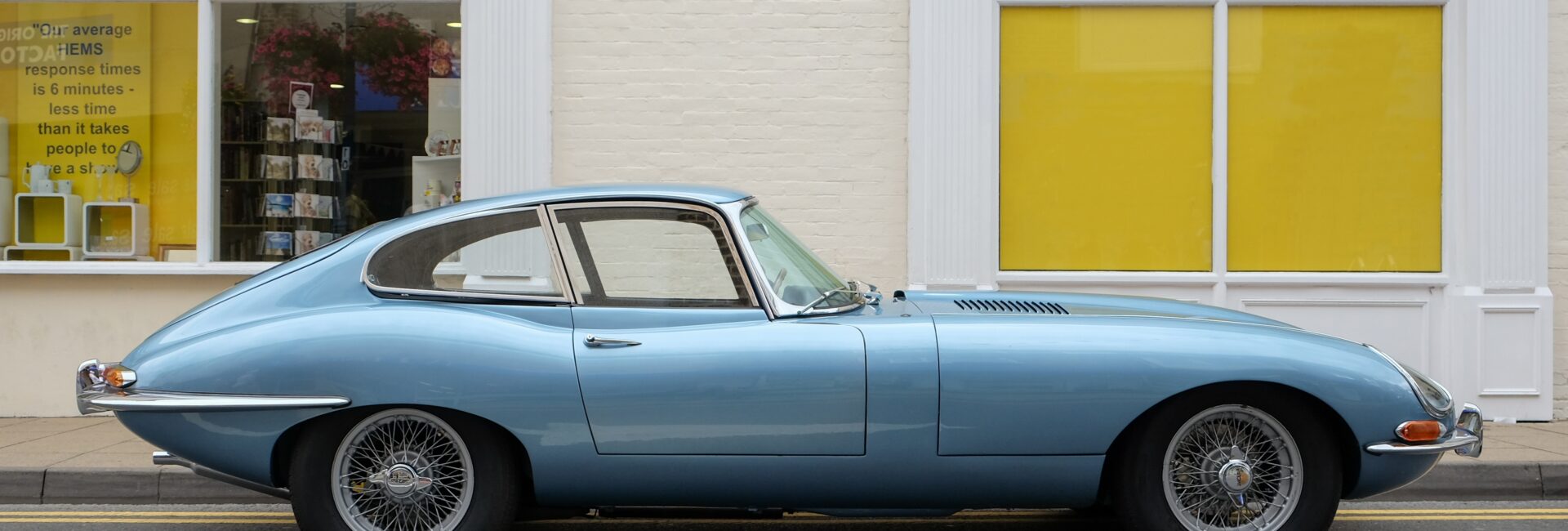
To purchase a Jaguar Type E, you must choose the series according to the intended use, then prioritise checking the structure, the car’s identity, and the quality of its restoration. A Series 1 is not automatically a better purchase than a Series 2 or a Series 3: a sound, well-documented, and properly restored car is generally worth more than a more prestigious example whose corrosion or history are poorly managed.
The Type E encompasses almost all the challenges of a great classic car: multiple series, three body styles, two engine families, different specifications depending on the markets, and over sixty years of possible repairs. The right example is therefore not just the one that shines the most. It is the one whose identity, structure, and work can be understood and verified.
Series 1, Series 2 or Series 3: which to choose?
Jaguar unveiled the E-Type in 1961. The detailed chronology published by the Jaguar Daimler Heritage Trust allows one to distinguish the evolutions of chassis and bodywork, while its exhibition dedicated to the model recalls the link between its structure and Jaguar’s racing cars.
| Version | Dominant character | To prioritise if… | Particular vigilance |
|---|---|---|---|
| Series 1 3,8 litres | Closest to the original definition | you seek the original presentation and accept an older ergonomics | authenticity, quality of restorations, Moss gearbox on the earliest cars |
| Series 1 4,2 litres | Six-cylinder with more refinement | you want the aesthetics of the Series 1 with easier usability | distinguish factory evolutions from later modifications |
| Series 2 4,2 litres | More evolved and often cheaper than a comparable Series 1 | you prioritise driving and a more modest purchase budget | actual condition rather than value hierarchy |
| Series 3 V12 5,3 litres | Large, smooth grand tourer, long wheelbase | you are looking for torque, space and the comfort of a GT | cooling, fuel supply, ignition and intervention costs of the V12 |
The Series 1 is available as an OTS roadster and FHC coupe; the 2+2 with extended wheelbase joined the range in 1966. The Series 2 retains the XK six-cylinder of 4,2 litres. The Series 3, launched in 1971, adopts the V12 of 5,3 litres and the long wheelbase for its two body styles. These markers help identify the car’s family; the chassis number remains essential to precisely date a particular example.
The best choice depends on your use
The Series 1 concentrates the demand of collectors, particularly in its oldest and best documented configurations. However, it is not universally superior. A Series 2 allows you to rediscover the six-cylinder and the general line of the Type E with a later specification. A Series 3 changes character more significantly: its V12, power steering and long wheelbase orient it towards grand touring.
Before consulting listings, set four criteria: open or closed bodywork, left- or right-hand drive, type of use and level of authenticity sought. The classic cars for sale then allow you to compare a Type E with other GTs of the same era without limiting the decision to the prestige of the badge alone.
First check: identity and historical file
A nice paint job proves neither identity nor origin of the components. Ask before travelling for:
- a copy of the registration certificate;
- the full chassis number and photos of its markings;
- the engine, gearbox and, when available, body numbers;
- sorted invoices and restoration photographs;
- previous titles, MOT certificates and import documents;
- a certificate from the Jaguar Daimler Heritage Trust if the seller has one.
The Heritage certificate can link the car to factory data — numbers, colour, trim or destination according to available archives. It does not alone certify the current condition, quality of a restoration or absence of repair. Compare it physically with the markings and documents.
The term matching numbers must also be defined: ask precisely which numbers correspond to the archives, who checked them and on what evidence. A claim in an advertisement does not replace examination.
Beware of conversions and specification changes
Many Type Es have crossed the Atlantic, changed driving side, received another gearbox or adopted cooling and braking improvements. These transformations do not automatically make the car bad. However, they must be declared, technically sound, compatible with registration and reflected in the price.
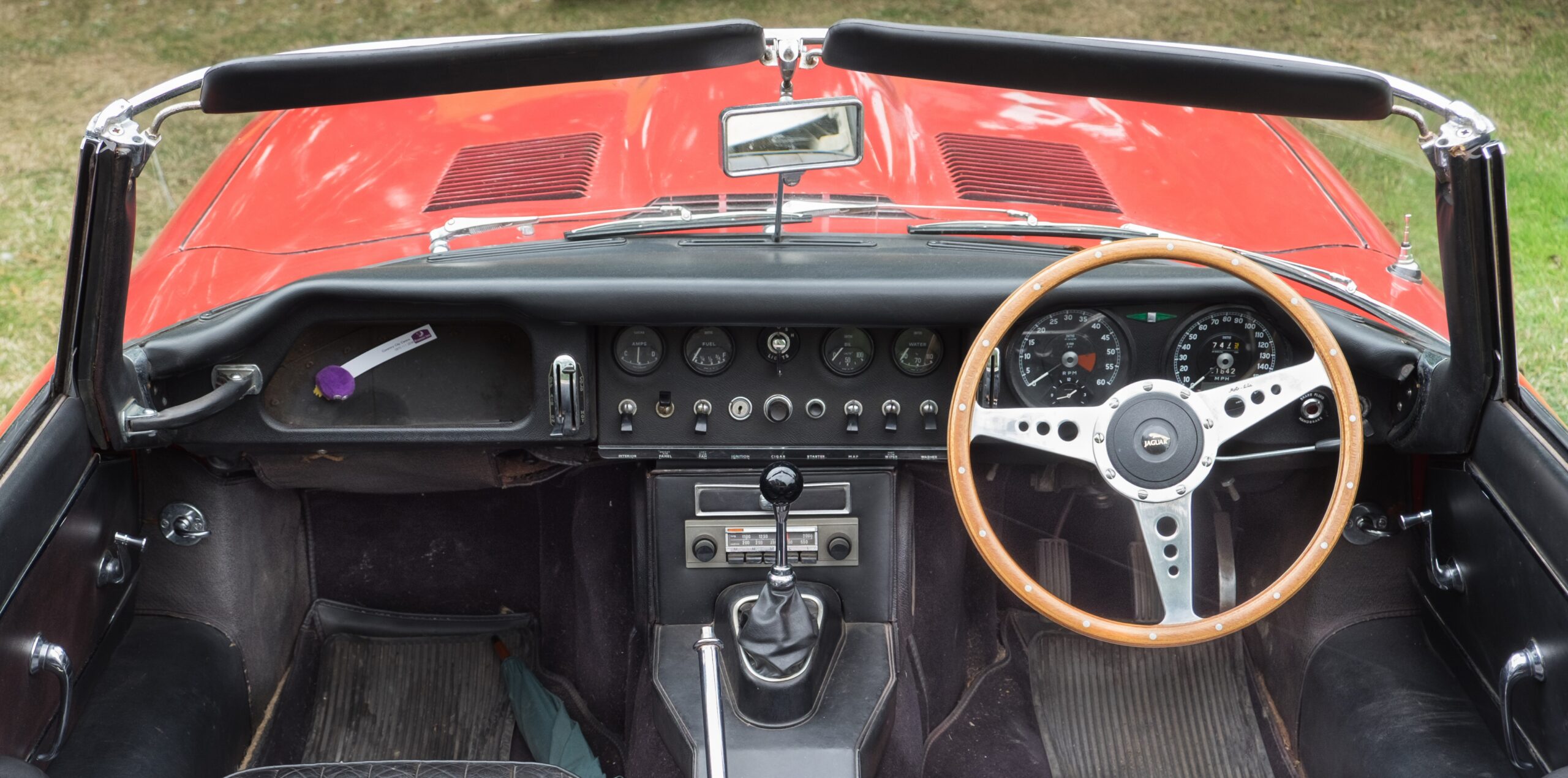
For a right-to-left conversion, examine the engine bay, bulkhead, column, pedal box, wiring loom, dashboard and finishes. A well-executed conversion can serve a usage project; a rough transformation creates costly electrical, ergonomic and structural defects to rectify.
Corrosion: the major financial risk
The Type E combines a central monocoque shell with a bolted front structure that supports the engine, suspension, and long bonnet. Therefore, corrosion should never be assessed solely on visible panels. The Hagerty buying guide and that of Classic & Sports Car both place the bodywork and structure at the heart of the inspection.
Have the following checked on a lift:
- the inner and outer sills;
- the floors and jacking points;
- the bulkhead, A-pillars and suspension mounts;
- the front chassis rails and frames, without accepting any makeshift repairs;
- the boot, spare wheel well and wheel arches;
- the rear suspension fixings;
- the gaps of the bonnet, doors and tailgate or boot.
Irregular gaps may result from poor adjustment, a substandard restoration, an old impact, or a distorted structure. They are a signal to interpret, not a standalone diagnosis. A magnet and thickness gauge detect some fillers, but they do not reveal the inside of hollow bodies. An endoscopic camera and the eye of a model specialist are far more useful.
Buying rule: do not sign because the engine runs well if the structure has not been examined. Mechanical work is easier to price than a shell reconstruction, the extent of which only becomes apparent after stripping.
Checking the XK six-cylinder or the V12
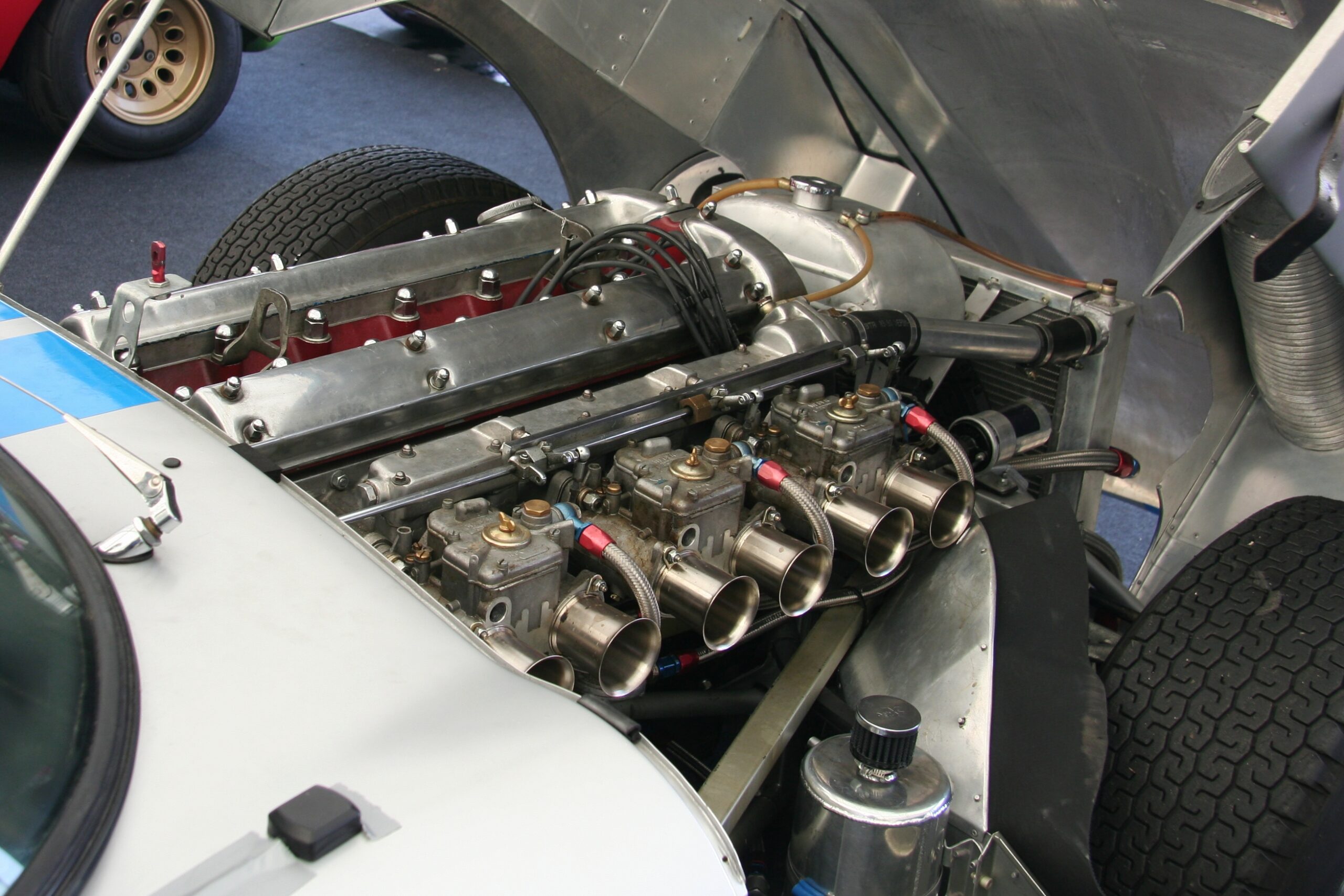
With an XK six-cylinder, insist on a cold start. Observe the oil pressure when hot, smoke, timing noises, idle stability, leaks and the condition of the coolant. Slight oil seepage does not carry the same weight as low pressure, overheating or a mixture of oil and coolant.
The carburettors must be synchronised and the temperature rise remain stable. Check the radiator, hoses, fan and signs of deposits. The test should include a hot restart and a slow phase: a car that only performs well on open road has not demonstrated the effectiveness of its cooling.
On the Series 3, the V12 requires a rigorous approach. Fuel supply, ignition and cooling must be maintained as a whole. A very smooth engine can mask a weak cylinder; a compression and ignition check is relevant if the history is incomplete. The Car & Classic guide also reminds that low mileage does not replace scheduled maintenance.
Gearbox, brakes, steering and rear suspension
The early 3,8 litre models use the Moss gearbox, which operates differently from a modern gearbox. The 4,2 litre models are fitted with a fully synchromesh Jaguar gearbox. During the test drive, listen for crunching noises, missed gear changes, clutch slipping, and vibrations under load or during deceleration.
The independent rear suspension combines the differentials, shafts, coil springs and shock absorbers, and inboard rear brakes. Discs positioned near the differential reduce unsprung mass but make certain maintenance tasks more time-consuming. Check for leaks, bearings, universal joints, bushings, the handbrake, and the condition of the brake lines.
The car should brake straight, maintain precise steering, and not bottom out. On wire wheels, inspect the spokes, trueness, splines, and hubs. Old tyres may appear new but have lost their qualities: check their date, size, and rating.
How to interpret a restoration?
A complete restoration is reassuring only if it is documented. The best evidence includes photos before and during dismantling, named invoices, a list of parts, geometry measurements, and the identity of the workshops involved. A mention of “full restoration” without documentation does not allow you to know which panels were replaced or verify the reused components.
Distinguish three levels:
- Maintenance and reliability upgrades : radiator, ignition, starter, alternator or improved brakes, ideally in a reversible manner.
- Restoration : documented dismantling, bodywork treatment, paint, upholstery and mechanical refurbishment.
- Rebuild or modification : substantial structural replacement, change of steering, engine or gearbox, which requires enhanced traceability.
A high-quality older restoration may be preferable to a recent restoration aimed at sale. Look for consistency: neat paintwork but neglected underside, new upholstery but old wiring loom, or a cosmetically tidy engine bay without mechanical invoices are reasons for further examination.
Should you have the car professionally appraised before purchase?
Yes, as soon as the financial stakes exceed what you would be willing to lose on a misdiagnosis. Choose an expert or workshop familiar with the Type E, independent from the seller. Their inspection should include identification, examination on a lift, road test, relevant measurements, and a prioritised estimate of necessary work.
Request a written report distinguishing: immediate safety issues, defects to be corrected, deferred maintenance, and authenticity discrepancies. The cost of bringing the car up to standard should be compared with the price of an already sound example, not just deducted from the asking price.
Before negotiating, you can also get a free valuation of your car or project to place the example in its market context. A remote valuation remains a guideline; it does not replace a structural inspection.
Checklist before paying a deposit
- Verify the series, bodywork, original market and year by the chassis number.
- Compare the markings with the registration document and available Heritage archives.
- Obtain the restoration history and invoices before travelling.
- Inspect the structure on a lift, including the hollow bodies and front frames.
- Start the engine cold, drive until it reaches operating temperature, then restart it while hot.
- Test the gearbox, clutch, braking, steering and rear suspension.
- Have defects assessed by an independent specialist.
- Write down the terms of the reservation, the promised documents and any possible reservations.
To manage the deposit payment, also consult our guide on thedeposit when selling a classic car.
FAQ on buying a Jaguar Type E
Which Jaguar Type E is the most sought after?
The early Series 1, notably the well-documented 3,8 litre models, generally attract the most demand. However, the bodywork, authenticity, condition and provenance can create greater variations than the series designation alone.
Is a Series 2 a bad choice?
No. It retains the 4,2 litre six-cylinder engine and can offer an interesting value-for-use ratio. Its structural condition and the quality of any work done remain more important than a theoretical ranking between series.
Does the Jaguar Heritage certificate guarantee a matching numbers Type E?
It documents the information preserved in the factory archives. You then need to compare this data with the numbers present on the car. It does not guarantee condition, completeness of parts, or the quality of a restoration.
What is the main defect to look out for?
Structural corrosion is the primary financial risk. It can affect the sills, floors, mounts, bulkhead and front structure without being visible under recent paintwork.
Can you buy a Type E converted to left-hand drive?
Yes, if the conversion is documented, properly executed and compatible with the vehicle’s paperwork. It should be carefully examined and factored into the valuation.
Is a V12 Type E more difficult to maintain?
It has more components related to fuel supply, ignition and cooling. When well tuned, it is very smooth; if neglected, it may require longer diagnostics and costly refurbishment.
Sources and date of verification
- Jaguar Daimler Heritage Trust — E-Type Research Guide : chronology, chassis numbers and variants.
- Jaguar Daimler Heritage Trust — E-Type Evolution Exhibition : architecture and historical evolution.
- Hagerty UK — Buyer’s Guide: Jaguar E-Type : corrosion, mechanics and inspection.
- Classic & Sports Car — E-Type S1, S1.5 & S2 buyer’s guide : component checks and differences between versions.
- Car & Classic — Five Things You Need To Know : bodywork, usage and maintenance.
Information verified on 18 September 2026. An annual update is recommended, or sooner in case of significant market developments.
Photographic credits
- Featured image: DeFacto, Wikimedia Commons, CC BY-SA 4.0.
- Engine: Lothar Spurzem, Wikimedia Commons, CC BY-SA 2.0 DE.
- Dashboard: DeFacto, Wikimedia Commons, CC BY-SA 4.0.