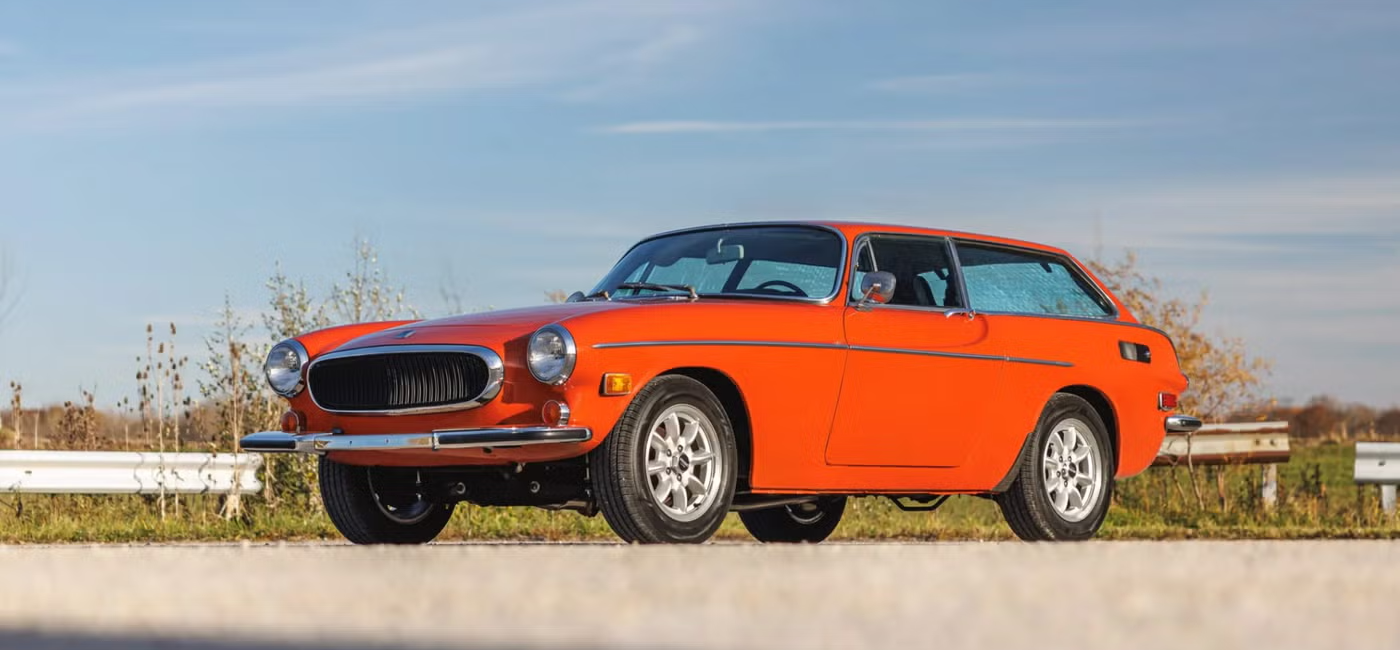
The Volvo P1800 wagon, more accurately called 1800ES, is one of the most improbable silhouettes ever produced by the automotive world of the 70s. Imagine an Italian Grand Touring coupe, designed by a young Swedish designer who was a pupil of Pietro Frua, grafted with a fully glass tailgate to transform the cabin into a two-door estate. This paradox, this Volvo P1800 shooting brake embodies with singular elegance, produced in only 8 077 examples between December 1971 and June 1973. Today, it ranks among the most sought-after collector cars from the Swedish manufacturer — an object halfway between the sporty coupe and the British shooting brake, whose design inspired the Volvo 480 ES, the C30, and more recently, the Cyan Racing P1800 Restomod.
What is a shooting brake, and why is the Volvo 1800ES its icon?
The term “break de chasse” — shooting brake in English — originates from 19th-century England. At the time, it referred to a two-door car whose extended rear section was used for pheasant hunting parties: rifles, whisky flasks, and cucumber sandwiches would be placed there. The format remains rare in the automotive industry because it requires marrying two contradictory logics — the sporty line of a coupe and the useful volume of an estate.
The Volvo P1800 wagon belongs to this exclusive tribe. It did not invent the genre — Aston Martin, Reliant Scimitar GTE, and Lancia Beta HPE also explored it — but it remains the most singular example, as its line derives directly from a Grand Touring coupe produced for a decade. Its vocation was never hunting. It was simply intended to breathe new commercial life into an ageing car while offering greater loading volume. This aesthetic compromise gave birth to a silhouette unlike any other.
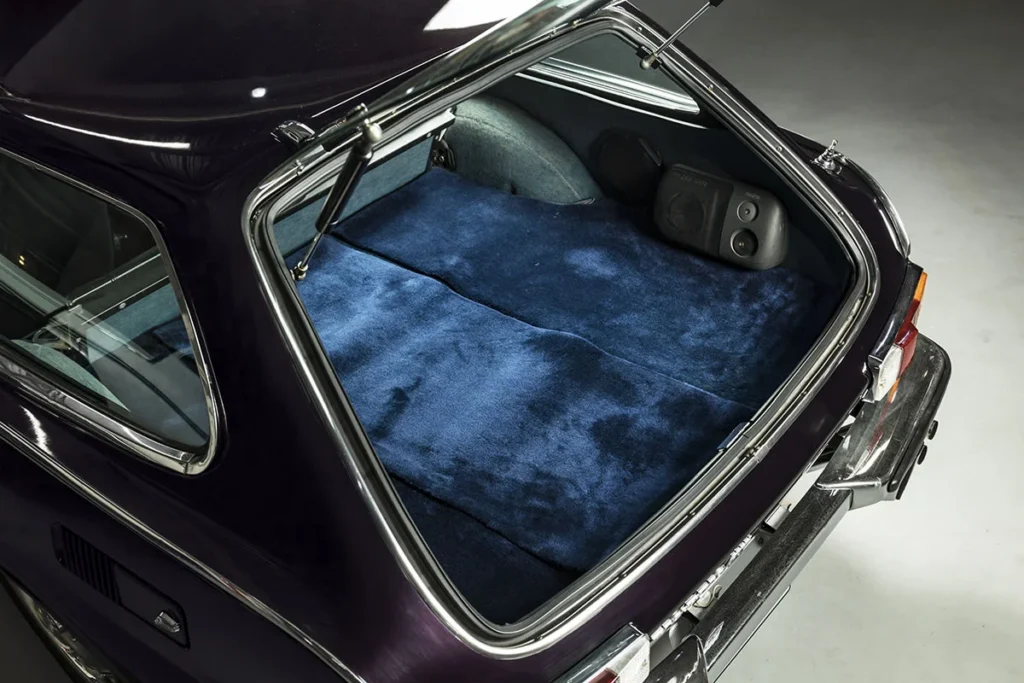
The fully glass, frameless tailgate is a world first on a production vehicle. This technical detail alone is now the subject of studies in industrial and automotive design schools. Viewed in profile, the 1800ES seems to float above the tarmac: the rear side window appears never-ending, extended by the immense glazed surface of the boot. An optical illusion that, in its graphic logic, recalls the elegant tapering of Mercedes coupes from the same era.
From the failed P1900 to the legendary P1800: the genesis of the coupe
To understand how the Volvo P1800 wagon was born, one must go back to the mid-50s. In 1957, Assar Gabrielson, Volvo’s boss, returned from the United States fascinated by the Chevrolet factory where the first Corvettes were produced. He was convinced that Europe could also welcome a small high-end sporty roadster — capable of giving the brand a more seductive image than the somewhat austere PV444 and Amazon saloons. This would be the P1900, a car with a fibreglass body that sold only 68 units before the new president Gunnar Engellau declared it unworthy of the Volvo badge, after having driven it himself. The failure was bitter. But the need for a sports car remained.
The P1800 project was entrusted to Helmer Petterson, already the spiritual father of the PV444, with a clear mission: to find an industrial partner capable of producing a body worthy of a major European brand, relying on the proven mechanical components of the Amazon. For styling, Volvo turned to Italy — more precisely to Pietro Frua, then a subsidiary of the coachbuilder Ghia, known for its sophisticated lines. Italy was the essential commercial endorsement at the time for a car to claim elegance.
This is where the most delightful anecdote of the project unfolds. Among the young designers at Frua was a Swedish man of 25 years, freshly graduated from the Pratt Institute: Pelle Petterson, Helmer’s son. The father discreetly slipped his son’s sketches into the group of proposals submitted to the Volvo jury. Of the five sketches presented to the board of directors, design number five — Pelle’s — was unanimously chosen, with its subtle fins, sloping roofline, and ‘moustache’ bumpers. The board believed they had selected an Italian creation. When Engellau, Volvo’s chairman, discovered the truth during contract negotiations, he was furious — but insisted on maintaining the Italian fable, the only commercial guarantee. Pelle Petterson’s official paternity would only be recognised nearly 50 years later.
Production of the P1800 coupe finally began in September 1960. Due to complex industrial reasons — Volkswagen forbade Karmann from producing the car, fearing competition with its Karmann Ghia — assembly was entrusted to Jensen Motors in West Bromwich (United Kingdom), while Pressed Steel in Linwood near Glasgow produced the bodies. After 6 000 poorly finished examples, Volvo terminated the contract in 1963 and brought production back to Gothenburg, at the Lundby factory. The model then took the nameP1800 S — where the S stands forSverige, Sweden in Swedish, and notSport as many still believe.
The cultural milestone: The Saint, Roger Moore and Irv Gordon
No chapter of the Volvo P1800’s history is complete without a detour through British television. In 1962, the producers of the seriesThe Saint planned for Simon Templar, their detective-hero played byRoger Moore, to drive aJaguar Mark X. Jaguar refused to collaborate. Volvo seized the opportunity and supplied a white P1800, registered ST1. The success was global. Roger Moore liked the car so much that he ordered a personal example. In 1965, the series switched to the P1800 S, and Volvo even adapted the production model to meet filming requirements. This screen appearance gave the Swedish brand unprecedented visibility, far beyond what the best advertising campaign could have purchased.
Another emblematic story is that ofIrv Gordon, an American science teacher who bought a new P1800 S in 1966. At his death in 2018, the car, still original, had covered3 250 257 miles (5 230 781 kilometres) — a world record for the highest mileage on a privately used vehicle, certified by the Guinness Book of Records. This feat is no coincidence: it illustrates the nickname the P1800 carried throughout its life, theSwedish Tank, the Swedish tank. This robustness is due to engineering choices inherited from Volvo trucks — five main bearings on the crankshaft instead of three on the B18 engine, thick steel bodywork, robust seals and powerful heating designed for Nordic winters.
The engine power of the Volvo P1800 coupe evolves over the model years, following industrial advancements: 100 hp for the B18 of 1961, 108 hp from 1963 with the move to Gothenburg, 115 hp in 1966, then a new 2 litre unit producing 118 hp in 1969, which became the B20E after adopting Bosch electronic injection.D-Jetronic— the same system fitted to the Citroën DS 21, the Renault 17 Gordini, and the Porsche 914. The engine then reached 130 hp SAE (120 hp DIN), and the M41 gearbox with Laycock de Normanville overdrive transformed the coupe into a genuine grand tourer capable of reaching 190 km/h at top speed.
The Birth of the Shooting Brake: Frua Rejected, Wilsgaard Selected
In the early 70s, the P1800 was beginning to show its age. Volvo had a limited budget and needed to devise an evolution capable of boosting sales without requiring a complete retooling of the production line. The idea emerged to transform the coupe into a shooting brake — a more practical, unexpected format, and above all less costly to industrialise since almost all the pressed steel panels of the coupe could be retained. Only the roof would need to change.
Three proposals were put forward in competition. Pietro Frua, faithful to the model’s history, designed a bold prototype called Raketen — the rocket in Swedish. Sergio Coggiola, formerly of Ghia, offered his own vision. Both Italian designs were deemed too futuristic by Volvo’s board of directors. Ultimately, the in-house proposal by styling director Jan Wilsgaard, internally named Beach Car, was chosen. Frua’s Raketen prototype is now preserved at the Volvo Museum in Gothenburg, a silent witness to a parallel history that never came to pass.
The chosen design stands out for its economy of means. Wilsgaard retained the entire front end of the P1800 coupe, with only minor adaptations: American-style side indicators, impossible to miss, mandated by US regulations of the time. All the boldness was concentrated at the rear, where the coupe’s rear window was replaced by a fully glass tailgate window, frameless, featuring a handle integrated directly into the glass surface. No production car had yet offered this feature. It was both a technical feat and an aesthetic manifesto.
The Volvo P1800 shooting brake — its commercial name would simply be 1800ES — was unveiled in autumn 1971 and went on sale from December 1971. The first examples rolled off the Lundby factory line, then from Torslanda, for the 1972 model year.
Technical Specifications of the Volvo 1800ES (1972-1973)
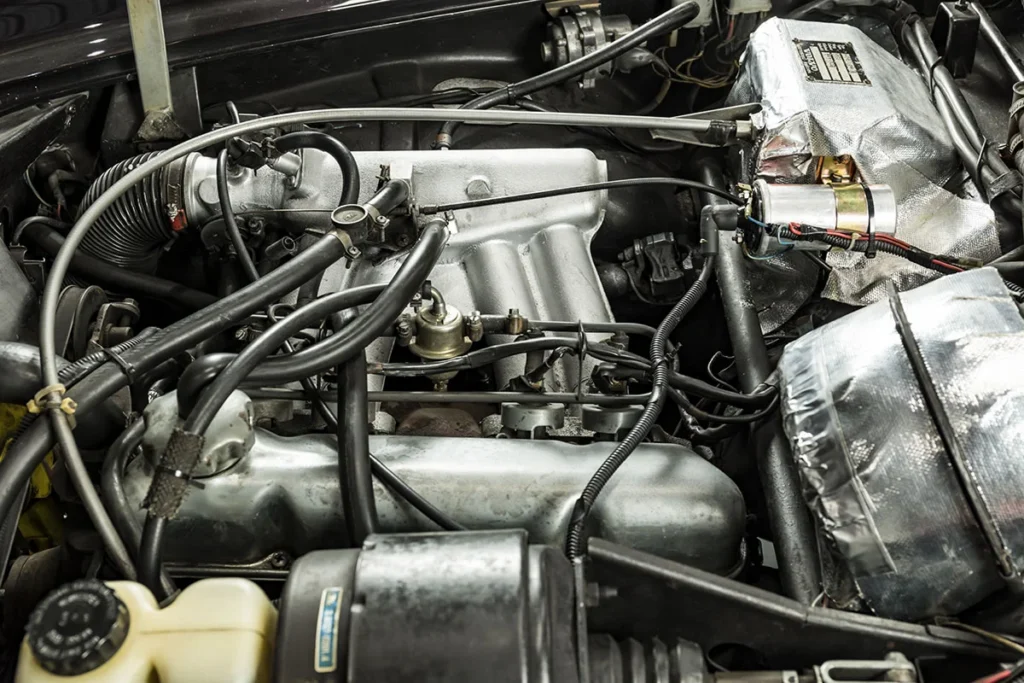
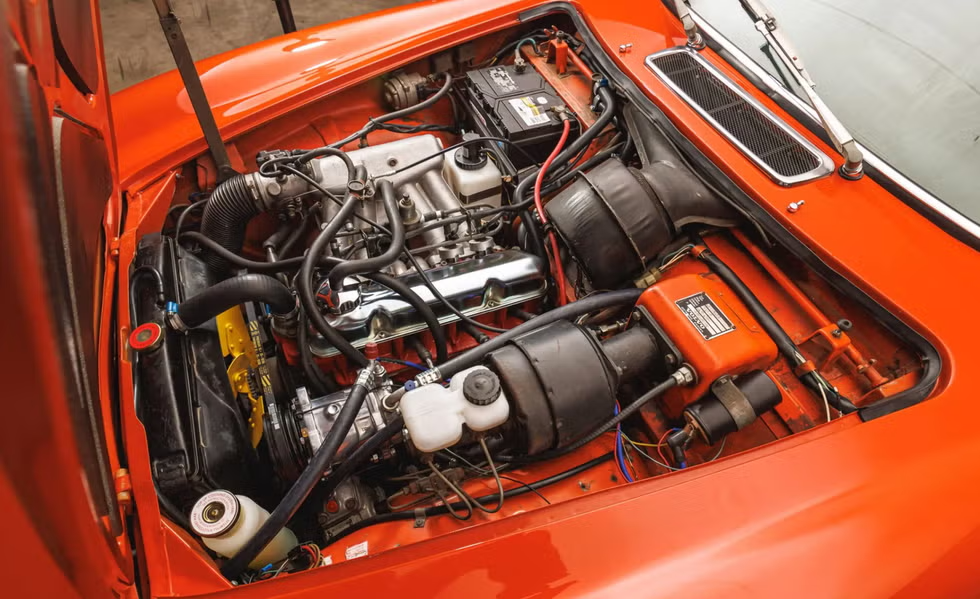
Mechanically, the 1800ES adopted the entire catalogue of the 1800E. Under the bonnet: the four-cylinder petrol B20E, exactly two litres (1 986 cm³), with Bosch D-Jetronic electronic injection, overhead camshaft, developing 135 bhp SAE (124 bhp DIN) at 6 000 rpm. A US version exists, the B20F, whose compression ratio is lowered to 8,7:1 by using a thicker head gasket to meet the early American emissions standards; it develops 125 bhp SAE. Volvo states that despite this slight power reduction, road performance is improved thanks to the new 185/70 HR 15 tyre and a gentler compression ratio favouring low-end torque.
The standard transmission is a four-speed manual gearbox M41 manufactured by ZF in West Germany, paired with a Laycock de Normanville overdrive which acts as an electric fifth gear and helps save fuel on long journeys. A three-speed automatic gearbox Borg-Warner 35 is offered as an option in certain markets. Disc brakes are fitted on all four wheels, with a dual hydraulic circuit — a Volvo hallmark inherited from the 1800E coupe.
The silhouette measures 4,42 metres in length for only 1,30 metres in height — an exceptionally low height for an estate car, which explains the unusual driving position and the feeling of being half-reclined at the wheel. The 1800ES is also distinguished by a handbrake placed to the left of the driver, on the door side, a peculiarity specific to the P1800 which has never been repeated on any other Volvo model.
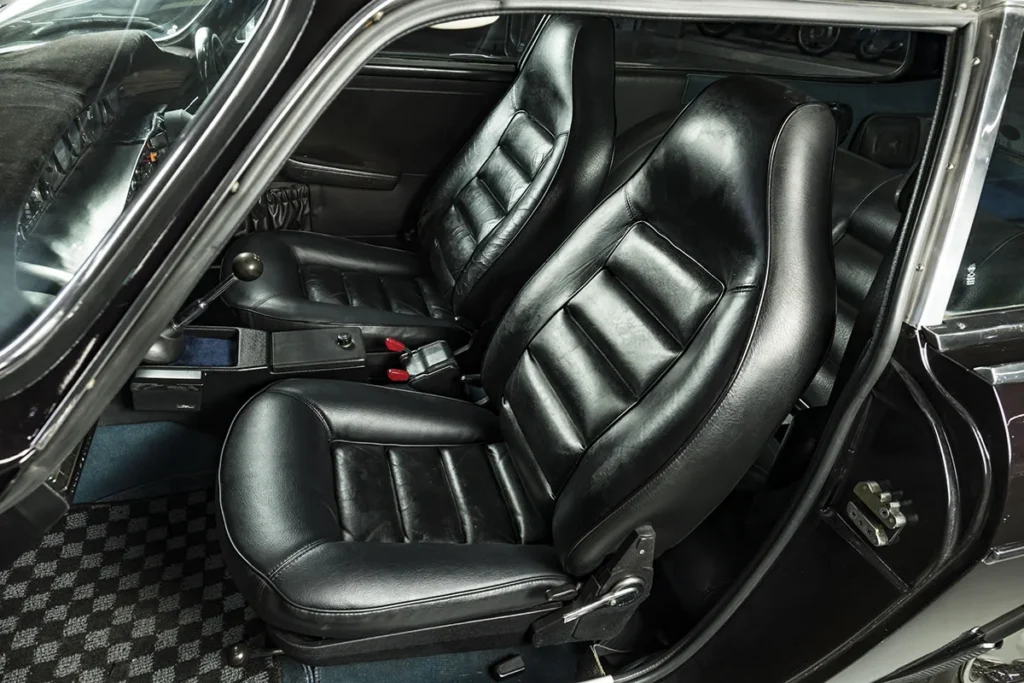
Inside the cabin, the dashboard is a quintessential example of the 70 era: faux wood trim, black-rimmed dials, a tachometer to the right of the speedometer, with toggle switches for the lights, wipers, and choke. The front seats are more luxurious than those in the coupe, featuring integrated headrests; the rear seats, however, remain in line with the coupe’s design and are more suited to a child than an adult, despite the estate car designation. The loading area becomescompletely flat when the rear bench is folded down — a rare advantage for a car of this silhouette.
Two model years, two years: 1972 and 1973
The 1800ES had an industrial career as brief as it was intense, with only two model years to its name.
1800ES 1972
3 070 units producedfrom December 1971 to July 1972. This model year retains the main features of the 1800E of the same year: B20E engine with 135 hp SAE, or B20F (125 hp SAE, 112 hp SAE net) for the American markets. The colours offered include California white, red, metallic gold, sun yellow (code 107), cypress green (110), and light metallic blue (111). The wheels are 5 and a half inch steel rims with square ventilation holes. 185/70 HR 15 tyres come as standard.
1800ES 1973
5 007 units producedfrom August 1972 to 27 June 1973. This model year brings several improvements: reinforcement bars are installed in the doors to meet new passive safety standards, the interior receives materials less sensitive to fire, and the first gear ratio is slightly shortened. Versions intended for the United States adopt energy-absorbing bumpers, as well as particularly large side indicator repeaters. The pull switches to the left of the steering wheel are replaced by toggle switches. The colour palette is enriched: nine shades are now available — California white, red, metallic gold, sun yellow, cypress green, light metallic blue, to which are added dark blue (108), metallic blue-green (115), and orange (113).
Total : 8 077 units of 1800ES produced over two model years. A limited volume which today explains the rarity of the car on the French collector market.
Why the 1800ES was discontinued in 1973
The decision to stop production of the 1800ES was primarily an economic one. The American passive safety and pollution standards planned for 1974 required profound modifications: structural reinforcement, mandatory catalytic converter, complete revision of the injection system, approved energy-absorbing bumpers. For a model produced at only a few thousand units per year, Volvo judged that the investment would not be profitable.
Production therefore stopped on 27 June 1973. Internal negotiations briefly considered an evolution called 1800ESC which would have incorporated the US 1974 standards — these never came to fruition. Volvo preferred to concentrate its investments on the future 200 series and, later, on the Volvo 262C, which would serve as the indirect spiritual successor to the 1800ES in the range.
The descendants: Volvo 480 ES, C30 and Cyan Racing P1800
The shooting brake DNA did not disappear at Volvo with the 1800ES. In 1986, the Volvo 480 ES openly revived the concept, with a modern angular line and front-wheel drive which constituted a technical break. The Volvo C30, launched in 2006, continued the lineage with its glass hatch and compact three-door coupe silhouette. These two heirs do not match, stylistically, the purity of the 1800ES — but they perpetuate the philosophy of the sporty two-door estate that Wilsgaard had embedded in the manufacturer’s DNA.
More recently, Cyan Racing , Volvo’s performance subsidiary, presented its P1800 Restomod — a fully re-engineered 1961, equipped with a four-cylinder turbo producing 420 hp, a reinforced chassis and a production limited to a few dozen units. The price, exceeding 500 000 euros, confirms the heritage icon status that the P1800 has acquired over the decades.
The Volvo 1800ES on the French collector market
In 2026, the Volvo P1800 wagon ranks among the most desirable classics in the segment affordable collector, this intermediate category situated between accessible youngtimers and major collections. The rarity (8 077 examples worldwide, with a significant portion exported to the United States), the iconic design, and the legendary reliability of the Amazon mechanics explain a steadily rising valuation.
In the French market, listings remain discreet. The platforms specialising in classic cars such as La Centrale, Leboncoin or AutoScout24 rarely list more than a dozen 1800ES simultaneously for sale. Prices observed vary considerably depending on condition: a restoration project might be negotiated around 10 000 to 18 000 euros, a model in good used condition ranges between 25 000 and 40 000 euros, while a carefully restored 1800ES, matching numbers and documented history, can exceed 50 000 euros. The finest examples, offered by European specialists, sometimes surpass the 60 000 euro mark. For a purchase or sale project, a free valuation allows an objective positioning of a vehicle on the current market.
For comparison, the Volvo P1800 S coupe remains slightly less valued, around 20 000 to 35 000 euros in good condition, confirming the rarity premium enjoyed by the shooting brake version. American listings, particularly numerous on Bring a Trailer or Hemmings, often serve as a global market reference.
Do you wish to sell your 1800ES?
The market is currently favourable to well-prepared sellers: supply remains structurally lower than demand in Europe, and serious buyers are willing to pay a fair price — provided the vehicle is properly presented. The resale value depends on three criteria that every informed buyer checks first: the coherence of matching numbers (B20E engine number corresponding to the registration document), the completeness of the documentary history (maintenance invoices, first registration, logbook), and the condition of the glazed tailgate — an intact window commands a substantial premium, as it is now unobtainable new. A vehicle combining these three assets can claim the upper market range (40 000–60 000 €); without documentation, even a beautiful bodywork does not justify a high price in the eyes of an expert. Before listing, a free valuation allows the vehicle to be correctly positioned from the outset — and avoids months of negotiation with unqualified buyers.
Discover the Plethore selection
Plethore brings together discerning classic car enthusiasts around authoritative editorial content and a handpicked selection of listings. If searching for a 1800ES is part of your plans, our selection of cars for sale or our free valuation serviceoffer you a reliable first point of reference in a market that is as niche as it is dynamic.
Restoration and maintenance: key points to watch
Considering the purchase of a 1800ES requires rigorous prior expertise. The car suffers from the same weaknesses as the majority of automobiles from the 70s — with some specificities to be aware of.
Rustis the number one enemy. The sills, wheel arches, boot floor and the structure around the glass tailgate are particularly susceptible to corrosion, especially on examples that have lived in humid climates. The inspection must be thorough: poorly executed straightening or a carelessly redone floor can ruin the value.
The rear windowsspecific to the 1800ES are now unobtainable new. If they are cracked or scratched, you will have to look for second-hand ones — with delays of several months and prohibitive prices. The seals of the glass tailgate also deserve careful checking: their replacement requires removing the glass.
The Bosch D-Jetronic injection systemis reliable but requires specialised diagnostics in case of failure. Few contemporary garages still master this technology, and original electronic components are becoming rare. A visit to a classic Volvo specialist is recommended before any purchase.
Spare partsare generally available, but you need to know where to look: mainly in Sweden, the United Kingdom and the United States — less so in continental Europe, where the model was little distributed. Suppliers such asIPD, Classic Volvo Restoration (CVR)orVolvo P1800 Specialistsremain essential contacts.
A useful detail to identify the engine of a P1800: Volvo adopted a colour code for its engine blocks. Safety components are paintedyellow, theB20block isred, theB19is green, and the B18 is blue. A quick glance under the bonnet allows you to verify the engine’s consistency with the year displayed on the registration document.
Finally, it is important to keep in mind that the 1800ES does not have power steering: the steering box, inherited from the coupe, requires a firm hand at low speeds. The dual-circuit braking system is, however, surprisingly effective for a car of this era.
Conclusion: a shooting brake that redefined the standards
The Volvo P1800 wagon was not designed to revolutionise the automobile. It was born from a compromise — transforming an ageing coupe into a model with greater useful volume, without retooling the production line. But this compromise, made brilliant by Jan Wilsgaard’s understated design, produced one of the most memorable silhouettes of the 20th century, a car that marries the sporty DNA of an Italian coupe with the Nordic pragmatism of a two-door estate. With only 8 077 examples, the 1800ES today embodies the quintessence of a classic Volvo: rare, durable, culturally rich, technically honest.
It holds a unique place in automotive mythology — that of the outsider who, without seeking it, set a standard. The all-glass tailgate that has become a case study in design schools, the 480 ES and C30 lineage, the Cyan Racing revival: every contemporary trace of the Swedish shooting brake concept consciously or unconsciously refers back to this small 1,30 metre tall car that left Gothenburg on 27 June 1973. For the patient collector, capable of enduring the search for rare parts and embracing the rigorous maintenance required by a classic from the 70s, the Volvo 1800ES today offers one of the most coherent entries into the Swedish automotive heritage — an elegant vehicle, built to last.
comparison_table — Volvo 1800ES: the two model years at a glance
| Model Year | Production | Period | Engine | Key Developments |
|---|---|---|---|---|
| 1800ES 1972 | 3 070 examples | December 1971 – July 1972 | B20E 135 hp SAE / B20F 125 hp (USA) | Launch, resumption of the features of the 1800E |
| 1800ES 1973 | 5 007 units | August 1972 – 27 June 1973 | B20E 135 hp SAE / B20F 125 hp (USA) | Door reinforcement bars, less flammable interior, 1re shortened, impact-absorbing bumpers (USA), toggle switches, 9 colours |
| Total | 8 077 units | 2 model years | — | End of production due to unprofitability against US 1974 standards |
Observed price ranges
- Project condition / to be restored : 10 000 to 18 000 €
- Good used condition, healthy engine : 25 000 to 40 000 €
- Documented restoration, matching numbers : 45 000 to 55 000 €
- Exceptional (concours, European specialist) : 55 000 to 65 000 €
For comparison, the P1800 S coupe trades from 20 000 to 35 000 € in good condition — the premium on the 1800ES comes from its rarity (8 077 ex.) and its unique shooting brake design.