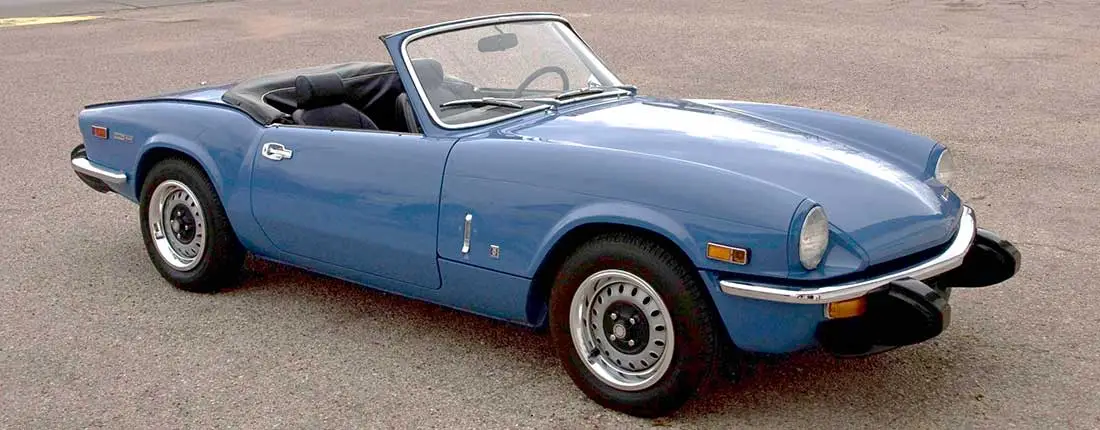
Before the Mazda MX-5, there was the Triumph Spitfire. A lightweight roadster weighing 711 kg, designed by the man who also signed off on Ferraris, sold in over 315 000 units between 1962 and 1980. This is the kind of machine that turns an ordinary journey into a memory. Yet, in France, few articles truly do it justice.
Used Triumph Spitfire listings are plentiful on specialised websites. But understanding what you’re buying, knowing the pitfalls of each version, and appreciating why this petrol car left its mark on an entire generation of drivers: that’s another matter. This article fills that gap.
The history of the Triumph Spitfire: birth of a legendary roadster
It all began in 1957 in the design offices of Standard-Triumph, Coventry. Harry Webster, chief engineer, sought to create a sporty version of the Herald saloon. The project bore a rather unsubtle codename: “Bomb”. Management hesitated. The market for small British roadsters was already occupied by the Austin-Healey Sprite and the MG Midget.
The acquisition of Triumph by Leyland Motors in 1961 changed the game. The new owner approved the project and entrusted the bodywork to Giovanni Michelotti, an Italian designer whose portfolio already included Ferrari, Maserati and Lancia. The result was unveiled at the London Motor Show in October 1962. The press was unanimous: for the price asked, the lines were scandalously beautiful.
Commercial success was immediate. Over eighteen years of production, the Spitfire sold 315 142 units assembled at the Canley factory near Coventry — more than each of its direct rivals individually.
The 5 generations of the Triumph Spitfire: from the Mk1 to the 1500
Five versions followed one another. Each corrected the faults of the previous one, sometimes creating new problems.
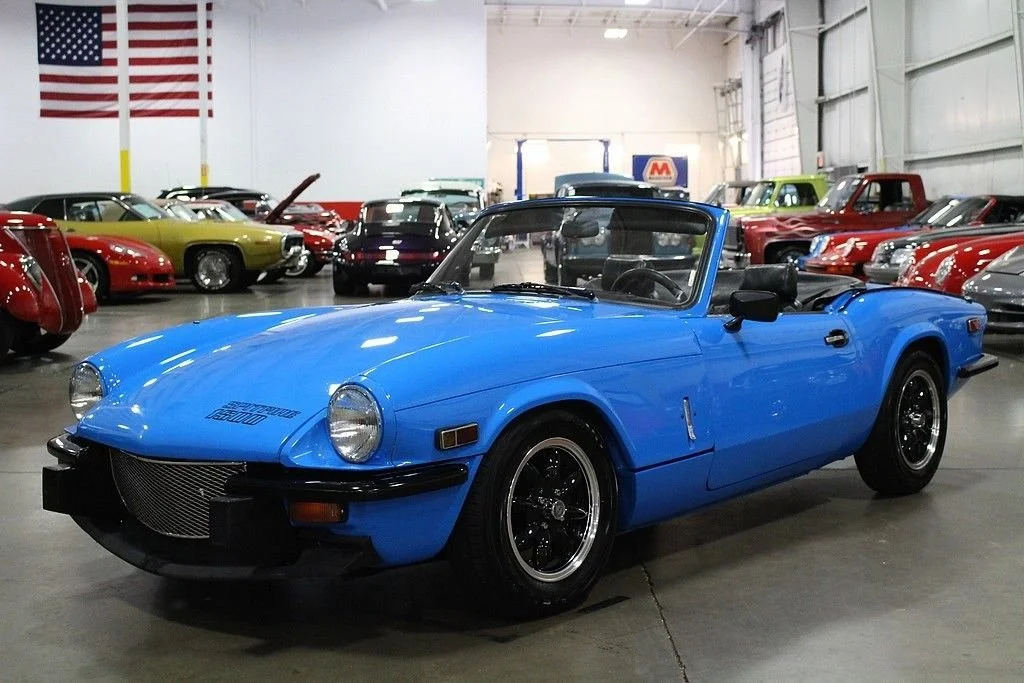
Spitfire 4 Mk1 (1962-1964) : 45 000 units produced. Engine 1 147 cm3 delivering 63 hp. This is the founding model, the one that established the formula. The Herald platform is present, with its qualities (mechanical simplicity, fully tilting bonnet) and its flaws (rear suspension with swing axle). A model in good condition today sells for between 20 000 and 25 000 euros.
Spitfire Mk2 (1964-1967): 37 000 units. Power increased to 67 hp thanks to a new camshaft. The clutch was reinforced, and the interior trim improved. This is the most sought-after by collectors, and also the rarest on the French market. Expect between 15 000 and 26 000 euros depending on condition.
Spitfire Mk3 (1967-1970) : 65 000 units. The engine increases to 1 296 cm3 and 75 hp. The hood is redesigned to facilitate its use. It is the ideal balance between vintage charm and everyday usability. The Spitfire 1300 remains the favourite version of many enthusiasts, for good reason: it offers the pure lines of the original design with a finally perfected engine. Budget: 13 000 to 20 000 euros.
Spitfire MkIV (1970-1974): 70 000 units. The design was modernised with a truncated rear that still divides enthusiasts. But the real revolution was under the bonnet and chassis: the gearbox received synchromesh on all gears, and above all, the rear suspension was finally corrected. The dangerous swing axle gave way to a more predictable setup. The Spitfire MkIV is the first version you can truly push through corners without fearing the rear end’s betrayal. Between 10 000 and 15 000 euros. In the same vein, two decades later,the BMW Z3revisited the formula of the accessible roadster.
Spitfire 1500 (1974-1980) : 95 000 units, the most produced of all. Engine increased to 1 493 cm3 and 71 hp. The announced power is lower compared to the Mk3 due to emission standards, but the torque is higher. This latest version suffers from a mixed reputation: the gearbox, borrowed from the Morris Marina, lacks precision. Nevertheless, it is the most affordable on the market, with prices starting at 9 990 euros for a model in need of restoration.
Comparison of the 5 generations
← Slide to view all columns →
| Version | Years | Engine | Power | Production | Price FR (2026) | Verdict |
|---|---|---|---|---|---|---|
| Mk1 | 1962-1964 | 1 147 cm³ | 63 hp | 45 000 | 20 000 – 25 000 € | Collector |
| Mk2 | 1964-1967 | 1 147 cm³ | 67 hp | 37 000 | 15 000 – 26 000 € | The rarest |
| Mk3 | 1967-1970 | 1 296 cm³ | 75 hp | 65 000 | 13 000 – 20 000 € | Best choice |
| MkIV | 1970-1974 | 1 296 cm³ | 63 hp | 70 000 | 10 000 – 15 000 € | The safest |
| 1500 | 1974-1980 | 1 493 cm³ | 71 hp | 95 000 | 9 990 – 14 000 € | Accessible but… |
The Michelotti design: Ferrari lines at a Mini price
Giovanni Michelotti is no anonymous designer. His portfolio includes over 1 200 models, including Ferrari 166 MM, Maserati 3500 GT, and Lancia Flaminia. When he designed the Spitfire in 1961, he brought an elegance to a popular roadster that its British rivals could not match.
The bonnet is long, the rear short. The wings are taut. The windscreen is angled just right. And above all, the front tilting bonnet opens in one piece, revealing all the mechanics with a single gesture. This technical detail is also an aesthetic stroke of genius: it gives the Spitfire a unique silhouette when working on it.
Comparing the Spitfire to a contemporary MG Midget is to measure the gap between competent industrial design and an author’s vision. Michelotti gave Triumph an advantage that neither power nor budget could buy: desire.
Technical specifications and engines of the Triumph Spitfire
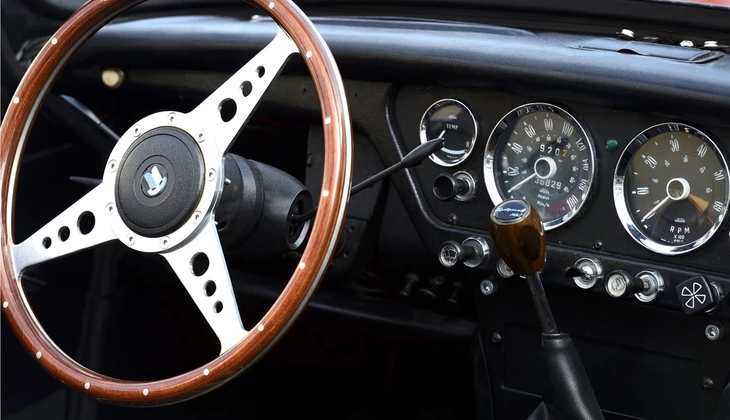
All versions share the same architecture: inline 4-cylinder petrol engine, rear-wheel drive, separate chassis derived from the Herald. Here are the essential data by generation.
Mk1 : 1 147 cm3 engine producing 63 hp, top speed 148 km/h, weight 711 kg. 4-speed gearbox with synchromesh (except first gear).
Mk2 : same block, 67 hp. Reinforced clutch.
Mk3 : 1 296 cm3 engine producing 75 hp, top speed 161 km/h. This is the most powerful of the “classic” Spitfires.
MkIV : same 1 296 cm3 engine, reduced to 63 hp to meet regulations. Fully synchromesh gearbox.
1500 : 1 493 cm3 engine producing 71 hp, torque of 106 Nm. Gearbox derived from the Morris Marina.
One technical point deserves particular attention. The Mk1 to Mk3 inherit from the Herald a rear suspension with a swing axle. On a sedate saloon, this system works. But on a roadster pushed hard in corners, the rear wheel can suddenly tuck under the chassis, resulting in extreme positive camber. The result: a sudden and often violent loss of control. This Achilles’ heel of the Spitfire was only corrected with the MkIV. It is a decisive factor when choosing a version.
Overall mechanical reliability is good. The 4-cylinder engine can reach 160 000 km before the first major signs of wear. The first symptom is a ticking noise in the upper part, caused by wear on the rocker shaft. Spare parts are plentiful thanks to specialised suppliers like Moss Europe, which offers a comprehensive catalogue ranging from aluminium radiators to adjustable Spax shock absorbers.
The Triumph Spitfire compared to its rivals: MG Midget and Austin-Healey Sprite
The Spitfire did not exist in a vacuum. Two direct rivals competed in the same segment of accessible British roadsters.
The MG Midget (1961-1979) shares the same philosophy as the Spitfire: small engine, low price, great thrills. But the Midget is more conservative in its design and mechanics. Its BMC A-series engine is robust but lacks character. And above all, its bonnet does not tilt. Changing spark plugs on a Midget is a contortionist’s task.
The Austin-Healey Sprite, nicknamed “Frogeye” for its first version with prominent round headlights, is the oldest of the trio (1958). Its charm is undeniable, but it lacks the refinement Michelotti brought to the Spitfire.
In terms of total sales, the Spitfire dominates: 315 142 units compared to around 236 000 for the Midget and 116 000 for the Sprite. The market has decided. The Spitfire offered the best balance of style, driving pleasure, and ease of maintenance.
Buying a Triumph Spitfire today: valuation, prices and practical guide
The Triumph Spitfire market is active in France. Listings on La Centrale, Leboncoin and Classic Number show a steady stock, with prices varying considerably depending on the version and condition.
For a restoration project, expect to pay between 3 000 and 8 000 euros. A vehicle in good running condition trades between 12 000 and 18 000 euros. Models restored to a high standard reach 20 000 to 26 000 euros, sometimes more for a Mk1 or Mk2 in concours condition. With a comparable budget, America offers a very different programme:the Corvette C3.
In the United Kingdom, where the market is more mature, prices in pounds sterling are comparable: 600 to 2 000 pounds for a project, 3 000 to 6 500 for good condition, 9 000 to 12 000 for concours condition. The auction record is 12 500 pounds for an example of 1966.
What to check first before any purchase: the sills. These are the most critical structural elements of the Spitfire. Rust attacks the leading edges and the junction with the rear wings. Also inspect the quarter panels, the bottom of the doors, the boot floor, the windscreen frame and the inner wheel arches. A car with rotten sills but a nice paint job probably hides other problems.
The Spitfire scores 4 out of 5 for practicality, running costs, parts availability, ease of DIY and investment potential. It is one of the most accessible classics for a first collector purchase.
Maintenance and reliability: what every owner should know
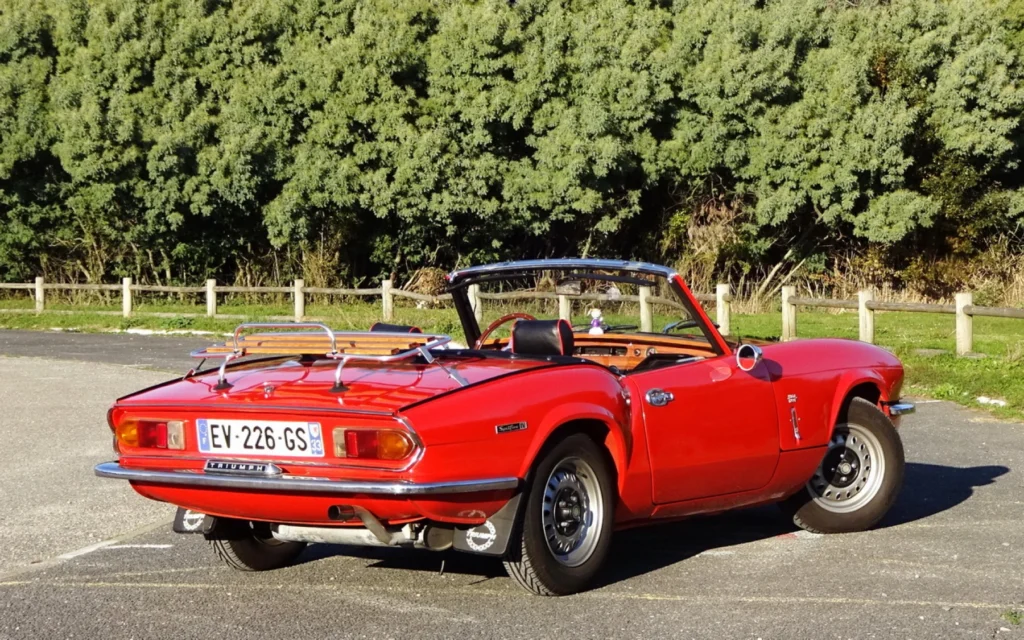
The Spitfire is a simple roadster. This is both its strength and its weakness.
The strong points: the tilting bonnet gives full access to the engine. A DIY enthusiast equipped with a basic set of spanners can carry out most routine maintenance. Oil filters, valve adjustments, and fan belt replacement are effortless.
Recurring weak points: rust is the number one enemy. Lucas electrics are notoriously temperamental. Engine overheating in summer is common on models whose cooling system has not been overhauled. And the nylon bushes in the brass suspension pivots require regular lubrication with EP90 oil to avoid premature wear.
For a complete overhaul of the suspension, brakes, exhaust and steering, the budget is around 5 000 to 6 000 euros in parts, excluding labour. The main restoration areas concern the bodywork (sills and wheel arches), the hood, the chrome and the upholstery.
Why the Triumph Spitfire remains an icon of the English roadster
More than forty years after production ended, the Spitfire continues to charm. Not because it is fast. Not because it is reliable. But because it embodies an idea of motoring pleasure that has almost disappeared: driving a light, open car, without electronic assistance, on a country road, with the sound of the four-cylinder engine and the wind in your hair.
The Spitfire proves you don’t need 300 horsepower to smile behind the wheel. Michelotti designed it with the talent he reserved for GTs ten times more expensive. The mechanics are simple enough for a novice to learn to maintain it. And the classic car market gives it real investment potential, provided you choose the right year and avoid botched restorations.
If you are looking for your first classic collector car, the Triumph Spitfire deserves to be at the top of your list.
Frequently asked questions about the Triumph Spitfire
What is the price of a Triumph Spitfire in France?
Prices range from 3 000 euros for a project to restore up to 26 000 euros for a Mk1 or Mk2 model in concours condition. The most common range for a vehicle in good running order is between 12 000 and 18 000 euros. The Spitfire 1500, newer and more produced, is the most accessible version with prices starting below 10 000 euros.
What is the best version of the Triumph Spitfire?
The Mk3 is the purists’ favourite: it combines the original lines designed by Michelotti with a 1 296 cm3 engine producing 75 hp, the most powerful in the range. But for regular use, the MkIV offers the security of a revised rear suspension and a fully synchromesh gearbox. The choice depends on your priority: aesthetics or driving experience.
What are the common problems of the Triumph Spitfire?
Three main enemies: rust (especially on the sills, wheel arches and floor), Lucas electrical systems (connections that oxidise, unreliable voltage regulator) and the rear suspension with swing axle on Mk1 to Mk3 versions, which can cause loss of control in fast corners. Regarding the engine, wear on the camshaft is the first sign of fatigue.
Is the Triumph Spitfire 1500 a good choice?
It is the entry-level model in the Spitfire range. Its gearbox, derived from the Morris Marina, lacks precision and the engine has lost horsepower due to emissions regulations. But it remains a true Spitfire: light, fun, and easy to maintain. For a first classic car purchase on a tight budget, it is a rational choice. Just avoid the American models whose rubber bumpers spoil the design.