To have a classic car appraised in an inheritance case, the heirs must appoint an automotive expert listed on the national register who is genuinely knowledgeable about the classic car market. Their task should focus on a market value as of the date of death, based on the car’s identity, authenticity, condition, history, and comparable transactions. The report is then sent to the notary to support the declared value and prepare for division or sale.
An appraisal is not just a printed price guide. Two Porsche 911, Jaguar Type E or Ferrari 308 of the same year can show considerable differences depending on their version, numbers, quality of restoration or provenance. In an inheritance, an insufficiently documented figure can also fuel disagreements among heirs or become difficult to defend before the tax authorities.
Quick answer: request a written report prepared as of the date of death value, choose an automotive expert listed on the national register and specialised in classics, gather all supporting documents, then have the notary validate the use of the report in the declaration.
What value must be determined in an inheritance?
The value sought is neither the price dreamed of by the family, nor the total of restoration invoices, nor necessarily the amount stated in an insurance contract. It is the market value of the vehicle on the day of death : the price at which it could reasonably have been negotiated on its market at that date, taking into account its actual characteristics.
The BOFiP recalls the principle of an evaluation at market value on the date of the tax event. For an inheritance, the expert must therefore be able to reconstruct the market as of the date of death, even if the inspection takes place several weeks or months later.
This valuation date is essential. If the car was restored, damaged, moved or restarted after death, the report must distinguish its condition at the date of transfer from its condition on the day of examination. Dated photographs, invoices, inspection reports and storage testimonies can help establish this chronology.
Why is the Argus price guide not always sufficient?
Service-Public states that vehicles in an inheritance are estimated according to the Argus value. This benchmark may be suitable for a common and sufficiently recent car. However, it becomes incomplete when an older vehicle is no longer listed, when transactions are rare, or when originality, restoration and provenance determine a large part of the value.
For a classic car, the expert compares several sources: specialised price guides, results of public sales, documented private transactions, comparable advertisements adjusted for their unrealised nature, market conditions and the specific characteristics of the example. The professional sheet of the French Federation of Automotive Expertise precisely describes this market study.
Is an appraisal mandatory?
There is no general obligation requiring an automotive appraisal report for every vehicle inherited. A common, recent and well-documented car can often be valued from coherent market references. However, an appraisal becomes particularly prudent when:
- the car is rare, old, modified or of high value;
- no relevant price guide exists;
- the actual condition is difficult to assess;
- the registration document, chassis number or configuration raise a question;
- several heirs disagree on the value;
- one of them wishes to keep the vehicle and compensate the others;
- a sale, donation or insurance declaration must follow;
- the authorities might ask how the value was determined.
The objective is not to obtain the lowest figure. It is to establish a coherent, well-argued and reproducible value. A fragile undervaluation can artificially reduce the declared assets, while an overvaluation can increase duties and complicate a family buyout.
Who can appraise the car?
For a report intended to determine the value of a vehicle, favour an automotive expert registered on the national list.Article L. 326-4 of the Highway Code specifically reserves the determination of vehicle values to professionals meeting this condition.
However, registration alone does not guarantee in-depth expertise on every classic car. Ask the expert which models, periods or brands they regularly handle, how they construct their comparables, and whether they examine the authenticity of the main components. The FFEA also offers a tool to find an automotive appraisal firm.
| Participant | Role in the file | What should not be asked of them alone |
|---|---|---|
| Automotive expert specialising in classics | Identify, examine and value the vehicle in a well-argued report | Decide on the succession distribution or calculate duties |
| Notary | Secure the succession, declaration and division | Authenticate the mechanics or conformity of a rare example alone |
| Auction house or judicial officer | Provide an analysis of the auction market and potentially organise a public sale | Automatically replace the technical appraisal when identity or condition are disputed |
| Brand specialist or restorer | Document a configuration, restoration or parts availability | Solely determine the fiscal value when there is a commercial interest |
For an exceptional automobile, the best approach may combine several areas of expertise: automotive expert, brand specialist, notary and auction house. The final report must specify who observed what and on which components.
Which documents should be prepared before the appraisal?
A complete file improves the accuracy of the appraisal and prevents the expert from turning a lack of evidence into mere assumptions. Gather before the appointment:
- the registration certificate and, if available, previous titles;
- the chassis number, engine number and accessible identification plates;
- the death certificate and the notary’s contact details, without providing more personal data than necessary;
- maintenance, restoration and parts purchase invoices;
- the logbook, manuals, manufacturer’s file and certificates of authenticity;
- previous appraisal reports and the insurance contract in force at the time of death;
- technical inspections, mileage records and available histories;
- old and recent photographs of the vehicle;
- the list of spare parts, wheels, tools, luggage, hard-top, keys and accessories;
- provenance elements: successive owners, competitions, exhibitions or publications, only if they can be proven.
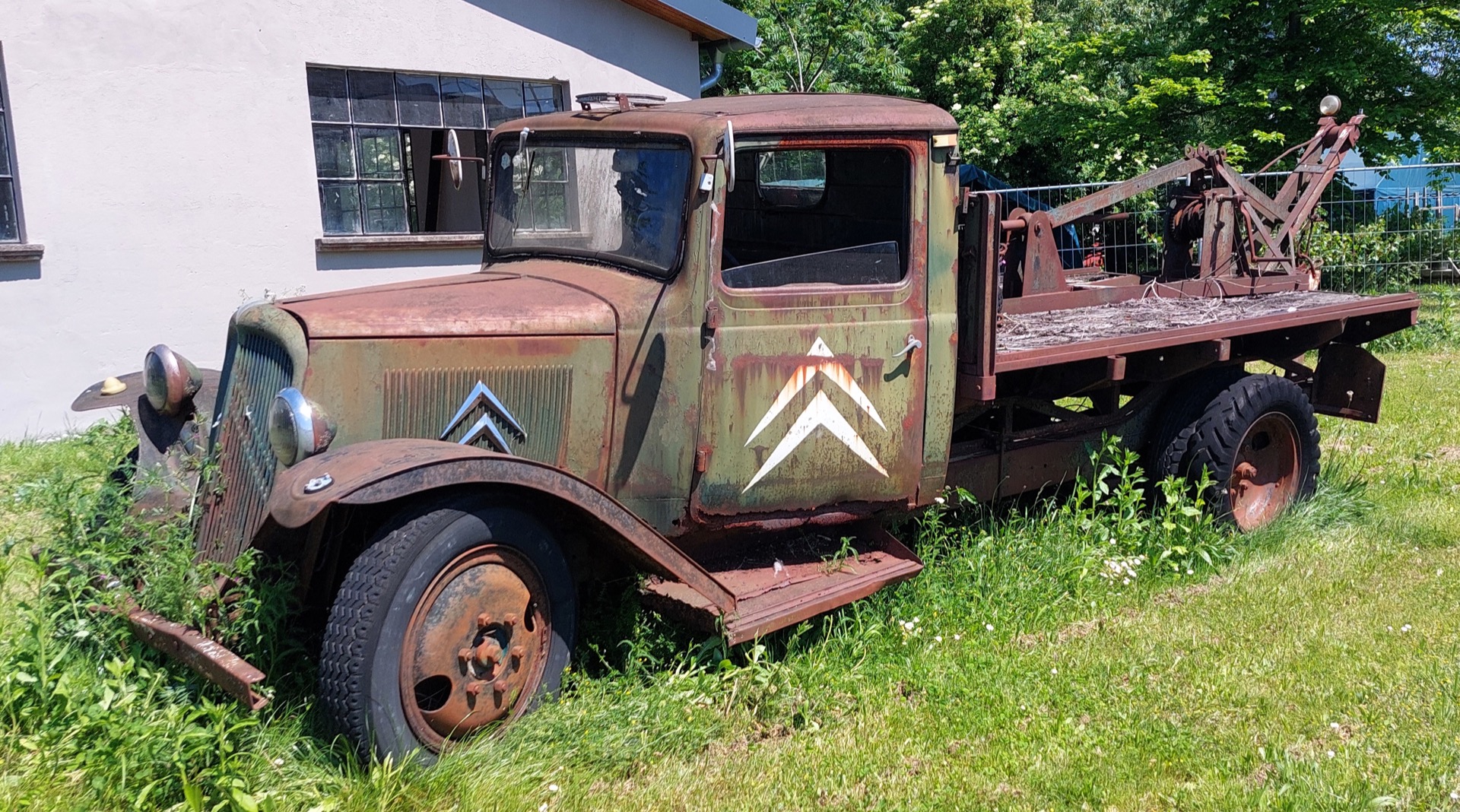
The observable condition and storage circumstances directly influence the analysis. Photo: Didivo67, licence CC0 1.0, via Wikimedia Commons.
Do not conceal a defect before the inspection. A leak, corrosion, a non-compliant component or an engine that won’t start are part of the condition to be documented. If urgent work is necessary to preserve the vehicle, photograph it before intervention and keep the estimate, invoice and replaced parts.
How does the appraisal proceed?
1. Defining the scope of the mission
The estimate or engagement letter must specify the vehicle concerned, the valuation date, the purpose of the report — inheritance, division, family buyout or sale — the place of examination, the research included and the delivery deadline. Explicitly request a market value as of the date of death, and not just an insurance value on the day of the inspection.
2. Identification and physical examination
The expert notes the identifiers, configuration and equipment. They examine the bodywork, structure, underside where accessible, engine, transmission, running gear, brakes, interior and signs of restoration. A road test is only carried out if the vehicle can legally and practically be driven with appropriate insurance.

The mechanical examination complements the documentary study and market comparables. Photo: Shixart1985 / Nenad Stojković, CC BY 2.0 licence, via Wikimedia Commons.
3. Verification of history and authenticity
The term “matching numbers” should not be accepted solely on the owner’s word. Its significance varies according to brands and eras. The expert must specify which numbers were seen, which archives were consulted and what limitations remain. The same applies to a sporting record or a famous provenance.
4. Study of comparables
A useful comparable corresponds as closely as possible to the same version, the same market, a period close to the date of death and a similar condition. A price shown in an advertisement is not a completed sale. An auction result must be read with its date, currency, fees, described condition and sale conditions.
5. Delivery of a reasoned report
The report must at minimum present the vehicle’s identity, the assignment, the date of examination, the valuation date, the documents consulted, findings, reservations, method, comparables and the value retained. An isolated figure sent by email may help guide a decision, but it offers much less protection for the inheritance.
Which criteria affect the value?
| Criterion | Questions to document |
|---|---|
| Exact version | Engine, bodywork, gearbox, delivery market, limited edition |
| Authenticity | Chassis, engine, colour, upholstery, original or replaced parts |
| Condition | Structure, corrosion, mechanics, paintwork, interior, operation |
| Restoration | Quality, date, invoices, photos, compliance with specifications |
| History | Continuity of ownership, maintenance, accidents, mileage |
| Origin | Proven record or genuinely demonstrated notable owner |
| Rarity and desirability | Production of the version and current depth of demand |
| Market | Comparable transactions at the date of death, country and currency |
| Accessories | Books, tools, wheels, original parts, luggage, hard-top |
The cost of a restoration does not mechanically add to the value. An expensive intervention may be necessary without being fully recovered on resale. Conversely, a very original and well-aged car may interest the market more than a restored example without documentation.
How much does a classic car appraisal cost?
Fees are flexible and vary according to the rarity of the vehicle, travel, access to a lift, volume of archives, authenticity research, number of cars, and whether the assignment is amicable or adversarial.Service-Public mentions an average range of 70 to 400 euros for automotive appraisals in general, but this benchmark mainly concerns the insurance context and does not constitute a guaranteed rate for a complex classic car.
For an inheritance, request at least two comparable quotes and verify that they include:
- a physical examination of the vehicle;
- travel expenses;
- search for comparables;
- the valuation date at death;
- the written report, photographs and reservations;
- the cost of an addendum or a contradictory meeting;
- the conditions applicable to multiple vehicles.
A free online estimate can provide an initial indication. It does not necessarily replace an inspection or a report designed for an inheritance declaration.
How to use the report with the notary?
Provide the notary with the complete report, not just its conclusion page. Report any public sale, insurance policy, previous appraisal or new information that could influence the valuation basis used.
Article764 of the General Tax Codeprovides several valuation bases for movable property: notably the price of a public sale conducted within two years of the death, then, failing that, certain estimates contained in inventories or other documents, and finally the detailed and estimated declaration of the parties. The exact treatment of a motor vehicle and the possible application of rules specific to collectibles must be verified by the notary depending on the case; a registration certificate bearing the “collection” mention alone does not settle all tax questions.
Keep the report, photographs, market sources and correspondence that led to the declared value. If the car is sold quickly at a significantly different price, inform the notary so they can assess the consequences and any possible adjustment.
For the complete order of transfer formalities, consult our guide:how to sell the car of a deceased person.
What to do if the heirs do not agree?
Start by having the letter of engagement approved together: identity of the expert, valuation date, documents provided and expected method. This precaution limits disputes over a report commissioned unilaterally by the heir wishing to buy or sell the car.
If disagreement persists:
- ask the expert to respond in writing to specific objections;
- arrange a joint amicable appraisal with a second expert if necessary;
- compare the assumptions rather than just the amounts: condition, authenticity, costs and transactions considered;
- have the notary oversee any buyout of shares or sale;
- as a last resort, consult a lawyer about the possibility of a judicial appraisal.
Co-ownership does not automatically justify a tax discount: the BOFiP reminds that the state of co-ownership among heirs has no impact on the market value of the asset on the day of its transfer. Our filecollectible car in co-ownership: selling without conflictdelves deeper into the organisation among co-heirs.
Checklist before submitting the file to the notary
- ☐ All heirs are aware of the existence and storage location of the vehicle.
- ☐ The condition of the car at the date of death is documented.
- ☐ The expert is registered on the national list and knows the market for the model.
- ☐ The assignment explicitly targets the market value at the date of death.
- ☐ The numbers, documents, accessories and spare parts have been inventoried.
- ☐ Comparable items distinguish between asking prices and completed sales.
- ☐ The report explains its reservations and is not limited to a single amount.
- ☐ The insurance contract and previous expert reports have been provided to the notary.
- ☐ Interventions carried out after the death are separated from the initial condition.
- ☐ Any significant discrepancy between the expert appraisal and the sale price is noted.
Frequently Asked Questions
Can a car that does not run be appraised?
Yes. The expert can examine a stationary car, but must specify which checks are impossible and their impact on the value. A lift, inspection pit or moving the vehicle to a workshop can improve the examination if this is authorised and insured.
Does an appraisal carried out before death remain valid?
It constitutes a useful document, especially if it is close to the date of death, but it does not always exempt from updating. The market, condition, mileage or restoration may have changed.
Is the insurance value the value to declare?
Not automatically. It must be communicated to the notary and the expert, but its role depends on the contract, its date and the vehicle’s tax classification. The inheritance value must remain consistent with applicable rules and the market on the date of death.
Who pays for the appraisal?
Payment depends on the agreement between the heirs and the organisation of the estate. Before commissioning, have the notary clarify whether the expense will be borne by the estate, advanced by an heir or shared among those concerned.
Should an entire car collection be appraised vehicle by vehicle?
Each vehicle must be identified and valued. For a coherent collection or one including common parts and archives, the expert can also analyse the interest of the whole. Request a global quote with an individualised value for each car.
Can the price obtained after death replace the appraisal?
A public sale carried out within two years of death can constitute a legal basis for valuation according to article 764 of the CGI. For a private sale or a price obtained under particular circumstances, the notary must assess the significance of the transaction and the supporting documents to be retained.
Key Points
A good inheritance appraisal does not seek to favour any heir. It technically and economically captures the vehicle at a precise date, explains its method and makes the value understandable to the family, the notary and, if necessary, the authorities.
For a rare car or a significant collection, the safest trio remains a notary for the inheritance framework, a specialised automotive expert for the vehicle and truly comparable market references. This method reduces fiscal risk, facilitates division and prepares a possible sale on credible grounds.
Sources
- Service-Public — Inheritance rights: estate valuation and calculation of duties, checked on 9 February 2026.
- Légifrance — Article 764 of the General Tax Code.
- BOFiP — Inheritances: principle of valuation at market value.
- Légifrance — Article L. 326-4 of the Highway Code.
- FFEA — Expertise of classic and prestige vehicles.
- Service-Public — Car insurance: procedure and cost of an expert assessment.
Photo credits
- Featured image: Vintage car dashboard (Unsplash), Benjamin Child, licence CC0 1.0, resized.
- Old vehicle near a workshop: Sessenheim classic garage rue des peupliers5, Didivo67, licence CC0 1.0, resized.
- Engine compartment: Engine components displayed in a red car, Shixart1985 / Nenad Stojković, licence CC BY 2.0, resized without other modification.