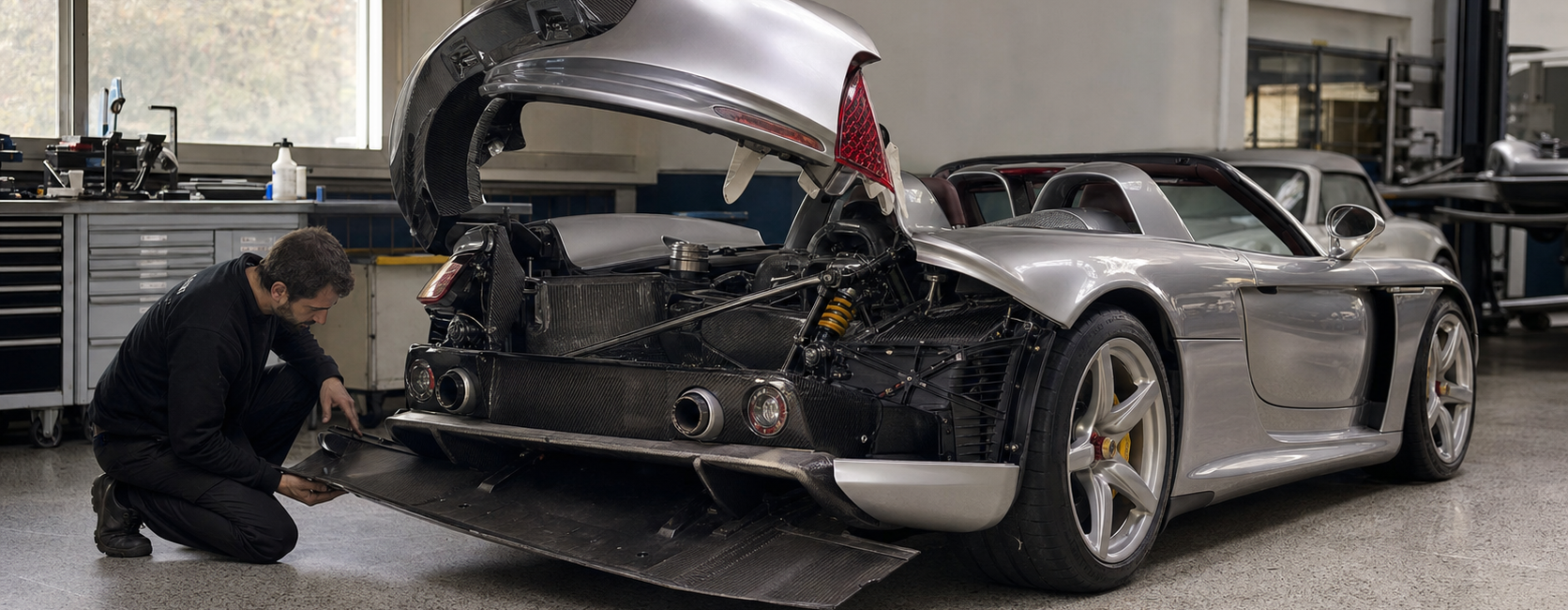
The Porsche Carrera GT attracts attention because it remains one of the most radical analogue supercars of its era. But for a buyer, the most important issue is not to repeat that the V10 is legendary. It is to know whether the example has been inspected with sufficient method to avoid an unpleasant surprise regarding the carbon, the clutch, the accessories and the traceability.
The short answer: a Carrera GT is not bought with a generalist inspection. It requires a specialist, documented check, focused on the specific parts and the history. Porsche reminds us that the Carrera GT is built around a carbon architecture, a V10 engine of 5,7 litres and a manual gearbox. It is precisely these qualities that make the prior inspection essential.
Why the specific parts change everything
Porsche presents the Carrera GT as a technical milestone: V10 engine, carbon monocoque, technology derived from racing and production of 1 270 units between 2003 and 2006. These elements explain the desirability, but also the need for a specialised eye. A crack, a poorly documented repair or a missing part can weigh more heavily than a visible cosmetic defect.
To place this logic in the world of restoration,our guide on the traceability of Mercedes 300 SL partsillustrates the principle well: authenticity is verified by evidence.
The inspections that change the negotiation
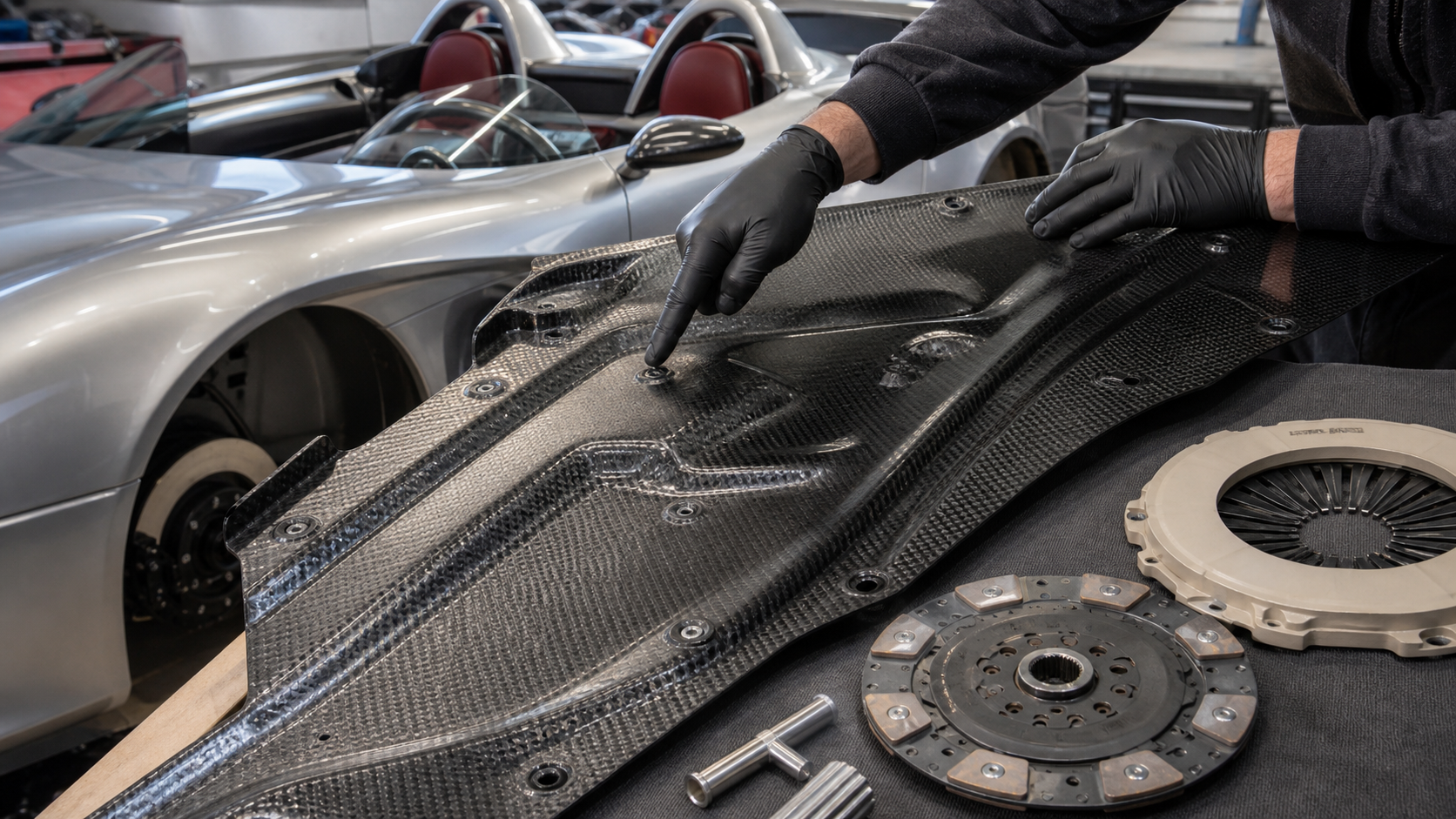
The inspection must start with the carbon structure and panels. One must look for signs of disassembly, rubbing, repair, yellowing, impact or undocumented repair. Porsche Classic has already shown that a serious refurbishment of carbon components can be lengthy and technical; it is therefore never a secondary matter.
The clutch deserves the same level of seriousness. Porsche described a Porsche Ceramic Composite Clutch with a diameter of 169 mm on the Carrera GT. For the buyer, the figure is not meant to impress; it reminds that the system is specific. One must request measurements, invoices, usage conditions and the opinion of a workshop that truly knows the model.
Do not forget the accessories and traceability
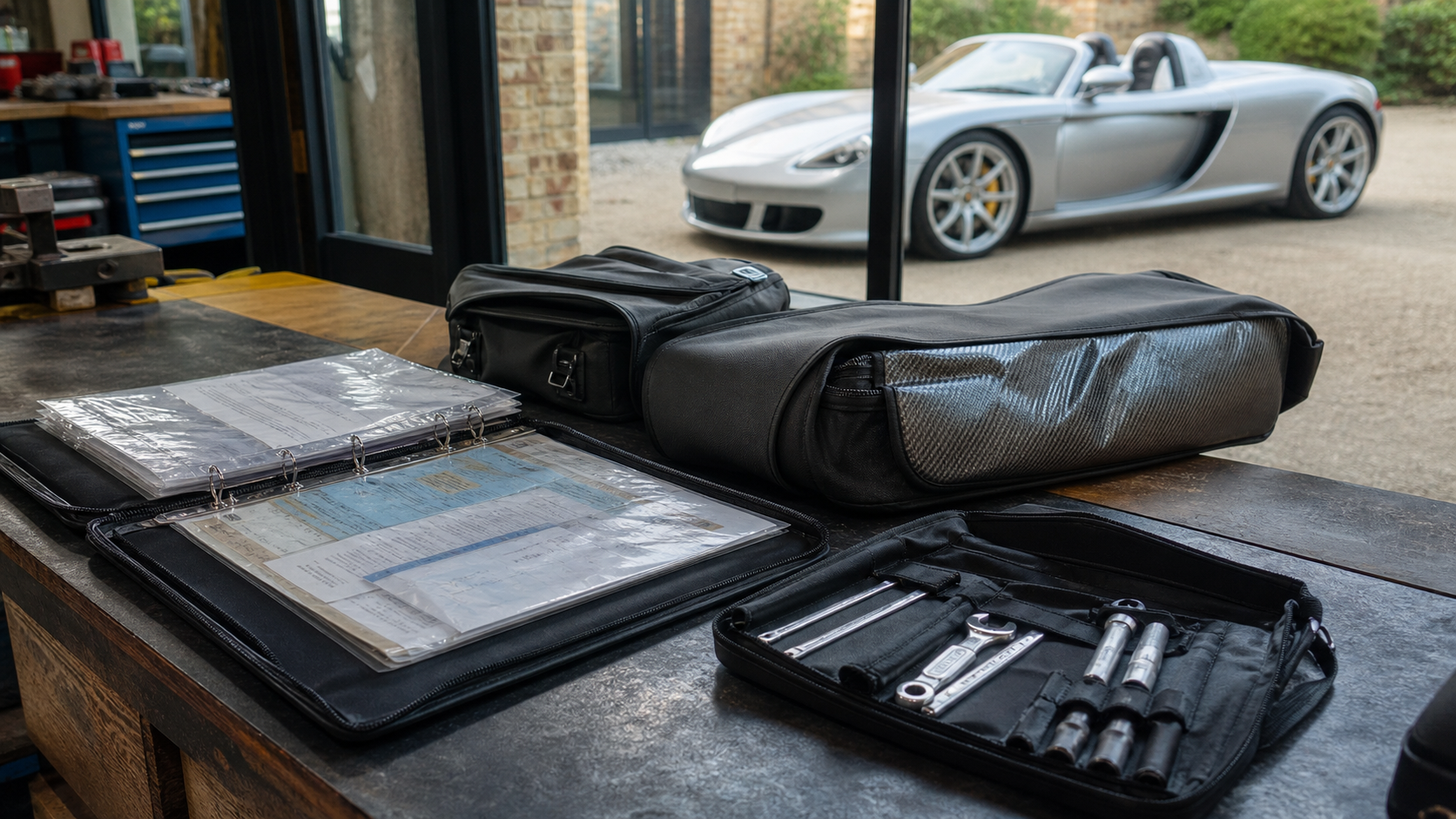
A complete Carrera GT is not just about its logbook. The items associated with the car, covers, bags, tools, documents, ownership history, invoices and interventions must be inventoried. The absence of an accessory may seem minor during the test, but quickly becomes a negotiation point when the car joins a collection.
The method aligns with what we recommend for rare cars: photograph, classify, date and link each item to the car. For another demanding supercar case,the Ford GT Mk IV analysisshows why a record or a technical sheet is never enough to guide the purchase.
Separate usage, condition and reputation
The Carrera GT has a reputation as a demanding car. This reputation must not replace the examination of the example. A car little used may hide incomplete maintenance; a regularly driven car may be more reassuring if every intervention is documented. One must therefore separate three questions: how has the car been used, what condition is it in today, and what evidence accompanies this story? This three-step reading also applies tofive Japanese iconswhich are much more accessible.
The test must remain cautious and supervised. The objective is not to validate a heroic feeling, but to confirm the operation, the absence of suspicious noise, the coherence of the controls and the behaviour of the clutch. The specialist’s written report must take precedence over the enthusiasm of the test.
Warning signs to address before purchase
- Incomplete history or overly general invoices.
- Carbon inspection missing or carried out by a non-specialist workshop.
- Accessories advertised but not visible on the day of the viewing.
- Clutch measurements not provided or impossible to interpret.
- Bodywork or underside repairs without photos or invoices.
- Seller eager to discuss price before inspections.
A buyer can also compare the approach with our Lamborghini Diablo checklist, as the same principles apply: provenance, parts, consistency and specialist input before negotiation.
The correct decision sequence
- Request the complete file before travelling.
- Identify the specialist workshop that will inspect the car.
- Check carbon, clutch, brakes, tyres, accessories and history.
- Obtain cost estimates for discrepancies before making an offer.
- Prepare to keep the file for future resale.
If the goal is to keep the car for a long time, this sequence protects both use and value. If the goal is a future resale, it avoids buying a history that will need to be reconstructed. To extend the reflection on presenting a file, the method applied to the BMW Z8 remains a good reference.
What a good report should contain
The inspection report must be readable by a buyer who was not present on the day of the inspection. It should therefore specify the areas examined, the limits of the examination, the available measurements, photos of the underside, remarks on the clutch and elements requiring monitoring. A simple phrase stating that the car is beautiful or compliant does not carry the same weight as an illustrated file.
Also ask who signs the report. On a Carrera GT, the inspector’s expertise is part of the evidence. A workshop capable of documenting the carbon panels, dismantled parts, accessories and consumables provides a firmer basis for discussion than a generalist appraisal. It is this document that then allows calm negotiation, prioritisation of work and retention of a useful record for future resale. This is the logic that also guides the preparation of the resale file for a Ferrari F80.
FAQ
Can a Porsche Carrera GT be inspected like a classic 911?
No. It requires a specialist familiar with carbon fibre, the V10, the specific clutch, and the procedures unique to the model.
Is low mileage enough to reassure?
No. Storage, maintenance, tyres, fluids, clutch, carbon components, and accessories must be checked. Low mileage does not replace a complete dossier.
What should be requested before travelling?
Ask for invoices, photos of the underside, available readings or measurements, list of accessories, ownership history, and contact details of the workshop that services the car.
General advice: before making any decision, verify the documents, history, actual condition, the opinion of an independent specialist, and market prices at the time of the transaction.