On a classic car fitted with a timing belt, replacement must follow the manufacturer’s schedule in years or kilometres, at the first threshold reached. A collector car that is driven infrequently is therefore not protected by its low mileage: the belt and its components also age over time. If the date of the last replacement cannot be proven by an invoice, it is prudent to consider the timing system as unknown and to replace it before sustained use.
There is no universal interval applicable to all classics. The exact engine, the model year, the assembly and the technical documentation always take precedence over a general rule found online.
Do all classic cars have a timing belt?
No. Depending on their engine, classic cars use a toothed belt, a chain or a set of gears to synchronise the crankshaft and the camshaft. Some side camshaft engines use a very short chain or gears, while many overhead camshaft engines produced from the 1970 and 1980 onwards adopted the belt.
Before looking for an interval, identify precisely:
- the make, model and year;
- the engine code, not just the capacity;
- the date of first registration;
- any modifications or engine swaps;
- the actual type of timing system fitted.
The same range may have had several engines, some with chains and others with belts. The registration document does not always provide enough information to decide: the engine plate, serial number, workshop manual or parts catalogue may be necessary.
What is the purpose of the timing belt?
The belt synchronises the rotation of the crankshaft and the camshaft so that the valves open at the correct time relative to the position of the pistons. Depending on the engine, it may also drive a fuel injection pump, a balance shaft or the water pump.
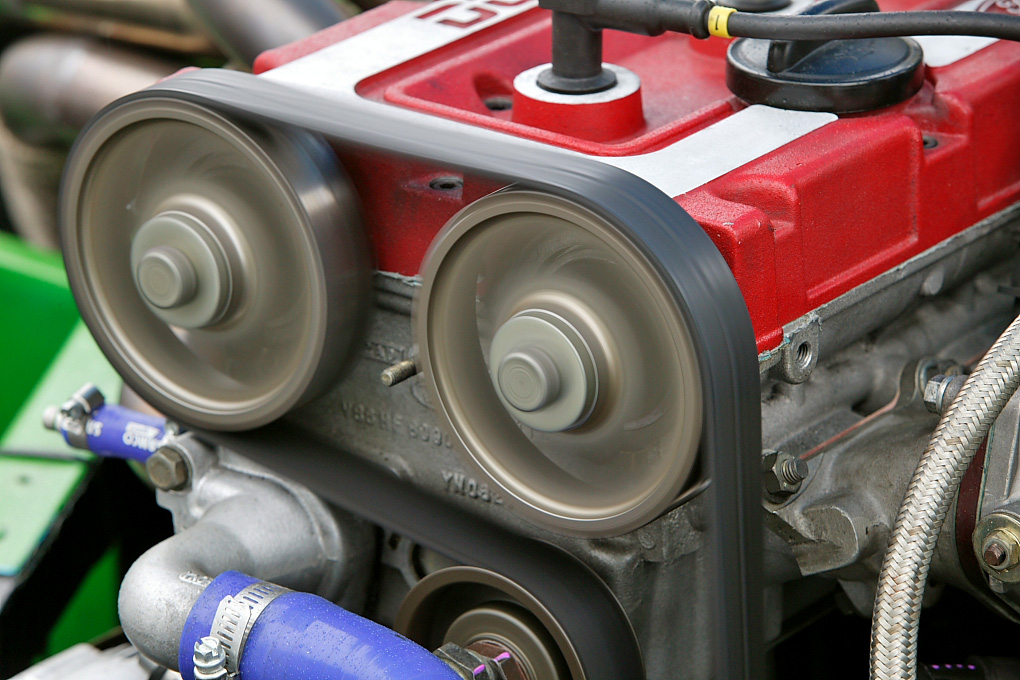
Timing belt on a Ford Cosworth YB engine. Credit: Tennen-Gas, CC BY-SA 2.5, via Wikimedia Commons.
On an “interference” engine, a break or tooth jump can cause pistons and valves to collide. The consequences range from bent valves to significant damage to the cylinder head, pistons or bottom end. On a non-interference engine, a break may be less destructive, but it still immobilises the car and can cause other damage. Therefore, one should not assume a timing system is risk-free simply because an engine is reputed to be tolerant.
When should the belt be changed?
The correct interval is stated in the manufacturer’s maintenance schedule or in reliable technical documentation corresponding to the engine code. It generally combines a time period and a mileage. Replacement becomes necessary as soon as either of the two thresholds is reached.
| Situation | Prudent decision |
|---|---|
| Recent invoice and engine original to the vehicle | Follow the manufacturer’s deadline based on the invoiced date and mileage |
| Belt with low mileage but age limit reached | Replace: time counts as much as distance |
| No history or only verbally declared | Consider replacement as unproven |
| Car immobilised for several years | Check the entire system and replace before sustained restart if the deadline is unknown |
| Oil or fluid leak near the timing system | Repair the leak and replace contaminated components according to diagnosis |
| Engine replaced or modified | Identify the actual installed engine and apply its documentation |
Continental recalls that inspection and replacement intervals are set by the vehicle manufacturer. In its technical documentation, the supplier indicates, when no manufacturer interval exists, a maximum recommendation of 120 000 km or seven years, whichever comes first. This value constitutes a fallback reference from the supplier, not a universal prescription: some engines require much more frequent replacement.
Does a car that is driven little wear out its timing belt?
Yes, even if the wear is not the same as that of a daily-driven car. The belt is a composite component subject to ageing, thermal cycles and its environment. Prolonged immobilisation does not stop the ageing of elastomers, pulley bearings, seals and the water pump.
Older cars add several risk factors:
- incomplete history or lost invoices;
- long periods of inactivity;
- oil leaks from camshaft or crankshaft seals;
- corrosion or seizure of a pulley;
- tension adjusted by an approximate method;
- new part but stored for a very long time;
- reference suitable for the model, but not for the exact engine code.
A car that has only covered a few thousand kilometres since the replacement may therefore reach its age limit. Conversely, a recent belt may need to be replaced prematurely if it has been contaminated by oil, fuel, or coolant.
Can the condition of a timing belt be judged by eye?
A visual inspection can reveal an obvious problem, but it is not sufficient to extend an expired deadline. Cracks, damaged teeth, frayed edges, shiny marks, rubber deposits, contamination by a fluid, or misalignment are warning signs. The absence of these signs does not prove that the belt is still safe.
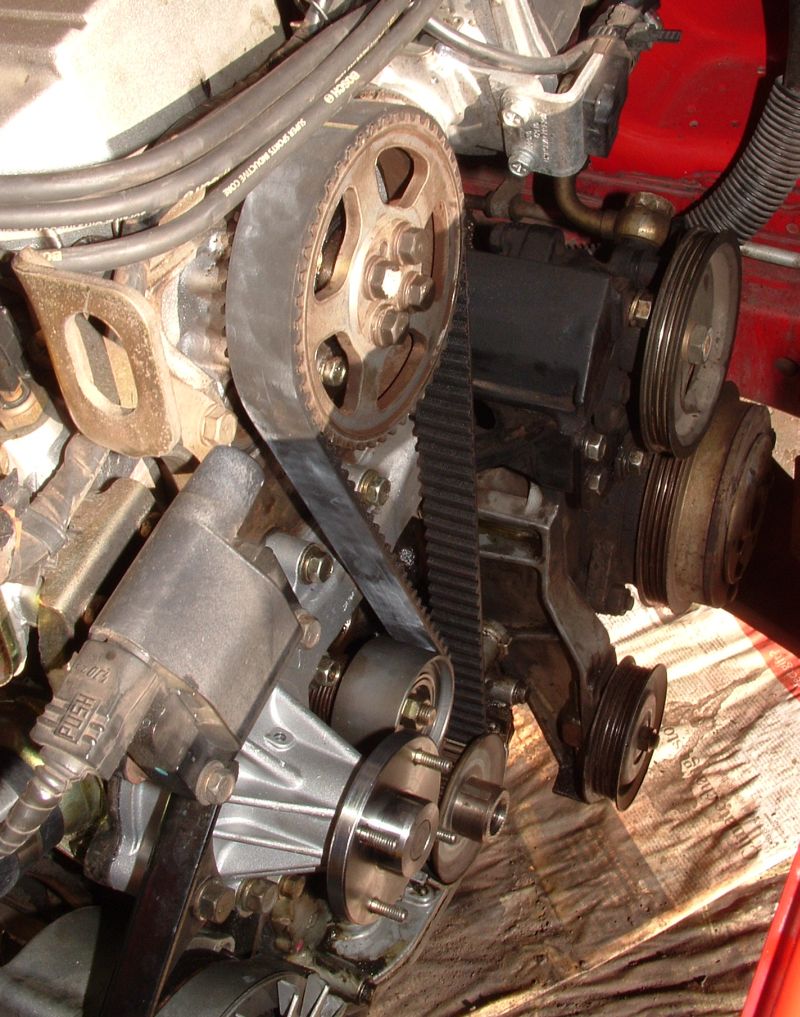
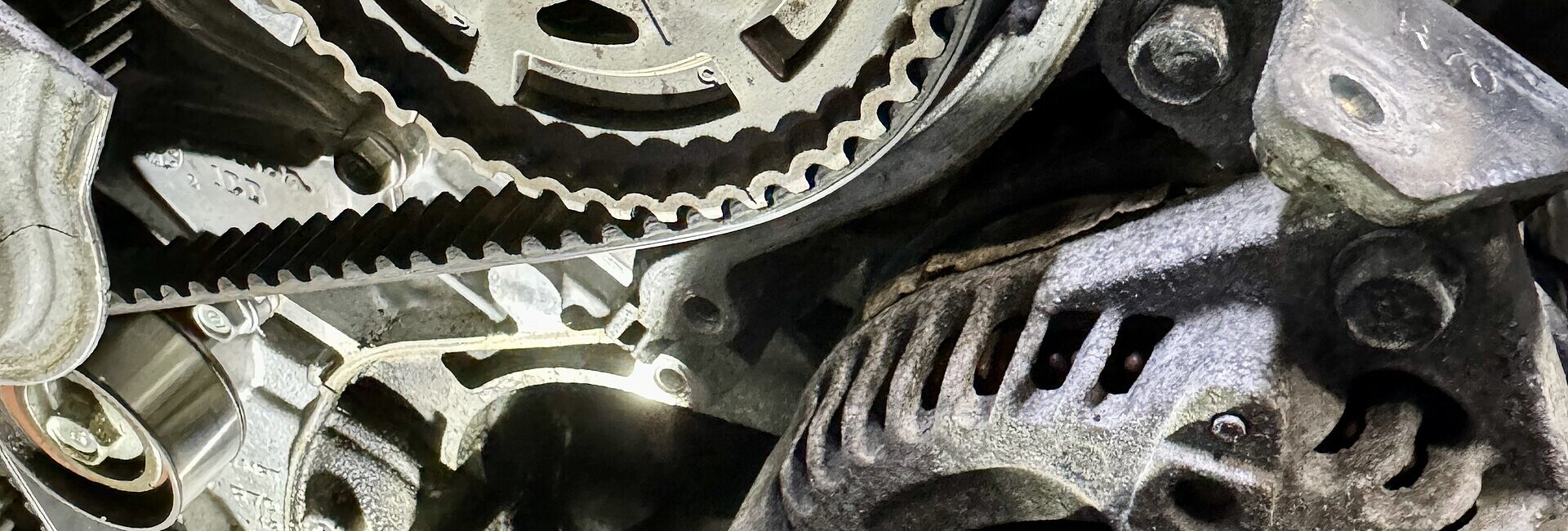
Timing system of a Nissan RB30E engine, cover removed. Credit: RB30DE, public domain, via Wikimedia Commons.
Dayco emphasises that worn tensioner and idler pulleys are among the common causes of system failure. A simple glance at the outer face of the belt does not provide information about the condition of the internal fibres, the bearings, or the correct tension. On many engines, a thorough inspection already requires the removal of covers.
What should be replaced with the timing belt?
Isolated replacement of the belt is rarely the best choice on an older car. The estimate should detail the complete system according to the assembly:
- timing belt;
- tensioner pulley and idler pulleys;
- hydraulic tensioner when present;
- single-use bolts, nuts and gaskets as specified by the procedure;
- water pump when it is driven by the timing belt or when its access requires the same removal;
- coolant if the circuit is opened;
- accessory belts removed, if their condition or age justifies it;
- gaskets responsible for oil contamination.
Gates recommends replacing the water pump driven by the belt at the same time. Dayco also explains that a worn or leaking pump can contaminate and damage a new belt. This does not mean that every water pump, regardless of the engine, must be changed automatically: one must consider its drive method, accessibility, and the manufacturer’s procedure.
To prepare for a broader recommissioning, also consult the checklist before restarting an immobilised classic car and the guide dedicated to coolant for a classic car.
Unknown history: should the car be started?
If a car has just been discovered, purchased, or inherited without proof of timing belt replacement, avoid the reflex to “try and see.” Starting the engine can turn a maintenance operation into an engine repair.
The correct sequence is to identify the engine, search for invoices and workshop notes, consult the documentation, then have the timing system inspected. A label in the engine compartment is a clue, not sufficient proof if it does not clearly state the date, mileage, reference, and the work carried out.
When the timing belt is accessible and the history remains unknown, the preventative cost of the kit should be factored into the purchase budget. Before choosing a vehicle, the adverts for classic cars for sale also allow you to compare the maintenance records offered with similar models.
What proof should be kept after replacement?
To preserve value and facilitate a future sale, keep:
- the invoice with the registration or chassis number;
- the date and mileage;
- the references for the belt, pulleys and pump;
- the type of coolant used;
- the seals and accessories replaced;
- photographs before, during and after the work;
- the old belt if this has been agreed with the workshop.
An invoice stating only “timing belt” is less useful than a detailed document. On a car with a non-original engine, the invoice should ideally mention the engine code and the fitted references. This traceability avoids having to reconstruct the history a few years later.
Can you change a timing belt yourself?
Technically, yes on some simple engines, but the operation is not just about replacing a rubber strip. It requires correct timing, appropriate locking tools, torque settings, the tensioning procedure and sometimes support or removal of an engine mount.
A one-tooth error, incorrect tension or a bolt reused incorrectly can cause malfunction or failure. For a rare car, an interference engine or an engine whose parts are hard to find, having the work done by a professional familiar with the model is generally the most sensible choice.
FAQ
What is the replacement interval for a timing belt on a classic car?
It depends on the engine and manufacturer. Look for a limit in years and a limit in kilometres, then apply whichever comes first. Do not use a generic value if a specific recommendation exists.
Is a ten-year-old belt with low mileage still good?
Low mileage does not negate the age limit. If the recommended deadline has passed, replace it even if it appears to be in good condition.
Should the water pump be changed with the timing belt?
Yes, when it is driven by the belt or when the procedure and access make simultaneous replacement sensible. Always check the exact assembly and the manufacturer’s recommendation.
Does a timing chain never need to be replaced?
A chain does not follow the same schedule as a belt, but it is not indestructible. The chain, guides, sprockets and tensioner may require inspection or replacement depending on the engine and its symptoms.
Does the MOT test check the timing belt?
No, it does not provide proof of its age or internal condition. The timing system is part of the maintenance schedule and mechanical history.
Can you drive a classic car after purchase without a timing belt invoice?
The prudent choice is to have the system identified and inspected, then replace the kit if the due date cannot be proven, before any significant journey or regular use.
Sources
- Continental — Timing belts, technical documentation: role of the system, diagnosis and priority given to manufacturer intervals.
- Continental — Timing belt technical workbook: fallback recommendation of 120 000 km or seven years without a manufacturer interval and replacement of the driven pump.
- Gates — Belt replacement guide: adherence to manufacturer intervals and risk of engine damage.
- Gates — Timing kits with water pump: kit components and simultaneous replacement of a driven pump.
- Dayco — Timing components webinar: pulleys, tensioners, seals, water pump and signs of failure.
Information verified on 19 October 2026. Revision recommended every 12 months and with each update of manufacturer documentation. Verdict: ready to publish.