The right oil for a classic car is not automatically a 20W-50 mineral oil. The primary choice remains the grade and performance level specified by the manufacturer, supplemented by the engine builder’s recommendations if the engine has been rebuilt. You must then consider the valve train architecture, filtration, mechanical clearances, the actual condition of the engine, the climate, and the usage.
Quick answer:first find the original recommendation, then have it interpreted by a specialist familiar with this engine and current formulations. A 20W-50 oil may suit many classic engines, but it can be too viscous when cold, unsuitable for a more modern engine, or insufficient for a very particular architecture. ZDDP is useful in some flat tappet engines, but “more zinc” does not automatically mean “better oil.”
Here is a reliable method to choose without relying on a universal recipe.
The five pieces of information to gather before buying oil
Start by precisely identifying the engine: type, year, version, displacement, and any modifications. Two cars of the same model may no longer have the same engine after several decades. Then look for, in this order:
- the user or workshop manual exactly matching the engine;
- technical bulletins and updates from the manufacturer;
- rebuild invoices indicating clearances, bearings, pistons, and camshaft;
- the oil used during the last oil changes and the observed behaviour;
- the opinion of a workshop or club truly specialised in this engine.
Also note the usual operating temperature, type of journey, presence of an oil filter, oil cooler, and catalytic converter, as well as hot oil pressure. A car that only makes short trips does not stress its oil like a GT competing in a historic rally.
If the maintenance history is unknown, do not add an additive at random. An inspection, a pressure measurement and, depending on the engine, checking the sump, pickup screen and filter provide a much more solid basis.
Understanding 20W-50, 15W-40 and other grades
A multigrade like 20W-50 describes the oil’s viscosity behaviour in standardised tests. The number followed by “W” indicates its performance at low temperature; the second number corresponds to its viscosity class when the oil is hot. These are neither operating temperatures nor direct measurements in millimetres.
An oil must circulate quickly enough at start-up while maintaining an adequate film when the engine reaches operating temperature. Arbitrarily increasing from 40 to 50 can raise the indicated pressure or reduce consumption on a worn engine, but also slow circulation when cold and mask a fault. Conversely, an oil significantly more fluid than specified can give insufficient pressure when hot on some engines with large clearances.
| Situation | Question to ask | Prudent decision |
|---|---|---|
| Original recommendation available | Which grade according to season and temperature? | Start from this table and check the current equivalent |
| Rebuilt engine | Have the clearances and components remained original? | Follow the engine manufacturer’s recommendation and the running-in protocol |
| Low pressure when hot | Are the sensor, pressure gauge, pump, bearings and level correct? | Diagnose before choosing a thicker oil |
| High oil consumption | Leak, guides, piston rings or breather? | Treat the cause; do not rely solely on viscosity |
| Winter use | What is the minimum temperature at start-up? | Choose the cold grade designed for this range |
| Circuit or heavy load | What is the actual oil temperature? | Check cooling, pressure and sports recommendations |
TotalEnergies explains SAE grades and reminds us that an engine needs oil that is sufficiently fluid when cold and sufficiently stable when hot. However, the manual’s reference remains more relevant than a choice based solely on the vehicle’s age.
Is 20W-50 suitable for all classic cars?
No. The 20W-50 is common in the classic car world because it corresponds to many engines from the 1950 to 1970 decades and there are modern classic formulations in this grade. TotalEnergies cites it as a traditional choice for several vehicles from the 1950 and 1960 decades when no more precise recommendation is available. Motul also markets a Classic 20W-50 intended for defined vintage applications.
But the decade alone is not enough. A pre-war engine with particular lubrication, a sports car from the 1980s, an air-cooled engine and a turbocharged youngtimer may require very different products. Some classics use a single-grade; others accept or require a more fluid multigrade. Bearing clearance, filtration system and oil temperature matter more than a rule based on “before such year.”
A 20W-50 does not repair a worn pump, worn bearings or defective piston rings. If the warning light takes time to go out, if pressure drops when hot or if consumption suddenly increases, have the engine measured and diagnosed.
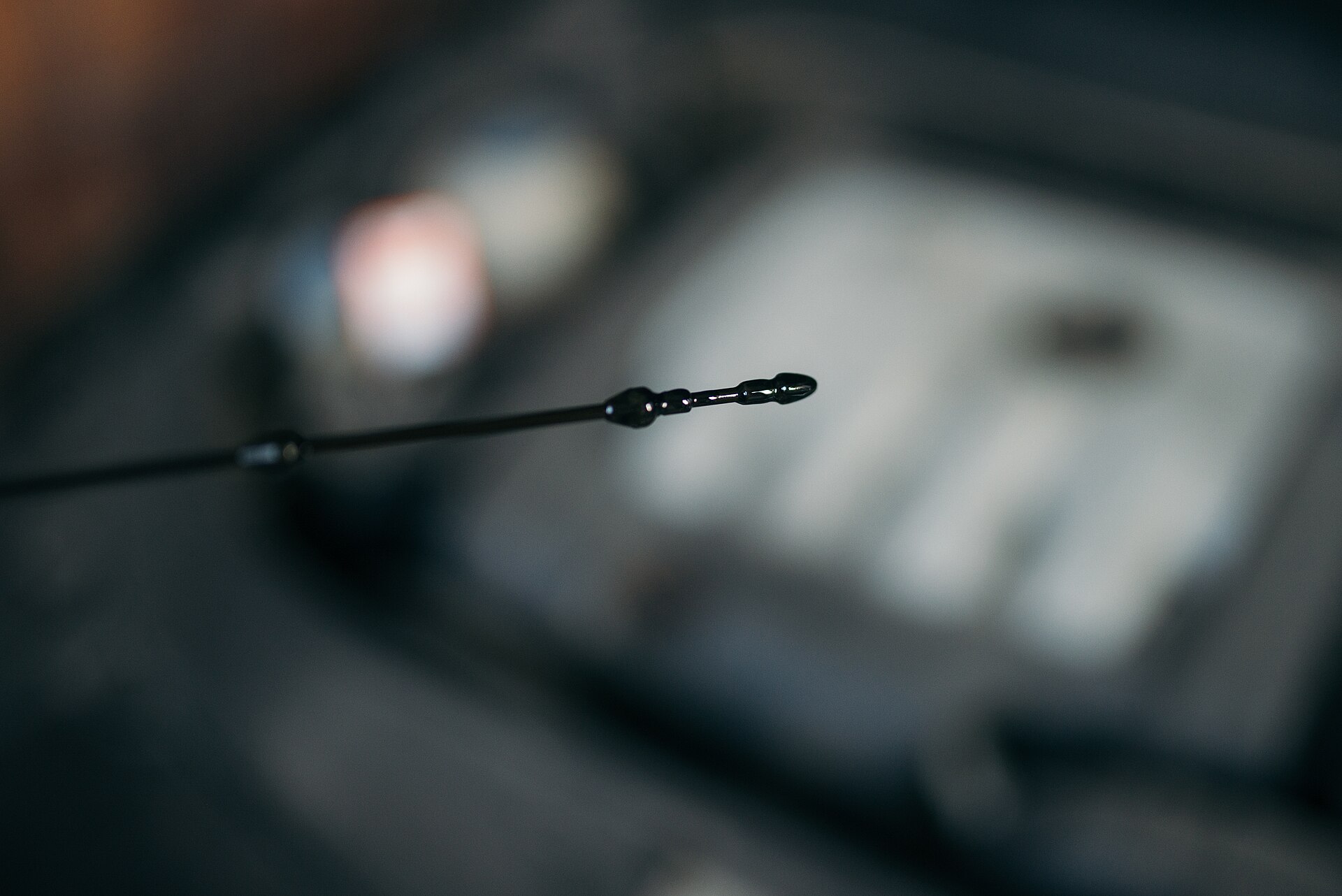
Checking the oil level with the dipstick. Photo: Shixart1985, CC BY 2.0 licence, via Wikimedia Commons.
Mineral or synthetic oil: dispelling misconceptions
The nature of the base — mineral, semi-synthetic or synthetic — alone does not determine whether an oil is suitable. One must consider the grade, the additive package, the claimed standards, the materials, the engine’s condition and the technical recommendations.
A synthetic oil does not mechanically cause a leak in a healthy engine. ExxonMobil states that its synthetic oils are compatible with automotive elastomers and recommends repairing any existing leaks before use. With very old engines, the issue is broader: the type of seals, accumulated deposits, filtration, consumption, and the complete formulation must all be examined.
It is therefore unwise to abruptly switch to a very different product on an engine with an unknown history in the hope of “cleaning” it. If the sump contains sludge, an oil change does not replace an inspection. Conversely, banning all synthetic oils simply because the car is old is too simplistic: some rebuilt or sports engines can benefit from a modern formulation expressly validated for them.
ZDDP and flat tappets: useful, but not at an improvised dosage
ZDDP, or zinc dialkyldithiophosphate, is an anti-wear additive. Under the effect of load and temperature, it helps form a sacrificial layer on metal surfaces. It is particularly monitored in engines with flat tappets, heavily loaded camshafts, and certain prepared engines.
Castrol presents its Classic 20W-50 oil rich in zinc and phosphorus for engines with flat tappets and warns that it is not intended for modern engines equipped with a catalytic converter. Motul announces for its Classic 20W-50 a formulation reinforced with ZDDP. These examples show that a “classic” oil can meet a specific architecture, not that the highest rate suits everywhere.
Penrite’s technical bulletin emphasises that ZDDP works within a set of additives and that more zinc does not automatically provide more protection. The balance with detergents, dispersants, antioxidants, and compatibility with any catalytic converter also matters. Therefore, prefer an oil formulated and documented for the application rather than a bottle of additive poured in without calculation. The engine manufacturer or camshaft maker must set the requirements during a running-in period.
API standards: why “old specification” does not mean better
API categories indicate a performance level, not just an era. The American Petroleum Institute specifies that, for automotive petrol engines, a current category incorporates the performance of previous categories and can serve engines that required those older categories. However, the API advises starting with the vehicle manual.
This general compatibility does not exempt checking viscosity, manufacturer approvals, engine architecture, or particular additive needs. Conversely, seeking a genuinely old can or an API SA/SB oil under the pretext of authenticity can be a bad idea: the API classifies several old categories as obsolete and warns of their limitations for more recent engines.
The correct logic is to seek a current formulation that meets the requirement of the old engine, rather than confusing product age with technical suitability.
How often should you change the oil in a car that is driven infrequently?
Low mileage alone is not enough to indefinitely extend the interval. The oil undergoes cold starts, fuel dilution, moisture, combustion by-products, and periods of inactivity. Short trips, during which the oil does not reach its operating temperature for long, can be more detrimental than a long outing.
Apply the first deadline reached between the mileage and the duration specified by the manufacturer or engine maker. In the absence of reliable documentation, an annual check with a specialist is a reasonable basis; TotalEnergies notably recommends at least one oil change per year for several cars from the 1950 and 1960 years. Engines without effective filtration or used under severe conditions may require shorter intervals.
The filter, pickup screen, or centrifugal element must be treated according to the engine’s architecture. A modern cartridge should not be added or replaced at random on an old circuit. If the car is coming out of a long rest, rather follow our checklist for restarting an old car.
The correct method for draining and checking
Before starting, check the quantity, the filter, the drain plug gasket, and the tightening torque. Warm up the engine if the manufacturer’s procedure allows it, immobilise the car on a stable surface, and protect yourself from hot oil. Then:
- drain into a suitable container and observe the oil without drawing conclusions based solely on its colour;
- check the magnetic plug, the pickup screen or the filter to spot any abnormal metal filings and debris;
- replace the specified components and tighten to the indicated torque;
- gradually pour in a quantity less than the total stated capacity;
- start the engine, immediately monitor the pressure and look for any leaks;
- stop, wait the prescribed time, then adjust the level without exceeding the maximum;
- record the date, mileage, grade, standard, brand, reference and quantity added.
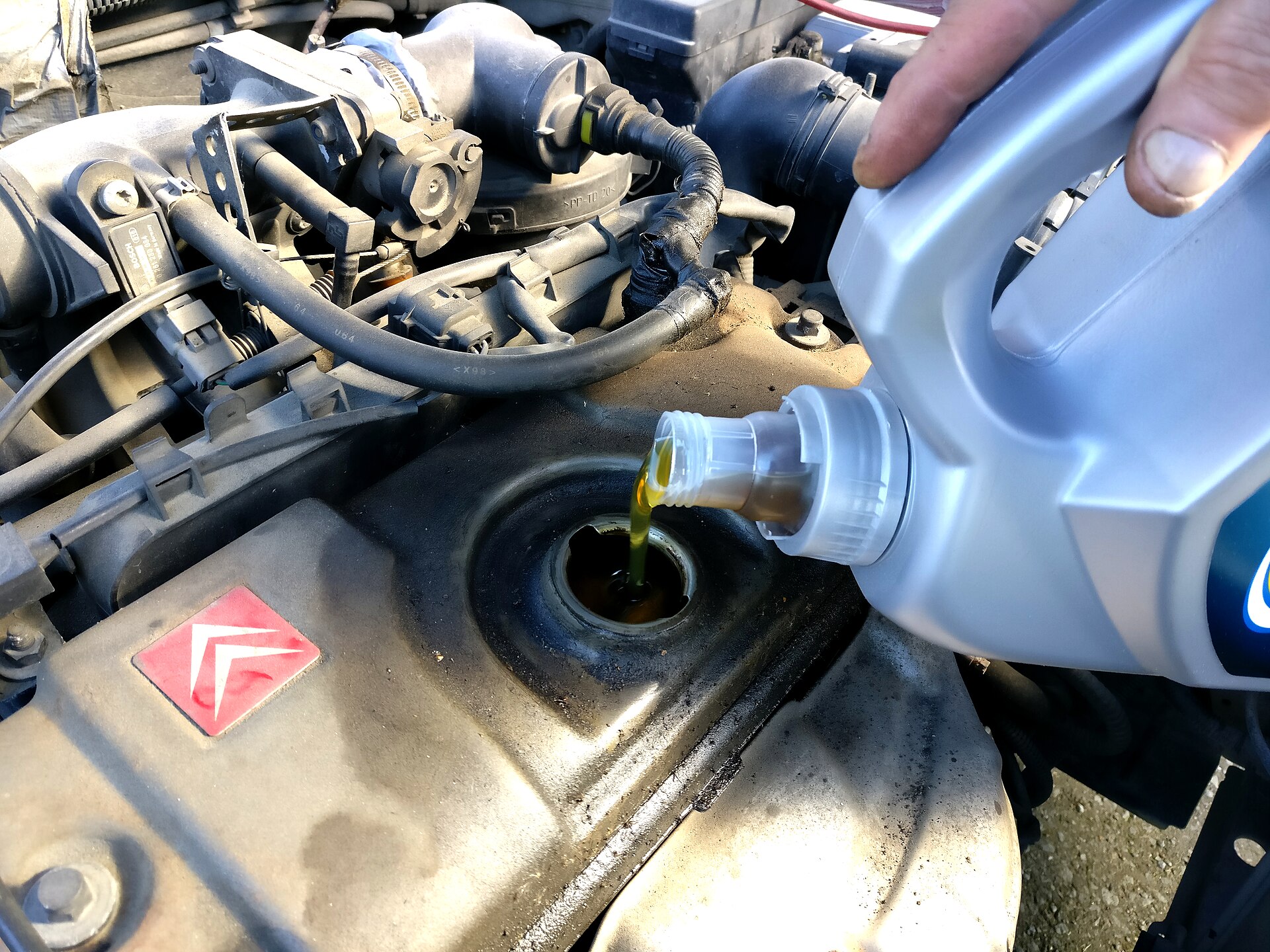
Adding engine oil. Photo: Santeri Viinamäki, CC BY-SA 4.0, via Wikimedia Commons.
Excess oil is not a safeguard: it can cause foaming, frothing, overpressure or oil entering the intake depending on the design. Also check the level before outings and after long periods of inactivity. To prepare the garage and seasonal checks, consult our guide for storing a classic car without damaging it.
Mistakes to avoid
- Choosing solely based on the car’s year or brand.
- Using a thicker oil to mask low pressure without diagnosis.
- Adding ZDDP separately without knowing the original formulation.
- Confusing black oil with necessarily degraded oil.
- Mixing several products to create a “home-made” grade.
- Exceeding the maximum level on the dipstick.
- Extending oil change intervals just because the car is driven infrequently.
- Forgetting that a gearbox, differential or hydraulic system have their own lubricants.
Consistent maintenance goes beyond the engine: the choice of brake fluid for a classic car and that of a battery 6 V or 12 V suitablefollow the same rule: start from the actual configuration, not from a generalisation found online.
If you are looking for a car whose maintenance record is already documented, browse the classic and prestige cars for sale on Plethore Cars. When purchasing, always ask for the oil references and invoices: they provide information on the maintenance history, even if they alone do not prove the internal condition of the engine.
FAQ: engine oil and classic cars
Can you use 20W-50 in all classic cars?
No. It is suitable for many classic engines, but the manual, climate, clearances, filtration, temperature and engine condition remain decisive. Some cars require a monograde, a 15W-40, a 10W-40 or another grade.
Does synthetic oil cause an old engine to leak?
Synthetic oil does not automatically cause a leak in a healthy engine. However, hardened seals, a pre-existing leak or deposits can make a change of formulation tricky. Inspect and follow the specialist’s recommendation.
Should ZDDP be added at every oil change?
No. Preferably use an oil whose formulation already meets the engine’s needs. An improvised overdose can unbalance the additive package and cause problems for a catalytic converter.
Does low oil pressure require a thicker oil?
Not before diagnosis. Check level, temperature, sensor, gauge, filter, pickup screen, pump and mechanical clearances. A higher viscosity may temporarily mask the symptom without correcting the cause.
Should the oil be changed every year if the car is driven very little?
First respect the manufacturer’s or engine maker’s time interval. Without documentation, an annual check is prudent, especially if journeys are short or humidity is high; the specialist can adapt the interval to the engine.
Can two engine oils be mixed?
An emergency top-up between compatible oils may be preferable to a low level, but mixing is not a maintenance strategy. It makes the final formulation less predictable. Then carry out an oil change with the chosen product.
Main sources
Technical information and links verified on 2 October 2026. An annual review is recommended, or sooner if the standards and formulations cited evolve.
- American Petroleum Institute — Motor Oil Guide
- API — categories of petrol engine oils
- TotalEnergies — which oil for a classic car?
- Motul — Classic 20W-50 technical data sheet
- Castrol — GTX Classic and the role of ZDDP
- ExxonMobil — common misconceptions about synthetic oils
- Penrite — role and limitations of zinc/ZDDP