In brief:The most sought-after classic cars remain the Ferrari 250 GTO, the Porsche 911, and the Mercedes-Benz 300 SL Gullwing, ahead of the Jaguar E-Type and the Citroën DS. Rarity, sporting achievements, and technical innovation shape the ranking.
In the demanding world of car collecting, certain vehicles transcend their mere mechanical status to become true coveted works of art. Between absolute rarity, sporting records, and aesthetic genius, the market distinguishes an elite group of models whose value continues to break records. According to the 2023 Classic Expert barometer published by L’Argus, several families of vehicles dominate searches and transactions, from accessible youngtimers to multimillion-dollar supercars.
But what truly makes a car sought after? Beyond price, it is the conjunction of several factors: limited production, significant competitive history, revolutionary design, and above all, the ability to crystallise the essence of an era. A dive into this mechanical pantheon where each model tells a page of automotive legend.
Ferrari 250 GTO: The ultimate grail for collectors
When discussing the most sought-after classic cars, the Ferrari 250 GTO naturally stands as the absolute reference. Produced between 1962 and 1964, this Prancing Horse icon remains the most expensive vehicle ever sold at public auction.
To delve deeper into this subject, consult our article dedicated tothe most expensive Bugatti collector cars.
A record-breaking pedigree and stratospheric prices
On 13 November 2023, a Ferrari 250 GTO was auctioned for 51,7 million dollars, setting a new record for a Ferrari sold at auction. Only the Mercedes 300 SLR Uhlenhaut Coupé, sold for 135 million euros in 2022, surpasses this amount overall. The extremely limited production —only 36 units— largely explains this exceptional valuation.
Technical and aesthetic excellence
Beneath its aluminium bodywork by Scaglietti lies a V12 of 2 953 cm³ developing 300 horsepower. Some examples, such as chassis 3765, were equipped with a 3 967 cm³ engine producing over 390 horsepower according to L’Argus, specifically designed for the 24 Hours of Le Mans. The top speed reaches 283 km/h, remarkable performance for the era.
A value in constant ascent
Originally sold for around 18 000 dollars in the 1960s, the 250 GTO saw its value skyrocket from the 1980s onwards. In 2018, a private transaction reached nearly 70 million euros, illustrating collectors’ insatiable appetite for this legendary model. Each GTO has its own chassis number and documented history, reinforcing the uniqueness of each example.
Porsche 911: The timeless icon in constant evolution
A symbol of durability and mechanical excellence, the Porsche 911 consistently ranks among the most sought-after classic cars. Launched in 1963, it continues to captivate enthusiasts.
The most coveted series
The Porsche 911 Type 901 (1963-1973), first generation, remains particularly prized. A well-preserved example can reach 400 000 euros according to Sarrut-Assurances, while the rare 901 Targa averages 114 000 euros, with a growth of 30% over five years. Total production of the Type 901 amounted to 89 256 units, spread over ten years.
The RS and GT3 versions: rising values
More recent generations are not left behind. The Porsche 997 GT3 RS 4.0, produced in only 600 numbered units, features a naturally aspirated flat-6 of 4 litres developing 500 horsepower at 8250 rpm according to sources. This model reaches 0 to 100 km/h in 3,9 seconds and 0 to 200 km/h in 12 seconds, with a top speed of 310 km/h.
The 991 Carrera 4 GTS, sold only between October 2014 and February 2016, develops 450 horsepower thanks to its flat-6 bi-turbo 3 litre engine. It reaches 100 km/h in 3,6 seconds and attains a top speed of 308 km/h. Its average price today is around 128 000 euros.
An increasing rarity index
According to analysis by 911andco, the rarity index — the ratio between global production of 911 and total automotive production — shows that recent 911 models are becoming as rare as older ones. For the 993, this index was 3062, meaning that one 911 Type 993 was produced for every 3062 other vehicles worldwide according to 911andco.
Mercedes-Benz 300 SL Gullwing: The wings of prestige
The Mercedes 300 SL “Gullwing” embodies the rebirth of post-war German engineering. Its iconic butterfly doors and technical innovations make it one of the most sought-after cars on the market.
Revolutionary technical innovation
Presented at the New York Auto Show in 1954, the 300 SL was the first production car equipped with direct fuel injection according to Wikipedia. Its inline six-cylinder of 2 996 cm³, tilted 45 degrees to the left, develops 240 horsepower at 6100 rpm, compared to only 115 horsepower in the carburettor version on the 300 saloon. Several of these models also feature inour overview of the best supercars in history.
This remarkable power allows a top speed exceeding 225 km/h, making the 300 SL the fastest car in the world at its time. Reported performance varies by configuration: from 215 km/h to 250 km/h, depending on the installed final drive ratio.
An exceptional sporting record
The 300 SL won the 24 Hours of Le Mans 1952 with Hermann Lang and Fritz Riess, as well as the Carrera Panamericana 1952 with Karl Kling and Hans Klenk. It was also European Rally Champion in 1955 and 1956.
Current value and rarity
Originally sold for 11 000 dollars in 1955 according to MotorsDB (equivalent to 120 000 euros in constant value 2024), the 300 SL today commands prices between 1,5 and 2,5 million euros in 2021. Examples with full aluminium bodywork, of which only 29 were produced between 1955 and 1956, fetch even higher sums due to a weight saving of 80 kg.
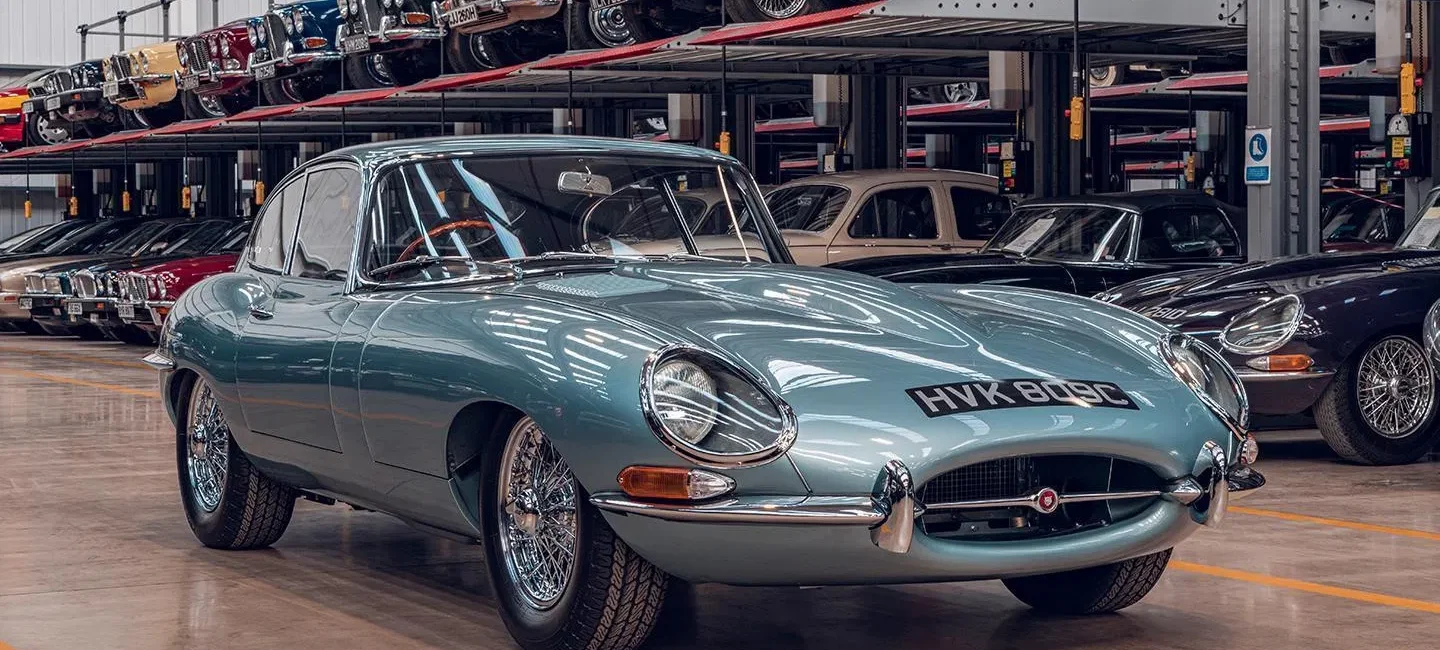
Jaguar E-Type: The most beautiful car according to Ferrari
“The most beautiful car ever built” — such was the tribute paid by Enzo Ferrari himself to the Jaguar E-Type at its unveiling at the Geneva Motor Show in 1961. This statement alone sums up the aura surrounding this British masterpiece.
Design and performance combined
Designed by aerodynamicist Malcolm Sayer under the supervision of William Lyons, the E-Type was produced from 1961 to 1975 with a total of72 584 units. The Series I, particularly sought after, comes in 3,8 litre and then 4,2 litre versions, developing up to 265 horsepower.
Claimed performance is impressive: a top speed of 241 km/h and 0 to 100 km/h in under 7 seconds. Independent front and rear suspension distinguishes the car and spurred industry-wide changes.
The flat floor and lightweight models
The very first models from 1961 until January 1962, called “flat floor”, are highly sought after, although they are less comfortable due to restricted legroom. For competition purposes, Jaguar developed a lighter version, the E-Type “Lightweight”, of which only 12 units were produced according to Atelier Jalaper.
Constantly rising value
The Series I’s value continues to rise, especially since the model’s fiftieth anniversary. The earliest 3,8 litre Series I versions are often the most valuable, while a well-restored example generally represents a worthwhile investment.
Citroën DS: The French UFO that changed the automobile
At its unveiling at the Paris Motor Show in 1955, the Citroën DS literally shook the automotive world. With 12 000 orders on the first day and 88 000 by the close of the show, it immediately established itself as a phenomenon.
Technical and aesthetic revolution
Designed by Italian designer Flaminio Bertoni and engineer André Lefèbvre, the DS introduced major innovations: power steering, front disc brakes, hydraulic gearbox, and above all, the famous hydropneumatic suspension that became its signature.
Produced from 1955 to 1975 with over1,3 million units, the DS measures 4838 mm before September 1967 and 4874 mm after. Its generous wheelbase of 3125 mm and low height of 1470 mm give it exceptional road holding.
Evolving powertrain
To explore this topic further, see our article dedicated tothe world’s top 10 most expensive cars.
Initially intended to receive a six-cylinder boxer engine, the DS ultimately inherited an evolved four-cylinder inline from the Traction Avant. Its power doubled over the years, peaking at 130 horsepower two years before production ceased.
Sought-after versions
The “Factory” DS Cabriolets made by Henri Chapron from 1960 to 1971 stand out as particularly special according to Classic Trader. The DS Pallas, introduced as early as 1964, enhanced interior equipment with leather, more chrome, and improved soundproofing. The IE models with electronic injection are highly sought after for their optimised engine behaviour and low fuel consumption.
Lamborghini Miura: The birth of the supercar
The presentation of the Lamborghini Miura at the Geneva Motor Show 1966 was a bombshell. Ferruccio Lamborghini wanted to make a strong impression, and he succeeded beyond all expectations with this revolutionary design.
Architectural innovation
The Miura is considered the first modern supercar. It innovated by adopting the V12 engine in a mid-rear position as standard, previously reserved for racing. Its transverse V12 of 4 litres delivers an enchanting sound and remarkable performance, exceeding 280 km/h in the SV version.
Limited production and versions
In total,765 units were built: 475 P400, 140 P400 S, and 150 P400 SV. The Miura SV, produced in 150 units, represents the ultimate evolution of the model.
Price surge
On 13 November 2023, a Lamborghini Miura P400 SV from 1971 was auctioned for 2 423 750 euros at the RM Sotheby’s sale according to Autosital. This value represents the second highest ever achieved for a Miura SV.
Today, a well-restored P400 starts around 1,8 million euros. A P400 S can reach 2,2 to 2,8 million euros, while a P400 SV often exceeds 3 million euros, with peaks over 4 million for examples with impeccable history according to AutoScout24.
Mercedes-Benz 300 SLR Uhlenhaut Coupé: The absolute record
Although not accessible to the average collector, the Mercedes 300 SLR Uhlenhaut Coupé deserves its place in this ranking for having set the absolute world automotive record. In 2022, one of the two existing examples was sold for 135 million euros according to RM Sotheby’s, in a private sale.
This legendary car, developed by Rudolf Uhlenhaut, uses the eight-cylinder inline 2,5 litre engine from the W196 Formula 1. It combines the chassis of the 300 SL-R race car with a coupé body featuring butterfly doors even more aerodynamic than the production 300 SL.
Alpine A110 Berlinette: The tricolour pride of rallies
A true icon of French motorsport, the Alpine A110 Berlinette embodies the golden age of rallies and the creativity of French engineering. Produced from 1962 to 1977, it symbolises the quintessence of the light and efficient sports car.
Lightness and sporting dominance
In July 1977,the 7176thand last Berlinette left the Alpine factory in Dieppe. Weighing around 600 kg, the A110 compensates for modest power with exceptional agility. Engines evolved from 956 cm³ with 55 SAE horsepower up to the 1 565 cm³ with 92 horsepower of the Renault 16 TS.
The crowning achievement came in 1973 when the Alpine A110 won the first World Rally Championship for manufacturers according to Guide-Automobiles-Anciennes, with victories at Monte-Carlo, Tour de Corse, Portugal, Greece, and San Remo. Drivers Jean-Claude Andruet, Bernard Darniche, Jean-Pierre Nicolas, and Jean-Luc Thérier inscribed Alpine’s name in legend.
Current value
Rarity and sporting record drive prices up. For a perfectly original A110 1600S, the price now easily reaches 90 000 euros. Even for a less sought-after version like the 1600 SX, it is difficult to find one for less than 30 000 euros. An example of 1600S was auctioned for 128 800 euros at RM Auctions in 2015 according to Automobile-Sportive.
Ford GT40: The American Le Mans legend
The Ford GT40 embodies one of the finest comeback stories in motorsport. Created to challenge Ferrari on its favourite ground, the 24 Hours of Le Mans, it succeeded with unprecedented dominance.
The historic quadruple
Built from 1964 to 1968 in only126 units, the GT40 won the 24 Hours of Le Mans four consecutive times from 1966 to 1969. The name GT40 comes from the initials “Grand Touring” complemented by its ride height of 40 inches, or 1,02 metres.
The 1966 edition remains etched in history with the famous Ford triple at the top three places, humiliating Ferrari after purchase negotiations failed. The Mk II number 5, driven by Ronnie Bucknum and Richard Hutcherson, finished third in this memorable edition.
Power and performance
The Mk II versions are equipped with a V8 of 7 litres developing 485 horsepower according to Motor1, an impressive power but with relative reliability over long endurance events. The design, derived from the Lola GT Mk6, adopts a mid-rear engine layout and a fibreglass body.
Exceptional valuation
Only 107 genuine Ford GT40 examples were produced, with values ranging between 5 and 10 million euros. In 2018, a GT40 MkII Le Mans 1966 was estimated between 9 and 12 million dollars. The street versions, produced in 31 units, were estimated between 3 and 4 million dollars at auctions in 2016.
Bugatti Type 57SC Atlantic: The absolute myth
With only three surviving examples from an already confidential production, the Bugatti Type 57SC Atlantic embodies absolute uniqueness. Although no recent sale establishes a market price, experts estimate these cars could theoretically surpass the Mercedes Uhlenhaut record.
The revolutionary design by Ettore and Jean Bugatti, with its characteristic central rib, makes it one of the boldest automotive creations in history.
Aston Martin DB5: Iconic British elegance
Made famous by James Bond, the Aston Martin DB5, produced from 1963 to 1965, remains one of the most sought-after Gran Turismos. Its six-cylinder 4 litre engine develops 282 horsepower, allowing it to reach 240 km/h.
Examples owned by celebrities or featured in films fetch considerable prices at auctions, demonstrating the importance of provenance in valuing a classic car.
Comparative table of the most sought-after classic cars
| Model | Period | Production | Power | Top Speed | Current Price |
| Ferrari 250 GTO | 1962-1964 | 36 units | 300-390 hp | 283 km/h | 70 M$ |
| Porsche 911 Type 901 | 1963-1973 | 89 256 units | Variable | 215-250 km/h | 400 000 € max |
| Mercedes 300 SL | 1954-1957 | Not specified | 240 hp | 225+ km/h | 1,5-2,5 M€ |
| Jaguar E-Type Series I | 1961-1968 | 72 584 units (total) | 265 hp max | 241 km/h | Variable |
| Citroën DS | 1955-1975 | 1,3 M units | 130 hp max | Not specified | Variable |
| Lamborghini Miura SV | 1970-1973 | 150 units | Not specified | 280+ km/h | 2,4-3+ M€ |
| Mercedes 300 SLR Uhlenhaut | 1955 | 2 units | Not specified | Not specified | 135 M€ |
| Alpine A110 Berlinette | 1962-1977 | 7176 units | 55-95 hp | Not specified | 30-90 k€ |
| Ford GT40 | 1964-1968 | 126 units | 485 hp (Mk II) | Not specified | 5-10 M€ |
| Bugatti 57SC Atlantic | 1936-1938 | 3 surviving units | Not specified | Not specified | Theoretical >135 M€ |
Conclusion: Passion, rarity, and excellence
The market for the most sought-after classic cars reveals a clear trend: rarity, sporting achievements, and technical innovation remain the pillars of valuation. Whether it is the 36 Ferrari 250 GTO, the 126 Ford GT40, or the 150 Lamborghini Miura SV, it is limited production combined with excellence that forges legend. Rarity alone is not enough:the most beautiful cars of all timealso owe their status to their design.
Beyond the stratospheric figures, these automobiles embody pivotal moments in history. The 300 SL that introduced injection, the Miura that invented the modern supercar, the Alpine A110 that glorified French rallying, or the GT40 that avenged American honour at Le Mans — each pushed the limits of its era.
From accessible youngtimers like the Alpine A110 (30 000 euros minimum) to the absolute records of the 300 SLR Uhlenhaut (135 million euros), this ranking shows there are entry points for all budgets. The key lies in authenticity, documented history, and condition.
For discerning collectors, these cars represent much more than an investment: they are guardians of a technical and aesthetic heritage to be preserved. In a context where electrification is reshaping the automotive landscape, these thermal engines become precious witnesses of a bygone era where man and machine were one.
And you, which car from this ranking would you dream of adding to your collection? Do you think some recent models already deserve their place in this pantheon?
Discover more exciting content about the world of classic cars on Plethore.fr. Brand sheets, analyses of iconic models, and news from the world of exceptional cars await you there.