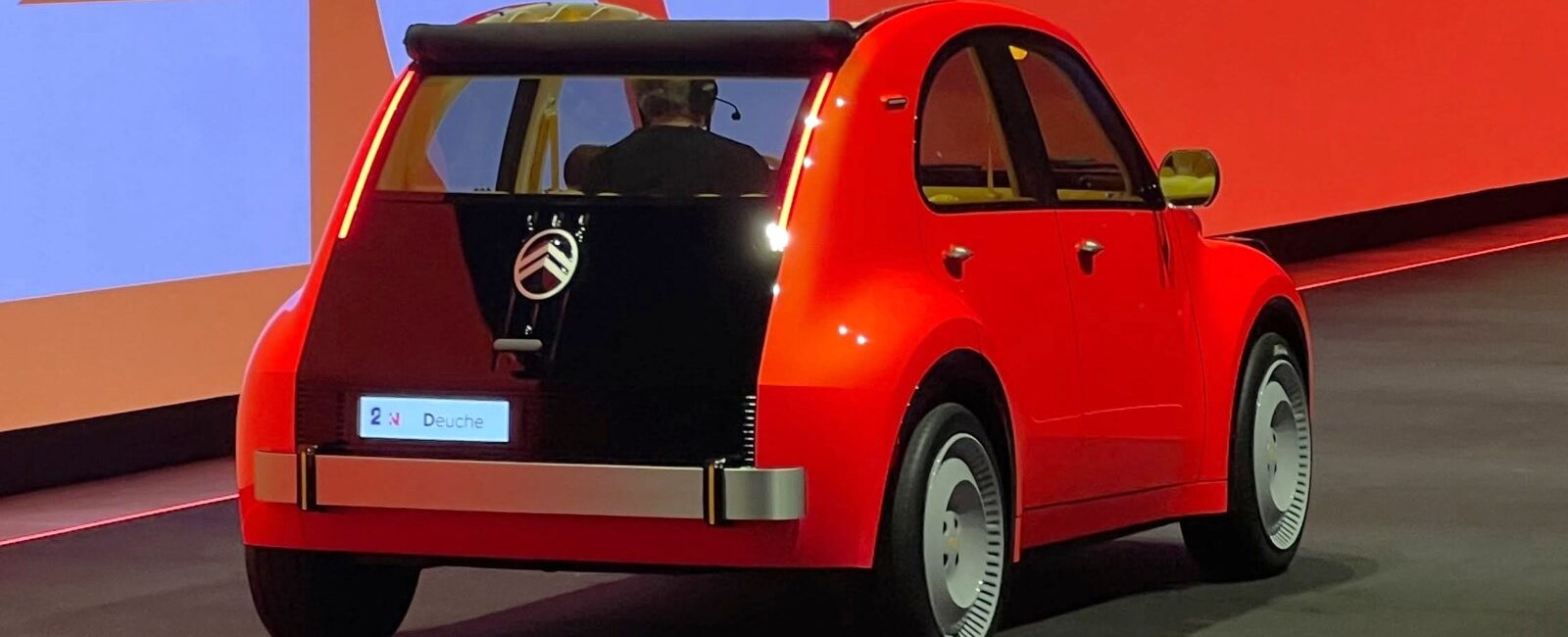
The 2 CV officially returns to Citroën’s vocabulary. Unveiled at the Paris Motor Show 2026, the 2 CV Concept is a small electric car measuring 3,76 metres, intended to inspire a production model expected around 2028. Citroën aims for European manufacturing, a weight close to one tonne, and a starting price near 15 000 euros.
These objectives are ambitious, but they do not yet constitute a commercial specification. The brand does not disclose battery capacity, range, power, or charging speed. The car displayed in Paris is a concept; its most striking elements may evolve before the final model is presented.
The new 2 CV in brief
| Information | Official data as of 12 October 2026 |
|---|---|
| Model presented | Citroën 2 CV Concept |
| Energy | 100 % electric |
| Length | 3,76 m |
| Positioning | Between Ami and C3 |
| Target weight | Around one tonne |
| Planned manufacturing | Europe |
| Target starting price | Close to 15 000 € |
| Production model | Presentation announced within two years, horizon 2028 |
| Battery, range, power | Not disclosed |
Citroën places the project within the forthcoming European regulation known as E-Car, intended to promote a new generation of more affordable small electric cars. As the final framework of this regulation may still evolve, the price and specifications of the production model remain ambitions, not definitive commitments.
Why is Citroën bringing the 2 CV back into fashion?
The original 2 CV was not conceived as a nostalgic product. Presented at the Paris Motor Show in 1948, it was designed to meet a simple brief: to transport people and their luggage on imperfect roads, with an economical, comfortable, and easy-to-maintain car.
Production ended in 1990 after more than five million units. In the meantime, the 2 CV had become a cultural symbol, far beyond its modest performance. Citroën is therefore not merely seeking to reuse a famous silhouette. The brand asserts it wants to transpose three principles: simplicity, accessibility, and freedom of use.
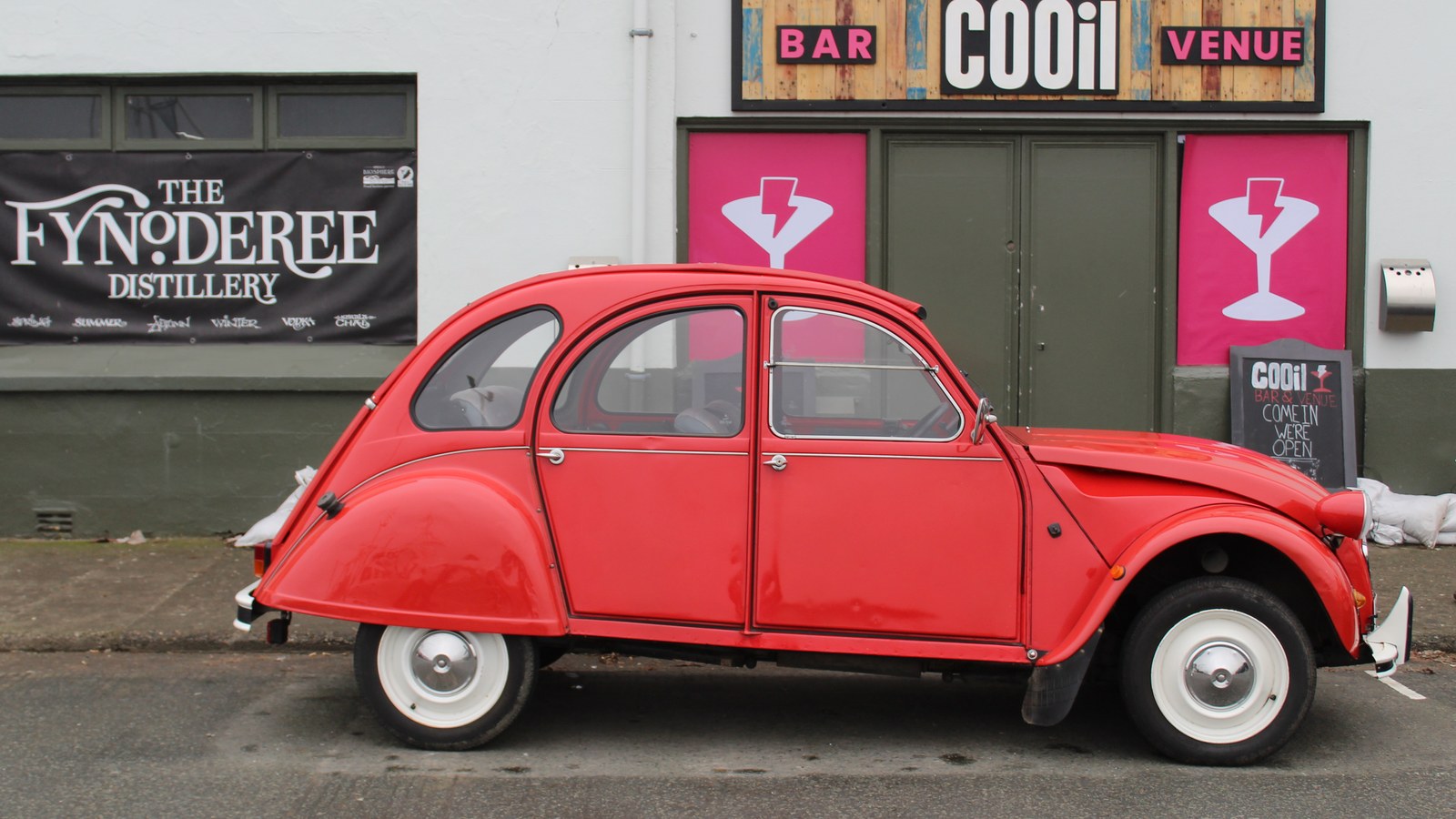
A historic 2 CV recalls the size and simplicity of the original model. Photo: Frank Schuengel,Wikimedia Commons, CC BY-SA 4.0 licence.
The context of 2026 makes this idea relevant. Electric cars are often heavier and more expensive than their petrol equivalents, largely due to the battery. By aiming for a compact car close to one tonne, Citroën hopes to reduce the amount of battery needed, the purchase price, and the running costs.
A size shorter than the original 2 CV
At 3,76 metres in length, the 2 CV Concept is announced as shorter than its ancestor. It sits between the Citroën Ami and the C3, in a segment of small versatile cars that has become rare in Europe.
The choice is not merely aesthetic. A reduced size facilitates parking, potentially decreases weight, and allows the use of a smaller battery if the range remains suitable for daily journeys. However, Citroën does not specify any mileage figure: any range estimate published at this stage would be speculative.
The target weight of around one tonne is particularly interesting. For comparison, many contemporary electric city cars far exceed this threshold. Achieving this goal with safety standards, expected comfort, and acceptable range will be one of the main industrial challenges of the project.
A design that references the 2 CV without copying it
The concept retains several immediately identifiable features: rounded wings, vertical windscreen, curved roof, headlights separate from the bodywork, and a fabric sunroof. However, the lines are sharper, the volumes broader, and the surfaces adapted to a modern automobile.
At the front, the round headlights adopt an LED signature. The sculpted bonnet features grooves evoking the TPV project that preceded the 2 CV. The windscreen wipers remain deliberately visible, as a reminder of the mechanical simplicity of the historic model.
From the side, the 18-inch steel wheels refer back to the old 2 CV, as do the very pronounced wings. At the rear, the sloping roof and black tailgate recall the first generations, while the LED lights and digital number plate clearly belong to the 21st century.
Citroën has multiplied playful details: the numbers 48, 90, and 26 on the windscreen correspond to 1948, 1990, and 2026; the pedals bear a tortoise for the brake and a rabbit for the accelerator; some storage compartments are designed to hold eggs, a nod to the famous original brief.
A simple interior, but not bare
The sought-after simplicity does not mean a lack of comfort. The concept removes the traditional dashboard in favour of a cylinder supporting the single-spoke steering wheel, the stalk controls, the transmission control, storage compartments, and a Citroën Smart Vision information band.
An eight-inch square screen adopts a presentation inspired by comic strips. A removable radio called “Radioën” can become a portable speaker. The fabric roof creates a bright atmosphere and directly recalls the old 2 CV.
The seats use Citroën Advanced Comfort technology. The front bench of the concept is removable, while the central storage takes the form of a removable basket. Some details probably belong more to the design manifesto than to an industrially validated equipment.
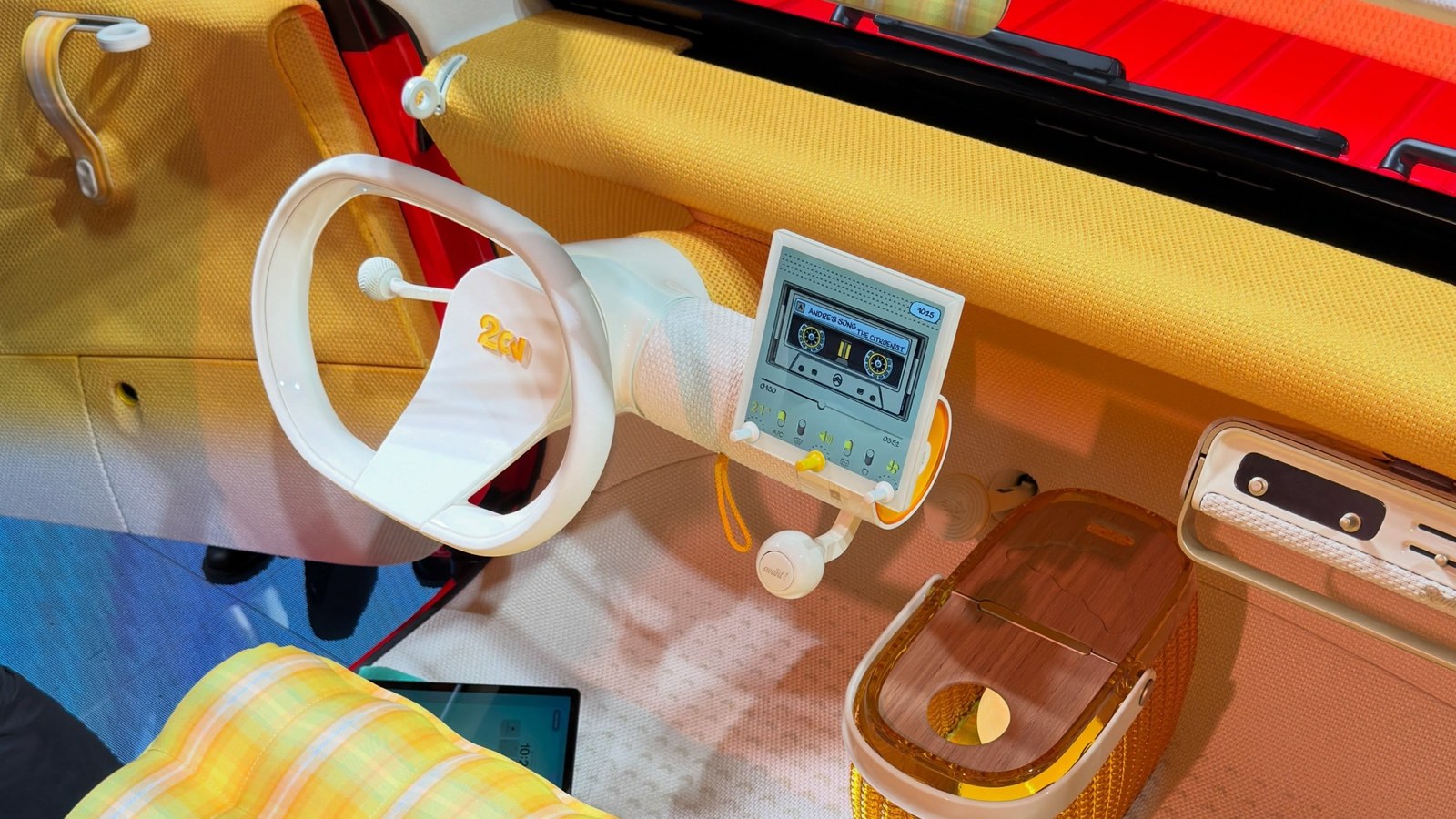
The interior of the 2026 concept combines a single-spoke steering wheel, square screen, and removable central basket. Photo: 2cv2026,Wikimedia Commons, CC BY-SA licence 4.0.
A small electric car designed to be repairable
Citroën highlights design solutions that promote industrialisation and reparability: flat surfaces, direct air intakes beneath the windscreen, and bumpers separate from the bodywork to allow independent replacement.
This approach is consistent with the spirit of the 2 CV. However, it will need to be confirmed on the production model, particularly regarding the actual price of parts, mechanical accessibility, battery warranty duration, and the possibility of repairing rather than replacing large sub-assemblies.
Michelin has developed a “universal digital twin of the tyre” for the concept. The system is intended to monitor tyre condition and enable the vehicle to adapt its behaviour to its environment. The 18-inch wheels are fitted with specific chevron-pattern tyres. Citroën has not yet detailed whether this technology will be present on the forthcoming commercial vehicle.
Price close to 15 000 euros: target or promise?
Citroën speaks of a starting price ambition close to 15 000 euros. This wording should be preserved as is: it is neither a definitive price, nor a guaranteed price after incentives, nor an already configured range.
Several parameters may still change by 2028: definition of the E-Car framework, battery costs, mandatory equipment, exact production location, taxation and amount of national subsidies. An entry-level price could also correspond to a version with a smaller battery or more limited equipment.
To succeed, the future 2 CV must above all avoid the trap of a prestigious name sold at a high price. Its historical appeal precisely comes from its accessibility. A simple, lightweight, and truly affordable electric city car would be more faithful to the philosophy of the original than a luxurious reproduction of its style.
What range for the new 2 CV?
No official range has been published. Citroën only indicates that it wants to size the battery for daily use, with the reduced weight theoretically allowing the battery size and cost to be limited.
We will have to wait for the production car to know:
- the usable battery capacity;
- the WLTP-certified range;
- the motor power;
- charging capabilities in alternating and direct current;
- the final number of seats;
- the boot volume;
- the safety and driver assistance equipment;
- the warranty duration.
Any figures circulating before an official Citroën announcement should therefore be regarded as estimates or rumours.
Will the old 2 CV increase in value?
The media revival of the name may attract new attention to historic 2 CVs, without guaranteeing a general price increase. The market strongly distinguishes between versions, condition, quality of restoration, and authenticity.
Rare models, documented special editions, and very well-preserved examples do not follow the same pricing as a common 2 CV restored without history. Before purchasing, one should check the chassis, corrosion, number conformity, bodywork quality, and the consistency of the documentation.
Enthusiasts can browse the vintage and classic cars offered for sale on Plethore Cars to gauge the available selection, without confusing the listed price with the transaction value.
Our analysis: spirit matters more than resemblance
The 2 CV Concept achieves its primary goal: to be identifiable without merely resembling a facelift of the 1948 car. But the essence is not in the round headlights or the canvas roof.
The real test will be industrial. A car close to 15 000 euros, manufactured in Europe, properly equipped, repairable and genuinely lightweight would represent a rare proposition on the electric market. If the price rises sharply or the weight strays from the target, the project risks becoming a charming homage rather than a credible successor.
FAQ
Is the new Citroën 2 CV confirmed?
Yes. Citroën presents the concept as the vision of a future model intended to join the range by 2028.
Will it be electric?
Yes, both the concept and the announced future model are part of a 100% electric mobility.
How much will the new 2 CV cost?
Citroën aims for a starting price close to 15 000 euros. This amount is not yet a definitive commercial price.
What will its range be?
It has not been disclosed. Battery capacity, power and charging details also remain unknown.
When will it be marketed?
Citroën mentions a model presentation within two years and a market launch by 2028.
Where will it be manufactured?
The brand announces European manufacturing, without specifying at this stage the factory chosen for the production version.
Sources
- Citroën / Stellantis Media — 2 CV Concept: it’s 2 back! : dimensions, price target, target weight, schedule, design and interior.
- Citroën — official site 2 CV Concept : presentation of the exterior design, interior and Van variant.
- Citroën Origins — A “Very Small Car” with a Great Future: presentation of 1948, history and production until 1990.
- Mondial de l’Auto 2026 — official website: context and dates of the Parisian presentation.
Information verified on 12 October 2026. Update recommended upon publication of a technical sheet or a definitive commercial schedule.